March 28, 2026
A Guide to Personal Injury Damages in Florida

One moment you’re driving through Clermont or shopping in Ocala, and the next, your life is turned upside down by an accident. In the days and weeks that follow, the reality of the situation sets in. You’re in pain, you can’t work, and you’re facing a mountain of unexpected expenses. This is the point where you need to understand your legal rights. The compensation available to you is legally referred to as personal injury damages. This isn’t just a single number; it’s a carefully calculated amount meant to cover every loss, from medical care and lost wages to the emotional distress and life changes you’ve endured.
Key Takeaways
- Florida personal injury victims can recover three categories of damages: economic damages, non-economic damages, and punitive damages.
- Economic damages cover quantifiable financial losses like medical bills, lost wages, and property damage, while non-economic damages compensate for pain, suffering, and emotional distress.
- Punitive damages in Florida are rare and capped under HB 837 at three times compensatory damages or $500,000, whichever is greater.
- Florida’s modified comparative negligence rule (the 51% bar) can reduce or eliminate your damages if you share fault for the accident.
- Thorough documentation, including medical records, expert testimony, and life care plans, is critical to maximizing your damage award.
If you have been injured in an accident in Florida, understanding the types of damages in personal injury cases is one of the most important steps you can take to protect your financial future. The term “damages” refers to the monetary compensation the law allows you to pursue when someone else’s negligence causes you harm. These damages are designed to cover everything from your hospital bills and lost paychecks to the pain and emotional toll your injuries have taken on your life.
Florida law divides personal injury damages into three distinct categories: economic damages, non-economic damages, and punitive damages. Each serves a different purpose, and the total compensation available to you depends on the specific facts of your case, the severity of your injuries, and how well your losses are documented. Recent changes under Florida’s tort reform law, House Bill 837, have also introduced new rules that directly affect how damages are calculated and awarded.
Contact Injury LawStars today at (407) 887-4690 for a free consultation. Attorney Katie Miller and her team will evaluate your case and fight to recover every dollar of compensation you deserve.
What Damages Can You Claim in a Florida Injury Case?
In a personal injury case, “damages” is the legal term for the financial compensation an injured person is entitled to receive. The fundamental goal of awarding damages is to restore the victim, as closely as possible, to the position they were in before the accident occurred. Florida courts recognize that no amount of money can truly undo the harm caused by a serious injury, but the legal system provides a structured framework for calculating fair compensation.
Personal injury damages in Florida fall into two broad categories: compensatory damages and punitive damages. Compensatory damages are further divided into economic damages (also called special damages) and non-economic damages (also called general damages). Understanding how each category works is essential to building a strong claim that accounts for every loss you have suffered.
Common Cases That Lead to Personal Injury Claims
Personal injury law isn’t limited to just one type of incident. It covers a wide range of situations where one person’s carelessness, or negligence, results in harm to another. While the circumstances of each case are unique, they all share a common thread: an unexpected event that leaves an individual facing physical, emotional, and financial challenges. From a fender bender on the streets of Ocala to a slip at a local shop in Mount Dora, these incidents can turn your life upside down in an instant. Understanding the most common types of personal injury claims can help you recognize when you might have a right to seek compensation for the losses you’ve suffered.
Motor Vehicle Accidents
Accidents involving cars, trucks, and motorcycles are, by far, the most frequent source of personal injury claims in Florida. Our roads in Lake County, Marion County, and Sumter County are busy, and unfortunately, not every driver is as careful as they should be. Distractions, speeding, and impaired driving often lead to collisions that cause serious injuries, from broken bones and whiplash to traumatic brain injuries and spinal cord damage. The aftermath can be overwhelming, as you’re suddenly faced with mounting medical bills, lost time from work, and the difficult process of physical recovery. It’s in these moments that holding the at-fault driver accountable becomes essential for protecting your future.
Car, Truck, and Motorcycle Accidents
Whether you’re commuting through Clermont or taking a scenic ride near The Villages, a collision can happen without warning. Car accidents are incredibly common, but cases involving large commercial trucks or motorcycles present unique challenges. Trucking companies are bound by strict federal regulations, and accidents often involve complex questions of liability that can extend to the driver, the company, and even maintenance crews. Motorcycle riders are especially vulnerable on the road, and their injuries are often catastrophic — see typical motorcycle accident settlement amounts — due to the lack of physical protection. In any of these cases, a thorough investigation is needed to establish fault and ensure you receive fair compensation.
Bicycle and Pedestrian Accidents
Florida’s beautiful weather encourages many of us to walk or bike, but this also puts more vulnerable people on our roads. Pedestrians and cyclists have little to no protection against a motor vehicle, and the consequences of a collision are often devastating. Drivers have a legal duty to share the road and be aware of their surroundings, especially in populated areas like Leesburg or Wildwood. When a driver’s inattention or recklessness leads to an accident, the injured person has the right to hold them responsible for the severe injuries and long-term medical care that often result from these tragic incidents.
Premises Liability and Slip and Fall Accidents
Property owners and managers have a legal obligation to maintain a safe environment for visitors. When they fail to do so, and someone gets hurt as a result, it falls under an area of law called premises liability. The most well-known example is a “slip and fall” accident, which could happen if a grocery store in Eustis fails to clean up a spill or a restaurant in Tavares has poorly lit stairs. However, premises liability also covers other hazards, such as inadequate security that leads to an assault, a swimming pool accident, or injuries caused by falling objects. The key is proving the property owner knew, or should have known, about the dangerous condition and did nothing to fix it.
Workplace and Construction Accidents
While most on-the-job injuries are covered by workers’ compensation, there are situations where a personal injury lawsuit is also possible. This typically occurs when the injury was caused by the negligence of a third party—someone other than your employer or a co-worker. For example, if you were injured on a construction site in Groveland because of defective equipment supplied by another company, you could file a claim against that manufacturer. These third-party claims are crucial because they allow you to recover damages for pain and suffering, which workers’ comp benefits do not cover.
Injuries from Dangerous Products
We use countless products every day, trusting that they are safe. When a product is defective in its design, manufacturing, or marketing (e.g., inadequate warnings), it can cause serious harm. This is known as product liability. These cases can involve anything from a faulty airbag in a car and contaminated food products to dangerous prescription drugs or defective children’s toys. Holding a large corporation accountable for putting a dangerous product on the market is a complex process that requires significant resources and legal experience to prove that the product’s defect was the direct cause of your injury.
Dog Bites
In Florida, dog owners are typically held strictly liable if their pet bites someone, regardless of whether the dog had ever shown aggression before. A dog bite can cause deep puncture wounds, nerve damage, significant scarring, and profound emotional trauma, particularly in children. Victims are often entitled to compensation for their medical treatment, including plastic surgery if needed, as well as for their pain and suffering. These claims are usually filed against the dog owner’s homeowners or renters insurance policy, which provides coverage for such incidents.
Medical Malpractice
We place immense trust in doctors, nurses, and other healthcare professionals to provide competent care. When they fail to meet the accepted standard of care and cause harm to a patient, it may constitute medical malpractice. These cases can arise from a variety of errors, such as a misdiagnosis, a surgical mistake, a birth injury, or a medication error. Proving medical malpractice is exceptionally difficult, as it requires demonstrating that the healthcare provider’s negligence directly led to the patient’s injury. These claims demand a deep understanding of both law and medicine, along with testimony from qualified medical experts.
Understanding Negligence: The Basis of Your Claim
At the heart of nearly every personal injury case is the legal concept of negligence. In simple terms, negligence means that someone failed to act with the level of care that a reasonably prudent person would have exercised under the same circumstances, and this failure caused you harm. It’s not about proving that someone intended to hurt you, but rather that their carelessness or recklessness led to your injuries. For example, a driver who texts while behind the wheel isn’t trying to cause a crash, but they are acting negligently. To win a personal injury lawsuit and recover damages, you and your attorney must be able to prove that the at-fault party was negligent.
The Four Elements of Negligence
Proving negligence isn’t just about pointing a finger; it requires establishing four specific elements. Think of them as building blocks—you need all four to construct a successful claim. First is Duty. You must show that the person who hurt you (the defendant) owed you a legal duty of care. For instance, every driver on the road in Marion County has a duty to operate their vehicle safely and obey traffic laws. Second is Breach. You must prove the defendant breached, or violated, that duty. A driver running a red light is a clear breach of their duty to drive safely. The team at Injury LawStars is experienced in gathering the evidence needed to prove these crucial first steps.
The third element is Causation. This means you have to demonstrate that the defendant’s breach of duty was the direct cause of your injuries. It’s not enough that the driver ran the red light; you must show that their action of running the light is what caused the collision that hurt you. Finally, you must prove Damages. This means you suffered actual, quantifiable harm as a result of your injuries. This includes economic losses like medical bills and lost wages, as well as non-economic losses like pain and suffering. Successfully proving all four of these elements is the key to holding the negligent party accountable and securing the compensation you deserve.
What Financial Losses Count as Economic Damages?
Economic damages are the measurable, quantifiable financial losses you incur as a direct result of your injury. These are the expenses and financial setbacks that can be verified with documentation like bills, receipts, pay stubs, and expert projections. Because they are based on hard numbers, economic damages are typically the most straightforward component of a personal injury claim to calculate.
Covering Your Medical Bills and Healthcare Costs
Medical expenses are often the largest component of economic damages. Be sure to understand how medical bills out of your settlement are paid before accepting an offer. This includes every healthcare cost related to your injury, from the initial ambulance ride and emergency room visit to ongoing treatment, surgeries, hospital stays, prescription medications, physical therapy, rehabilitation, and medical equipment like wheelchairs or braces. If your injuries require long-term care, you can also claim the cost of home health aides, nursing care, and assisted living.
Planning for Future Medical Needs
Many personal injury victims require medical treatment that extends months or even years beyond the initial accident. Future medical care damages account for anticipated costs including additional surgeries, ongoing physical therapy, pain management, follow-up appointments, and prescription medications. Calculating future medical expenses often requires testimony from medical experts and may involve a life care plan, which is a detailed document outlining all future medical needs and their projected costs. Victims of severe injuries like traumatic brain injuries often face decades of future medical expenses.
Recovering Lost Wages and Future Earnings
When an injury prevents you from working, you are entitled to recover the income you lost during your recovery period. Lost wages include salary, hourly wages, bonuses, commissions, tips, and any other employment income you would have earned. If your injuries are severe enough to permanently limit your ability to work, or if you must accept a lower-paying position because of physical restrictions, you can also claim loss of earning capacity. An economist or vocational rehabilitation expert can calculate the difference between what you would have earned over your career and what you are now able to earn.
Getting Your Property Repaired or Replaced
If your personal property was damaged in the accident, such as your vehicle in a car accident, you can recover the cost of repair or replacement. Property damage also covers personal items that were in the vehicle, including electronics, clothing, or child car seats.
Don’t Forget These Out-of-Pocket Costs
Accident victims frequently incur miscellaneous expenses that add up quickly. Out-of-pocket costs may include transportation to and from medical appointments, parking fees at hospitals, costs of hiring help for household tasks you can no longer perform, home modifications for accessibility (like wheelchair ramps), and any other reasonable expenses directly related to your injury and recovery.
Accounting for the Human Cost: Non-Economic Damages
Non-economic damages compensate you for the intangible, non-financial losses that result from your injury. While these losses do not come with a receipt or an invoice, they are just as real as economic damages, and in many cases, they make up the largest portion of a personal injury settlement or verdict. Florida law recognizes several categories of non-economic damages.
Compensation for Your Pain and Suffering
Pain and suffering damages compensate you for the physical pain and discomfort caused by your injuries. This includes the acute pain immediately following the accident, the pain endured during medical treatment and rehabilitation, and any chronic or ongoing pain you experience as a result of your injuries. Pain and suffering is a deeply personal experience, and its value depends on the nature, severity, and duration of your injuries. If you are dealing with pain and suffering from an accident, an experienced attorney can help you understand what your claim may be worth.
The Toll on Your Mental Health
Serious injuries do not just affect your body. They can take an enormous toll on your mental health. Emotional distress damages cover conditions like anxiety, depression, post-traumatic stress disorder (PTSD), insomnia, fear, and other psychological impacts caused by the accident and your injuries. Medical records from mental health professionals, therapists, and psychiatrists are critical to documenting these claims.
When an Injury Changes Your Life
When injuries prevent you from participating in hobbies, recreational activities, social events, or other aspects of life that you previously enjoyed, you may be entitled to loss of enjoyment of life damages. A person who can no longer play sports, travel, garden, or spend active time with their family because of accident-related injuries has suffered a genuine and compensable loss.
How an Injury Affects Your Relationships
Loss of consortium is a claim brought by the spouse or close family member of the injured person. It compensates for the loss of companionship, affection, intimacy, support, and the ability to maintain a normal marital or family relationship. In wrongful death settlement cases, loss of consortium damages can be especially significant for surviving family members.
Addressing Permanent Scars or Disfigurement
If your injuries result in permanent scarring, disfigurement, or the loss of a limb, you are entitled to additional non-economic damages that reflect the lasting physical and emotional impact of these visible injuries. The value of scarring and disfigurement damages depends on factors including the location and visibility of the scars, the victim’s age and occupation, whether corrective surgery is possible, and the psychological impact of living with permanent reminders of the accident.
The Daily Inconvenience and Loss of Freedom
Injuries that limit your mobility, require you to depend on others for basic daily tasks, or force significant changes to your lifestyle can result in inconvenience damages. A victim who previously lived independently but now requires assistance with bathing, dressing, cooking, or driving has suffered a compensable loss of independence that goes beyond what medical bills and lost wages can capture.
Call Injury LawStars at (407) 887-4690 to discuss your non-economic damages with Attorney Katie Miller. We do not charge any fees unless we win your case.
How Are Personal Injury Damages Calculated in Florida?
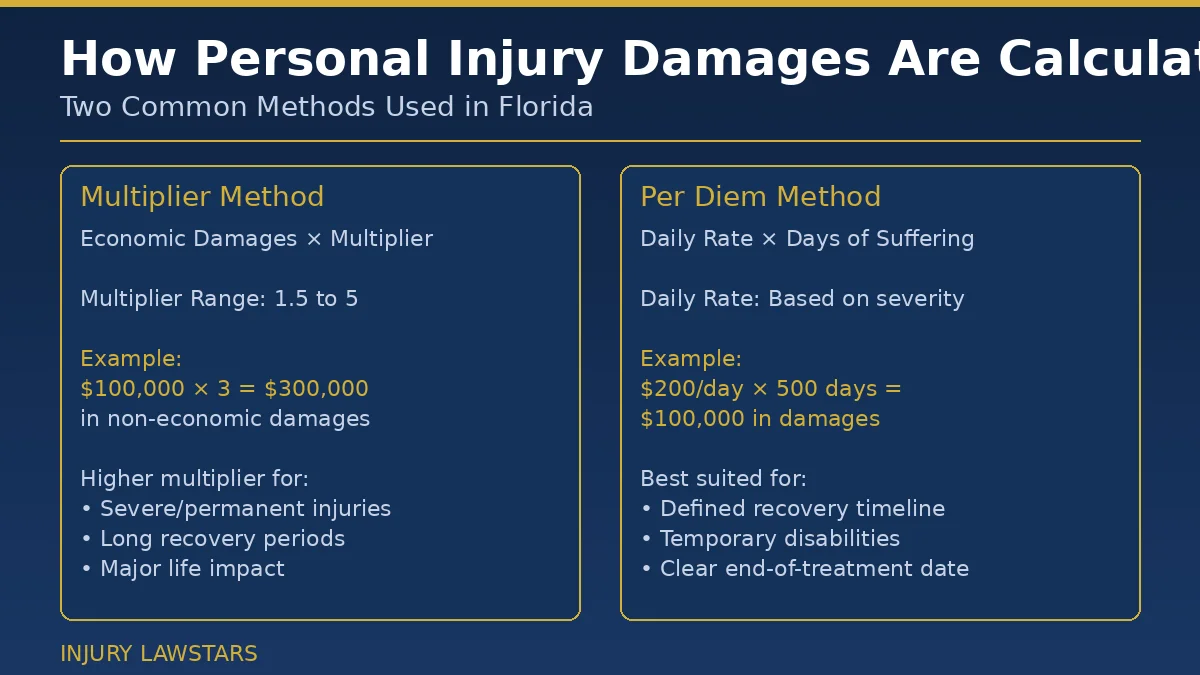
Calculating personal injury damages involves both objective financial analysis and subjective evaluation of intangible losses. Economic damages are relatively straightforward because they rely on documentation. Non-economic damages, however, require different approaches because there is no receipt for pain or a bill for emotional distress. Two widely used methods for calculating non-economic damages in Florida are the multiplier method and the per diem method. Understanding how these methods work can help you evaluate whether a settlement offer fairly reflects the true value of your claim.
Using the Multiplier Method
The multiplier method is the most common approach used by attorneys and insurance companies. It involves adding up the total economic damages and multiplying that figure by a number (the “multiplier”) typically ranging from 1.5 to 5. The multiplier selected depends on several factors, including the severity of your injuries, the length of your recovery, the impact on your daily life, and whether your injuries are permanent. For example, if your economic damages total $100,000 and a multiplier of 3 is applied, your non-economic damages would be calculated at $300,000, bringing the total compensatory damages to $400,000.
Understanding the Per Diem (Daily Rate) Method
The per diem (Latin for “per day”) method assigns a specific dollar amount to each day you live with pain and limitations caused by your injury. This daily rate is then multiplied by the number of days you are expected to suffer from the effects of your injury. For instance, if a daily rate of $200 is assigned and you are expected to experience pain and limitations for 500 days, the non-economic damages would be calculated at $100,000. The per diem method can be particularly effective for injuries with a defined recovery timeline.
Why You Shouldn’t Trust Online ‘Average Settlement’ Calculators
When you’re facing mounting medical bills and lost income, it’s tempting to search for an online settlement calculator to get a quick estimate of your case’s value. However, these tools are notoriously unreliable. A serious injury can affect your life in countless ways, and a simple online form cannot capture the unique details of your situation. These calculators can’t account for the severity of your pain, the quality of your medical evidence, the long-term impact on your career, or the skill of the attorney representing you. The only way to get an accurate assessment of what your claim is worth is to speak with an experienced personal injury attorney who can review every aspect of your case and explain the full range of damages you can pursue.
What a Settlement Might Look Like: Some Examples
Because every case is different, there is no single “average” settlement amount. The value of a claim can range from a few thousand dollars for minor injuries to millions for catastrophic ones. For example, a driver who suffers whiplash in a fender-bender in Leesburg and recovers after a few months of physical therapy will have a very different claim value than a construction worker who suffers a traumatic brain injury in a fall at a site in Ocala. The second case involves permanent disability, immense future medical costs, and a total loss of earning capacity, justifying a much higher settlement. These examples show why focusing on an “average” is misleading; the value is always tied to the specific losses you have suffered.
What Happens to the Money After a Settlement?
It’s important to understand that the final settlement amount is not what you will receive in your bank account. Several deductions are made first. Out of a settlement, these deductions typically include attorney’s fees, case costs (like expert witness fees and court filing costs), and any outstanding medical liens from hospitals or health insurers. After these obligations are paid, the remaining amount is yours. At Injury LawStars, we operate on a contingency fee basis, which means we only get paid if we successfully recover money for you. We are always transparent about our fee structure and all potential costs, ensuring you understand exactly how your settlement funds will be distributed from the very beginning.
The Role of a Jury in Deciding Damages
While the vast majority of personal injury cases are resolved through a settlement, some proceed to trial. If your case goes to court, a jury of your peers from the local community, whether in Sumter County or Marion County, will decide how much compensation you receive. Juries can be influenced by factors you can’t control, such as the credibility of witnesses, the likeability of the defendant, and the emotional impact of your story. An experienced trial lawyer knows how to present evidence and testimony in a clear, compelling way that connects with a jury and persuades them to award fair compensation for complex claims like medical malpractice or wrongful death.
When Can You Get Punitive Damages in Florida?
Punitive damages serve a fundamentally different purpose than compensatory damages. While economic and non-economic damages are designed to compensate the victim, punitive damages are intended to punish the defendant for particularly egregious, reckless, or malicious behavior and to deter others from engaging in similar conduct. Punitive damages are not awarded in most personal injury cases. They are reserved for situations where the defendant’s actions go far beyond ordinary negligence.
Punishing Gross Negligence or Intentional Harm
Under Florida Statute § 768.72, a plaintiff must receive permission from the court before even presenting a claim for punitive damages to a jury. The plaintiff must demonstrate a reasonable basis for recovering punitive damages through evidence of the defendant’s intentional misconduct or gross negligence. Examples of conduct that may warrant punitive damages include:
- Drunk driving or driving under the influence of drugs
- Intentional acts of violence or road rage
- Gross negligence by a healthcare provider in medical malpractice cases
- A company knowingly selling a dangerous or defective product
- An employer deliberately ignoring workplace safety regulations
Understanding Florida’s Punitive Damage Caps
Florida’s tort reform law, House Bill 837, established caps on punitive damages. In most cases, punitive damages cannot exceed the greater of:
- Three times the amount of compensatory damages, or
- $500,000
However, there are important exceptions. If the defendant’s conduct was motivated by unreasonable financial gain and the defendant knew the conduct was likely to result in injury, the cap increases to the greater of four times compensatory damages or $2 million. In cases involving intentional misconduct where the defendant acted with specific intent to harm, there is no cap on punitive damages.
Other Types of Damages You Might Encounter
While economic, non-economic, and punitive damages cover the majority of personal injury claims, some situations involve other specific types of compensation. These damages are designed to address unique circumstances, from cases where a legal wrong occurred with minimal financial loss to the devastating impact of a fatal accident on a family. It’s important to recognize these additional categories because a thorough personal injury claim accounts for every single loss, no matter how small or specific. Understanding these ensures that you and your attorney can build a comprehensive case that truly reflects the full scope of what you have endured.
Nominal Damages
Imagine a situation where someone has legally wronged you, but you didn’t suffer a significant financial or emotional injury. This is where nominal damages come into play. They are a small, symbolic amount of money—sometimes as little as one dollar—awarded to formally acknowledge that the defendant was at fault. While it isn’t a large sum, it serves as an official, legal declaration that a wrong was committed. This can be crucial for holding the responsible party accountable on principle, establishing a legal record of their fault even when substantial harm can’t be proven.
Incidental Damages
Incidental damages cover the extra costs that arise directly because of your injury, beyond the major expenses like hospital bills and lost wages. Think of them as the necessary but often overlooked financial burdens of recovery. This could include the money you spend on transportation to get to your doctor’s appointments, the cost of hiring someone for household help or childcare while you are unable to manage these tasks, or the expense of modifying your home with a wheelchair ramp to accommodate a new disability. These out-of-pocket costs are a direct result of the accident and are fully compensable, so it’s vital to keep track of every related expense.
Damages in Wrongful Death Cases
When an accident tragically results in a person’s death due to someone else’s negligence, the surviving family members can file a claim to seek justice and financial stability. These damages are unique because they are designed to compensate the family for their own losses stemming from their loved one’s death. Handling these claims requires a deep understanding of the law and a compassionate approach, as families are navigating immense grief. A wrongful death claim addresses both the financial and emotional voids left behind, providing a path for accountability and support during an unimaginable time.
Funeral and Burial Expenses
One of the most immediate financial burdens a family faces after a loss is the cost of a funeral and burial. These expenses can be substantial, and wrongful death damages are intended to cover them completely. Your family should not have to worry about how to afford a dignified service for your loved one while grieving. This compensation ensures the at-fault party is held responsible for these final expenses, allowing you to focus on honoring your family member’s memory without added financial stress.
Loss of Financial Support and Companionship
Beyond the immediate costs, a wrongful death claim addresses the profound, long-term impact of the loss. This includes the loss of financial support the deceased would have provided for their family over their lifetime, such as their income and benefits. It also compensates for the profound personal loss of companionship, guidance, affection, and support. For a child who has lost a parent or a spouse who has lost their partner, this loss is immeasurable, but the legal system provides a way to seek compensation for that devastating void and help secure the family’s future.
How Do Damage Caps Affect Your Florida Injury Case?
While Florida does not impose a general cap on compensatory damages in most personal injury cases, there are specific situations where statutory limits apply.
Limits in Medical Malpractice Cases
Florida has a complicated history with medical malpractice damage caps. The Florida Supreme Court struck down certain non-economic damage caps in medical malpractice cases as unconstitutional. However, the legislative landscape continues to evolve, and specific limitations may apply depending on the type of medical provider involved and whether the case involves wrongful death. If you believe you have a medical malpractice claim, consulting with an attorney who understands the current state of the law is essential.
Suing the Government? Know the Limits
If your injury was caused by a government entity or government employee, Florida’s sovereign immunity waiver limits your recovery. Under Florida Statute § 768.28, the current caps are $200,000 per claim and $300,000 per incident. To recover amounts above these caps, you must petition the Florida Legislature through a special claims bill, which is a lengthy and uncertain process.
How Workers’ Comp Affects Your Claim
If you were injured on the job, workers’ compensation may be your exclusive remedy against your employer, and it does not allow recovery for pain and suffering. However, if a third party (someone other than your employer) contributed to your injury, you may be able to file a separate personal injury claim against that party and recover full damages, including non-economic losses.
What if You’re Partially at Fault for the Accident?
Florida’s modified comparative negligence law, enacted under HB 837, significantly affects how damages are calculated when the injured person shares some fault for the accident. Under the 51% bar rule, if you are found to be 51% or more at fault for the accident, you are completely barred from recovering any damages.
If your share of fault is 50% or less, your total damage award is reduced by your percentage of fault. For example, if you are awarded $200,000 in damages but found to be 20% at fault, your recovery is reduced by 20%, and you would receive $160,000. Understanding how Florida’s comparative negligence law works is critical because insurance companies routinely try to shift blame onto the injured person to reduce or eliminate their payout.
This rule makes it especially important to work with an attorney who can build a strong case establishing the defendant’s liability and minimizing any allegations of shared fault on your part. Insurance companies frequently investigate accident victims’ backgrounds, review police reports for any suggestion of contributory fault, and hire accident reconstruction experts to support their arguments. Having your own legal team prepared to counter these tactics can protect your right to full compensation.
Do not let the insurance company reduce your compensation. Call Injury LawStars at (407) 887-4690 for a free case evaluation with Attorney Katie Miller.
How to Document Your Damages for a Stronger Claim
The strength of your personal injury claim depends heavily on the quality and completeness of your documentation. Insurance companies look for gaps in your records to argue that your injuries are not as severe as you claim or that certain expenses are unrelated to the accident. Here is how to protect the value of your case:
Keep Every Medical Record
Seek medical attention immediately after your accident and follow every treatment recommendation from your doctors. Keep copies of all medical records, bills, diagnostic reports, imaging results, prescription records, and discharge summaries. Consistent medical treatment creates a clear timeline linking your injuries to the accident.
The Role of Expert Witnesses
For serious or permanent injuries, expert testimony is often essential. Medical experts can testify about the nature and extent of your injuries, your prognosis, and the treatment you will need in the future. Economists can project your future lost earning capacity. A life care plan, prepared by a qualified specialist, outlines every anticipated medical expense, assistive device, home modification, and therapeutic service you will require over your lifetime. Life care plans are particularly important in cases involving traumatic brain injuries, spinal cord injuries, and other catastrophic harm.
Track Your Financial Losses
Gather pay stubs, tax returns, employment records, and any documentation that establishes your income before and after the accident. If you are self-employed, business financial statements and contracts can help prove lost income. Keep receipts for every out-of-pocket expense related to your injury.
Why You Should Keep a Daily Journal
Keeping a daily journal documenting your pain levels, emotional state, physical limitations, and how your injuries affect your daily activities can be powerful evidence for non-economic damages. Personal statements from family members describing the changes they have observed in you can further support your claim.
The Challenge of Proving Non-Visible Injuries
Some of the most debilitating injuries after an accident aren’t the ones you can see on an X-ray. Conditions like chronic pain, anxiety, depression, and post-traumatic stress disorder (PTSD) can have a far greater impact on your life than a broken bone, but they are much harder to prove. Insurance adjusters are often skeptical of these claims and will look for any reason to argue that your suffering isn’t as severe as you say it is. This is why meticulous documentation is so important. Records from therapists and mental health professionals are essential for validating claims of emotional distress. Additionally, keeping a detailed daily journal that tracks your pain levels, emotional state, and the ways your injuries limit your daily activities can provide compelling evidence to support your case for non-economic damages.
Common Mistakes That Can Weaken Your Claim
Many personal injury victims unknowingly take actions that reduce the value of their claims. Avoiding these mistakes can make a significant difference in the compensation you ultimately receive:
- Delaying medical treatment: Waiting to see a doctor creates a gap in your medical records that insurance companies use to argue your injuries are not related to the accident or are not as serious as you claim.
- Giving recorded statements to insurance adjusters: Anything you say to the at-fault party’s insurance company can be used against you. Insurance adjusters are trained to ask questions that minimize your claim.
- Posting on social media: Photos, check-ins, and comments on social media are routinely used by defense attorneys and insurance companies to undermine injury claims. Even an innocent photo at a family gathering can be twisted to suggest your injuries are not severe.
- Failing to follow medical advice: If you skip appointments, stop treatment early, or ignore your doctor’s recommendations, the defense will argue that your injuries were not significant enough to warrant the damages you are seeking.
- Accepting a quick settlement offer: The first offer from an insurance company is almost always far below the true value of your claim. Accepting before you fully understand the extent of your injuries and future expenses can leave you significantly undercompensated.
- Missing the statute of limitations: Under Florida law, you have two years from the date of the accident to file a personal injury lawsuit. Missing this deadline means losing your right to seek any compensation.
- Not hiring an attorney: Handling a personal injury claim without legal representation puts you at a significant disadvantage against experienced insurance adjusters and defense lawyers.
Frequently Asked Questions About Personal Injury Damages in Florida
Economic vs. Non-Economic Damages: What’s the Difference?
Economic damages are financial losses you can verify with documentation, such as medical bills, lost wages, and property damage. Non-economic damages compensate for intangible losses like pain and suffering, emotional distress, and loss of enjoyment of life. Both types are part of compensatory damages designed to make the injured person whole.
A Quick Look at Florida’s Damage Caps
Florida does not cap compensatory damages (economic and non-economic) in most personal injury cases. However, punitive damages are capped at three times compensatory damages or $500,000, whichever is greater, with exceptions for intentional misconduct. Claims against government entities are capped at $200,000 per claim and $300,000 per incident under sovereign immunity.
How Is ‘Pain and Suffering’ Actually Calculated?
Pain and suffering is most commonly calculated using the multiplier method, which multiplies your total economic damages by a factor of 1.5 to 5 based on the severity and impact of your injuries. The per diem method assigns a daily dollar value to your suffering and multiplies it by the number of days you are affected. Your attorney and the specific facts of your case will determine which approach is most appropriate.
Could Your Case Qualify for Punitive Damages?
Punitive damages are only available when the defendant’s conduct was intentionally harmful or grossly negligent. You must obtain court permission before presenting a punitive damages claim to a jury. Examples include drunk driving accidents, intentional acts of violence, and cases where a company knowingly endangered consumers. Punitive damages are rare but can significantly increase the total award.
What Happens to My Damages if I’m Partially at Fault?
Under Florida’s modified comparative negligence law, your damage award is reduced by your percentage of fault. If you are found to be 20% at fault, you receive 80% of the total damages. However, if you are 51% or more at fault, you are completely barred from recovering any damages. This is why it is critical to work with an attorney who can counter any attempts to shift blame onto you.
Don’t Miss Florida’s Deadline to File a Lawsuit
Under the changes enacted by HB 837, the statute of limitations for personal injury cases in Florida is two years from the date of the accident. If you miss this deadline, you lose the right to pursue compensation entirely. There are limited exceptions for cases involving minors or delayed discovery of an injury.
Do You Really Need a Lawyer for Your Injury Claim?
While you are not legally required to have an attorney, personal injury cases involve complex legal rules, aggressive insurance tactics, and detailed damage calculations. An experienced personal injury attorney can identify all categories of damages you are entitled to, properly document and value your claim, negotiate with insurance companies, and take your case to trial if necessary. At Injury LawStars, we work on a contingency basis, which means you pay nothing unless we win your case.
Related Articles
- Types of Damages in Personal Injury Cases | Florida Guide
- 5 Pain and Suffering Settlement Examples in Florida
- Car Accident Settlement Amounts in Stuart, FL
- Are Personal Injury Settlements Taxable in Florida? | Injury LawStars
About the Author
Katie Miller, Esq.
Managing Partner · Injury LawStars
Attorney Katie Miller was once an injury victim herself. After a car accident in 2016 that required spinal surgery and a 13-month recovery, she turned her experience into a mission: fighting for people who are hurting. With 17+ years of legal experience and over \$45 million recovered for clients, Katie brings both professional expertise and personal understanding to every case.