March 27, 2026
How Florida Comparative Negligence Impacts Your Case

A single percentage point can now make or break your injury claim in Florida. Thanks to a major law change, being 50% at fault for an accident means you can still recover money. But if that number hits just 51%, your compensation drops to zero. This isn’t a small change; it’s a total bar to recovery. This is the new reality of Florida comparative negligence, a system that gives insurance companies a powerful tool to deny your claim. You also have less time to file, with a shortened two-year deadline. It’s more important than ever to understand how this works to protect your financial future.
Injured in a Florida accident? Call Injury LawStars now at (407) 887-4690 for a FREE consultation.
What Exactly Is Comparative Negligence?
Comparative negligence is a legal framework that determines how fault is shared among parties involved in an accident and how that shared fault affects each party’s right to compensation. Rather than placing 100% of the blame on a single person, comparative negligence recognizes that accidents often involve mistakes by more than one party.
In a personal injury case, a judge or jury assigns a percentage of fault to everyone involved. Learn more about choosing the right personal injury lawyer. Your compensation is then adjusted based on your share of responsibility. For example, if you suffered $100,000 in damages and were found 20% at fault, your recovery would be reduced to $80,000.
There are three main types of negligence systems used across the United States:
- Pure comparative negligence allows an injured person to recover damages even if they were 99% at fault. Their compensation is simply reduced by their fault percentage.
- Modified comparative negligence sets a threshold, typically 50% or 51%. If your fault exceeds that threshold, you recover nothing.
- Contributory negligence is the strictest approach, barring any recovery if you had any fault at all. Only a handful of states still use this system.
Understanding which system your state follows matters because it directly determines whether you can seek compensation after an accident and how much you can receive.
Key Legal Terms Defined Under Florida Law
When dealing with a personal injury claim, you’ll encounter specific legal terms. Understanding what they mean is the first step toward protecting your rights. Here are a few key definitions from Florida law, explained in simple terms.
Economic Damages
Economic damages are the measurable financial losses you suffer because of an accident. Think of these as any expense you can track with a receipt, bill, or pay stub. This includes all your medical bills, from the initial ambulance ride to ongoing physical therapy, and any future medical care you might need. It also covers lost wages if you were unable to work while recovering. If your car was damaged in a collision in Lake County, the cost of repairs or replacement falls under economic damages. In the most tragic cases, this category also includes funeral and burial expenses, which are central to a wrongful death claim.
Negligence Action
A “negligence action” is the official legal term for a lawsuit filed to get compensation for harm caused by someone else’s carelessness. It’s the foundation of most personal injury cases. Whether you were injured by a distracted driver in Ocala, a doctor who made a preventable error, or a property owner in The Villages who failed to maintain a safe environment, your case is likely a negligence action. The goal is to prove that the other party had a duty to act with reasonable care, failed to do so, and caused your injuries as a result. Most of the cases we handle at Injury LawStars, including car accidents and premises liability claims, fall into this category.
Products Liability Action
A products liability action is a type of lawsuit filed when a defective product causes harm. This isn’t about a product that simply doesn’t work; it’s about one that is unsafe and causes an actual injury. The defect could have happened during the manufacturing process, like a single faulty part on a new motorcycle. Or, the problem could be with the product’s fundamental design, making every single item in that product line dangerous. This also includes situations where a product, like a defective seatbelt, makes an injury from an accident even worse. These cases hold manufacturers, designers, and sellers accountable for putting dangerous products into the hands of consumers in communities like Leesburg and Wildwood.
Florida’s Big Shift to Modified Comparative Negligence
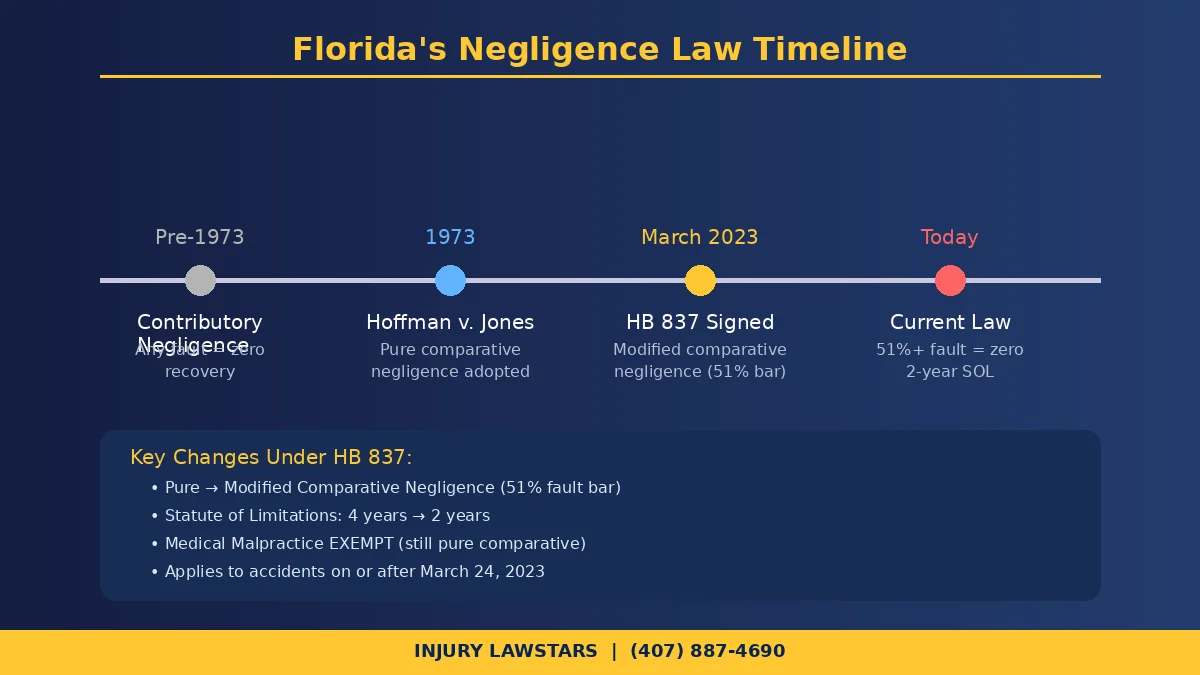
For nearly 50 years, Florida operated under a pure comparative negligence system. This standard was established by the Florida Supreme Court in the landmark 1973 case Hoffman v. Jones, which replaced the harsh contributory negligence doctrine that had previously barred recovery for anyone with even 1% fault.
Under the pure comparative negligence system, Florida accident victims could recover compensation regardless of how much fault they shared. A driver who was 70% responsible for a crash could still recover 30% of their damages from the other driver. This system was considered plaintiff-friendly and ensured that even significantly at-fault victims had some path to financial recovery.
That changed on March 24, 2023, when Governor Ron DeSantis signed House Bill 837 into law. This sweeping tort reform legislation transformed Florida from a pure comparative negligence state to a modified comparative negligence state.
The Old Rule: Understanding Joint and Several Liability
Before we get into the recent changes, it’s helpful to understand a related concept: joint and several liability. In some states, if multiple parties are at fault for an accident, any single defendant can be forced to pay the entire amount of damages, regardless of their individual share of the blame. However, Florida law generally works differently. In most negligence lawsuits, each person or company found responsible only has to pay for their *own percentage* of the fault. This means if one driver is found 20% at fault and another is 80% at fault, they are each responsible for their respective share of the damages, not the full amount. This principle of apportioning fault is a cornerstone of how Florida handles personal injury claims.
The History Behind Florida’s Negligence Law Changes
For nearly five decades, Florida followed a “pure comparative negligence” standard. This rule was established in a landmark 1973 Florida Supreme Court case, *Hoffman v. Jones*, which did away with the old, unforgiving contributory negligence doctrine that prevented anyone from recovering money if they were even 1% at fault. Under the pure comparative system, accident victims in communities from Clermont to Leesburg could recover compensation no matter how much fault they shared. For example, a driver who was found 70% responsible for a crash could still sue the other driver to recover 30% of their damages. This approach ensured that even those who were partially to blame had a path to financial recovery for their injuries.
The 2011 Change After D’Amario v. Ford Motor Co.
Even under the pure comparative fault system, Florida’s negligence laws have evolved. A notable adjustment occurred in 2011, when the state legislature amended the law to address a specific issue in products liability cases. This change was a direct response to a 2001 Florida Supreme Court decision, *D’Amario v. Ford Motor Co.* The court had ruled that a plaintiff’s own negligence couldn’t be used to reduce their damages in a crashworthiness case involving a defective product. The legislature disagreed, believing this wasn’t a fair way to divide blame. The 2011 update aimed to ensure that fault for damages is divided among *all* responsible parties in these specific cases, making the system more consistent with Florida’s broader comparative fault principles, especially in complex truck accident scenarios involving manufacturing defects.
What Did House Bill 837 Actually Change?
HB 837 introduced a strict fault threshold into Florida’s personal injury system. Under the new modified comparative negligence standard:
- If you are 50% or less at fault, you can still recover compensation, but the amount is reduced by your percentage of fault.
- If you are 51% or more at fault, you are completely barred from recovering any damages.
This single change has profound consequences. Previously, even a plaintiff who was 90% responsible for an accident could recover 10% of their damages. Under the new law, crossing the 51% threshold means you get nothing.
The law applies to most negligence-based personal injury claims, including car accidents, truck accidents, motorcycle crashes, pedestrian injuries, and premises liability cases like slip-and-fall accidents.
Important exception: Medical malpractice claims are exempt from the modified comparative negligence standard and continue to follow the pure comparative negligence framework.
The Stated Goal: Tort Reform and Insurance Costs
Proponents of House Bill 837 presented it as a necessary step toward “tort reform.” The stated goal was to reduce the number of personal injury lawsuits filed across Florida and, as a result, lower insurance costs for residents and businesses. The logic was that by preventing individuals who are mostly at fault for an accident from receiving compensation, the overall number of claims and payouts would decrease, leading to lower premiums for everyone. This change was specifically designed to make it more difficult for at-fault parties to secure large payouts, shifting the financial risk away from insurance companies.
Other Major Changes in House Bill 837
The 51% fault bar was the headlining change, but HB 837 was a comprehensive piece of legislation that altered the personal injury landscape in several other key ways. One of the most critical changes for accident victims is the shortened statute of limitations. For most negligence claims, the time limit to file a lawsuit was cut in half, from four years down to just two. This means if you were injured in a truck accident in Ocala or a slip and fall in The Villages, you now have significantly less time to take legal action. This compressed timeline makes it more important than ever to speak with an attorney as soon as possible after an injury.
New Rules for Proving Medical Costs
The new law also introduced complex changes to how medical expenses can be proven in court. Previously, the total amount billed by a healthcare provider was generally admissible as evidence of damages. Now, the rules are more restrictive, which can affect the amount of compensation you can claim for your medical care. These changes often limit the evidence to what was actually paid or is currently owed. This makes documenting every expense and presenting it correctly even more critical, whether your injuries came from a motorcycle crash in Leesburg or a construction accident in Wildwood.
Changes to Insurance “Bad Faith” Claims
Finally, HB 837 modified the framework for “bad faith” claims against insurance companies. A bad faith claim arises when an insurer fails to handle a claim fairly and honestly, such as by unreasonably denying or delaying payment. The new law provides insurance companies with more protection against these claims, making it more challenging to hold them accountable for improper conduct. Navigating these new standards requires a deep understanding of insurance law and tactics, underscoring the need for experienced legal guidance to ensure your rights are protected throughout the claims process.
The 51% Bar: How It Affects Your Injury Claim
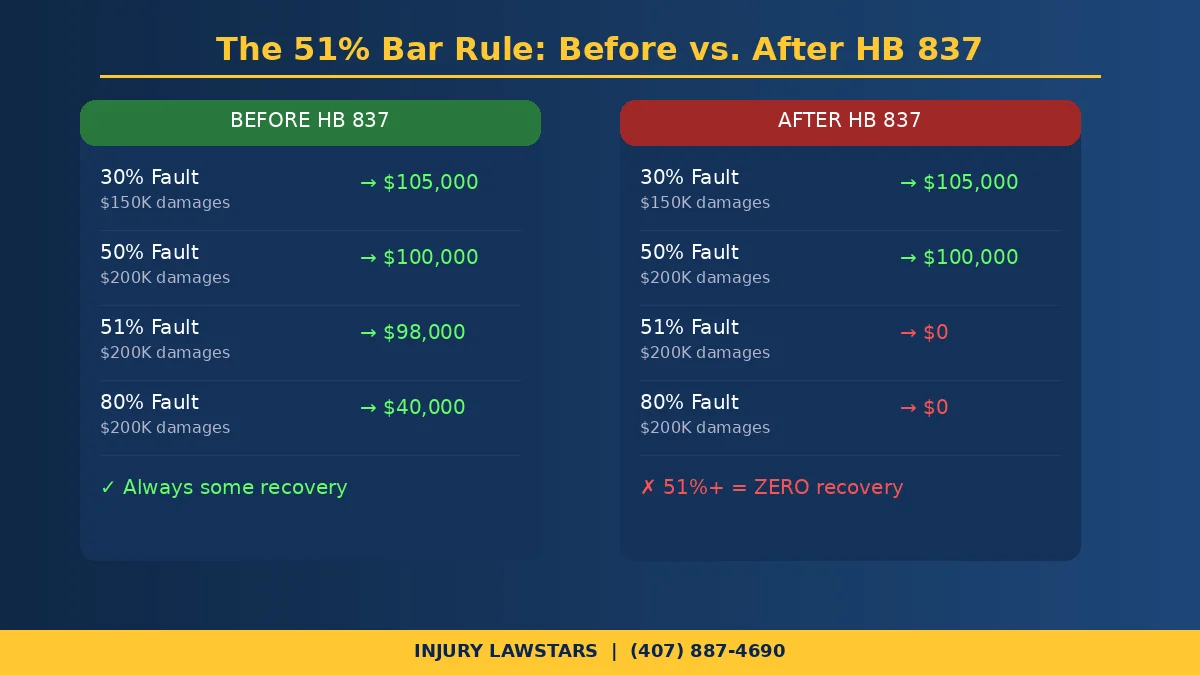
The 51% bar rule is the most significant element of HB 837 for injury victims. Here is how it works in practice:
Scenario: You’re 20% at Fault (You Can Recover Damages)
You are involved in a car accident. Investigation reveals you were 30% at fault for failing to check your mirror before changing lanes, and the other driver was 70% at fault for speeding. Your total damages are $150,000.
Under modified comparative negligence, your recovery is reduced by your 30% fault:
$150,000 × (100% – 30%) = $105,000 recovery
Scenario: You’re 50% at Fault (You Can Still Recover Damages)
You are exactly 50% at fault. Your total damages are $200,000.
$200,000 × (100% – 50%) = $100,000 recovery
At exactly 50% fault, you can still recover. The cutoff does not trigger until you reach 51%.
Scenario: You’re 51% at Fault (You Cannot Recover Damages)
You are found 51% at fault. Your total damages are $200,000.
Recovery = $0
Even though you sustained significant injuries, the 51% fault finding bars you entirely. Under Florida’s old pure comparative negligence system, you would have recovered $98,000. Under the new law, you receive nothing.
This means the difference between 50% and 51% fault is not a $2,000 adjustment. It is the difference between $100,000 and zero.
When the 51% Bar Rule Doesn’t Apply
While the 51% bar rule has reshaped the landscape for most personal injury claims in Florida, it’s not a universal mandate. The law includes specific exceptions for certain types of cases, meaning that not every injury victim is subject to this strict cutoff. Understanding these carve-outs is crucial, as they can completely change the viability of your claim. If your situation falls into one of these categories, the old “pure comparative negligence” standard may still apply, allowing you to seek compensation even if you are found to be more than 50% at fault for your injuries. It’s another reminder that every case is unique and deserves a careful legal review.
Medical Malpractice Claims
One of the most significant exceptions to the new law involves medical malpractice. Claims against doctors, hospitals, or other healthcare providers in places like Clermont or The Villages are exempt from the 51% bar. Instead, these cases continue to operate under Florida’s original pure comparative negligence system. This means that if a healthcare professional’s negligence caused you harm, you can still recover damages even if you are found to be more than half at fault. For example, if a jury determines you were 70% responsible for a negative medical outcome, you could still claim 30% of your damages. These cases are notoriously difficult to prove, which is why having a lawyer who understands the specific rules for a medical malpractice claim is essential.
Intentional Harm Lawsuits
The 51% bar rule was created to address accidents and unintentional mistakes, which fall under the legal category of negligence. It does not apply to cases where someone intentionally caused you harm. These actions, known as “intentional torts,” include things like assault, battery, and fraud. If you were injured because someone deliberately hurt you, they cannot use the modified comparative negligence defense to avoid responsibility. The law recognizes a fundamental difference between a careless mistake and a purposeful act designed to cause injury. In these situations, the focus is on holding the wrongdoer accountable for their intentional actions, not on apportioning blame for an accident.
Other Exclusions Under Florida Law
Beyond medical malpractice and intentional harm, Florida statutes outline a few other specific situations where the 51% rule does not apply. For instance, the law explicitly excludes lawsuits seeking to recover financial losses resulting from pollution. While this may not apply to most people, it shows how detailed and specific personal injury law can be. It’s a perfect example of why you should never assume how the law will treat your case based on something you read online. The specifics of your accident, whether it happened on the roads of Leesburg or at a property in Wildwood, determine which rules apply. An experienced attorney can analyze the unique facts of your situation to ensure your rights are protected under the correct legal standard.
How Is Fault Determined in a Florida Injury Case?
Because the fault percentage now determines whether you receive any compensation at all, understanding how fault is assigned has become more important than ever.
Who Decides Who Is at Fault?
Fault can be determined at several stages of a case:
- Insurance adjusters evaluate fault during the claims process, reviewing police reports, witness statements, and physical evidence.
- Attorneys for both sides present evidence and arguments about each party’s share of responsibility during negotiations.
- A judge or jury makes the final determination if the case goes to trial, assigning specific percentages of fault to every party involved, including parties not present in court.
What Evidence Is Used to Prove Fault?
Florida courts consider a wide range of evidence when assigning comparative fault:
- Police accident reports and citations
- Witness testimony from bystanders and passengers
- Surveillance and dashcam footage
- Cell phone records showing distracted driving
- Accident reconstruction expert analysis
- Medical records documenting injury patterns consistent with specific impacts
- Traffic signal and road condition data
- Toxicology reports for impaired driving cases
The strength and completeness of your evidence is now the single most important factor in your case. An experienced car accident lawyer will gather and preserve this evidence from day one to prevent the other side from shifting blame onto you.
A Note on the Admissibility of Police Reports
While police reports are a critical piece of evidence, it’s important to understand their role in a formal legal setting. Insurance adjusters frequently use the officer’s report as a primary tool to assign fault and make settlement offers. However, in a Florida courtroom, the report itself—specifically the officer’s opinion on who caused the accident—is often considered hearsay and may not be admissible as evidence. This means that even if the police report places you partially at fault, it is not the final word. An experienced attorney can challenge the findings and use other evidence, like witness testimony and expert analysis, to present a more accurate picture of what happened and protect your right to compensation.
How Insurance Companies Use the New Law Against You
Insurance companies are well aware of the 51% bar rule, and they actively use it as a strategy to avoid paying claims. Common tactics include:
- Inflating your fault percentage even slightly to push you past the 51% threshold
- Using your recorded statements against you to suggest you admitted to fault
- Pointing to minor traffic violations to argue you contributed more to the accident
- Hiring their own accident reconstruction experts to build a case that you were primarily responsible
This is why having legal representation from the start matters more under HB 837 than it ever did before. At Injury LawStars, Attorney Katie Miller understands these tactics firsthand. As someone who was once an injury victim herself, she knows how insurance companies operate and fights back aggressively to protect your right to fair compensation.
The Process for Blaming a Third Party
Under Florida law, fault isn’t always a simple split between two parties. A defendant can blame a “non-party” for the accident, a tactic often called the “empty chair” defense. They might claim a “phantom vehicle” cut them off or, in complex cases like truck accidents, blame an equipment manufacturer to reduce their own share of responsibility. To do this, their attorney must file a formal notice and provide evidence proving the third party’s fault. The jury then assigns a percentage of blame to everyone, including the absent party. This strategy is designed to spread the fault around, making it more likely that your percentage will be pushed past the 51% bar, which could eliminate your right to compensation entirely. Learn more about running a stop sign.
How Florida Comparative Negligence Works in Different Accidents
The 51% bar rule affects every type of personal injury case differently. Here are real-world examples showing how Florida comparative negligence plays out across common accident scenarios.
In a Car Accident
A driver is rear-ended at a red light. However, investigation reveals the victim’s brake lights were not functioning. The jury assigns 25% fault to the victim for the defective brake lights and 75% fault to the rear driver for following too closely.
Result: The victim’s $120,000 in damages is reduced by 25%, resulting in a $90,000 recovery. Under the old system, the result would have been the same. But if the insurance company had successfully argued the victim was 51% at fault, the victim would receive nothing. This is why gathering evidence like maintenance records and dashcam footage is critical. If you have been in a collision, contact a Florida car accident lawyer immediately to preserve your evidence.
In a Truck Accident
A passenger car merges onto I-4 and is struck by an 18-wheeler. Evidence shows the car driver merged without signaling, but the truck driver was fatigued and exceeding hours-of-service regulations. Fault is split 35% to the car driver and 65% to the trucking company.
Result: The car driver’s $500,000 in damages is reduced to $325,000. Truck accident cases are complex because multiple parties, including the driver, trucking company, and maintenance providers, may share fault. An experienced truck accident attorney can investigate electronic logging device data, truck maintenance records, and driver history to minimize the fault attributed to you.
In a Motorcycle Accident
A motorcyclist is struck by a car making a left turn at an intersection. The car driver failed to yield, but the motorcyclist was traveling 10 mph over the speed limit. The jury assigns 20% fault to the motorcyclist and 80% to the car driver.
Result: The motorcyclist recovers $160,000 of their $200,000 in damages. Motorcyclists face unique bias, as juries sometimes view them as inherently reckless. A motorcycle accident lawyer who understands this bias can present evidence that reframes the narrative and keeps your fault percentage below that critical 51% line.
In a Pedestrian Accident
A pedestrian is crossing at an intersection when struck by a vehicle. The driver was distracted by their phone, but the pedestrian entered the crosswalk against a “don’t walk” signal. Fault is assigned 40% to the pedestrian and 60% to the driver.
Result: The pedestrian’s $250,000 in damages is reduced to $150,000. Under the old pure comparative negligence system, the outcome would be the same. But the insurance company’s goal under the new law is to push that 40% up to 51%, where the pedestrian gets nothing. Evidence like traffic camera footage and witness accounts become essential. A pedestrian accident lawyer can fight to keep the fault assessment fair and accurate.
In a Slip and Fall Case
A customer slips on a wet floor inside a grocery store. The store failed to place warning signs, but the customer was looking at their phone while walking. Fault is split 30% to the customer and 70% to the store.
Result: The customer’s $80,000 in damages is reduced to $56,000. Premises liability cases under HB 837 now come with an additional challenge: the law created new presumptions that favor property owners in certain negligent security cases. A premises liability lawyer can challenge these presumptions and build a case that demonstrates the property owner’s negligence outweighs any fault attributed to you.
How Will HB 837 Impact Your Settlement Negotiations?
The modified comparative negligence standard has fundamentally changed how personal injury cases are negotiated in Florida.
Why Insurance Companies Now Have the Upper Hand
Before HB 837, insurance companies could not use the “you were mostly at fault” argument to eliminate a claim entirely. Under pure comparative negligence, even a heavily at-fault plaintiff was entitled to some recovery. Now, insurance adjusters use the 51% bar as a negotiation weapon.
A common tactic is to present an initial fault assessment showing the victim at 51% or higher, then offer a lowball settlement “just to resolve the claim.” The implied message: take this offer, or risk getting nothing at trial.
Expect Lower Initial Settlement Offers
Because the risk of a zero recovery at trial is now real, many plaintiffs accept lower settlement offers than they would have before. Insurance companies factor this risk into their offers, knowing that the modified comparative negligence system gives them substantial leverage.
Why You Need a Lawyer Sooner Rather Than Later
The window for building a strong case is shorter, and the stakes for fault determination are higher. Getting an attorney involved immediately after your accident helps ensure:
- Evidence is preserved before it disappears
- Your recorded statement does not inadvertently admit fault
- Expert witnesses can be engaged early to establish the other party’s negligence
- Your fault percentage is documented accurately from the start
If you have been injured in an accident in Florida, do not wait. Contact Injury LawStars for a free consultation at (407) 887-4690. Attorney Katie Miller has been where you are. As she says, “I was you, now I represent you.”
The New Two-Year Deadline to File a Claim
HB 837 did not just change comparative negligence rules. It also cut the statute of limitations for personal injury claims in half.
From Four Years Down to Two
- Before HB 837: You had four years from the date of your accident to file a negligence-based personal injury lawsuit.
- After HB 837: You now have only two years for any cause of action accruing after March 24, 2023.
Are There Any Exceptions to the Rule?
- Medical malpractice claims retain their existing two-year statute of limitations (with a four-year statute of repose).
- Wrongful death claims retain their existing two-year deadline.
Why This Shorter Deadline Is a Big Deal
Two years may seem like plenty of time, but personal injury cases involve extensive medical treatment, evidence gathering, and negotiations. Many accident victims are still in active treatment when the two-year deadline approaches. If you miss this deadline, your case is gone, regardless of how strong it was.
This shortened timeline makes it essential to consult an attorney as soon as possible after your accident. The earlier you begin the legal process, the more time your attorney has to build a thorough case, negotiate effectively, and file suit if necessary.
How to Protect Your Claim Under the New Law
HB 837 has created a new reality for anyone injured in an accident in Florida. Here are the most important strategic takeaways:
1. Document Everything—Right Away
From the moment an accident occurs, the evidence clock starts ticking. Take photos of the scene, your injuries, and all vehicles or property involved. Get contact information from witnesses. Request a copy of the police report. Do not rely on memory; document everything in writing as soon as possible.
2. Never Give a Recorded Statement Without Your Lawyer
Insurance adjusters will contact you quickly after an accident, often within hours. They may ask you to provide a recorded statement. Anything you say can be used to increase your fault percentage toward that 51% bar. Politely decline until you have spoken with an attorney.
3. Get Medical Care Immediately
Delaying medical treatment gives insurance companies ammunition to argue that your injuries are not serious or were caused by something other than the accident. Prompt medical documentation links your injuries directly to the accident and strengthens your case.
4. Talk to an Attorney as Soon as Possible
Under the old system, you had more time and less risk. Under HB 837, the two-year deadline is shorter, the stakes are higher, and the insurance company’s playbook is designed to deny your claim. An experienced personal injury attorney can level the playing field.
5. Know That Medical Malpractice Rules Are Different
If your injury involves medical malpractice, the pure comparative negligence standard still applies. You can recover damages even if you shared fault. However, medical malpractice cases have their own complex procedural requirements, including a pre-suit investigation period and mandatory expert affidavits, so early legal guidance is still essential.
6. What if Your Accident Happened Before the Law Changed?
The old four-year statute of limitations and pure comparative negligence rules still apply to any accident or injury that occurred before March 24, 2023. If you were injured before that date, you may still have the benefit of the old rules. However, if you have not yet filed and you are approaching the four-year mark, you should contact an attorney immediately.
7. Understand How Fault Works in Multi-Car Pileups
In multi-vehicle pileups and chain-reaction crashes, fault is distributed among all involved parties. Under the new law, each driver, each vehicle owner, and even government entities responsible for road maintenance can be assigned a percentage. The more parties involved, the more complex the fault analysis becomes. Having an attorney who can investigate and apportion fault across all responsible parties is critical to keeping your percentage below 51%.
How Does Comparative Negligence Work With No-Fault Insurance?
Florida operates under a no-fault auto insurance system, which requires every driver to carry Personal Injury Protection (PIP) insurance. PIP covers up to $10,000 in medical expenses and lost wages after an accident, regardless of who was at fault. This system was designed to reduce the number of minor injury lawsuits and speed up access to medical care after motor vehicle accidents.
However, PIP coverage is limited. It only applies to motor vehicle accidents and caps coverage at $10,000, which is often a fraction of the actual costs of a serious injury. When your injuries meet Florida’s serious injury threshold, such as permanent disability, significant scarring, disfigurement, broken bones, or death, Florida law allows you to step outside the no-fault system and file a personal injury lawsuit against the at-fault party.
This is exactly where Florida comparative negligence and the 51% bar come into play. Your PIP benefits are not affected by comparative negligence, because PIP pays regardless of fault. But any lawsuit you file for damages beyond PIP, including compensation for pain and suffering, long-term medical care, and lost earning capacity, is fully subject to the modified comparative negligence rules.
If you are found 51% or more at fault in your lawsuit, you recover nothing beyond what PIP already paid. For someone with $500,000 in medical bills and a $10,000 PIP cap, the difference between 50% fault and 51% fault could mean the difference between recovering $245,000 and recovering zero additional compensation.
How Does Florida’s Negligence Law Compare to Other States?
| System | Rule | States |
|---|---|---|
| Pure Comparative Negligence | Recover damages at any fault level, reduced by your percentage | 12 states including California, New York, Florida (pre-2023) |
| Modified Comparative Negligence (50% bar) | Barred if more than 50% at fault | 23 states including Florida (current), Georgia, Colorado, Tennessee |
| Modified Comparative Negligence (51% bar) | Barred if 51% or more at fault | States including Texas, Illinois, Ohio |
| Contributory Negligence | Barred if any fault at all | 4 states + D.C.: Alabama, Maryland, North Carolina, Virginia |
Florida’s threshold is the 50% bar version of modified comparative negligence, meaning you must be 50% or less at fault to recover. Some sources describe it as a “51% bar” because being at 51% triggers the bar. Both descriptions refer to the same rule.
Florida Joins the Majority of States
With the passage of HB 837, Florida moved away from its plaintiff-friendly pure comparative negligence system and joined the 34 other states that follow a modified comparative negligence rule. This change was part of a broader tort reform effort aimed at reducing lawsuits and insurance costs by preventing parties who are mostly responsible for an accident from collecting damages. For residents in communities like Clermont, The Villages, and Ocala, this means the legal landscape for personal injury claims is now stricter. The new law places a much heavier burden on you, the victim, to prove that your share of fault was 50% or less. This shift impacts a wide range of personal injury cases, from car accidents in Leesburg to slip and falls in Mount Dora. Learn more about uneven road accidents.
Frequently Asked Questions
What is comparative negligence in Florida?
Comparative negligence in Florida is a legal standard that assigns a percentage of fault to each party involved in an accident. Under Florida’s current modified comparative negligence system, your compensation is reduced by your percentage of fault. If you are found 51% or more at fault, you cannot recover any compensation. This system was established by HB 837, which took effect on March 24, 2023.
What happens if I am 51% at fault for my accident?
If you are found 51% or more at fault, you are completely barred from recovering any damages under Florida law. This is the most significant change introduced by HB 837. Under the previous pure comparative negligence system, you could have recovered a reduced amount even at 51% fault. Under the current law, crossing that threshold results in zero compensation.
How does modified comparative negligence differ from pure comparative negligence?
Under pure comparative negligence, you could recover damages regardless of your fault percentage. Even at 99% fault, you could recover 1% of your damages. Under modified comparative negligence, there is a cutoff. In Florida, that cutoff is 51%. Once your fault reaches 51% or higher, you lose all right to compensation. Below that threshold, your damages are reduced proportionally, just as they were under the pure system.
Does Florida comparative negligence affect my settlement?
Yes. Florida’s modified comparative negligence standard directly impacts settlement negotiations. Insurance companies use the 51% bar as leverage to reduce offers or deny claims entirely. If they can argue you were primarily at fault, they may offer nothing. Even if fault is below 51%, your settlement will be reduced by your fault percentage. This makes early legal representation essential to protect your claim’s value.
When did Florida change its negligence law?
Florida changed its negligence law on March 24, 2023, when Governor Ron DeSantis signed House Bill 837. The law replaced Florida’s pure comparative negligence system with a modified comparative negligence standard and reduced the statute of limitations for negligence claims from four years to two years. These changes apply to all causes of action arising on or after March 24, 2023.
Injury LawStars is a Florida-based personal injury firm dedicated to protecting the rights of those hurt in accidents. Managing Partner Attorney Katie Miller was once an injury victim herself and now uses that firsthand experience to fight relentlessly for others. She knows the fear, stress, and frustration you are facing, and she refuses to let insurance companies take advantage of you. With a proven record of results and no fees unless we win, Injury LawStars delivers powerful advocacy and compassionate guidance to help you recover physically, financially, and emotionally.
When you have been injured, justice starts today. Contact Injury LawStars for a free consultation at (407) 887-4690.
Learn more about hit and run cases and what victims need to know about their legal rights.
Related Articles
- Strict Liability vs. Negligence: Key Differences
- Wet Road Accidents: Causes & Legal Options | Injury LawStars
- Injury LawStars | Orlando Personal Injury Lawyer
About the Author
Katie Miller, Esq.
Managing Partner · Injury LawStars
Attorney Katie Miller was once an injury victim herself. After a car accident in 2016 that required spinal surgery and a 13-month recovery, she turned her experience into a mission: fighting for people who are hurting. With 17+ years of legal experience and over \$45 million recovered for clients, Katie brings both professional expertise and personal understanding to every case.