
March 25, 2026
Your Guide to a Florida Brain Injury Settlement

A brain injury changes your life in an instant. You’re facing a mountain of medical bills, you can’t work, and the future feels completely uncertain. If someone else’s negligence caused this, you deserve compensation that covers the true cost of your ordeal. But what does that number actually look like? A brain injury settlement isn’t arbitrary. It’s a detailed calculation of everything you’ve lost—from medical expenses and lost income to the physical and emotional pain you now live with. We’ll break down exactly how that final number is determined.
Call Injury LawStars today at (407) 887-4690 for a free brain injury case evaluation. We do not charge any fees unless we win your case.
As a personal injury attorney who has been on both sides of the recovery process, I understand the fear and frustration that comes after a serious injury. At Injury LawStars, we fight to make sure insurance companies do not take advantage of brain injury victims in Florida. Golf carts are another common source of traumatic brain injuries in Florida. Learn more about golf cart accident laws and liability in Florida.
This guide breaks down how brain injury settlements work in Florida, what your claim may be worth, and the factors that determine your compensation.
Key Takeaways
- Brain injury settlements in Florida range from $20,000 for mild concussions to over $10 million for severe traumatic brain injuries (TBI) with permanent impairment.
- The average traumatic brain injury settlement is approximately $540,000, though every case is unique and depends on severity, medical costs, lost income, and long-term care needs.
- Florida’s modified comparative negligence law bars recovery if you are more than 50% at fault for the accident.
- Proving a brain injury claim requires neuropsychological testing, advanced imaging, and expert medical testimony.
- You have two years from the date of injury to file a brain injury lawsuit in Florida under § 95.11, Fla. Stat.
- Workers’ compensation head injury settlements follow different rules and typically provide lower payouts than personal injury claims.
What Are the Different Types of Brain Injuries?
Not all brain injuries are the same. The type and severity of your injury directly affects your settlement value, your treatment needs, and your long-term prognosis.
What Is a Traumatic Brain Injury (TBI)?
A traumatic brain injury occurs when an external force disrupts normal brain function. This can result from a blow, jolt, or penetrating wound to the head. The Centers for Disease Control and Prevention (CDC) reports that approximately 2.9 million TBI-related emergency department visits occur in the United States each year.
How Common Are Brain Injuries?
Brain injuries are far more common than many people realize. In the United States, a traumatic brain injury contributes to about 30% of all injury-related deaths. The statistics are staggering when you break them down: every single day, around 190 people die from a TBI, and nearly 600 are hospitalized. These injuries often result from everyday incidents that turn tragic, such as falls, assaults, and especially motor vehicle crashes. Whether it’s a car accident in Ocala or a slip and fall in The Villages, the impact can be devastating. Understanding the prevalence of these injuries highlights just how critical it is to seek proper medical and legal support after an accident.
Concussion vs. TBI: What Is the Difference?
A concussion is technically a form of mild traumatic brain injury. However, the term “concussion” often understates the seriousness of the condition. Even a “mild” TBI can produce persistent symptoms that affect your ability to work, think clearly, and maintain relationships for months or years after the initial injury.
Post-concussion syndrome occurs when concussion symptoms persist beyond the normal recovery period of a few weeks. Victims with post-concussion syndrome often experience ongoing headaches, cognitive difficulties, dizziness, and mood changes. These cases typically settle for significantly more than a standard concussion that resolves quickly.
Mild, Moderate, or Severe: Classifying Brain Injuries
Mild TBI (Concussion)
Mild traumatic brain injuries involve a brief loss of consciousness (less than 30 minutes) or a period of disorientation. Symptoms often include headaches, dizziness, memory problems, and difficulty concentrating. While many mild TBIs resolve within weeks to months, some develop into post-concussion syndrome with lasting effects.
Moderate TBI
Moderate traumatic brain injuries involve an extended loss of consciousness (30 minutes to 24 hours) and more significant cognitive impairment. Victims may experience amnesia, speech difficulties, and documented deficits on neuropsychological testing. Recovery can take months to years, and some impairments may be permanent.
Severe TBI
Severe traumatic brain injuries involve prolonged unconsciousness exceeding 24 hours, significant brain swelling or bleeding, and permanent cognitive and physical impairments. Many severe TBI victims require lifetime care, including assistance with daily activities, ongoing rehabilitation, and 24-hour supervision.
Diffuse Axonal Injury
Diffuse axonal injuries occur when the brain’s nerve fibers (axons) are torn by rotational forces, often in high-speed car accidents or violent shaking. This type of injury frequently results in coma, vegetative state, or death. Survivors typically face severe, permanent disabilities.
Penetrating Brain Injury
Penetrating injuries occur when an object pierces the skull and enters brain tissue. These catastrophic injuries cause localized but severe damage and carry high mortality rates. Survivors often require extensive reconstructive surgery and lifelong rehabilitation.
How Much Is a Brain Injury Settlement Worth in Florida?
The honest answer is that every brain injury case is different. Settlement amounts depend on your specific injuries, medical expenses, lost income, and the impact on your daily life. However, understanding general settlement ranges based on injury severity can give you a starting point for evaluating your claim.
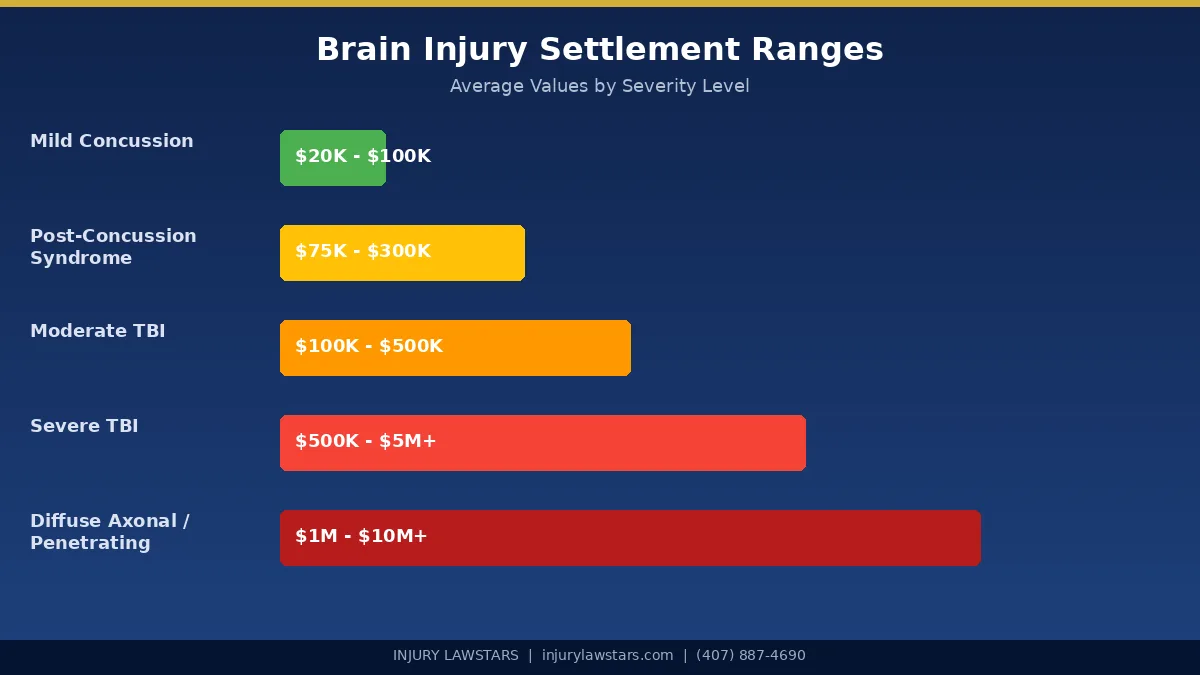
How Injury Severity Affects Your Settlement Amount
| Injury Type | Typical Settlement Range | Key Factors |
|---|---|---|
| Mild Concussion (resolves quickly) | $20,000 to $100,000 | Brief symptoms, full recovery expected, minimal ongoing treatment |
| Post-Concussion Syndrome | $75,000 to $300,000 | Persistent symptoms beyond 3 months, documented cognitive deficits, impact on work |
| Moderate TBI | $100,000 to $500,000 | Extended treatment, hospitalization, neuropsychological testing shows deficits |
| Severe TBI | $500,000 to $5,000,000+ | Permanent impairment, lifetime care needs, loss of earning capacity |
| Diffuse Axonal Injury | $1,000,000 to $10,000,000+ | Catastrophic damage, coma, vegetative state, 24-hour care required |
| Penetrating Brain Injury | $1,000,000 to $10,000,000+ | Surgical intervention, severe localized damage, permanent disability |
These ranges reflect national settlement data from 2025-2026. Your Florida case value will depend on additional factors including available insurance coverage, the strength of your evidence, and the specific circumstances of your accident.
Why Are Brain Injury Settlement Ranges So Wide?
No injury category produces wider settlement ranges than brain injuries. A mild concussion that resolves in two weeks is fundamentally different from a concussion that develops into post-concussion syndrome lasting years. The key variables include:
- Injury permanence. Temporary symptoms settle for far less than permanent cognitive impairment.
- Proof quality. Brain injuries are often invisible on standard imaging. Cases with strong neuropsychological testing and expert documentation settle for significantly more.
- Future care needs. A severe TBI requiring lifetime assistance can add millions to a claim’s value.
- Lost earning capacity. A 30-year-old professional who can never return to work has dramatically higher damages than a retired person with the same injury.
What Do TBI Settlement Statistics Show?
Looking at the data can help you get a general idea of what to expect. Brain injury settlements in Florida can range from as low as $20,000 for a mild concussion that heals quickly to well over $10 million for a catastrophic traumatic brain injury (TBI) that results in permanent impairment. While the average TBI settlement is approximately $540,000, it’s important not to get too focused on this number. An “average” figure lumps together thousands of unique cases, from minor bumps on the head to life-altering injuries. The true value of your claim will always depend on the specific details of your accident, the severity of your injury, and the total impact it has on your life.
To get more specific, settlement values often correlate with the type of injury. A mild concussion might settle for $20,000 to $100,000, whereas a case involving post-concussion syndrome could be valued between $75,000 and $300,000. Moderate TBIs often fall in the $100,000 to $500,000 range. For severe, diffuse axonal, or penetrating brain injuries that require lifelong care, settlements can easily reach $1 million to $10 million or more. Remember, these are national statistics. The final value of your case in areas like Ocala, The Villages, or Clermont will also be influenced by factors like available insurance coverage and the strength of your medical evidence.
What Factors Affect Your Brain Injury Settlement Value?
Understanding what drives settlement amounts helps you and your attorney build the strongest possible case. Here are the primary factors that determine compensation in Florida brain injury claims.
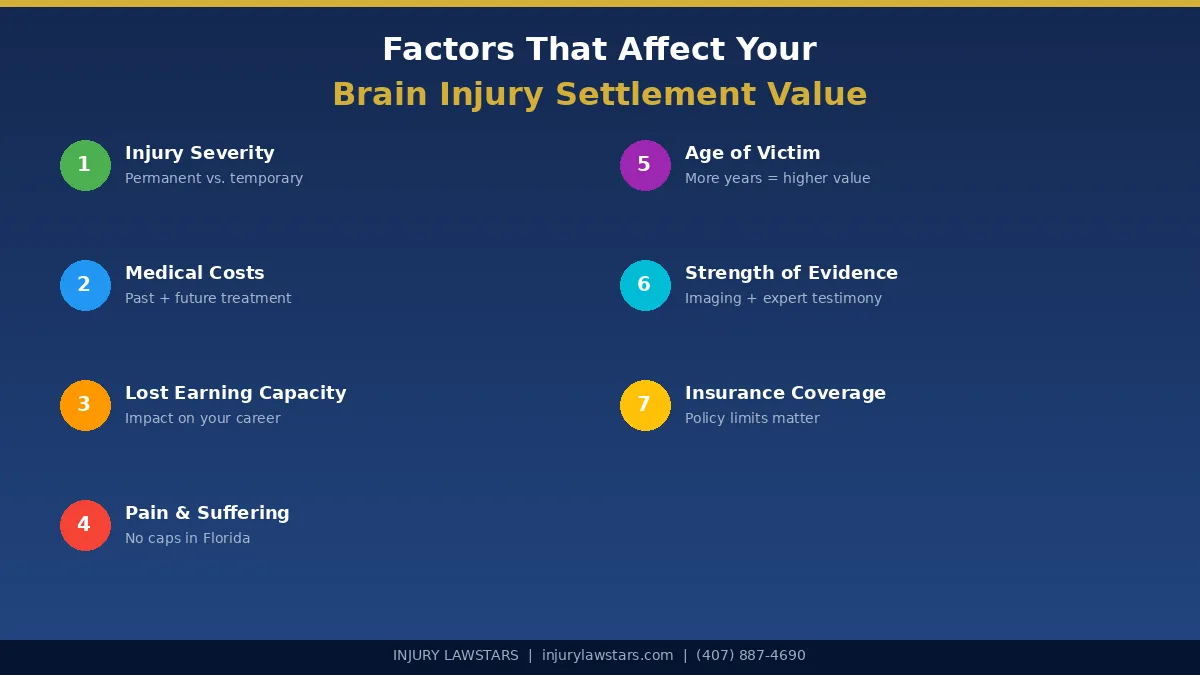
Your Injury’s Severity and Long-Term Outlook
This is the single most important factor. A brain injury that produces permanent cognitive deficits, personality changes, or physical limitations will be worth significantly more than one that resolves within a few months. Medical documentation establishing the severity and expected trajectory of your injury is critical.
Calculating Your Past and Future Medical Bills
Current and future medical costs form the foundation of your economic damages. Brain injury treatment can include emergency surgery, ICU stays, inpatient rehabilitation, outpatient therapy, neuropsychological evaluations, medications, and assistive devices. For severe TBIs, medical expenses over a lifetime can reach $3 million to $5 million or more.
Lost Income and Future Earning Potential
If your brain injury prevents you from working during recovery, you are entitled to compensation for lost income. More significantly, if your TBI permanently limits your ability to perform your previous job or any work at all, you can claim diminished earning capacity. For younger victims with high earning potential, this component of damages can be the largest single element of the settlement.
Do not let the insurance company undervalue your brain injury. Call (407) 887-4690 now to speak with a Florida brain injury attorney who will fight for what you deserve.
Valuing Your Pain and Suffering
Non-economic damages in brain injury cases reflect the physical pain, emotional distress, anxiety, depression, loss of enjoyment of life, and loss of consortium that result from the injury. Florida does not cap non-economic damages in most personal injury cases, which means there is no arbitrary limit on what a jury can award for pain and suffering.
How Your Age Can Affect Your Settlement
A younger victim generally receives a larger settlement because they will live with the consequences of their brain injury for more years. Future medical costs, lost earning capacity, and pain and suffering are all calculated over the victim’s expected remaining lifespan.
Do Pre-Existing Conditions Matter?
Insurance companies frequently argue that a victim’s symptoms are related to pre-existing conditions rather than the accident. However, under Florida law, you are entitled to compensation for the aggravation of a pre-existing condition. If you had a prior concussion and a new accident worsened your symptoms, the at-fault party is responsible for that worsening.
How Insurance Coverage Limits Your Settlement
The at-fault party’s insurance policy limits can serve as a practical cap on your settlement. In a car accident, the at-fault driver’s bodily injury liability limits may be as low as $25,000 per person in Florida. For severe brain injuries, your attorney may need to pursue underinsured motorist coverage, additional liable parties, or a personal judgment against the defendant to recover adequate compensation.
How Strong Is Your Case?
Brain injury cases live and die on medical evidence. Cases supported by neuropsychological testing, advanced brain imaging (MRI, CT, DTI), expert medical testimony, and comprehensive treatment records consistently achieve higher settlements than those relying solely on subjective symptom reports.
How Are Brain Injury Settlements Calculated in Florida?
There is no single formula for calculating a brain injury settlement, but Florida attorneys and insurance adjusters generally consider the same core components.
Calculating Your Financial Losses (Economic Damages)
Economic damages are the measurable financial losses resulting from your brain injury:
- Past medical expenses. All treatment costs from the date of injury to the present, documented with medical records and bills.
- Future medical expenses. Projected costs for ongoing treatment, rehabilitation, therapy, medication, and assistive devices. A life care plan prepared by a medical expert is essential for severe TBI cases.
- Lost wages. Income lost during recovery, supported by employment records and tax returns.
- Lost earning capacity. The difference between what you could have earned over your working life and what you can now earn (if anything) with your brain injury. Vocational rehabilitation experts typically calculate this figure.
- Out-of-pocket expenses. Transportation to medical appointments, home modifications, caregiving costs, and other accident-related expenses.
Accounting for Intangible Losses (Non-Economic Damages)
Non-economic damages compensate for losses that do not have a precise dollar value:
- Physical pain and suffering
- Emotional distress and mental anguish
- Loss of enjoyment of life
- Loss of consortium (impact on your relationship with your spouse)
- Cognitive impairment and personality changes
- Depression, anxiety, and PTSD
Florida courts often use a “multiplier method” to estimate non-economic damages by multiplying total economic damages by a factor between 1.5 and 5, depending on severity. Severe, permanent brain injuries typically warrant multipliers at the higher end.
Understanding Punitive Damages
In some rare cases, you may also be able to recover punitive damages. Unlike other forms of compensation designed to cover your losses, punitive damages are intended to punish the defendant for extreme wrongdoing and deter similar behavior in the future. In Florida, you must prove by clear and convincing evidence that the defendant was guilty of intentional misconduct or gross negligence. A common example is a drunk driving accident where the at-fault driver had an extremely high blood alcohol level and a history of similar offenses. These damages are not guaranteed and are capped by Florida law, but they can significantly increase a settlement when the circumstances warrant them.
Should You Use a Settlement Calculator?
Many websites offer brain injury settlement calculators, and while these tools can provide a rough estimate, they cannot account for the unique facts of your case. A calculator cannot evaluate the strength of your medical evidence, the credibility of your expert witnesses, or the likelihood of a favorable jury verdict in your specific Florida county. For an accurate assessment, consult a brain injury attorney in Florida who can review your complete case.
Why Online Calculators Are Often Inaccurate
It’s tempting to plug your numbers into an online settlement calculator for a quick answer. However, these tools are often misleading and can create false expectations. Most are simply marketing gimmicks designed to capture your contact information, not to provide a reliable valuation. A calculator can’t grasp the specific circumstances of your accident, whether it was a truck collision on a busy highway near The Villages or a slip and fall at a store in Mount Dora. They use a generic formula that completely misses the critical, human details that give a case its true value. Relying on one can give you a number that is either far too high or, more dangerously, far too low, potentially causing you to accept an unfair offer.
The true value of a brain injury claim goes far beyond a simple calculation of medical bills and lost wages. A calculator cannot measure the profound impact the injury has on your quality of life, your relationships, or your emotional well-being for the years to come. It doesn’t account for the strength of your medical documentation, the credibility of expert testimony from neurologists, or the complex insurance policy limits at play. These factors are essential for determining a fair settlement. A brain injury that causes personality changes and cognitive struggles requires a much deeper analysis than a formula can provide, as these non-economic damages often make up a significant portion of the final award.
Only an experienced personal injury attorney can provide an accurate assessment of what your claim is worth. A lawyer will conduct a detailed investigation, gather all necessary evidence, and consult with medical and financial experts to build a comprehensive picture of your total losses—past, present, and future. They understand how to present your case to insurance adjusters and, if necessary, to a jury in your local jurisdiction, whether that’s in Marion County or Lake County. This personalized evaluation is the only way to understand the real potential of your case and ensure you don’t settle for less than you deserve for your long-term recovery.
If you are located in Lake County or the Clermont area, our Clermont brain injury team handles TBI cases with direct knowledge of local courts and jury dynamics. For those injured in golf cart accidents — a growing TBI risk in communities like The Villages — our golf cart accident legal guide covers the unique liability rules that apply to these crashes.
How Do You Prove Brain Injury Damages in Florida?
Brain injuries are notoriously difficult to prove because the damage is often invisible on standard medical imaging. Insurance companies exploit this by dismissing symptoms as subjective, pre-existing, or exaggerated. Building a strong evidentiary foundation is essential to securing fair compensation.
The Importance of Neuropsychological Testing
Neuropsychological evaluations are the gold standard for documenting cognitive deficits from a brain injury. These comprehensive assessments measure memory, attention, processing speed, executive function, language, and emotional regulation. The results provide objective, quantifiable evidence of how your brain injury has affected your cognitive abilities compared to baseline function.
Proving Your Injury with Advanced Brain Imaging
While CT scans and standard MRIs may not detect all brain injuries, advanced imaging techniques can reveal damage that standard tests miss:
- Diffusion Tensor Imaging (DTI) detects damage to white matter tracts (axons) that connect different brain regions.
- Functional MRI (fMRI) shows changes in brain activity patterns.
- PET scans reveal metabolic changes in brain tissue.
These imaging studies, combined with neuropsychological testing, create a powerful evidence package that demonstrates your brain injury to the insurance company or jury.
Why You Need an Expert Medical Witness
Brain injury cases typically require testimony from:
- Neurologists to explain the nature and severity of the brain injury.
- Neuropsychologists to present testing results and explain cognitive deficits.
- Life care planners to project future treatment needs and costs.
- Vocational rehabilitation experts to calculate lost earning capacity.
- Economists to determine the present value of future losses.
The cost of retaining these experts is significant, but their testimony often makes the difference between a lowball settlement offer and fair compensation.
Using Non-Medical Evidence to Strengthen Your Claim
Medical records and expert testimony are the backbone of a brain injury claim, but they don’t tell the whole story. To truly show an insurance company or a jury how a TBI has affected your life, we need to look beyond the clinical data. Non-medical evidence provides a human perspective, illustrating the day-to-day realities of your injury. It helps translate abstract medical terms into tangible, real-world consequences. This is especially critical for an injury that is often invisible, where standard medical imaging might not capture the full extent of the damage. This personal evidence is essential for proving the full scope of your losses and securing the compensation you deserve.
Statements from Family, Friends, and Coworkers
The people who know you best are often the most powerful witnesses to the changes you’ve undergone. We can gather statements from your spouse, children, close friends, and colleagues who can describe the “before and after.” They can speak to shifts in your personality, memory lapses they’ve noticed, increased irritability, or your inability to participate in hobbies you once loved. These personal accounts are invaluable because they demonstrate the real-world impact of the injury on your relationships and quality of life. This type of testimony helps justify compensation for your pain and suffering, which is a critical component of your settlement.
Personal Journals and Witness Testimony
A personal journal kept by you or a family member can become a crucial piece of evidence. This day-by-day log of your symptoms, challenges, frustrations, and small victories provides a detailed, contemporaneous account of your recovery journey. It captures the daily struggles with headaches, cognitive fog, or emotional swings that a doctor’s report might only summarize. Additionally, testimony from witnesses to the accident itself—whether it was a car crash, a slip and fall, or a construction accident—can be vital for establishing who was at fault. Proving liability is the first step in any successful personal injury claim.
How a Life Care Plan Documents Future Needs
For moderate to severe brain injuries, future care costs often represent the largest component of a settlement. A life care plan is a comprehensive document prepared by a medical expert that projects all future medical and personal care needs resulting from the brain injury.
What Does a Life Care Plan Include?
- Ongoing neurological care and monitoring
- Cognitive rehabilitation therapy
- Physical, occupational, and speech therapy
- Psychiatric and psychological treatment
- Prescription medications
- Assistive devices and technology
- Home modifications (wheelchair ramps, bathroom adaptations)
- In-home nursing or attendant care
- Residential care facility costs (if independent living is not possible)
- Transportation for medical appointments
What Are the Lifetime Costs of a Brain Injury?
According to the CDC and the Brain Injury Association of America, the lifetime cost of care for a TBI patient varies dramatically:
- Mild TBI with full recovery: $85,000 to $150,000 in total medical costs
- Moderate TBI with partial recovery: $500,000 to $1,500,000
- Severe TBI requiring lifetime care: $2,500,000 to $6,000,000+
These figures underscore why a life care plan is essential in any moderate to severe brain injury case. Without one, you risk settling for far less than what you will actually need for your care.
The True Cost of Long-Term TBI Care
The lifetime cost figures for TBI care can be overwhelming, but they represent more than just a running tally of hospital visits and therapy sessions. The true cost of long-term care includes expenses that families often don’t anticipate. Think about the need for home modifications like wheelchair ramps or accessible bathrooms, a specialized vehicle to get to appointments in places like Ocala or The Villages, or the cost of vocational rehabilitation to learn new job skills. It also includes the lost income of family members who have to reduce their work hours to become caregivers. A thorough life care plan accounts for every one of these future needs. This is why working with an experienced brain injury attorney is so critical; we fight to ensure your settlement covers the complete, lifelong impact of the injury, not just the initial medical bills.
How Florida’s Fault Rules Affect Your Settlement
Florida’s modified comparative negligence law (HB 837, effective March 2023) significantly impacts brain injury claims. Under this law, your compensation is reduced by your percentage of fault, and you are barred from recovering any compensation if you are found to be more than 50% responsible for the accident.
How Being Partially at Fault Reduces Your Payout
If you suffer a severe TBI in a car accident and your case is worth $1,000,000, but you are found 20% at fault (for example, you were driving 5 mph over the speed limit), your settlement would be reduced to $800,000.
If you are found 51% or more at fault, you recover nothing.
This makes it critical to work with an experienced attorney who can counter any attempts by the insurance company to shift blame onto you. In brain injury cases, this defense tactic is common because the victim often cannot clearly recall the events leading up to the accident due to their injuries.
Don’t Miss Florida’s Filing Deadline
Under § 95.11, Fla. Stat., you have two years from the date of your injury to file a brain injury lawsuit in Florida. This deadline is strict. If you miss it, you lose your right to seek compensation entirely.
For brain injury victims, the statute of limitations is particularly dangerous because symptoms may not be immediately apparent. Some TBI symptoms develop gradually over weeks or months. Do not wait to seek legal help. If you have been in an accident and are experiencing any neurological symptoms, contact a brain injury attorney immediately to protect your rights. You can also learn more about how long you have to file a lawsuit after an accident.
Common Causes of Brain Injuries in Florida
Brain injuries can result from virtually any accident involving impact to the head. However, certain types of accidents produce brain injuries more frequently than others.
Car Accidents
Motor vehicle crashes — including the average car accident settlement in Florida — are one of the leading causes of traumatic brain injuries. Even with seatbelts and airbags, the violent forces in a collision can cause the brain to strike the inside of the skull, producing contusions, diffuse axonal injuries, or other forms of TBI. Car accident victims should always be evaluated for brain injuries after a crash, even if they feel fine initially. Concussion symptoms can take hours or days to appear.
Truck Accidents
The size and weight disparity between commercial trucks and passenger vehicles means that truck accident victims frequently suffer catastrophic brain injuries. An 80,000-pound semi-truck colliding with a car creates forces that far exceed what the human brain can withstand. Truck accident TBI cases often involve multiple liable parties, including the truck driver, trucking company, and vehicle manufacturer.
Motorcycle Accidents
Motorcycle riders are particularly vulnerable to brain injuries because they lack the structural protection of an enclosed vehicle — see how this affects a motorcycle accident settlement. Even with a helmet, a motorcycle crash can produce sufficient force to cause a severe TBI. Florida’s motorcycle helmet law exemption for riders over 21 with adequate insurance coverage means that many riders do not wear helmets, significantly increasing their risk of brain injury.
Slip and Fall Accidents
Falls are the leading cause of TBI-related hospitalizations, according to CDC data. Slip and fall accidents in stores, parking lots, and other properties can cause victims to strike their heads on hard surfaces. Property owners in Florida have a duty to maintain safe conditions, and they may be liable for brain injuries caused by hazardous conditions on their premises.
Workplace Accidents
Construction workers, warehouse employees, and industrial workers face elevated risks of brain injury from falling objects, falls from heights, and equipment malfunctions. Brain injuries sustained at work may be covered by workers’ compensation, but the compensation available differs significantly from personal injury claims.
Sports and Recreational Injuries
Contact sports, cycling, boating, and other recreational activities can cause concussions and more severe brain injuries. In Florida, golf cart accidents are an increasingly common cause of TBI, particularly in communities like The Villages, Clermont, and Ocala where golf carts are a primary mode of transportation.
Should You File for Workers’ Comp or a Personal Injury Claim?
If you suffered a brain injury at work, you may be wondering whether to pursue workers’ compensation or a personal injury claim. Understanding the differences is critical because the compensation available under each system varies dramatically.
What Does Workers’ Comp Cover for a Brain Injury?
Workers’ compensation provides:
- Payment for all reasonable and necessary medical treatment
- Temporary disability benefits (66.67% of your average weekly wage, up to $1,260/week maximum in 2024)
- Permanent impairment benefits based on your impairment rating
- No requirement to prove fault
Under Florida’s workers’ compensation system, traumatic brain injuries are rated using the AMA Guides to the Evaluation of Permanent Impairment (6th Edition). A TBI resulting in moderate cognitive deficits may be assigned an impairment rating of 10–29% of the whole person, while severe TBIs with major neurobehavioral consequences can be rated at 50% or higher. These ratings directly determine the dollar value of your permanent impairment benefits. In Florida, permanent impairment benefits are calculated by multiplying your impairment rating by a statutory formula tied to your average weekly wage.
For a brain injury affecting your cognitive function, memory, or personality, a neuropsychologist’s formal evaluation is typically required to establish the rating. An attorney can ensure your impairment is properly documented and rated to maximize your workers’ comp benefit — and evaluate whether a third-party personal injury claim can supplement it. For broader brain injury legal support, visit our Florida brain injury attorney page.
However, workers’ compensation does not provide:
- Compensation for pain and suffering
- Full lost wages (only a percentage)
- Damages for loss of enjoyment of life
When Can You File a Lawsuit for a Work Injury?
A personal injury lawsuit is available when a third party (not your employer) caused your brain injury. For example, if you suffered a TBI at a construction site due to a defective piece of equipment, you could pursue workers’ compensation against your employer and a product liability claim against the equipment manufacturer.
Personal injury claims provide full compensation including pain and suffering, full lost wages, and punitive damages in some cases. The trade-off is that you must prove the other party’s negligence.
Which Path Is Right for You?
In many cases, both options are available simultaneously. An experienced attorney can help you determine whether a third-party claim exists alongside your workers’ compensation case, potentially doubling or tripling your total recovery. Contact our workers’ compensation attorneys to discuss your options.
Can You Sue for a Brain Injury in Florida?
Yes, you can sue for a brain injury in Florida if it was caused by another party’s negligence. To succeed, you must prove four elements:
- Duty of care. The defendant owed you a duty to act reasonably. For example, every driver on the road has a duty to operate their vehicle safely.
- Breach. The defendant breached that duty through negligent or reckless behavior. Running a red light, texting while driving, or failing to maintain safe property conditions are all examples of breach.
- Causation. The defendant’s breach directly caused your brain injury. Medical evidence connecting the accident to your TBI is essential.
- Damages. You suffered actual damages as a result, including medical expenses, lost income, and pain and suffering.
If these elements are met, you have the right to file a brain injury lawsuit and seek full compensation for your losses.
What Happens in a Wrongful Death Claim?
In the most tragic cases, a severe traumatic brain injury can be fatal. When a person dies from an injury caused by someone else’s negligence, the legal case transitions from a personal injury claim to a wrongful death settlement claim. Under Florida law, the personal representative of the deceased’s estate is responsible for filing the claim on behalf of the surviving family members, such as a spouse, children, or parents. The goal is to secure compensation for the family’s devastating losses, which include medical and funeral expenses, the loss of future income and support, and the survivors’ own pain and suffering. An experienced attorney investigates the accident, gathers evidence to prove liability, and calculates the full extent of the family’s damages. Navigating a wrongful death claim while grieving is an overwhelming burden, making dedicated legal support essential.
How Long Does a Brain Injury Lawsuit Take?
The timeline for a brain injury lawsuit in Florida depends on several factors:
- Mild TBI cases with clear liability and cooperative insurance companies may settle in 6 to 12 months.
- Moderate TBI cases requiring more extensive medical documentation and negotiation typically take 12 to 24 months.
- Severe TBI cases that go to trial can take 2 to 4 years or longer.
Brain injury cases often take longer than other personal injury claims because:
- Victims may need months or years of treatment before reaching maximum medical improvement (MMI), and settling before MMI risks undervaluing the claim.
- The evidence required is more complex, involving multiple medical experts and extensive documentation.
- Insurance companies frequently contest brain injury claims more aggressively because the stakes are higher.
Your attorney will advise you on the optimal timing for settlement negotiations based on the specifics of your case.
What Are the Steps in a Brain Injury Lawsuit?
Navigating a brain injury lawsuit might seem overwhelming, but it follows a structured path designed to secure the compensation you need for your recovery. The process begins with an initial consultation to discuss your case and understand your legal options. From there, the focus shifts to building a powerful claim. Proving a brain injury requires more than just standard medical records; it involves gathering comprehensive evidence like neuropsychological testing, advanced imaging, and testimony from medical experts. This detailed investigation is crucial because it documents the full impact of the injury on your life, from cognitive challenges to future care needs. Our team handles this entire process, allowing you to focus on your recovery while we lay the groundwork for your case in communities from Clermont to The Villages.
Once we have a strong evidence package, we will file a formal lawsuit on your behalf, always mindful of Florida’s strict two-year deadline to take legal action. The next phase involves negotiation with the insurance company. These discussions can be lengthy, as it’s vital to wait until you reach what’s known as maximum medical improvement (MMI). Settling before understanding the full long-term prognosis risks accepting an offer that won’t cover your future needs. While most cases are resolved through a settlement, we prepare every case as if it will go to trial. If the insurance company refuses to offer fair compensation for your losses, we are fully prepared to present your case to a jury and fight for the outcome you deserve.
When Should You Hire a Brain Injury Attorney?
If you or a loved one has suffered a brain injury in an accident, you should consult an attorney as soon as possible. Here is why timing matters:
- Evidence preservation. Critical evidence, including surveillance footage, witness memories, and electronic data, can be lost if not preserved quickly.
- Medical documentation. An attorney can ensure you are seeing the right specialists and that your treatment is being documented in a way that supports your claim.
- Statute of limitations. Florida’s two-year filing deadline leaves no room for delay, especially when symptoms may not be immediately apparent.
- Insurance company tactics. Insurers often contact brain injury victims early, while they are vulnerable and unrepresented, to obtain recorded statements and push low settlement offers.
At Injury LawStars, we handle brain injury cases on a contingency fee basis, which means you pay nothing unless we win your case. Attorney Katie Miller was once an injury victim herself and understands the physical, emotional, and financial toll a serious injury takes on your life. That personal experience drives our commitment to fighting for every dollar our clients deserve.
Ready to find out what your brain injury claim is worth? Call Injury LawStars at (407) 887-4690 for your free consultation, or visit our contact page to schedule your case evaluation today.
Frequently Asked Questions About Brain Injury Settlements
What Is a Typical Brain Injury Settlement Amount?
Brain injury settlement values range from $20,000 for mild concussions to over $10 million for severe traumatic brain injuries with permanent impairment. The specific value depends on injury severity, medical costs, lost income, future care needs, and the strength of your evidence. There is no fixed “average” because every case involves unique circumstances. A Florida brain injury attorney can evaluate your case and provide an estimate based on your specific situation.
Are There Average Settlement Amounts for a TBI?
Based on 2025-2026 data from multiple legal sources, the average traumatic brain injury settlement is approximately $540,000. However, this figure includes everything from minor concussions to catastrophic injuries. Mild TBI settlements typically range from $20,000 to $150,000, moderate TBI settlements from $100,000 to $500,000, and severe TBI settlements from $500,000 to $5 million or more.
Do I Have Grounds to Sue for My Brain Injury?
Yes, you can sue for a brain injury in Florida if it was caused by another person’s negligence. You must prove that the at-fault party owed you a duty of care, breached that duty, and directly caused your brain injury and resulting damages. Common brain injury lawsuits arise from car accidents, truck accidents, motorcycle accidents, slip and fall accidents, workplace incidents, and medical malpractice.
What Is the Timeline for a Brain Injury Lawsuit?
Brain injury lawsuits in Florida typically take 6 months to 4 years depending on severity and complexity. Mild TBI cases with clear liability may settle in 6 to 12 months. Moderate cases usually take 12 to 24 months. Severe TBI cases that go to trial can take 2 to 4 years or longer. Your attorney will advise waiting until you reach maximum medical improvement before settling to avoid undervaluing your claim.
What Are the Most Important Factors in a TBI Settlement?
The primary factors are injury severity and prognosis, total medical expenses (past and future), lost wages and earning capacity, pain and suffering, the victim’s age, pre-existing conditions, available insurance coverage, the strength of medical evidence, and Florida’s comparative negligence rules. A case involving a young professional with a severe, permanent TBI and strong medical documentation will be worth significantly more than a mild concussion case with limited proof.
Does Florida Have a Cap on Brain Injury Settlements?
Florida does not cap economic or non-economic damages in most personal injury cases. This means there is no statutory limit on what a jury can award for medical expenses, lost income, pain and suffering, or other damages in a brain injury case. The practical cap is typically the amount of available insurance coverage, although your attorney may pursue additional recovery options if policy limits are insufficient.
Is a Concussion Considered a Traumatic Brain Injury?
A concussion is a form of mild traumatic brain injury. All concussions are TBIs, but not all TBIs are concussions. TBI is the broader medical term that encompasses the full spectrum of brain injuries from mild (concussion) to severe (coma, permanent disability). The distinction matters for settlement value because more severe classifications generally produce higher compensation.
What Can I Expect from a Workers’ Comp Head Injury Settlement?
Workers’ compensation head injury settlements in Florida are generally lower than personal injury settlements because workers’ comp does not include pain and suffering or full lost wages. Workers’ comp benefits include medical treatment coverage, temporary disability benefits (up to $1,260/week), and permanent impairment ratings. However, if a third party contributed to your workplace brain injury, you may be eligible for a separate personal injury claim that provides additional compensation.
This article is for informational purposes only and does not constitute legal advice. Every brain injury case is unique, and settlement values depend on specific facts and circumstances. For a personalized case evaluation, contact Injury LawStars for a free consultation.
Many brain injury victims who were hurt on the job may also be entitled to workers’ compensation benefits in Florida in addition to a personal injury claim.
How Contingency Fees Work
The financial strain after a brain injury can be overwhelming, and the thought of paying for a lawyer shouldn’t add to that stress. That’s why most personal injury attorneys work on a contingency fee basis. This arrangement means you don’t pay any attorney’s fees upfront. Instead, the lawyer’s fee is a percentage of the settlement or verdict they obtain for you. If they don’t win your case, you don’t owe them a fee. At Injury LawStars, we handle brain injury cases on a contingency fee basis, which means you pay nothing unless we win your case. This approach ensures everyone has access to quality legal representation, regardless of their financial situation.
The Impact of Legal Representation on Settlement Size
Hiring an experienced brain injury attorney does more than just level the playing field; it can significantly impact the final value of your settlement. A skilled lawyer understands how to build a compelling case by gathering crucial evidence, consulting with medical specialists, and accurately calculating your total damages. This often involves hiring neurologists, life care planners, and vocational experts to provide testimony. The cost of retaining medical experts is significant, but their testimony often makes the difference between a lowball settlement offer and fair compensation. An established law firm has the resources to cover these upfront costs, investing in your case to secure the best possible outcome.
Identifying All Potentially Liable Parties
In many accidents, the at-fault party’s insurance coverage is not enough to cover the immense costs of a serious brain injury. In a car accident, the at-fault driver’s bodily injury liability limits may be as low as $25,000 per person in Florida. This is where a thorough investigation by your attorney becomes critical. They will work to identify every potentially liable party to maximize your sources of recovery. For example, if a commercial truck driver caused your accident, their employer might also be liable. If a defective product contributed to your injury, the manufacturer could be held responsible. Your attorney may also need to pursue underinsured motorist coverage or other avenues to recover adequate compensation.
Dealing with Insurance Companies After a Brain Injury
After an accident, you will likely be contacted by an insurance adjuster from the at-fault party’s company. It is crucial to remember that the adjuster’s primary goal is to protect their company’s bottom line by minimizing the amount they pay out. Insurance companies often contact brain injury victims early, while they are vulnerable and unrepresented, to obtain recorded statements and push low settlement offers. These statements can be twisted and used against you later to devalue your claim. It is always best to politely decline to give a statement or sign any documents until you have spoken with an attorney who can handle all communications on your behalf.
Beware of Early Settlement Offers
One of the most common tactics used by insurance companies is to offer a quick, low settlement soon after the accident. While the offer might seem tempting when medical bills are piling up, it is almost always a fraction of what your case is actually worth. The full extent of a brain injury is often not known for weeks or even months, and settling too soon might mean you don’t get enough money if new problems come up later. Do not let the insurance company undervalue your brain injury. Once you accept a settlement, you forfeit your right to seek any further compensation for that injury, even if your condition worsens significantly.
Common Defenses Used by Insurance Companies
Insurance companies have a playbook of defenses they use to deny or reduce brain injury claims. They may argue that your own negligence contributed to the accident, attempting to shift blame under Florida’s comparative fault rules. Another common tactic is to claim your symptoms are from a pre-existing condition, not the accident. Because the stakes are higher, insurance companies frequently contest brain injury claims more aggressively. They might downplay the severity of your TBI or argue that your medical treatments were unnecessary. An experienced attorney anticipates these defenses and builds a strong case with robust medical evidence to counter them effectively.
Finding Support and Resources in Florida
Recovering from a brain injury is a marathon, not a sprint, and the journey extends far beyond the legal process. The emotional, cognitive, and physical challenges can be isolating for both survivors and their families. Building a strong support network is essential for navigating this new reality. Fortunately, there are numerous organizations and support groups across Florida dedicated to helping brain injury survivors. Whether you are in Lake County, Marion County, or Sumter County, connecting with these resources can provide invaluable guidance, community, and hope as you move forward with your recovery.
Connecting with Brain Injury Associations
One of the best first steps is to connect with a local or state brain injury association. Organizations like the Brain Injury Association of Florida are dedicated to providing support and resources for individuals and families affected by TBI. As the Brain Injury Association of America notes, these groups can provide invaluable resources, including connections to medical professionals and legal experts who specialize in brain injury cases. They can connect you with doctors, rehabilitation services, support groups, and other help. Finding a community of people who truly understand what you are going through can make a profound difference in your recovery journey.
Related Articles
- Do I Have to Pay Medical Bills from My Settlement?
- Is Your Settlement Taxable in Florida? What You Need to Know
- Average Personal Injury Settlement: What You Need to Know
About the Author
Katie Miller, Esq.
Managing Partner · Injury LawStars
Attorney Katie Miller was once an injury victim herself. After a car accident in 2016 that required spinal surgery and a 13-month recovery, she turned her experience into a mission: fighting for people who are hurting. With 17+ years of legal experience and over \$45 million recovered for clients, Katie brings both professional expertise and personal understanding to every case.