
March 31, 2026
Florida Wrongful Death Settlement: A Complete Guide

After a fatal accident, you might hope for compassion from the at-fault party’s insurance company. Instead, you will likely encounter a business focused on protecting its profits. Their goal is to minimize their payout, and they have specific tactics to achieve that. Understanding how they operate is the first step in protecting your family’s rights. This article explains the key factors that determine a fair wrongful death settlement and exposes the common strategies insurers use to reduce it. This knowledge can help you fight for the full compensation your family deserves during this incredibly difficult time.
Key Takeaways
- The average wrongful death settlement in Florida ranges from $250,000 to over $5 million, depending on factors like the victim’s age, income, cause of death, and available insurance coverage.
- Florida law (F.S. §768.16-768.26) defines who can file and what damages are recoverable, including economic losses, non-economic suffering, and individual survivor claims.
- Only the personal representative of the deceased person’s estate can file a wrongful death lawsuit in Florida.
- The statute of limitations is two years from the date of death, with very limited exceptions.
- Most wrongful death cases settle within 6 months to 2 years, though complex cases involving litigation can take longer.
- Insurance company tactics like lowball offers and recorded statements are designed to minimize your recovery.
Losing a family member because of someone else’s negligence leaves you dealing with grief, confusion, and financial uncertainty all at once. If you are considering a wrongful death claim in Florida, one of the first questions on your mind is likely: How much is a wrongful death settlement worth?
Call Injury LawStars at (407) 887-4690 for a free consultation. Attorney Katie Miller has personal experience with injury and fights to get families the compensation they deserve.
This guide breaks down wrongful death settlement values, timelines, the factors that affect your case, and what Florida families can realistically expect. It complements our guide to wrongful death claims in Florida, which covers the legal process in detail.
What’s a Typical Wrongful Death Settlement in Florida?
There is no single “average” that accurately represents every wrongful death case. Settlement amounts vary dramatically based on the specific circumstances. However, research across publicly reported cases provides useful benchmarks.
According to data compiled from legal research databases tracking wrongful death cases between 2019 and 2024, the national average wrongful death settlement is approximately $973,054, while the median settlement of $294,728 better represents what most families actually receive. The median is a more reliable figure because a small number of multi-million-dollar verdicts skew the average upward.
In Florida specifically, civil litigation surveys indicate:
- Non-medical wrongful death cases: Median settlement around $750,000
- Medical malpractice wrongful death cases: Often exceed $1 million, especially when negligence is clear and dependents are involved
- Overall range: $250,000 to over $5 million, with exceptional cases reaching $10 million or more
It is important to understand the difference between the mean (total divided by number of cases) and the median (the middle value). If ten wrongful death claims range from $300,000 to $2 million, the mean might be around $850,000, but the median could be $600,000. The median gives you a more realistic picture of what a typical family receives.
What You Need to Prove in a Florida Wrongful Death Claim
Winning a wrongful death settlement isn’t automatic. Florida law requires you to prove four specific elements to hold the at-fault party accountable. Think of it as building a case, piece by piece, to show that your family’s loss was the direct result of someone else’s actions or inaction. This is where the legal process can feel overwhelming, as insurance companies will scrutinize every detail to challenge your claim. Proving these elements requires gathering evidence, consulting experts, and presenting a clear, compelling argument. Whether the death occurred from a collision in The Villages or a workplace incident in Ocala, the fundamental legal requirements remain the same.
Successfully proving your case is the foundation for securing the compensation your family needs to cover funeral expenses, lost income, and the profound emotional suffering you’ve endured. Each element connects to the next, forming a chain of logic that establishes liability. A wrongful death attorney works to gather the necessary proof for each of these four points, from accident reports and medical records to expert testimony. Understanding what needs to be proven can help you see the path forward and appreciate the work that goes into building a strong claim on your family’s behalf.
A Duty of Care Was Owed
The first step is to show that the person or entity responsible for the death owed your loved one a “duty of care.” This is a legal obligation to act with a reasonable level of caution to avoid harming others. This duty exists in countless everyday situations. For example, every driver in Lake County has a duty to follow traffic laws to protect others on the road. Likewise, a doctor in a Tavares hospital has a duty to provide a standard of care that another competent medical professional would. This principle also applies to property owners in Mount Dora, who must keep their premises safe for visitors.
The Duty of Care Was Breached (Negligence)
Next, you must prove that the at-fault party breached, or violated, their duty of care. This breach is what we commonly call negligence. It means they failed to act as a reasonably prudent person would have under similar circumstances. For instance, a driver who is texting and causes a fatal car accident (see what the average car accident settlement in Florida looks like) in Clermont has clearly breached their duty to drive safely. Similarly, a trucking company that fails to maintain its vehicles, leading to a deadly brake failure on a highway near Wildwood, has acted negligently. The key is to demonstrate that the defendant’s actions fell below the expected standard of care.
The Breach Directly Caused the Death
Proving negligence isn’t enough; you must also establish a direct link between that negligence and your loved one’s death. This is known as causation. The defendant’s breach of duty must be the primary cause of the fatal injury. For example, if a drunk driver runs a red light and causes a collision that kills another motorist, causation is clear. However, if a person slips and falls on a wet floor but the death is later determined to have been caused by a pre-existing, unrelated medical condition, the claim may fail. Our team at Injury LawStars works with investigators and experts to firmly establish this critical link in cases ranging from motorcycle accidents to medical malpractice.
The Death Resulted in Measurable Damages
Finally, you must demonstrate that your loved one’s death resulted in measurable damages for the surviving family members. These damages are what a settlement is designed to compensate for. They fall into two main categories: types of damages in personal injury cases — both economic and non-economic losses. Economic damages include tangible costs like medical bills, funeral and burial expenses, and the value of lost income and support the deceased would have provided. In cases involving brain injury claims, these amounts can be especially significant given long-term care costs before death. Non-economic damages compensate for intangible losses, such as the surviving family members’ pain and suffering settlement amounts and the loss of the deceased’s companionship, protection, and guidance. Calculating these damages is a crucial step in ensuring your family receives fair compensation for your devastating loss.
Does the Cause of Death Impact the Settlement Amount?
The circumstances surrounding the death significantly impact settlement value. Here are general ranges based on publicly reported data and national trends:
| Cause of Death | Typical Settlement Range | Key Factors |
|---|---|---|
| Fatal Car Accident | $500,000 – $2,000,000+ | Clear liability, insurance limits, number of dependents |
| Truck Accident Fatality | $1,000,000 – $5,000,000+ | Commercial insurance policies, corporate negligence, FMCSA violations |
| Medical Malpractice Death | $1,000,000 – $3,000,000+ | Standard of care violation, expert testimony, pre-suit requirements |
| Workplace Accident | $500,000 – $2,000,000+ | Third-party liability, OSHA violations, workers’ comp interaction |
| Nursing Home Negligence | $500,000 – $2,500,000+ | Staffing records, documentation of neglect, regulatory violations |
| Pedestrian or Bicycle Accident | $500,000 – $2,000,000+ | Driver fault, crosswalk/intersection factors, severity of impact |
| Drunk Driving Fatality | $750,000 – $3,000,000+ | Punitive damages often available, criminal conviction as evidence |
| Defective Product | $1,000,000 – $5,000,000+ | Product liability, manufacturer resources, recall history |
These ranges are general benchmarks, not guarantees. Every case depends on its unique facts, the strength of the evidence, and the skill of your legal team.
What Determines the Value of a Wrongful Death Settlement?
Several key factors determine how much compensation a family may receive in a Florida wrongful death case:
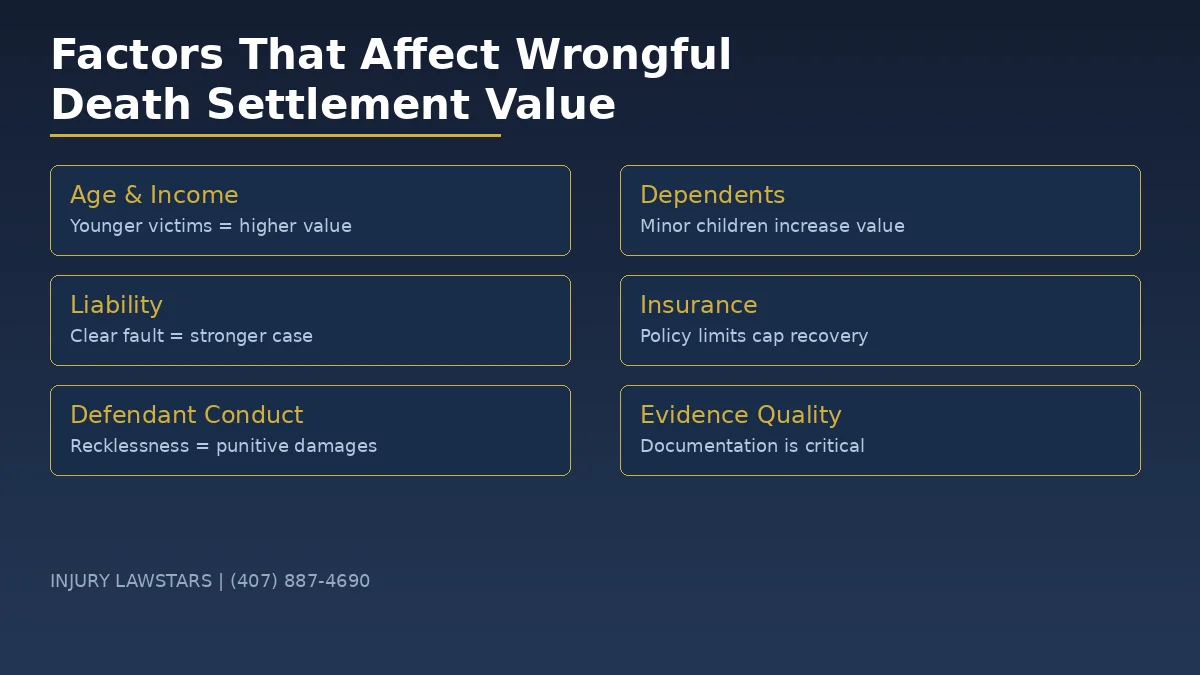
Your Loved One’s Age and Earning Potential
Younger victims with higher income and longer expected working lives typically generate larger settlements. A 35-year-old earning $80,000 per year with young children represents significantly more in lost future income than an 80-year-old retiree. Courts and insurance adjusters calculate the present value of decades of lost earnings, benefits, and household services.
The Number of Surviving Family Members
Cases involving minor children who depended on the deceased for financial support, parental guidance, and daily care tend to result in higher settlements. The more dependents affected, the greater the total recoverable damages.
The Strength of Evidence in Your Case
Clear, undisputed liability, such as a drunk driver running a red light, strengthens the case significantly. When fault is contested or the deceased shared some responsibility, Florida’s modified comparative fault system may reduce compensation. Under current Florida law, if the deceased was more than 50% at fault, the family cannot recover damages.
How Much Insurance Coverage Is Available?
The defendant’s insurance policy limits often cap the practical recovery. A negligent driver with only $10,000 in liability coverage presents a very different situation than a trucking company with a $5 million commercial policy. Multiple defendants or umbrella policies can increase the available pool of compensation.
The Reality of Florida’s Minimum Insurance Limits
Unfortunately, Florida’s insurance laws can present a significant hurdle for grieving families. The state does not mandate that drivers carry bodily injury liability coverage—the very insurance that would pay for your family’s loss. Even when a driver has this coverage, it might only be the minimum of $10,000. This amount is tragically inadequate when you’re facing a lifetime of lost income, companionship, and support. It highlights the stark difference between a claim against an individual in a car accident and a case involving a commercial truck with a multi-million dollar policy. An experienced lawyer’s first job is to uncover all possible sources of recovery, including your own uninsured/underinsured motorist (UIM) coverage and any other at-fault parties.
Calculating Financial vs. Emotional Losses
Cases with well-documented economic losses, including high income, extensive medical bills before death, and significant household service value, tend to produce higher settlements. Non-economic damages like loss of companionship and mental suffering are inherently subjective and vary based on the jury pool and jurisdiction.
Using the “Multiplier Method” to Value Emotional Damages
While financial losses can be calculated with receipts and pay stubs, putting a number on emotional suffering is far more complex. There is no set formula, but attorneys often use the “multiplier method” as a starting point to value these non-economic damages. This approach involves adding up all the specific economic damages—like lost income and medical bills—and multiplying that total by a number, typically between 1.5 and 5. The more severe and devastating the circumstances, the higher the multiplier. For example, a death caused by the extreme negligence of a drunk driver would likely warrant a higher multiplier than a case of simple carelessness. This calculation helps create a reasonable demand for settlement negotiations, supported by powerful testimony from family and friends who can speak to the true depth of the loss.
Does Florida Cap Non-Economic Damages?
You may have heard about legal “caps” limiting the amount of money families can receive for pain and suffering. While Florida did have such caps for medical malpractice cases in the past, the legal landscape has changed significantly. The Florida Supreme Court has since ruled these caps unconstitutional. This means that for the vast majority of wrongful death cases in Florida—including those arising from car accidents, workplace incidents, or even medical malpractice—there is no longer a limit on non-economic damages. A jury has the authority to award an amount it deems fair and just based on the evidence presented. This makes it incredibly important to build a compelling case that clearly demonstrates the profound impact the loss has had on the surviving family members.
The At-Fault Party’s Level of Negligence
Gross negligence, recklessness, or intentional misconduct can open the door to punitive damages in Florida. Drunk driving fatalities, for example, frequently involve punitive damage claims that can substantially increase the total recovery beyond compensatory amounts.
Every wrongful death case is different. Call Injury LawStars at (407) 887-4690 for a free case evaluation to understand what your family’s claim may be worth.
Who Can File a Wrongful Death Lawsuit in Florida?
Under the Florida Wrongful Death Act (F.S. §768.16-768.26), only the personal representative of the deceased person’s estate can file a wrongful death lawsuit. This person is either named in the deceased’s will or appointed by the probate court.
The personal representative files on behalf of the estate and all eligible statutory survivors, who include:
- Surviving spouse: Can recover damages for loss of companionship, protection, and mental pain and suffering
- Minor children (under age 25 per the Act): Can recover for lost parental companionship, instruction, guidance, and mental pain and suffering
- Adult children: May recover for mental pain and suffering if there is no surviving spouse
- Parents: Can recover for mental pain and suffering in the death of a minor child, or an adult child if no other survivors exist
- Dependent blood relatives or adoptive siblings: Those who were partly or wholly dependent on the deceased for support may qualify
Each survivor category has different rights and recoverable damages under Florida law. The personal representative must list all potential beneficiaries when filing the lawsuit, even if some may not ultimately receive compensation.
What Compensation Can Your Family Receive?
Florida divides wrongful death damages into two categories: damages for individual survivors and damages recoverable by the estate.
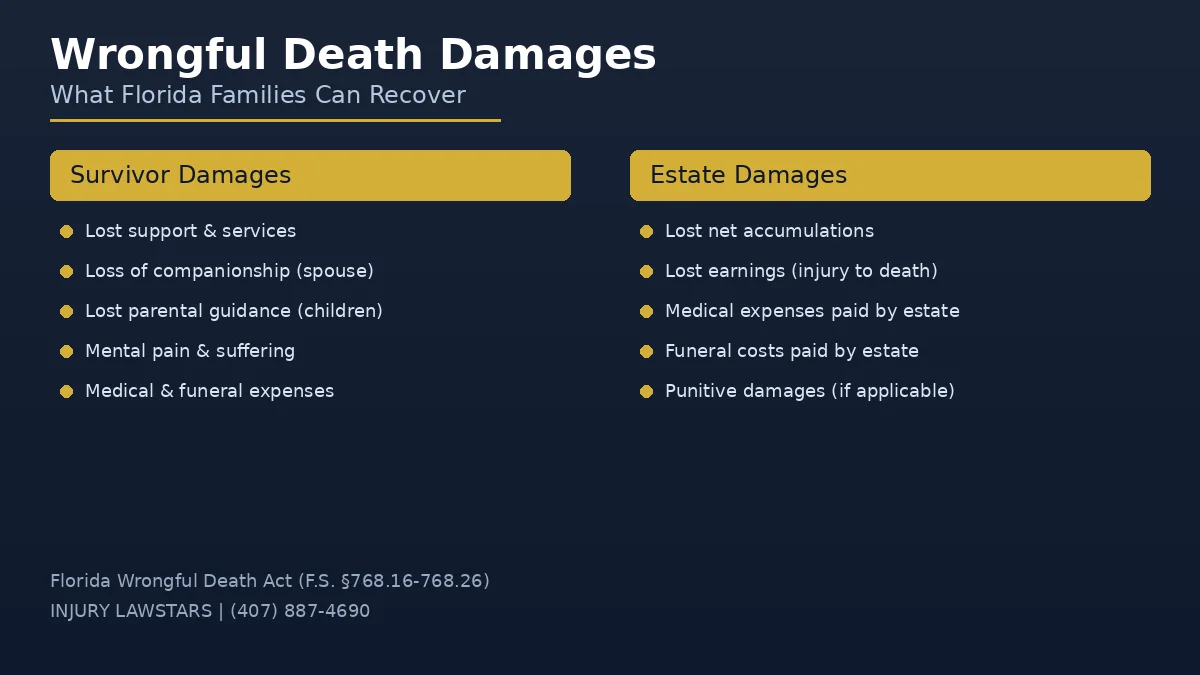
Compensation for Surviving Family Members
These are personal losses experienced by each eligible survivor:
- Lost support and services: The financial value of income, benefits, and household services the deceased would have provided
- Loss of companionship and protection (spouse)
- Loss of parental companionship, instruction, and guidance (minor children)
- Mental pain and suffering (varies by survivor type and whether other survivors exist)
- Medical bills and funeral expenses paid by the survivor
Compensation Paid to the Deceased’s Estate
The estate may recover:
- Lost net accumulations: The income the deceased would have saved and left as part of their estate after personal expenses
- Lost earnings: From the date of injury to the date of death
- Medical and funeral expenses paid by the estate
Punishing Negligence: When Punitive Damages Apply
In cases involving intentional misconduct, gross negligence, or recklessness (such as drunk driving fatalities), the court may award punitive damages. These are designed to punish the defendant and deter similar behavior, and they can significantly increase the total settlement or verdict amount.
It is worth noting that most wrongful death settlement compensation is not taxable under federal law, as it compensates for physical injuries. However, portions allocated to punitive damages or interest may be subject to taxation. Consult with a tax professional regarding your specific situation.
What Is the Statute of Limitations for Wrongful Death in Florida?
Florida imposes a strict deadline: you have two years from the date of death to file a wrongful death lawsuit under Florida Statute §95.11(4)(d).
This deadline is firm. If you miss it, the court will almost certainly dismiss your case, regardless of how strong the evidence is.
Limited exceptions exist in certain circumstances:
- Medical malpractice cases: A discovery rule may apply when negligence was not immediately apparent, but even then, an outer limit of four years from the date of death applies
- Fraud or concealment: If the defendant actively concealed their wrongful conduct, the clock may start from the date of discovery
- Government entity claims: Claims against state or local government may require earlier notice (often within 3-6 months)
The two-year window sounds like enough time, but wrongful death investigations require gathering medical records, expert opinions, witness statements, and financial documentation. Starting early gives your attorney the best chance to build a strong case.
How Long Does a Wrongful Death Settlement Take?
Most wrongful death cases in Florida settle within 6 months to 2 years. However, the timeline depends on several factors:
- Complexity of the case: Medical malpractice cases often take longer due to pre-suit investigation requirements and expert testimony
- Number of defendants: Multiple at-fault parties can extend negotiations
- Insurance company cooperation: Some insurers negotiate in good faith; others delay and force litigation
- Whether litigation is necessary: Cases that go to trial can take 2-4 years or more, especially with appeals
- Discovery and investigation: Gathering evidence, deposing witnesses, and hiring experts takes time
The typical timeline looks like this:
| Phase | Typical Duration |
|---|---|
| Initial investigation and case evaluation | 1 – 3 months |
| Filing the lawsuit and discovery | 3 – 12 months |
| Mediation and settlement negotiations | 1 – 6 months |
| Trial (if no settlement reached) | Additional 6 – 18 months |
While faster resolution is often better for grieving families, rushing to settle can result in far less compensation than the case deserves. An experienced attorney balances the need for timely resolution with maximizing the settlement value.
Why Insurance Companies Often Prefer to Settle
While it might feel like you’re in for a long court battle, most wrongful death cases end in a settlement. Insurance companies are for-profit businesses, and their decisions are driven by financial calculations, not compassion. Going to trial is a massive gamble for them. The costs associated with litigation, including high legal fees, expert witness payments, and court expenses, can be enormous. More importantly, a trial introduces uncertainty. A jury in Lake County or Marion County might sympathize with a grieving family and award a verdict that far exceeds what the insurer could have paid in a settlement. Avoiding that financial risk and unpredictability is a powerful motivator for them to resolve the case beforehand.
Beyond the direct costs, insurance companies are deeply concerned with their public image. A trial can generate negative publicity, painting the company as an entity that refuses to help a family who lost a loved one in a tragic car accident. This kind of press in communities like The Villages or Ocala can damage their brand and drive away customers. Settling a case quietly keeps the dispute out of the public eye. However, this doesn’t mean they will offer a fair amount from the start. Their initial strategy often involves making a lowball offer, hoping your family’s financial and emotional distress will lead you to accept less than you deserve. This is precisely why having an experienced attorney is critical to level the playing field.
Insurance Company Tactics to Lower Your Settlement
Insurance companies are businesses focused on their bottom line. In wrongful death cases, they commonly use these tactics to reduce what they pay:
Watch Out for Quick, Lowball Offers
Insurers often extend a quick settlement offer shortly after the death, hoping grieving families will accept before fully understanding the value of their claim. These initial offers are almost always significantly below what the case is worth.
Why You Shouldn’t Give a Recorded Statement
Insurance adjusters may ask family members for recorded statements, framing it as routine. In reality, they are looking for anything that can be used to reduce liability or minimize damages. You are not required to provide a recorded statement to the at-fault party’s insurer.
Shifting the Blame to Your Loved One
Under Florida’s modified comparative fault system, any percentage of fault attributed to the deceased directly reduces the settlement. Insurers aggressively argue that the deceased was partially responsible to lower their payout.
Using Delay Tactics to Wear You Down
Extended delays in responding to demands, requesting unnecessary documentation, and dragging out negotiations are designed to pressure families into accepting less. Families under financial stress from lost income and mounting bills may feel forced to settle quickly.
Downplaying Your Pain and Suffering
Insurers often challenge the value of loss of companionship, mental pain and suffering, and lost parental guidance. They may argue these damages are speculative or exaggerated, even when the emotional toll on the family is severe.
Having an experienced wrongful death attorney levels the playing field. Your lawyer can counter these tactics with strong evidence, expert testimony, and a credible threat of taking the case to trial.
How an Attorney Maximizes Your Wrongful Death Settlement
Wrongful death cases are among the most complex personal injury claims. An experienced attorney provides critical advantages:
- Accurate case valuation: An attorney accounts for all current and future economic losses, non-economic damages, and potential punitive damages to ensure you do not settle for less than your case is worth
- Evidence preservation: Critical evidence like surveillance footage, accident scene evidence, and electronic data can be lost or destroyed without prompt legal action
- Expert resources: Wrongful death attorneys work with economists, medical experts, accident reconstructionists, and life care planners who strengthen the case
- Insurance negotiation experience: Attorneys who regularly handle wrongful death cases understand insurer tactics and know how to counter them effectively
- Trial readiness: Insurance companies offer better settlements when they know your attorney is prepared and willing to go to trial
At Injury LawStars, Attorney Katie Miller was once an injury victim herself. That personal experience drives her commitment to fighting for families who are dealing with loss and uncertainty. The firm operates on a contingency fee basis, meaning there are no upfront costs and no fees unless you recover compensation.
If you lost a loved one due to someone else’s negligence, call Injury LawStars at (407) 887-4690 for a free case review. You deserve an attorney who understands your pain and will fight for the full value of your claim.
Risks to Avoid During the Settlement Process
When you’re grieving and facing financial pressure, it’s easy to fall for things that promise quick answers or immediate cash. Unfortunately, some of these “solutions” can seriously harm your case and reduce the compensation your family ultimately receives. Insurance companies are not the only ones with tactics that can hurt your claim; certain third-party services prey on vulnerable families. Knowing what to watch out for is just as important as knowing what to fight for. Be cautious of anything that promises a simple fix to a complex situation, as these often come with hidden costs that can jeopardize your family’s financial future.
The Problem with Online Settlement Calculators
You’ve probably seen them: websites promising to calculate your wrongful death settlement value in just a few clicks. It’s tempting to use them when you’re desperate for answers, but these tools are misleading at best and harmful at worst. As legal research confirms, online calculators are notoriously inaccurate because they can’t possibly account for the unique factors of your case. They don’t know the strength of your evidence, the specific insurance limits involved, or the nuances of how a jury in Lake County or The Villages might value non-economic damages. Often, these sites are just designed to capture your personal information for marketing purposes. The only way to get a realistic valuation of your claim is to discuss the specific details with an experienced wrongful death attorney who can analyze every factor that applies to your family’s situation.
The Dangers of “Settlement Loans”
When bills are piling up and income is lost, the idea of a “settlement loan” or “legal funding advance” can sound like a lifeline. These companies offer you cash now in exchange for a portion of your future settlement. However, this is not a traditional loan; it’s a high-risk financial product with devastatingly high interest rates, often ranging from 27% to 60%. This means a significant chunk of your family’s compensation will go directly to the loan company, not to you. For example, a $10,000 advance could easily require you to pay back $15,000 or more from your final settlement. Before ever considering one of these loans, talk to your attorney about the financial strain you’re under. At Injury LawStars, we handle cases on a contingency fee basis, so you won’t have to worry about upfront legal fees, which can help ease some of the immediate financial burden.
How Are Wrongful Death Settlements Paid Out?
Once a wrongful death settlement is reached, the personal representative distributes the funds among eligible survivors. Florida law requires that distribution be fair and equitable, and courts often oversee the process to ensure proper allocation.
Settlements can be structured in two ways:
- Lump sum payment: The entire settlement amount is paid at once. This gives families immediate access to funds but requires careful financial planning.
- Structured settlement: Payments are spread over time, often through an annuity. This can provide long-term financial security, especially when minor children are involved.
When minor children are beneficiaries, Florida courts typically require that their portion be placed in a protected account or structured settlement until they reach the age of majority. The personal representative may need to seek court approval for the distribution plan to protect the interests of all beneficiaries.
Frequently Asked Questions About Wrongful Death Settlements in Florida
Is there a “typical” settlement amount in Florida?
The average varies widely, but most Florida wrongful death settlements range from $250,000 to over $5 million. The median for non-medical cases is approximately $750,000. Medical malpractice death cases often exceed $1 million. Your specific settlement depends on factors like the victim’s age, income, number of dependents, and the strength of liability evidence.
Are wrongful death settlements taxable in Florida?
Most wrongful death settlement compensation is not taxable under federal law because it compensates for physical injury or death. However, portions allocated to punitive damages or pre-judgment interest may be subject to federal income tax. Florida has no state income tax. Consult a tax professional for guidance on your specific situation.
How long do I have to file a wrongful death lawsuit in Florida?
Florida has a two-year statute of limitations from the date of death. Missing this deadline almost always results in losing your right to file. Limited exceptions exist for medical malpractice discovery and fraud or concealment situations.
How are wrongful death settlements divided among family members?
The personal representative distributes the settlement among eligible survivors based on Florida law and, in many cases, court approval. Each survivor receives compensation based on their relationship to the deceased and the specific damages they experienced, such as lost support, lost companionship, or mental pain and suffering.
Can I file a wrongful death claim if there was no criminal conviction?
Yes. A wrongful death lawsuit is a civil action with a lower burden of proof than a criminal case. You must prove negligence by a “preponderance of the evidence” (more likely than not), whereas criminal cases require proof “beyond a reasonable doubt.” Many successful wrongful death claims proceed even without criminal charges.
What if my loved one was partially at fault?
Florida uses a modified comparative fault system. If the deceased was partially responsible, the settlement is reduced by their percentage of fault. However, if the deceased was more than 50% at fault, the family cannot recover any damages under current Florida law (HB 837, effective March 2023).
Understanding Deductions: A Settlement Payout Example
It’s important to understand that the final settlement amount is not what you will receive in your bank account. Several deductions are made first. Let’s use a hypothetical $100,000 settlement to see how this works. The first deduction is for attorney’s fees. Most personal injury firms, including Injury LawStars, work on a contingency fee basis, which means you pay nothing unless we win your case. This fee is typically a percentage of the settlement, often between 33.3% and 40%. Using 33.3%, the fee would be $33,333. Next, case costs are deducted. These are the expenses paid to build your case, such as court filing fees, expert witness fees, and deposition costs. After these deductions, the remaining funds are used to pay any outstanding medical liens.
Paying Back Medical Liens
After your attorney’s fees and case costs are paid, the next step is to resolve any medical liens. A lien is a legal claim for repayment against your settlement funds. If your loved one received medical care for their injuries before passing away, the hospitals, doctors, or ambulance services may have a lien for their unpaid bills. Similarly, if a health insurance company, Medicare, or Medicaid paid for any treatment, they have a legal right to be reimbursed from the settlement. An experienced attorney does more than just pay these bills; they actively negotiate with these entities to reduce the lien amounts. Lowering these liens directly increases the net amount of money your family gets to keep, which is a critical part of maximizing your recovery.
Timeline for Receiving Your Funds After an Agreement
Once you sign the settlement agreement, the final check doesn’t arrive overnight. Typically, you can expect to receive your funds within 30 to 45 days. This period is necessary for several administrative steps to take place. First, the defendant’s insurance company must process and mail the settlement check to your attorney’s office. Your attorney then deposits this check into a special trust account, as required by law. During this time, your legal team will finalize negotiations on all medical liens and other bills. Once the check has cleared and all liens are resolved, your attorney will deduct their fees and costs, prepare a final settlement statement for your review, and issue the net proceeds to the estate’s personal representative for distribution.
Related Articles
- Wrongful Death Settlements in Florida | What to Expect
- Wrongful Death Claims in Florida | Injury LawStars
- Are Personal Injury Settlements Taxable in Florida? | Injury LawStars
About the Author
Katie Miller, Esq.
Managing Partner · Injury LawStars
Attorney Katie Miller was once an injury victim herself. After a car accident in 2016 that required spinal surgery and a 13-month recovery, she turned her experience into a mission: fighting for people who are hurting. With 17+ years of legal experience and over \$45 million recovered for clients, Katie brings both professional expertise and personal understanding to every case.