March 31, 2026
Your Guide to a Florida Rideshare Accident Claim

A rideshare accident in Florida isn’t just another car accident; it’s a complex legal event governed by a specific state law, Florida Statute 627.748. This law dictates who is responsible and how much insurance coverage is available, but it all depends on whether the driver was off-duty, waiting for a ride, or actively transporting a passenger. These distinctions create layers of complexity that insurance companies often use to their advantage. This article cuts through the legal jargon to explain exactly how these cases work, who can be held liable, and what you need to know to secure fair compensation.
Your Guide to Florida Rideshare Accidents
Rideshare accidents involving Uber and Lyft are rising across Florida, and the legal process for filing a claim is more complicated than a standard car accident. Insurance coverage depends on what the driver was doing at the time of the crash, with three distinct phases of coverage under Florida Statute 627.748. During an active ride, Uber and Lyft carry up to $1 million in liability coverage. Florida’s no-fault insurance system, the 14-day PIP rule, and the two-year statute of limitations all affect your ability to recover compensation. If you were injured as a passenger, driver, or third party in a rideshare accident in Florida, understanding these rules is the first step toward protecting your rights.
Contact Injury LawStars today for a free consultation or call (407) 887-4690. We fight for rideshare accident victims across Florida on a contingency basis — you pay nothing unless we win.
Why a Rideshare Accident Isn’t Just Another Car Wreck
When a standard car accident happens in Florida, the process is relatively straightforward: you file a claim with the at-fault driver’s insurance or your own PIP coverage. Rideshare accidents involving Uber or Lyft add layers of complexity because multiple insurance policies may apply, the driver’s employment status is contested, and the rideshare company’s coverage changes depending on the driver’s activity at the time of the crash.
Uber and Lyft classify their drivers as independent contractors, not employees. This distinction matters because it limits the rideshare company’s direct liability for driver negligence under Florida law. However, Florida Statute 627.748 requires these companies to maintain specific insurance coverage that protects passengers and third parties, regardless of the driver’s employment classification.
If you have been involved in a rideshare accident in Florida, the single most important factor determining your available insurance coverage is what the driver was doing with the rideshare app when the crash occurred. This creates what attorneys call the “three phases” of rideshare insurance coverage.
How Does Uber & Lyft Insurance Work in Florida?
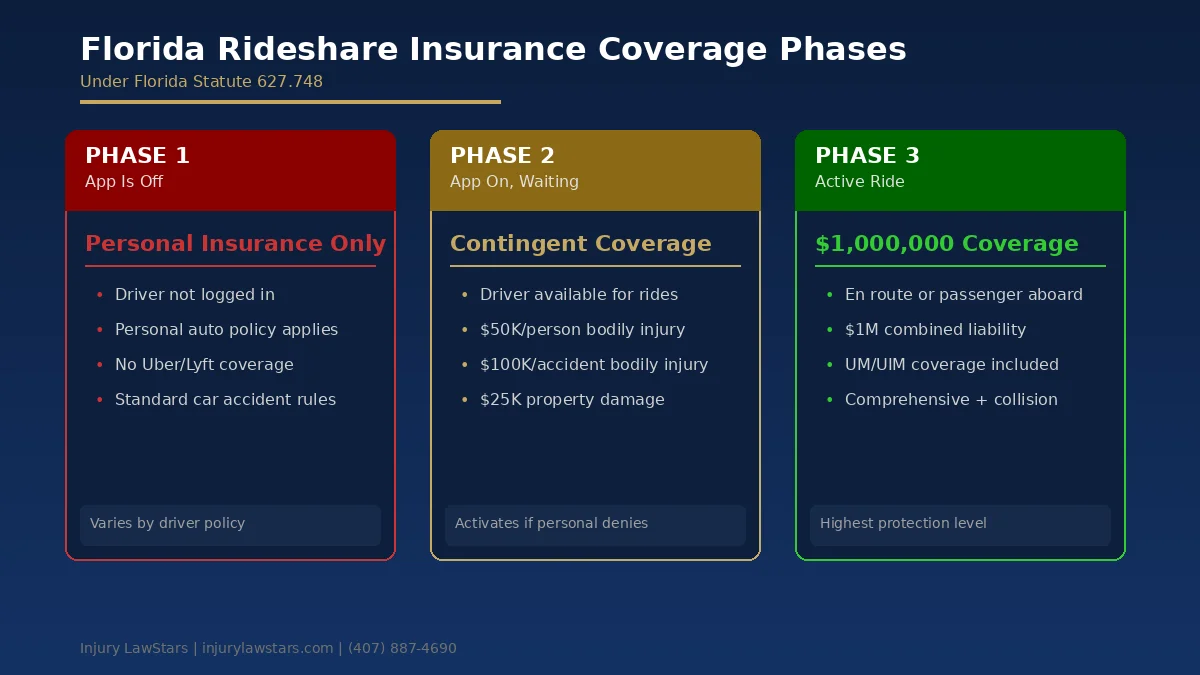
Florida Statute 627.748 establishes three distinct insurance coverage phases for rideshare drivers. Each phase carries different coverage limits and determines which insurance policy responds to your claim. Understanding these phases is essential for any rideshare accident claim.
Phase 1: When the Driver’s App is Off
When an Uber or Lyft driver is not logged into the rideshare app, they are considered off-duty. Only the driver’s personal auto insurance policy applies. Neither Uber nor Lyft provides any coverage during this phase. If you are hit by someone who happens to drive for a rideshare company but was off-duty at the time, the claim is handled like any other car accident in Florida.
Phase 2: While Waiting for a Passenger
Once the driver logs into the Uber or Lyft app and is available to accept rides, Florida law requires the rideshare company to provide contingent liability coverage. The minimum coverage during this phase includes:
- $50,000 per person for bodily injury
- $100,000 per accident for bodily injury
- $25,000 for property damage
This coverage only activates if the driver’s personal auto insurance denies the claim or does not provide sufficient coverage. Many personal auto policies exclude coverage for commercial driving activity, which makes the rideshare company’s contingent coverage critically important during this phase.
Phase 3: During an Active Ride
This phase provides the highest level of protection. Once a driver accepts a ride request and is en route to pick up a passenger, or when a passenger is in the vehicle, both Uber and Lyft are required to carry:
- $1,000,000 in combined single-limit liability coverage
- Uninsured/underinsured motorist (UM/UIM) coverage
- Comprehensive and collision coverage (subject to a deductible)
The $1 million policy limit during active rides is significantly higher than most personal auto insurance policies and provides substantial protection for injured passengers and third parties. This is one of the primary reasons rideshare accident claims involving active rides can result in meaningful compensation for victims.
Who’s at Fault in a Florida Rideshare Accident?
Determining liability in a rideshare accident requires identifying every party whose negligence contributed to the crash. Multiple parties can potentially be held responsible:
When the Rideshare Driver is Liable
If the Uber or Lyft driver caused the accident through careless or reckless driving, the driver bears personal liability. Common causes include distracted driving (checking the app for ride requests), speeding, running red lights, drowsy driving during long shifts, or driving under the influence.
Can You Hold Uber or Lyft Responsible?
While Uber and Lyft generally avoid direct liability by classifying drivers as independent contractors, the companies can be held responsible in certain situations. If the company failed to conduct adequate background checks, allowed a driver with a suspended license or serious traffic violations to remain on the platform, or negligently maintained the app in a way that distracted the driver, the company may share liability.
The “Common Carrier” Standard
A pivotal Florida court ruling is changing how rideshare companies are viewed under the law. A judge designated Uber as a “common carrier,” a classification typically reserved for public transport like buses and taxis. This is significant because common carriers are held to a much higher standard of care for passenger safety. It means a company like Uber or Lyft can be held directly responsible for a driver’s negligence, challenging their long-held argument that they are merely tech platforms connecting independent contractors with riders. This legal precedent strengthens the position of those injured in rideshare accidents. It opens a new avenue for holding the company accountable, not just the driver, for all types of personal injury claims. This development could impact cases for victims in communities across Central Florida, from Clermont and Leesburg to Ocala and The Villages.
Liability for Other Drivers Involved
Another motorist may have caused or contributed to the rideshare accident. In that case, the third-party driver and their insurance become part of the claim. Under Florida’s modified comparative negligence rule (Florida Statute 768.81), each party is responsible for their percentage of fault.
Could Someone Else Be at Fault?
Depending on the circumstances, liability could extend to vehicle manufacturers (if a defective part caused the crash), government entities (if dangerous road conditions contributed), or employers (if a commercial vehicle was involved). An experienced accident attorney will investigate all potential sources of liability to maximize your recovery.
Don’t navigate rideshare insurance claims alone. Call Injury LawStars at (407) 887-4690 for a free case review with our Florida personal injury team.
Does Florida’s No-Fault Law Apply to Your Claim?
Florida is a no-fault insurance state, which means that after any vehicle accident, including rideshare crashes, you must first turn to your own Personal Injury Protection (PIP) coverage for initial medical expenses and lost wages, regardless of who was at fault.
PIP coverage in Florida pays up to $10,000 for medical bills and 60% of lost wages. However, there is a critical deadline: you must seek medical treatment within 14 days of the accident to maintain your PIP eligibility under Florida Statute 627.736. Missing this deadline can forfeit your right to PIP benefits entirely.
If your injuries meet Florida’s “serious injury” threshold, which includes significant and permanent loss of an important bodily function, permanent injury, scarring or disfigurement, or death, you can step outside the no-fault system and pursue a liability claim against the at-fault party for full damages, including pain and suffering. To learn more about how Florida’s insurance system works, read our guide on Florida’s no-fault insurance and PIP.
PIP Coverage for Rideshare Passengers
If you were a passenger in an Uber or Lyft during an accident in areas like Lake County, Marion County, or Sumter County, you might be surprised to learn that your own car insurance is the first place you’ll turn for help. Under the state’s no-fault system, your Personal Injury Protection (PIP) coverage is your primary source for initial medical bills and lost wages, no matter who caused the crash. This policy provides up to $10,000 for medical care and covers 60% of your lost income. The most important thing to remember is the 14-day rule: you must see a doctor within two weeks of the accident to use your PIP benefits. Waiting longer could mean losing your right to this coverage entirely, which is why seeking prompt medical attention after any car accident is so critical.
First Steps After a Florida Rideshare Accident
The steps you take immediately after a rideshare accident can significantly impact your ability to recover compensation. Follow these steps to protect your health and your legal rights:
- Call 911 and ensure everyone’s safety. Move to a safe location if possible. A police report is essential evidence for your claim.
- Seek medical attention within 14 days. Even if you feel fine, some injuries take time to appear. This also preserves your PIP eligibility.
- Screenshot your ride details in the app. This is critical and unique to rideshare accidents. Capture the driver’s name, trip details, route, and fare information before it disappears from the app.
- Report the accident through the Uber or Lyft app. This creates an official record and triggers the rideshare company’s insurance process.
- Document the scene. Take photos and videos of vehicle damage, injuries, road conditions, traffic signals, and skid marks.
- Collect contact and insurance information from all drivers involved, including witnesses.
- Do not give recorded statements to insurance adjusters before speaking with an attorney. Anything you say can be used to reduce your claim.
- Contact a rideshare accident attorney. An experienced lawyer can protect your rights from the start and handle communications with multiple insurance companies.
Common Mistakes to Avoid After a Rideshare Accident
After a crash, you’re dealing with injuries, stress, and a disrupted routine. It’s a vulnerable time, and insurance companies know this. They often count on victims making simple mistakes that can weaken their claims. Being aware of these common pitfalls is your first line of defense. What you do—and don’t do—in the days and weeks following a rideshare accident can have a lasting impact on your financial recovery. Protecting your claim means being mindful of your actions, especially when it comes to social media and communicating with insurance adjusters.
Posting on Social Media
It might seem harmless to post an update about your accident or share photos with friends and family, but you should resist the urge. Insurance adjusters are trained to look for any reason to dispute your claim, and they will absolutely scrutinize your social media profiles. A simple photo of you smiling at a family gathering in Ocala or a post about taking a short walk in a park in Mount Dora could be twisted and used as “evidence” that your injuries aren’t as severe as you claim. The best policy is to avoid posting anything about the accident, your injuries, or your daily activities until your case is resolved. It’s also wise to ask friends and family to refrain from posting photos of you or tagging you in their posts.
Accepting a Quick Settlement Offer
Soon after the accident, you will likely receive a call from an insurance adjuster offering a quick settlement. This offer might seem tempting, especially as medical bills start arriving. However, these initial offers are almost always far less than what your claim is actually worth. Insurance companies are businesses, and their goal is to pay out as little as possible. They may pressure you to accept before you know the full extent of your injuries or future medical needs. Once you accept a settlement, you forfeit your right to seek any further compensation for that accident, even if your condition worsens. Before you even consider an offer, you should speak with an experienced attorney who understands the complexities of Florida car accident claims and can fight for the full compensation you deserve.
Common Injuries from Uber and Lyft Accidents
Rideshare passengers are particularly vulnerable in crashes because they are often seated in the back seat without the same safety protections as front-seat occupants. Common injuries in Florida Uber and Lyft accidents include:
- Whiplash and soft tissue injuries from sudden impact
- Traumatic brain injuries (TBI) from head impacts against windows, seats, or other surfaces. Learn more about brain injury claims in Florida.
- Spinal cord injuries and herniated discs that can cause chronic pain or paralysis
- Broken bones and fractures to arms, legs, ribs, and facial bones
- Internal bleeding and organ damage that may not be immediately apparent
- Lacerations and burns from broken glass or deployed airbags
- Psychological trauma including PTSD, anxiety, and depression
In the most tragic cases, rideshare accidents can result in wrongful death, leaving families to cope with devastating loss while navigating complex insurance claims.
What Determines Your Florida Rideshare Settlement?
Every rideshare accident case is unique, and settlement amounts vary widely based on several factors:
- Severity and permanence of injuries: More serious injuries with long-term consequences generally result in higher settlements. Cases involving traumatic brain injury, spinal cord damage, or permanent disability carry the highest values.
- Which insurance phase applies: Claims during Phase 3 (active ride) have access to the $1 million policy, while Phase 2 claims are limited to lower coverage amounts.
- Medical expenses: Both past and projected future medical costs, including surgery, rehabilitation, therapy, and ongoing care.
- Lost income and earning capacity: Wages lost during recovery and any reduction in your ability to earn income in the future.
- Comparative fault: Under Florida’s modified comparative negligence standard, your compensation is reduced by your percentage of fault. If you are found more than 50% at fault, you cannot recover damages.
- Pain and suffering: Physical pain, emotional distress, loss of enjoyment of life, and impact on your daily activities.
- Insurance policy limits: The total available insurance coverage from all liable parties caps the realistic recovery amount.
- Evidence quality: Strong documentation, including the ride app data, police reports, medical records, and witness statements, supports higher settlements.
For more information about how settlements are calculated in personal injury cases, see our guide on average personal injury settlements.
Injured in an Uber or Lyft accident? Get the compensation you deserve. Call Injury LawStars at (407) 887-4690 today for your free consultation. No fees unless we win.
Potential Settlement Ranges Based on Injury Severity
While it’s impossible to predict an exact settlement amount, looking at typical ranges can help you understand what might be possible. These figures are estimates and depend heavily on the specific details of your accident, the available insurance coverage, and the quality of your legal representation. The value of a claim is directly tied to the severity of the injuries and their long-term impact on your life. An experienced attorney can evaluate these factors to build a strong case that reflects the true cost of your accident.
Minor Injuries
For minor injuries like whiplash, severe bruising, or minor cuts, settlements typically range from $10,000 to $50,000. This amount generally covers initial emergency room visits, a few follow-up appointments with doctors or physical therapists, and compensation for a short period of missed work. Even if your injuries seem minor at first, it’s crucial to get a full medical evaluation to ensure there are no underlying issues that could worsen over time. This documentation is essential for proving your damages and securing fair compensation for your medical care.
Moderate Injuries
Cases involving moderate injuries, such as broken bones, herniated discs, or concussions, often see settlements between $50,000 and $200,000. These injuries require more extensive medical treatment, potentially including surgery, prolonged physical therapy, and prescription medications. The higher settlement range reflects the greater medical costs, longer recovery periods, and more significant impact on your ability to work and enjoy daily activities. These claims require careful calculation of both current and future medical expenses to ensure you are fully covered.
Severe Injuries
When an accident results in severe, life-altering injuries, settlements can range from $200,000 to over $1,000,000. These catastrophic cases involve injuries like traumatic brain injuries, spinal cord damage leading to paralysis, or severe burns. The compensation must account for a lifetime of medical care, loss of all future earning capacity, permanent disability, and profound pain and suffering. These complex claims require a deep investigation to calculate the full, long-term financial and personal costs to ensure your future is secure.
How Florida Law Limits Medical Compensation
Florida’s no-fault insurance system creates specific rules for how you get your initial medical bills paid. Your own Personal Injury Protection (PIP) coverage is your first source of benefits, paying up to $10,000 for medical care and 60% of lost wages. However, there’s a strict deadline: under Florida Statute 627.736, you must seek medical treatment within 14 days of the accident to use your PIP benefits. If you miss this window, you could lose your right to this coverage entirely, making it a critical first step after any crash.
To recover compensation beyond your PIP limits, including damages for pain and suffering, your injuries must meet Florida’s “serious injury” threshold. This means you must have suffered a permanent injury, significant and permanent scarring or disfigurement, or the permanent loss of an important bodily function. Proving your injury meets this threshold is a key legal hurdle that allows you to step outside the no-fault system and file a liability claim against the at-fault driver for the full extent of your damages.
Typical Timelines for Resolving a Claim
Most rideshare accident cases in Florida settle within six months to a year. However, this timeline can change based on the complexity of your case. If liability is clear and the injuries are straightforward, the claim may resolve relatively quickly. Cases involving severe injuries, disputes over who was at fault, or multiple insurance companies can take longer, sometimes requiring a lawsuit to be filed to secure fair compensation. The legal landscape for rideshare accidents is also constantly changing, which can add time to the process.
Patience is often necessary to ensure you receive the full value of your claim. Settling too quickly, before the full extent of your injuries and future medical needs are known, can leave you with unpaid bills down the road. An experienced attorney can manage the legal deadlines and negotiations, allowing you to focus on your recovery. Whether you’re in Ocala, Leesburg, or The Villages, having a legal team to handle the process ensures your rights are protected every step of the way.
Who Can File a Rideshare Accident Claim in Florida?
Rideshare accidents can affect different people in different ways, and the claims process varies depending on your role at the time of the crash.
Filing a Claim as a Passenger
As a passenger, you are almost never at fault for the accident. This puts you in a strong legal position. You can file a claim against the at-fault driver’s insurance, the rideshare company’s insurance (based on the applicable phase), or both. During an active ride (Phase 3), you have access to the $1 million policy, which provides substantial coverage for serious injuries.
What Are Your Rights as a Driver?
If you drive for Uber or Lyft and are injured in a crash caused by another driver, you can pursue a claim against the at-fault driver. Your available coverage depends on which phase you were in at the time of the accident. During Phase 3, you are covered by the rideshare company’s $1 million policy, including UM/UIM and comprehensive/collision coverage.
Claims for Other Drivers and Pedestrians
If you were driving another vehicle, cycling, or walking when a rideshare driver hit you, you can file a claim against the rideshare driver and potentially against the rideshare company’s insurance. The coverage available depends on the driver’s app status at the time of the crash.
Florida’s Rideshare Laws: What You Need to Know
Florida has established specific regulations for rideshare companies under Florida Statute 627.748 and related statutes. Key provisions include:
- Mandatory insurance coverage at specified minimums for each phase of driver activity
- Background check requirements for all rideshare drivers, including criminal history and driving record checks
- Zero-tolerance drug and alcohol policies for drivers while on the platform
- Vehicle inspection requirements to ensure rideshare vehicles meet safety standards
- Fare transparency rules requiring upfront pricing or fare estimates before rides begin
- Two-year statute of limitations for personal injury lawsuits (reduced from four years under HB 837 in 2023)
These regulations are designed to protect passengers and the public. When rideshare companies or drivers fail to follow them, it can strengthen your accident claim.
The “Three Crashes in Three Years” Rule
Florida law includes a strict provision known as the “Three Crashes in Three Years” rule, which applies to all drivers, including those operating in areas like Lake County, Marion County, and Sumter County. This rule is especially relevant for rideshare drivers who spend significant time on the road. If a driver is found at fault and receives a ticket for three separate crashes within a 36-month period, they face serious consequences. According to the Suncoast Safety Council, Florida law mandates that these drivers complete a 12-hour Advanced Driver Improvement Course and four hours of behind-the-wheel training. They must fulfill these requirements within 90 days of being notified by the state to avoid having their driver’s license canceled, which can impact their ability to work and create potential liability issues for the rideshare companies they drive for.
When Should You Hire a Rideshare Accident Lawyer?
Rideshare accident claims are more complex than standard car accident cases. You are dealing with multiple insurance companies, each with their own adjusters working to minimize your payout. The rideshare company may dispute the driver’s app status. The driver’s personal insurer may deny coverage because the vehicle was being used commercially. These complications make experienced legal representation essential.
You should contact a rideshare accident attorney as soon as possible after the crash, especially if:
- You suffered injuries requiring medical treatment beyond basic first aid
- The insurance company is disputing liability or the driver’s app status
- You are receiving pressure to accept a quick settlement
- Multiple parties may be at fault
- You are unsure which insurance policies apply to your situation
- The rideshare company or its insurer has denied your claim
At Injury LawStars, Attorney Katie Miller understands the fear and frustration that comes after being injured, because she has been through it herself. That personal experience drives her commitment to fighting for every client. We handle rideshare accident claims across Florida, from Clermont and Orlando to Ocala, The Villages, Tampa, and beyond. Our firm works on a contingency basis, meaning you pay nothing unless we recover compensation for you.
The Statistical Advantage of Legal Representation
While there’s no magic formula, having an experienced attorney on your side significantly levels the playing field. Rideshare accident claims aren’t a simple one-on-one negotiation. You’re up against multiple powerful insurance companies—the rideshare company’s, the driver’s personal insurer, and potentially a third party’s—all of whom have teams of adjusters and lawyers dedicated to protecting their bottom line. Their primary goal is to pay out as little as possible. An attorney acts as your advocate, managing these complex communications and fighting back against lowball offers to ensure you pursue the full compensation you deserve for your injuries.
Navigating Challenges in Your Rideshare Claim
The path to compensation after a rideshare accident is filled with unique obstacles that rarely appear in a typical car wreck case. The core of the problem often lies in the conflict between different insurance policies and the rideshare company’s business model. For example, the driver’s personal auto insurance will almost certainly deny your claim if they discover the driver was using their vehicle for commercial purposes, like driving for Uber or Lyft. This is a standard exclusion in most personal policies, and it can leave you feeling stuck with no clear path forward.
At the same time, the rideshare company’s insurer may try to dispute which “phase” the driver was in at the time of the crash. They might argue the driver wasn’t logged into the app or wasn’t on an active trip, attempting to push liability back onto the driver’s (denied) personal policy. Proving the driver’s status requires specific evidence, like app data and trip logs, which can be difficult to obtain without legal help. These hurdles are designed to frustrate unrepresented victims and pressure them into accepting less than their claim is worth. An experienced personal injury lawyer knows how to gather the necessary evidence to overcome these challenges.
Insurance Company Tactics
Insurance companies for Uber, Lyft, and other drivers often use specific tactics to reduce their liability. Adjusters may question the exact circumstances of the accident, trying to shift blame onto you or another party. A common strategy is to dispute the status of the rideshare app at the moment of impact, as this directly affects which insurance policy and coverage limits apply. They might also request a recorded statement early on, hoping you’ll say something that unintentionally weakens your claim. Remember, their adjusters are trained negotiators working for the company, not for you. Having a lawyer handle all communications prevents you from falling into these traps.
Understanding Lyft’s Arbitration Clause
When you sign up to use Lyft, you agree to their terms of service, which often include a mandatory arbitration clause. In simple terms, this means you give up your right to have your case heard by a jury in a traditional court of law. Instead, any dispute must be resolved through a private process called arbitration. This clause also typically prevents you from joining a class-action lawsuit. While arbitration can sometimes be faster, it can also limit your potential recovery and the evidence you can present. A skilled attorney can review your case and determine the best strategy, whether that involves working within the arbitration process or finding grounds to challenge the clause itself.
Frequently Asked Questions About Rideshare Accidents in Florida
Can I sue Uber or Lyft directly after an accident in Florida?
Uber and Lyft classify their drivers as independent contractors, which generally shields them from direct vicarious liability. However, you can file a claim against the company’s insurance policy under Florida Statute 627.748. In some cases, if the company was negligent in its own right (such as failing to screen a dangerous driver), direct claims may be possible.
What is the statute of limitations for a rideshare accident claim in Florida?
You have two years from the date of the accident to file a personal injury lawsuit in Florida. This deadline was reduced from four years under HB 837, which took effect in March 2023. Additionally, you must seek medical treatment within 14 days to preserve your PIP benefits.
How much does it cost to hire a rideshare accident lawyer?
Most personal injury attorneys, including Injury LawStars, work on a contingency fee basis. This means you pay no upfront fees and owe nothing unless your attorney recovers compensation on your behalf. The initial consultation is free.
What if the rideshare driver was not at fault?
If another driver caused the accident, you can pursue a claim against that driver’s insurance. If the rideshare driver was in Phase 3 (active ride), the rideshare company’s UM/UIM coverage can also provide protection if the at-fault driver is uninsured or underinsured.
Does Florida’s comparative negligence rule apply to rideshare accidents?
Yes. Under Florida’s modified comparative negligence standard, your compensation is reduced by your percentage of fault. If you are more than 50% responsible for the accident, you cannot recover any damages. For rideshare passengers, fault is rarely an issue since you were not driving. Read more about Florida’s comparative negligence law.
Protect Your Rights After a Rideshare Accident in Florida
Rideshare accidents create a complicated web of insurance policies, liability questions, and tight legal deadlines. Whether you were a passenger, another driver, or a pedestrian, you deserve experienced legal guidance to navigate the process and fight for full compensation.
At Injury LawStars, we know what it takes to hold insurance companies accountable because Attorney Katie Miller has walked in your shoes. She was once an injury victim herself, and that firsthand experience fuels her relentless advocacy for every client. We serve rideshare accident victims throughout Florida, including Clermont, Orlando, Ocala, The Villages, Tampa, Jacksonville, and all surrounding areas.
Ready to take the first step? Contact Injury LawStars for a free, no-obligation consultation. Call (407) 887-4690 or reach out online today. Time is limited under Florida’s two-year statute of limitations, so don’t wait to protect your rights.
Key Takeaways
- Insurance coverage is tied to the driver’s app status: In Florida, the available insurance depends entirely on what the driver was doing. An active ride with a passenger unlocks a $1 million policy, but a driver simply waiting for a request has significantly less coverage.
- Your actions right after the crash matter: You must seek medical attention within 14 days to use your PIP benefits. It is also vital to screenshot your ride details in the Uber or Lyft app before the information disappears, as this is key evidence for your claim.
- Rideshare claims involve multiple parties: Unlike a standard car wreck, you will likely deal with the driver’s personal insurance and the rideshare company’s corporate insurer. An experienced attorney can manage these complex communications and fight for the compensation you deserve.
Related Articles
- Rideshare Accidents in Florida | Uber & Lyft Claims Guide
- Truck Accident Lawsuit in Florida: What Victims Need to Know
- Bicycle Accident Laws in Florida | Injury LawStars
- Golf Cart Accidents in Florida: Laws, Liability & Rights
About the Author
Katie Miller, Esq.
Managing Partner · Injury LawStars
Attorney Katie Miller was once an injury victim herself. After a car accident in 2016 that required spinal surgery and a 13-month recovery, she turned her experience into a mission: fighting for people who are hurting. With 17+ years of legal experience and over \$45 million recovered for clients, Katie brings both professional expertise and personal understanding to every case.