March 27, 2026
How a Florida Truck Accident Lawsuit Really Works

If you or a loved one has been in a serious truck accident in Florida, you know the aftermath is overwhelming. The medical bills are piling up, insurance adjusters are calling, and you’re suddenly facing one of the most complex areas of personal injury law. Truck accident claims are a different beast than typical car wrecks. They involve strict federal regulations, multiple responsible parties, and often, catastrophic injuries. This guide breaks down everything you need to know to build a strong Truck Accident Lawsuit Florida, from preserving critical evidence to understanding what your case may be worth.
Contact Injury LawStars today for a free consultation about your truck accident case. Call (407) 887-4690 to speak with Attorney Katie Miller and learn how we can fight for the compensation you deserve.
Why a Truck Accident Case Isn’t Like a Car Wreck
When a commercial truck weighing up to 80,000 pounds collides with a passenger vehicle, the result is almost always catastrophic. According to the National Highway Traffic Safety Administration (NHTSA), 5,936 people were killed in crashes involving large trucks in 2022, and approximately 71% of those fatalities were occupants of other vehicles. Florida consistently ranks among the top states for fatal truck accidents due to its high traffic volume on corridors like I-4, I-95, and the Florida Turnpike.
Truck accident lawsuits differ from standard car accident claims in several critical ways:
- Federal regulations create additional standards of care and a paper trail that can prove negligence.
- Multiple liable parties may share responsibility, including the driver, the trucking company, the vehicle manufacturer, and the cargo loading company.
- Higher insurance limits are mandated by federal law, with minimums ranging from $750,000 to $5 million depending on the cargo type.
- More severe injuries typically result in higher medical costs, longer recovery times, and greater compensation.
- Aggressive defense teams employed by trucking companies often begin investigating the scene within hours of a crash to protect their interests.
The Staggering Financial Impact of Truck Crashes
The physical and emotional toll of a truck accident is immense, but the financial fallout can be just as devastating for families in communities like Ocala, Leesburg, and The Villages. The costs extend far beyond initial hospital bills, often including long-term rehabilitation, lost income, and modifications to your home. The average cost for a truck accident where one person is injured is nearly $150,000. If the crash results in a fatality, that figure can skyrocket to over $7 million. These numbers show why it is so important to account for all current and future expenses when pursuing a claim. Without experienced legal guidance, victims may accept a settlement that falls far short of what they need to truly recover.
Higher Likelihood of Serious Injury or Fatality
Due to the sheer size and weight difference between a commercial truck and a passenger car, the occupants of the smaller vehicle almost always suffer the most severe consequences. National data confirms this sobering reality: of the 5,936 people killed in large truck crashes in a recent year, a staggering 71% were occupants of other vehicles. This disproportionate risk means victims are more likely to suffer from catastrophic injuries like traumatic brain injuries or spinal cord damage. For families in Lake County, Marion County, and Sumter County who have lost a loved one, pursuing a wrongful death claim may be the only path to holding the responsible parties accountable and securing financial stability for the future.
Which Federal Trucking Laws Affect Your Lawsuit?
The Federal Motor Carrier Safety Administration (FMCSA) enforces strict safety regulations under Title 49 of the Code of Federal Regulations that every commercial trucking company and driver must follow. When a trucking company or driver violates these regulations and causes an accident, those violations become powerful evidence in your truck accident lawsuit.
Rules on Driver Hours and Rest
Under 49 CFR Part 395, commercial truck drivers are limited to:
- 11 hours of driving after 10 consecutive hours off duty
- A mandatory 30-minute break after 8 hours of driving
- A maximum of 70 hours on duty in any 8-day period
Since December 2019, most commercial trucks are required to use Electronic Logging Devices (ELDs) to track compliance. When a truck driver exceeds these limits and causes an accident due to fatigue, the ELD data becomes critical evidence in your lawsuit.
Mandatory Truck Maintenance and Inspections
Under 49 CFR Part 396, trucking companies must maintain detailed inspection and maintenance records. Drivers must perform pre-trip and post-trip inspections, and trucks must undergo a comprehensive annual inspection. Research from the Insurance Institute for Highway Safety (IIHS) shows that approximately 42% of trucks involved in crashes had brake defects, making maintenance violations a common factor in truck accident cases.
What Makes a Truck Driver Qualified?
Under 49 CFR Part 391, every commercial driver must hold a valid Commercial Driver’s License (CDL), pass a Department of Transportation (DOT) physical every 24 months, and submit to pre-employment and random drug and alcohol testing. Hiring unqualified or impaired drivers is a frequent source of trucking company liability.
Secure Loads and Legal Weight Limits
Federal law caps the gross vehicle weight of a commercial truck at 80,000 pounds on interstate highways. Improperly loaded or overweight cargo can cause rollovers, jackknife accidents, and brake failures. When a cargo loading company fails to follow 49 CFR Part 393 securement requirements, they may share liability for the resulting crash.
Florida Laws That Impact Your Truck Accident Case
While federal regulations provide a baseline for safety, Florida’s specific state laws add another layer of complexity to your personal injury claim. These laws govern everything from insurance requirements to how fault is determined, and they can significantly influence your case’s outcome. For residents in communities like Leesburg, Ocala, or The Villages, handling a claim means dealing with a legal landscape shaped by Florida’s unique no-fault system and comparative negligence rules. An experienced Florida truck accident attorney knows how to use these state-specific statutes to build the strongest possible case and counter the tactics used by trucking companies and their insurers to minimize your compensation.
Why Florida’s Lack of a Bodily Injury Insurance Requirement Matters
Florida is a “no-fault” insurance state, so you must first turn to your own Personal Injury Protection (PIP) coverage for initial medical bills. However, PIP benefits are often exhausted quickly after a devastating truck accident. The bigger issue is that Florida law doesn’t require all drivers to carry bodily injury (BI) liability insurance. While federal law mandates high liability coverage for commercial trucks, this state rule can complicate matters. More importantly, Florida follows a modified comparative negligence rule. If you are found partially at fault, your financial recovery is reduced by your percentage of fault. If a jury decides you were more than 50% responsible, you are barred from recovering any compensation at all. This makes it essential to have a legal team that can prove the truck driver or company was primarily at fault for your truck accident injuries.
Florida’s “Three-Accident Rule” and Proving Driver Negligence
Proving a truck driver was negligent is central to any successful lawsuit, and their driving history can be powerful evidence. Florida’s “Three-Accident Rule” requires any driver who gets three crash-related tickets within 36 months to complete an advanced driver improvement course. This creates an official record of drivers with a pattern of unsafe behavior. In a lawsuit, this history can demonstrate the driver’s tendency for recklessness. It can also be used to build a case for negligent hiring against the trucking company. If the company employed a driver with a poor safety record, they may also be liable for putting a dangerous driver on the roads of Lake County or Marion County. This is just one example of how our attorneys investigate all practice areas to secure justice for our clients.
Why Do Truck Accidents Happen in Florida?
Understanding what caused your truck accident is essential to building a strong lawsuit. The most common causes include:
Tired Truckers on the Road
Despite federal Hours of Service rules, driver fatigue remains one of the leading causes of truck accidents. The FMCSA estimates that fatigue is a factor in roughly 13% of all commercial vehicle crashes. Drivers who are pressured by tight delivery schedules may falsify their ELD records or push past legal driving limits.
When Truck Drivers Aren’t Paying Attention
Texting, using GPS systems, eating, or adjusting the radio at highway speeds in an 80,000-pound vehicle creates extreme danger. Federal regulations prohibit commercial truck drivers from texting or using handheld mobile devices while driving.
Unsafe and Overloaded Trucks
Overweight trucks take significantly longer to stop and are more likely to experience tire blowouts, brake failure, and rollover accidents. Improperly secured cargo can shift during transit, causing the driver to lose control.
Brake Failure and Other Mechanical Issues
Brake failures, tire blowouts, steering malfunctions, and defective coupling devices are all preventable with proper maintenance. When a trucking company cuts corners on vehicle upkeep to save money, they put every driver on the road at risk.
Driving Under the Influence (DUI)
Commercial truck drivers are held to a stricter standard than passenger vehicle drivers. The legal blood alcohol concentration (BAC) limit for CDL holders is 0.04%, half the standard 0.08% limit. Any positive drug or alcohol test result creates significant liability for both the driver and the company that employed them.
Speeding and Aggressive Driving
A fully loaded truck traveling at highway speeds requires approximately 525 feet to come to a complete stop, nearly twice the distance of a passenger car. Speeding reduces this margin even further and is a contributing factor in many fatal truck crashes on Florida highways.
Were you or a family member hurt in a truck accident on a Florida highway? Call Injury LawStars at (407) 887-4690 today. Attorney Katie Miller has the experience to investigate your crash, identify every responsible party, and fight for maximum compensation.
Who Can Be Held Responsible for a Truck Accident?
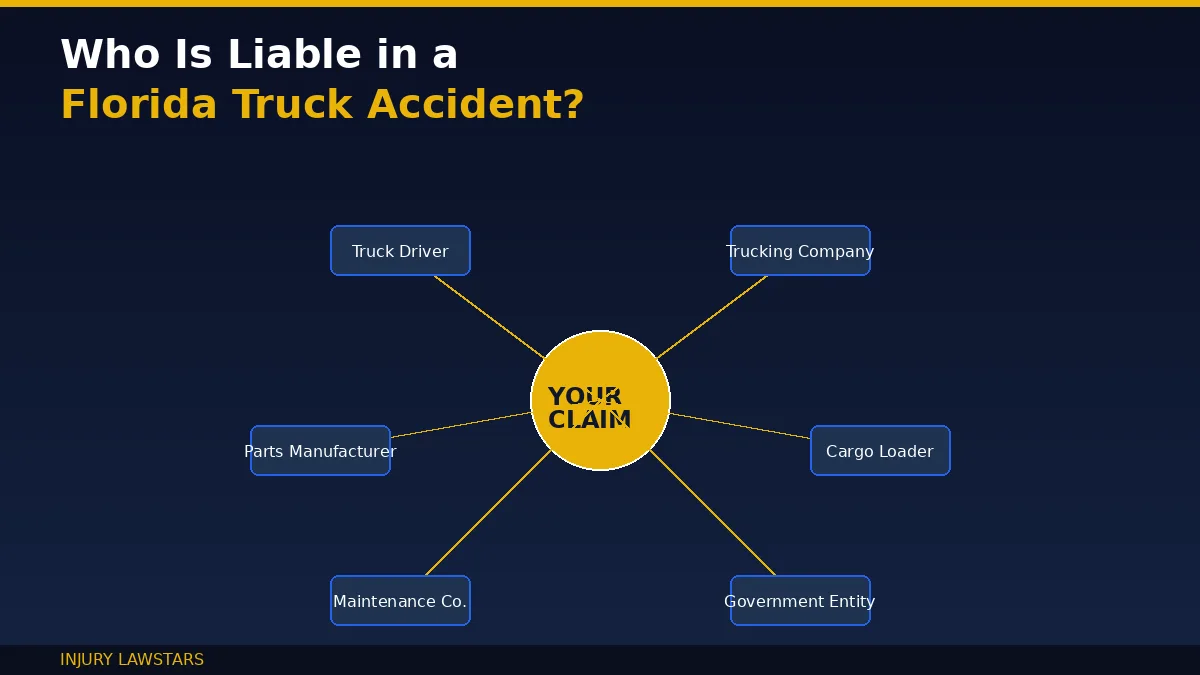
One of the most important differences between a truck accident lawsuit and a standard car accident claim is the number of potentially liable parties. Your attorney will investigate all of the following:
The Driver Behind the Wheel
The driver may be directly liable if they were speeding, fatigued, distracted, impaired, or in violation of federal regulations at the time of the crash.
The Company That Hired the Driver
Under the legal doctrine of respondeat superior, a trucking company can be held vicariously liable for the negligent actions of its drivers. The company may also be directly liable for negligent hiring, inadequate training, failure to maintain vehicles, pressuring drivers to violate HOS rules, or falsifying compliance records.
The Manufacturer of the Truck or Its Parts
If a defective brake system, tire, steering component, or other mechanical part contributed to the accident, the manufacturer may be liable under Florida product liability law.
The Team That Loaded the Cargo
Third-party companies responsible for loading and securing cargo can be held liable when improperly loaded or overweight cargo contributes to a crash.
The Mechanics Who Serviced the Truck
If a third-party maintenance provider performed negligent repairs or failed to identify critical safety issues during an inspection, they may share liability.
Government Agencies for Poor Road Conditions
In some cases, poor road design, missing signage, or failure to maintain roadways may contribute to a truck accident. Claims against government entities in Florida have specific notice requirements and shorter filing deadlines.
What Evidence Do You Need to Win Your Case?
The strength of your truck accident lawsuit depends heavily on the evidence your attorney can gather. Unlike standard car accidents, commercial trucks generate a wealth of documented data that can prove negligence. However, this evidence can be destroyed or overwritten quickly, which is why contacting an attorney immediately after the crash is essential.
Truck “Black Box” and Electronic Log Data
Commercial trucks are equipped with an Event Data Recorder (EDR), commonly called a “black box,” which captures speed, braking patterns, steering input, and other critical data in the moments before a crash. ELD records show the driver’s hours of service compliance. Your attorney can send a spoliation letter to preserve this data before the trucking company overwrites or destroys it.
The Driver’s Employment and Log History
The FMCSA requires trucking companies to maintain a Driver Qualification (DQ) file for every driver, including CDL verification, medical exam results, drug and alcohol testing history, employment history, and driving record. These files can reveal patterns of negligence in hiring or retention.
The Truck’s Repair and Maintenance History
Detailed maintenance logs, pre-trip and post-trip inspection reports, and annual inspection records can show whether the trucking company was properly maintaining its fleet. Missing or incomplete records often indicate negligence.
Company Dispatch and GPS Records
Dispatch records can show whether the trucking company was pressuring drivers to meet unrealistic deadlines. GPS tracking data can verify the truck’s route, speed, and any unauthorized stops.
Photos, Videos, and Witness Statements
Photos and video from the accident scene, dashcam footage, surveillance camera recordings, witness statements, and the official police crash report all play important roles in establishing what happened.
Why a Police Report Isn’t Enough to Prove Fault
It’s a common misconception that the police report is the final word on who caused a truck accident. While the report is a crucial starting point, it’s rarely the whole story. Police officers arriving at a chaotic scene are focused on securing the area, helping the injured, and gathering basic facts for a preliminary report. They typically don’t have the time or specialized training to conduct a full investigation into violations of federal trucking regulations, review maintenance logs, or analyze a trucking company’s safety history. The officer’s opinion on fault is just that—an opinion—and it is often not admissible as evidence in court. A successful truck accident claim requires a much deeper investigation to uncover evidence of driver fatigue, improper cargo loading, or corporate negligence that the initial report will almost certainly miss.
How Much Is a Truck Accident Settlement Worth in Florida?
Truck accident settlements in Florida typically range from $150,000 to well over $5 million, depending on the severity of injuries, the strength of evidence, the number of liable parties, and available insurance coverage. Below is a general overview of settlement ranges based on injury severity:
| Injury Type | Estimated Settlement Range | Key Factors |
|---|---|---|
| Minor soft-tissue injuries (whiplash, strains) | $15,000 – $50,000 | Typically resolved through PIP; short recovery |
| Moderate injuries (fractures, herniated discs) | $50,000 – $200,000 | Outpatient surgery, moderate time off work |
| Serious injuries (traumatic brain injury, multiple surgeries) | $250,000 – $750,000 | Long-term care, rehabilitation, lost future income |
| Catastrophic injuries (spinal cord damage, amputation) | $1 million – $5 million+ | Permanent disability, life care plans |
| Wrongful death | $500,000 – $10 million+ | Dependency, lost income, emotional damages |
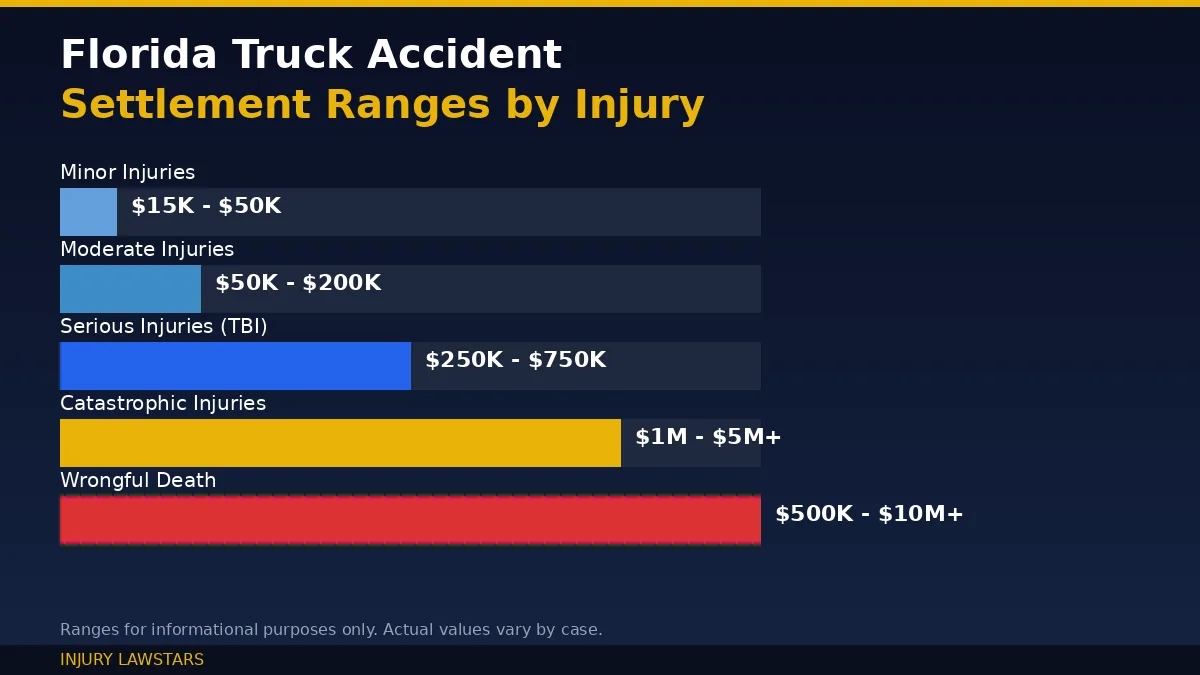
These ranges are provided for general informational purposes only. Actual settlement values depend on the specific facts of each case, including severity of injuries, available evidence, insurance coverage, and other legal factors. This table does not guarantee or predict any outcome.
Looking at National Truck Accident Settlement Averages
While the value of every case is unique, looking at national data can provide a helpful frame of reference. Across the country, settlements for commercial truck accidents are consistently higher than those for typical car wrecks. This is due to the catastrophic nature of the injuries, the extensive federal regulations involved, and the high-value insurance policies trucking companies are required to carry. National statistics often show average truck accident settlements ranging from six to seven figures. For example, some legal data aggregators estimate that cases involving severe, non-fatal injuries can settle for several hundred thousand dollars, while those resulting in fatalities or permanent disability frequently exceed one million dollars.
A Word of Caution About “Average” Settlement Values
It’s important to approach “average” settlement figures with caution. These numbers can be misleading because they are often skewed by a small number of exceptionally large, multi-million dollar verdicts. A more realistic picture often comes from understanding that the final value of your case depends entirely on its specific facts. Factors like the total cost of your medical care, the amount of your lost wages, the long-term impact of your injuries, and the clarity of the evidence against the trucking company will determine your compensation. A case involving a wrongful death or a permanent disability will have a vastly different value than one with injuries that heal completely in a few months.
What Factors Affect Your Settlement Amount?
- Documented FMCSA violations by the trucking company or driver
- Evidence of willful negligence, such as falsified ELD records or ignored maintenance issues
- Catastrophic or permanent injuries requiring long-term medical care
- Multiple liable parties with separate insurance policies
- Clear evidence of fault supported by black box data, dashcam footage, or witness testimony
- Punitive damages, which may be awarded in cases involving gross negligence or willful misconduct
How Quickly You Seek Medical Treatment
Insurance companies for trucking corporations will scrutinize every action you take after an accident. Delaying medical treatment is one of the biggest red flags they look for. If you wait days or weeks to see a doctor, their defense attorneys will argue that your injuries weren’t serious or were caused by something other than the crash. Seeking immediate medical attention is not only critical for your health—especially for injuries like a traumatic brain injury that may not show immediate symptoms—but it also creates an official record. This medical documentation becomes a cornerstone of your case, establishing a direct timeline between the accident and the harm you suffered.
The Impact of Pre-Existing Injuries or Prior Claims
It’s a common worry: will a previous injury or an old workers’ comp claim hurt my truck accident case? The short answer is no, as long as it’s handled correctly. You are still entitled to compensation if the truck accident aggravated or worsened a pre-existing condition. The key is to be completely transparent with your attorney about your medical history from the start. An experienced lawyer can work with medical experts to clearly distinguish your prior condition from the new injuries caused by the crash. Attempting to hide a previous injury will only damage your credibility and give the defense team ammunition to challenge your entire claim.
What if You’re Partially at Fault? Florida’s Law Explained
In March 2023, Florida enacted House Bill 837 (HB 837), which replaced the state’s long-standing pure comparative negligence system with a modified comparative negligence standard. This change has a significant impact on truck accident lawsuits.
Understanding Florida’s 51% Bar Rule
Under Florida’s modified comparative negligence law, if you are found to be more than 50% at fault for the accident, you are completely barred from recovering any compensation. If your share of fault is 50% or less, your damages are reduced by your percentage of responsibility.
For example, if a jury determines your total damages are $500,000 but finds you were 20% at fault, your recovery would be reduced to $400,000.
How This Rule Could Impact Your Claim
Trucking companies and their insurance carriers will aggressively try to shift blame onto the injured victim. They may argue that you were speeding, failed to stay in your lane, or were distracted at the time of the crash. Having an experienced truck accident attorney who understands how to counter these tactics is essential to protecting your right to compensation.
The Deadline for Filing a Florida Truck Accident Lawsuit
Under HB 837, the statute of limitations for filing a personal injury lawsuit in Florida was reduced from four years to two years from the date of the accident. For wrongful death claims, the statute of limitations is also two years from the date of death.
This compressed timeline makes it critical to contact an attorney as soon as possible after a truck accident. Evidence can be lost, witnesses’ memories fade, and trucking companies may destroy or overwrite ELD data and maintenance records if not preserved through legal action.
Critical Mistakes to Avoid After a Truck Accident
The moments and days following a truck crash are chaotic and stressful. While you’re focused on medical treatment and recovery, the trucking company’s insurance carrier is already working to protect its bottom line. They may seem friendly and helpful, but their goal is to resolve your claim for the lowest possible amount. The decisions you make during this critical period can have a lasting impact on your ability to recover fair compensation for your injuries, lost wages, and suffering. Understanding the common pitfalls and how to avoid them is the first step toward protecting your rights.
Dealing with Insurance Company Tactics
Soon after the accident, you will likely receive a call from the trucking company’s insurance adjuster. It’s crucial to remember that this person is not on your side. Their job is to minimize the financial liability of their company. They may ask you to provide a recorded statement about the accident, hoping you’ll say something that can be used to undermine your claim later. They might imply that cooperating is the fastest way to get paid, but these statements are often used to assign partial fault or question the severity of your injuries. It is always best to politely decline to give a statement until you have spoken with an experienced truck accident attorney who can handle all communications on your behalf.
Why You Shouldn’t Settle Your Claim Too Quickly
Insurance companies often make quick, low settlement offers to victims, hoping to close the case before the full extent of the damages is known. Accepting one of these early offers can be a devastating mistake. The initial offer rarely accounts for future medical expenses, long-term rehabilitation, lost earning capacity, or the full impact of chronic pain and suffering. For example, the long-term effects of a traumatic brain injury may not be fully apparent for months. Once you accept a settlement and sign a release, you forfeit your right to seek any further compensation, even if your injuries turn out to be far more severe and costly than you first realized.
Protecting Your Claim: What Not to Do
Beyond avoiding quick settlements, there are several other actions you should avoid to protect the value of your claim. The trucking company’s defense team will be looking for any reason to deny or reduce your compensation. This means you need to be careful about what you say, what you sign, and what you share publicly. Never speak directly with the at-fault party’s insurance company without your lawyer present, and do not sign any documents they send you, including medical authorizations or settlement releases, without a thorough legal review. Every action you take can be scrutinized, so it’s vital to proceed with caution and professional guidance.
Avoid Discussing the Accident on Social Media
In the age of social media, it’s natural to want to share updates with friends and family, but you must avoid posting anything about your accident, injuries, or recovery online. Insurance adjusters and defense attorneys regularly search claimants’ social media profiles for evidence they can use against them. A photo of you attending a family gathering in Ocala or a simple post saying you’re “feeling better today” can be taken out of context and used to argue that your injuries are not as serious as you claim. The safest approach is to set your profiles to private and refrain from posting about the accident or your physical condition entirely.
Don’t Sign Anything Without a Lawyer’s Review
The insurance company may send you various documents to sign, often under the guise of “processing your claim.” Be extremely wary of signing anything without having it reviewed by your attorney first. A medical authorization form might seem harmless, but it could grant the insurer access to your entire medical history, which they can use to argue that your injuries were pre-existing. Most importantly, never sign a settlement release. As mentioned, this document is final and permanently ends your right to any future compensation for the accident. Before you put your signature on any paperwork, contact a lawyer to ensure you aren’t signing away your rights.
What to Expect During Your Truck Accident Claim
Filing a truck accident lawsuit in Florida involves several stages. While every case is unique, here is a general overview of what to expect:
Step 1: Gathering Critical Evidence
Your attorney will immediately send a spoliation letter to the trucking company demanding they preserve all evidence, including ELD data, driver logs, maintenance records, dispatch communications, and dashcam footage. An independent accident reconstruction expert may be brought in to analyze the crash.
Step 2: Notifying the Insurance Companies
Florida is a no-fault state, which means your own Personal Injury Protection (PIP) insurance covers up to $10,000 in initial medical expenses regardless of who caused the accident. However, for serious injuries that meet Florida’s threshold (significant and permanent loss of a bodily function, permanent injury, scarring or disfigurement, or death), you can step outside the no-fault system and file a claim against the at-fault parties.
Step 3: Sending a Demand and Negotiating a Settlement
Once your medical treatment has stabilized and damages can be fully calculated, your attorney will send a demand package to the trucking company’s insurance carrier. This package includes medical records, evidence of lost wages, documentation of pain and suffering, and evidence supporting liability.
Step 4: Taking Your Case to Court
If the insurance company refuses to offer a fair settlement, your attorney will file a formal lawsuit in Florida civil court. This must occur within the two-year statute of limitations.
Step 5: The Discovery Phase
During the discovery phase, both sides exchange evidence and take depositions from witnesses, drivers, trucking company representatives, and expert witnesses. This is often when FMCSA violations and internal company communications are uncovered through the legal discovery process.
Step 6: Reaching a Resolution Through Mediation or Trial
Most truck accident cases settle before trial, often during mediation. However, if the insurance company refuses to offer fair compensation, your case may proceed to a jury trial. Having an attorney who is prepared and willing to go to trial often results in better settlement offers.
Do not wait to take legal action after a truck accident. Florida’s two-year statute of limitations is strict, and critical evidence can disappear quickly. Call Injury LawStars at (407) 887-4690 right now for a free, no-obligation case review with Attorney Katie Miller.
What Compensation Can You Claim After a Truck Accident?
Victims of truck accidents in Florida may be entitled to recover both economic and non-economic damages, including:
Covering Your Financial Losses
- Past and future medical expenses (surgeries, rehabilitation, medication, assistive devices)
- Lost wages and lost earning capacity
- Property damage
- Home and vehicle modifications for permanent disabilities
- In-home care and assistance
Compensation for Pain and Suffering
- Physical pain and suffering
- Emotional distress and mental anguish
- Loss of enjoyment of life
- Loss of consortium (impact on spousal relationship)
- Scarring and disfigurement
How Insurance Companies Calculate Pain and Suffering
Unlike medical bills or lost wages, there’s no simple invoice for pain and suffering. Insurance companies often use a “multiplier method” to assign a dollar value to these non-economic damages. They start by adding up all your concrete financial losses (economic damages) and then multiply that total by a number, typically between 1.5 and 5. The multiplier they choose depends entirely on the severity of your injuries and their impact on your life. For instance, a minor injury with a quick recovery might get a low multiplier, while a catastrophic injury like a traumatic brain injury or spinal cord damage would justify a much higher number. The adjuster will consider factors like the length of your recovery, the permanence of your injuries, and how your daily life has been altered.
It’s important to remember that the insurance adjuster’s goal is to minimize this payout. They will look for any reason to use a lower multiplier and downplay the extent of your suffering. This is where an experienced attorney makes a significant difference. We know how to gather and present compelling evidence—from medical expert testimony to statements from family and friends—to build a strong case that accurately reflects the true value of your pain and suffering and ensures you are not shortchanged by the insurance company’s formula.
When Punitive Damages Are Awarded
In cases involving gross negligence or intentional misconduct, such as a trucking company that knowingly put an impaired driver on the road or systematically falsified safety records, a Florida court may award punitive damages to punish the defendant and deter similar conduct.
Understanding Your Settlement Payout
After the stress of a truck accident and the complexities of a lawsuit, reaching a settlement agreement feels like a huge relief. But the gross settlement amount you see on paper isn’t the final number that will be deposited into your account. It’s important to understand how these funds are distributed so you know what to expect. The total settlement is first used to cover the costs associated with your case, and what remains is your net recovery. This process ensures that all financial obligations related to your accident and legal claim are settled before you receive your portion of the funds, giving you a clear picture of your financial future.
How Your Settlement Funds Are Divided
The first deductions from your settlement are for legal fees and case expenses. Most personal injury attorneys, including our team at Injury LawStars, work on a contingency fee basis. This means we only get paid if we win your case, and our fee is a pre-agreed percentage of the settlement. Next, any costs advanced to build your case—such as fees for expert witnesses, court filings, and obtaining medical records—are reimbursed. Finally, any outstanding medical liens must be paid. This includes bills from hospitals, doctors, or health insurance companies that covered your treatment, as they have a legal right to be repaid from your settlement. After these deductions, the remaining amount is your take-home recovery.
Lump-Sum vs. Structured Payouts
Once all the deductions are calculated, you will receive your net settlement. This payment can come in one of two forms: a lump sum or a structured settlement. A lump-sum payment is exactly what it sounds like—you receive the entire amount in one single payment. This is the most common type of payout and gives you immediate access to your funds. A structured settlement, on the other hand, provides a series of smaller payments over an extended period. This option is often used in cases involving catastrophic injuries that require lifelong care or when the victim is a minor, ensuring a steady stream of income for future needs.
The Finality of a Settlement Agreement
It is crucial to understand that once you accept a settlement offer and sign the release agreement, the decision is final. You cannot go back and ask for more money later, even if your injuries turn out to be more severe than you initially thought or you require unexpected future medical treatment. Insurance companies are aware of this and may try to offer a quick, low settlement before the full extent of your damages is known. This is why having an experienced legal team is so important. We ensure that any settlement offer fully accounts for all your past, present, and future needs before you ever agree to a final amount for your truck accident claim.
Frequently Asked Questions About Truck Accident Lawsuits in Florida
What’s the time limit to file a lawsuit in Florida?
You have two years from the date of the accident to file a personal injury lawsuit in Florida. For wrongful death claims, the deadline is two years from the date of death. Missing this deadline almost always results in your case being permanently dismissed, so contacting an attorney quickly is critical.
What’s a typical settlement for a Florida truck accident?
Truck accident settlements in Florida typically range from $150,000 to over $5 million, depending on the severity of injuries, evidence of fault, the number of liable parties, and available insurance coverage. Catastrophic injury and wrongful death cases often settle for significantly more.
Can I sue the trucking company, not just the driver?
Yes. Under the doctrine of respondeat superior, trucking companies are generally liable for accidents caused by their drivers acting within the scope of employment. The company can also be held directly liable for negligent hiring, inadequate maintenance, violations of FMCSA regulations, and pressuring drivers to exceed Hours of Service limits.
What is a spoliation letter, and why is it important?
A spoliation letter is a formal legal notice sent to the trucking company demanding that they preserve all evidence related to the accident, including ELD data, driver logs, maintenance records, dashcam footage, and internal communications. Without this letter, critical evidence may be destroyed or overwritten within days of the crash.
What if I was partially at fault for the truck accident?
Under Florida’s modified comparative negligence law (HB 837), you can still recover compensation as long as you are 50% or less at fault. Your recovery is reduced by your percentage of fault. However, if you are found to be 51% or more at fault, you are barred from recovering any damages.
What is the black box in a commercial truck?
The “black box,” or Event Data Recorder (EDR), is an electronic device installed in commercial trucks that records data such as vehicle speed, brake application, engine RPM, seatbelt use, and other critical metrics in the seconds before and during a crash. This data is invaluable in proving what happened and who was at fault.
How long does a truck accident lawsuit take in Florida?
Most truck accident cases take between 12 and 24 months to resolve, though complex cases involving multiple defendants, catastrophic injuries, or disputed liability can take longer. Many cases settle during the negotiation or mediation phase without going to trial.
Do I need a lawyer for a truck accident claim?
Truck accident cases are significantly more complex than standard car accident claims due to federal regulations, multiple potentially liable parties, and the aggressive legal teams employed by trucking companies. An experienced truck accident attorney can preserve critical evidence, identify all liable parties, calculate the full value of your damages, and negotiate with insurers who are trained to minimize payouts. Attorney Katie Miller at Injury LawStars offers free consultations and works on a contingency basis, meaning you pay nothing unless we win your case.
Key Takeaways
- Recognize that truck accidents are different: Your case isn’t just a bigger car wreck; it involves strict federal rules, several potential defendants (like the driver, company, and parts maker), and requires a specific legal approach to succeed.
- Act quickly to protect crucial evidence: You only have two years to file a lawsuit in Florida, and key evidence like the truck’s “black box” data can be erased within days. Securing legal help immediately is the best way to preserve the proof you need.
- Know how fault impacts your settlement: Florida law prevents you from recovering any money if you’re found more than 50% responsible for the accident, so building a strong case that clearly proves the truck driver or their company was at fault is essential.
Related Articles
- Truck Accident Lawsuit in Florida: What Victims Need to Know
- Truck Accident Lawyer in Miami: An Ultimate Guide
- Why You Need a Truck Accident Lawyer Port St. Lucie
- Hiring a Truck Accident Attorney: A Florida Guide
About the Author
Katie Miller, Esq.
Managing Partner · Injury LawStars
Attorney Katie Miller was once an injury victim herself. After a car accident in 2016 that required spinal surgery and a 13-month recovery, she turned her experience into a mission: fighting for people who are hurting. With 17+ years of legal experience and over \$45 million recovered for clients, Katie brings both professional expertise and personal understanding to every case.