March 28, 2026
What to Do After a Car Accident in Florida

A car accident happens in a flash, but the aftermath can feel overwhelming. You’re likely dealing with shock, maybe even pain, and a flood of questions about what to do next. The steps you take in these crucial moments matter. Making the right moves after a car accident in Florida can protect your rights, while one wrong step could seriously hurt your claim. Think of this as your clear, simple checklist for handling the chaos and ensuring you don’t make a costly mistake.
Injured in a car accident? Call Injury LawStars today at (407) 887-4690 for a free consultation.
I know this firsthand. On January 19, 2016, my life changed forever when I was rear-ended by a Ford F-150 traveling roughly 50 mph, crushing my Honda Civic under a citrus semi-truck. The injuries I sustained required painful treatment and major surgery to stabilize my spine. I was out of work for 13 months. As a 39-year-old with an 18-month-old baby, my life was literally and figuratively turned upside down.
That experience is why I became a personal injury attorney. I was you, and now I represent you. This guide walks you through every step you need to take after a car crash in Florida so you can protect your health, your rights, and your future.
Key Takeaways
- Stay at the scene. Leaving a Florida car accident can result in criminal charges, even if you believe no one is hurt.
- Call 911 immediately. Florida law requires you to report any accident involving injuries, death, or property damage exceeding $500.
- See a doctor within 14 days. Under Florida’s no-fault insurance system, you must seek medical treatment within 14 days to access your Personal Injury Protection (PIP) benefits.
- Document everything. Photos, witness information, and a police report are critical evidence for your claim.
- Do not admit fault or give recorded statements to insurance companies without legal guidance.
- Contact a Florida car accident lawyer early. An experienced attorney can protect you from insurance tactics and help you recover the compensation you deserve.
Step 1: Secure the Scene and Stay Put
The first and most important rule after a car accident in Florida is simple: do not leave. Florida Statute 316.061 requires all drivers involved in an accident to stop immediately at the scene or as close to it as safely possible.
Leaving the scene of an accident is a serious offense in Florida. If the crash involves injuries, fleeing can be charged as a felony. Even in a minor fender bender, leaving without exchanging information can result in a hit-and-run charge with penalties including fines, license suspension, and possible jail time.
What to do:
- Pull over to a safe location as close to the accident scene as possible
- Turn on your hazard lights to alert other drivers
- If your vehicle is blocking traffic and can be safely moved, pull to the shoulder or a nearby parking area
- If the vehicle cannot be moved, stay inside with your seatbelt fastened until help arrives, especially on busy Florida highways like I-4 or the Florida Turnpike
Even if the accident seems minor, never drive away. Exchange information and follow the remaining steps below.
Step 2: Prioritize Safety & Call 911
Your immediate priority after stopping is safety. Check yourself and your passengers for injuries. Then check on the occupants of the other vehicle if you can do so safely.
Call 911 right away if:
- Anyone is injured, no matter how minor it seems
- There is significant vehicle damage
- Fuel or fluids are leaking from any vehicle
- A vehicle is blocking traffic and creating a hazard
Under Florida Statute 316.065, you are legally required to report any accident that results in injury, death, or property damage of $500 or more. In practice, calling 911 for almost any accident is a smart move. The responding officer will create an official police report, which becomes critical evidence for your insurance claim and any future legal action.
Important: Even if you feel fine immediately after the crash, adrenaline can mask serious injuries. Symptoms of whiplash, concussions, and internal injuries often appear hours or even days later. Do not refuse medical attention at the scene.
Florida sees an alarming number of car accidents each year. The Florida Department of Highway Safety and Motor Vehicles reported over 400,000 crashes in recent years, resulting in thousands of injuries and fatalities. Taking immediate action after an accident is not just good advice, it is essential.
How to Contact Law Enforcement in Florida
The quickest and most effective way to contact law enforcement is to dial 911 from your cell phone. When the dispatcher answers, stay as calm as possible and clearly state that you’ve been in a car accident. Be prepared to provide your exact location, including the street name, nearest cross-street, or mile marker if you’re on a highway. Let them know if there are any injuries and describe the scene briefly. Depending on where the crash occurred—whether on a city street in Ocala, a busy intersection in The Villages, or a rural road in Lake County—the responding agency could be the local police, the county sheriff’s office, or the Florida Highway Patrol. The official report they generate is a cornerstone for building a successful car accident claim, so stay on the line until help arrives.
Step 3: Exchange Key Information (and Nothing More)
Once you have confirmed everyone is safe and emergency services are on the way, exchange the following information with all drivers involved in the accident:
- Full legal name
- Phone number and address
- Driver’s license number
- License plate number
- Insurance company name and policy number
- Vehicle make, model, year, and color
Under Florida Statute 316.062, drivers involved in a crash are required to provide their name, address, vehicle registration, and, upon request, their driver’s license to the other party.
Tips for this step:
- Use your phone to photograph the other driver’s license and insurance card. This prevents errors from hand-written notes
- Be polite and cooperative, but keep the conversation factual
- Do not apologize or admit fault. Even a simple “I’m sorry” can be used against you by an insurance adjuster later. Stick to the facts
If a driver refuses to provide their information or leaves the scene, write down their license plate number and vehicle description and report it to the police immediately.
Step 4: Gather Evidence While You Wait
Thorough documentation is one of the most important steps after a car accident, and it is often the most overlooked. The evidence you gather at the scene can make or break your claim. Insurance companies and courts rely heavily on physical evidence, and what you capture in the first minutes after a crash often determines the outcome of your case.
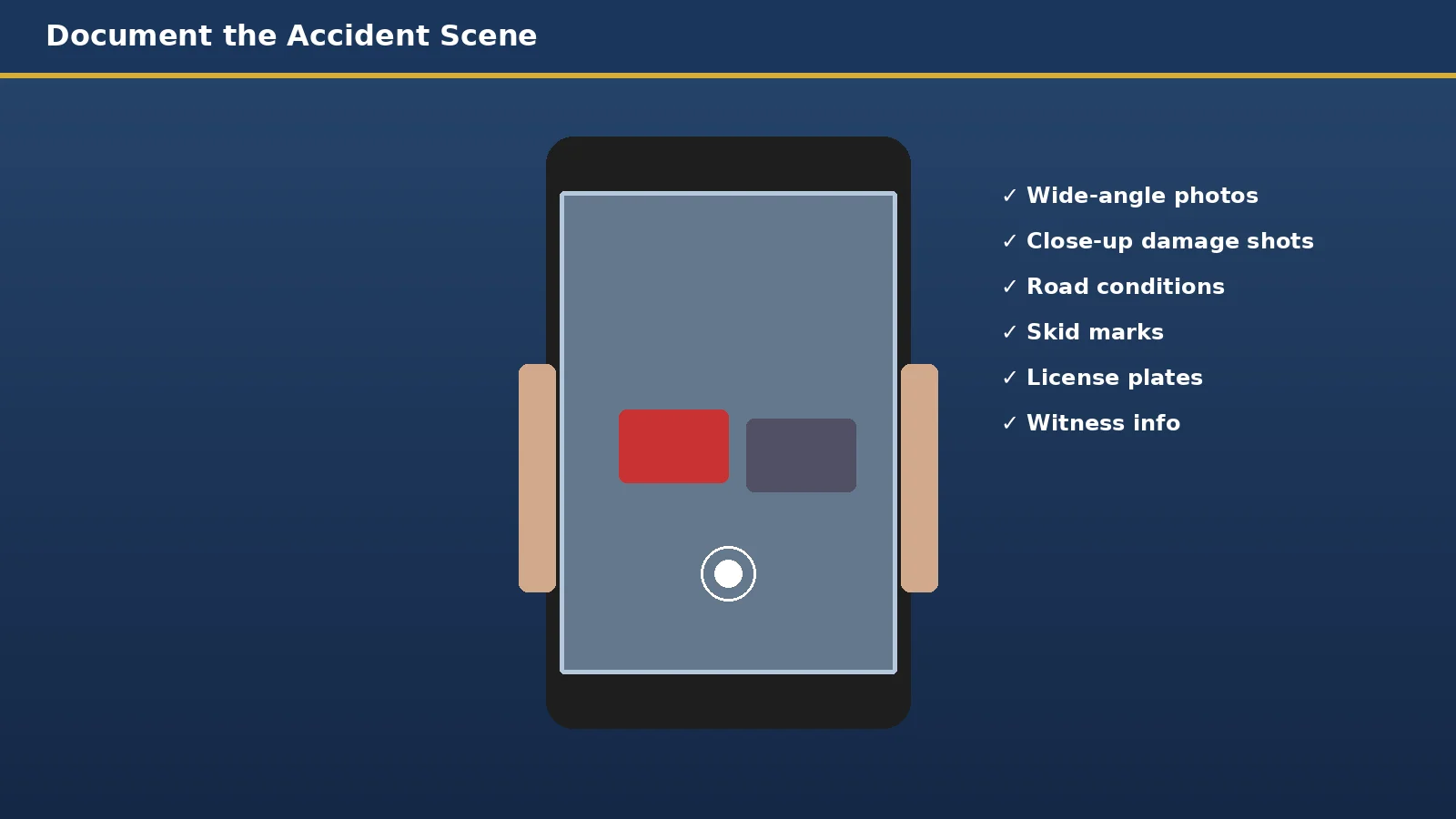
Use your phone to capture:
- Wide-angle photos of the entire accident scene showing vehicle positions, road conditions, and traffic signals
- Close-up photos of damage to all vehicles involved, from multiple angles
- Your injuries — visible cuts, bruises, swelling, or any marks on your body
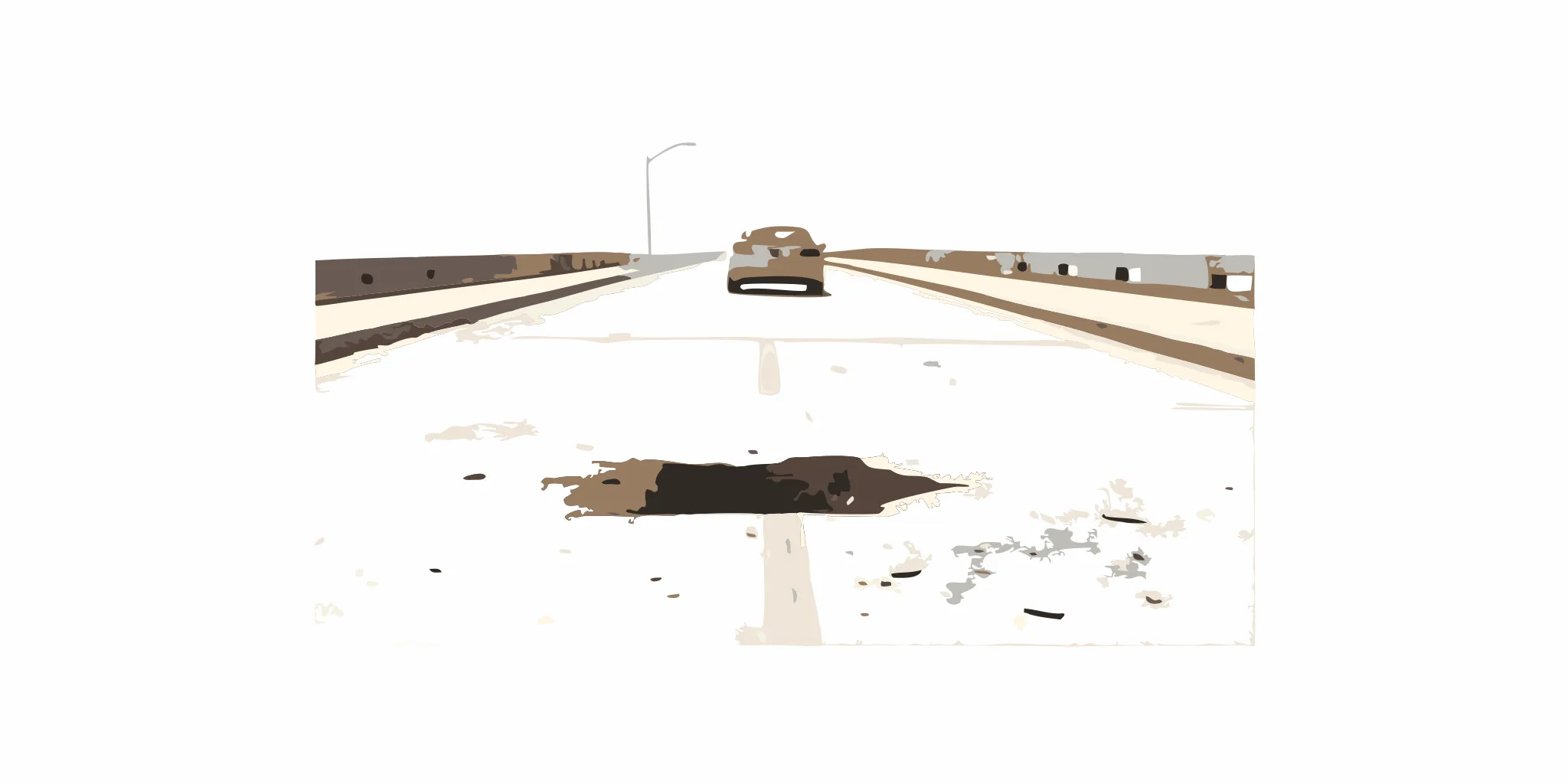
- Road conditions — wet pavement, potholes, construction zones, debris, or poor lighting
- Skid marks or tire tracks on the road
- Traffic signs and signals near the accident
- The other vehicle’s license plate (as a backup to the information you exchanged)
- Street signs and mile markers that confirm the exact location
- Weather conditions — overcast skies, rain on the pavement, sun glare
If there are witnesses, ask for their names and phone numbers. Witness testimony can be extremely valuable, especially if there is a dispute about who caused the accident. Bystanders, other drivers who stopped, and employees at nearby businesses may all have seen something important.
Pro tip: Take a short video panning across the entire accident scene. Video captures details that photos sometimes miss, including the flow of traffic, lighting conditions, and the overall scope of the accident. A 30-second video walking around the scene can preserve evidence that individual photos cannot convey.
Write down your own account of what happened while it is still fresh in your memory. Include the time, weather conditions, direction you were traveling, the speed you were going, and exactly what you saw and felt before, during, and after the impact. Memory fades quickly, and notes written within an hour of the accident carry far more weight than a statement given weeks later.
If the police respond to the scene, ask for the responding officer’s name, badge number, and the incident report number. You can typically obtain a copy of the official police report from the Florida Highway Patrol or local police department within a few business days.
Step 5: Accessing Your Official Accident Report
The police report, officially called the Florida Traffic Crash Report, is a cornerstone of your insurance claim. It’s the official, third-party account of what happened, detailing the officer’s initial findings on how the crash occurred and who they believe was at fault. Insurance adjusters place significant weight on this document when they begin evaluating your claim and determining compensation. For this reason, obtaining a copy and verifying that all the information is accurate is a non-negotiable step. This report lays the groundwork for your entire case, so you want to make sure it’s correct from the start.
How to Get a Copy of Your Florida Crash Report
The most direct way to get your official report is through the Florida Highway Safety and Motor Vehicles (FLHSMV) online portal. This is the state’s centralized system, making it easy to access your report efficiently. You can also request a copy in person from the law enforcement agency that responded to your accident, whether it was the Florida Highway Patrol, the Ocala Police Department, or the Sumter County Sheriff’s Office. Be aware that Florida law restricts public access to crash reports for the first 60 days to protect the privacy of those involved. During this period, only the drivers, their attorneys, and their insurance companies can obtain a copy. The fee is typically $10 plus a small convenience fee for online processing.
Understanding the Information in Your Report
Once you have the report, you’ll find it’s filled with critical information. It contains the names and contact details of everyone involved, insurance policy numbers, a diagram of the accident scene, the officer’s written narrative, and a record of any traffic citations issued. It’s essential that you review every detail with a fine-tooth comb. An error in the report—whether it’s a misquoted statement, an incorrect street name, or a mistake in the crash diagram—can create major hurdles for your claim. If you spot a factual error, contact the reporting law enforcement agency immediately to request a correction or an addendum. An experienced attorney can help you interpret the report and its implications for your car accident claim.
Step 5: Get Medical Care, No Matter What
This step is critical for two reasons: your health and your legal rights.
Even if you feel okay after the accident, you need to see a doctor as soon as possible. Many common car accident injuries do not show symptoms right away. Whiplash, concussions, herniated discs, internal bleeding, and even traumatic brain injuries can take hours or days to manifest noticeable symptoms.
Why Florida’s 14-Day Rule Matters
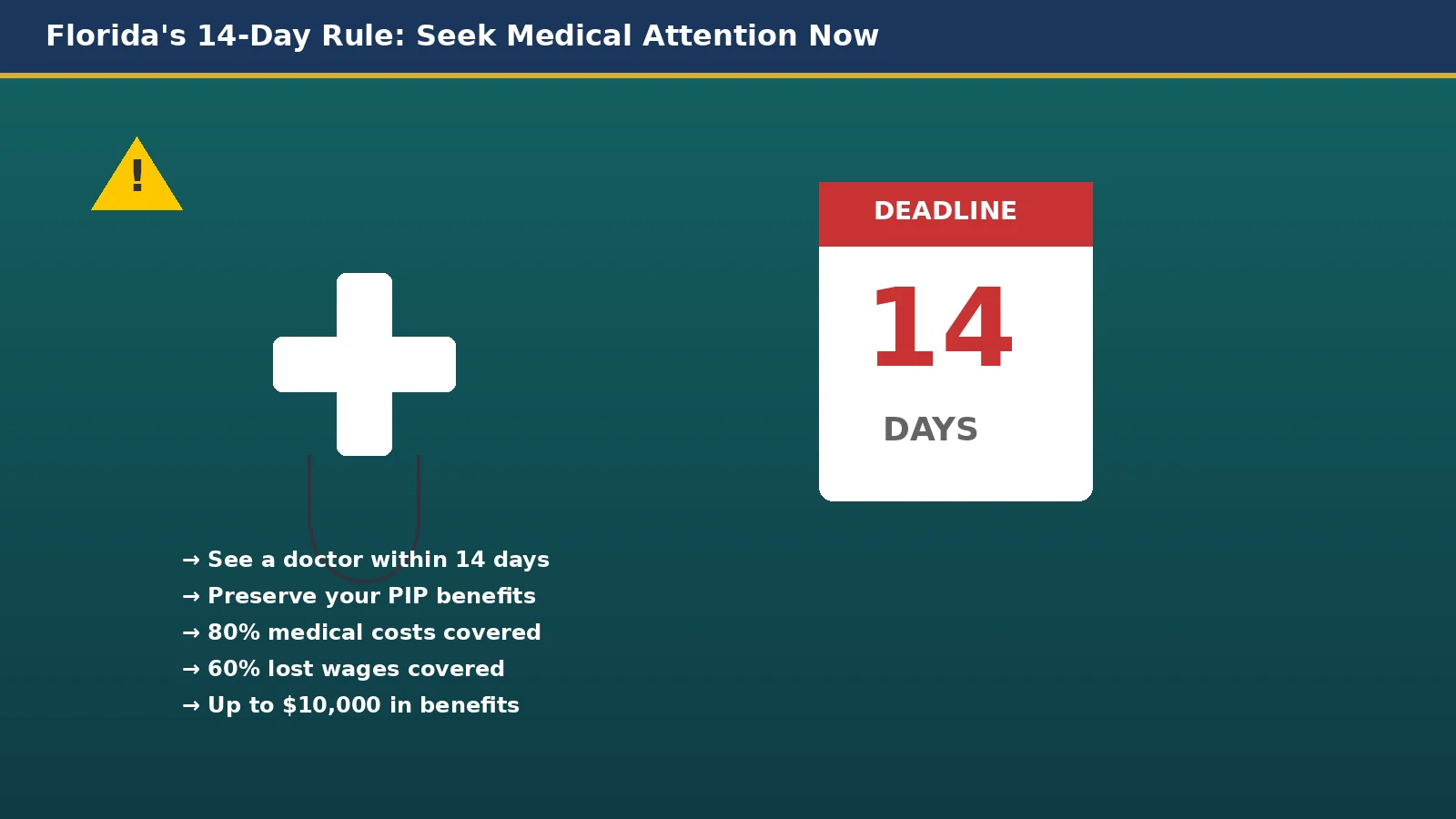
Here is where Florida law adds urgency. Under the state’s no-fault insurance system, your Personal Injury Protection (PIP) insurance covers your initial medical expenses regardless of who caused the accident. However, there is a strict deadline: you must seek medical treatment within 14 days of the accident to qualify for PIP benefits.
If you wait until day 15, your PIP coverage can be denied entirely. That means you could be personally responsible for thousands of dollars in medical bills.
PIP coverage in Florida typically provides:
- 80% of medical expenses up to $10,000
- 60% of lost wages if your injuries prevent you from working
- $5,000 death benefit in the event of a fatal accident
For emergency medical conditions, PIP covers up to the full $10,000 limit. For non-emergency conditions, coverage may be limited to $2,500.
What to tell your doctor: Be completely honest about every symptom you are experiencing, even if it seems minor. Headaches, neck stiffness, back pain, dizziness, numbness, and mood changes can all indicate serious underlying injuries. Thorough medical documentation creates a direct link between the accident and your injuries, which is essential for your claim.
Don’t let the insurance company take advantage of you. Call (407) 887-4690 for a free case review.
Step 6: Notify Your Insurance Company
Florida is a no-fault state, which means your own insurance company is your first point of contact after an accident, regardless of who was at fault. You are required to report the accident to your insurer in a timely manner, typically within a few days.
When reporting to your insurance company:
- Stick to the facts: date, time, location, and a basic description of what happened
- Provide the other driver’s information and the police report number
- Do not give a recorded statement without speaking to an attorney first
- Do not accept a quick settlement offer — initial offers are almost always far below what your claim is actually worth
- Do not sign any documents or medical releases from the insurance company without legal review
What Florida’s No-Fault Law Means for You
Florida’s no-fault system is designed so that each driver’s own insurance covers their injuries up to the PIP limit, regardless of fault. This means you file a claim with your own insurance company first, not the other driver’s.
However, the no-fault system has limits. If your injuries are serious, you may be able to step outside the no-fault system and file a claim directly against the at-fault driver. Florida law allows this when injuries meet a “serious injury threshold,” which includes:
- Significant and permanent loss of a body function
- Permanent injury (other than scarring or disfigurement)
- Scarring or disfigurement
- Death
When your injuries exceed what PIP covers, or when the other driver’s negligence caused significant harm, a Florida car accident lawyer can help you pursue full compensation through a fault-based claim.
Step 7: Watch What You Say at the Scene
In the days and weeks following your accident, you may be contacted by insurance adjusters from the other driver’s insurance company, or even your own. Their job is to minimize what the company pays out on your claim.
Rules to follow:
- Do not admit fault to anyone, including the other driver, police, or insurance adjusters
- Do not post about the accident on social media. Insurance companies actively monitor Facebook, Instagram, and other platforms for posts that can be used to undermine your claim
- Do not discuss your injuries in detail with anyone other than your doctor and your attorney
- Do not accept blame even if you think you may have contributed to the accident
Florida follows a modified comparative negligence rule. This means that even if you were partially at fault, you can still recover compensation, though your award is reduced by your percentage of fault. However, if you are found to be more than 50% at fault, you cannot recover damages. Admitting fault prematurely can destroy your ability to receive compensation even if the accident was partially your fault.
Step 8: Create Your Car Accident File
From the moment the accident happens, start building a file. Organized records strengthen your claim and ensure nothing slips through the cracks. Attorneys, insurance adjusters, and judges all make decisions based on documentation. The more thorough your records, the harder it is for anyone to dispute your losses.
Your accident file should include:
- A copy of the police report
- Photos and videos from the accident scene
- Medical records and bills from all treatments, including emergency room visits, specialist appointments, physical therapy, and prescription medications
- Receipts for prescriptions, medical devices, and rehabilitation
- Documentation of lost wages (pay stubs, employer letters, tax returns)
- Records of any out-of-pocket expenses related to the accident (transportation to medical appointments, home care, childcare costs, household help)
- A personal injury journal documenting your daily pain levels, emotional state, and how the injuries affect your daily life
- Correspondence with insurance companies, including claim numbers and adjuster names
- Copies of any repair estimates or vehicle damage assessments
Why a pain journal matters: Insurance companies will try to argue that your injuries are not as severe as you claim. A daily journal that tracks your pain on a scale of 1-10, what activities you cannot perform, how your sleep is affected, and the emotional toll of the accident creates a real-time record that is very difficult to dispute. This kind of documentation directly supports claims for pain and suffering, which can represent a significant portion of your total compensation.
This documentation becomes the foundation of your claim. It helps your attorney calculate the true value of your case, including both economic damages (medical bills, lost wages, property damage) and non-economic damages (pain and suffering, emotional distress, loss of enjoyment of life).
Understanding what your claim may be worth is important. Learn more about average personal injury settlement amounts and pain and suffering in car accident cases.
Step 9: Don’t Miss Your Filing Deadline
Time matters. Florida has strict deadlines for filing a personal injury lawsuit after a car accident.
- Personal injury claims: You have two years from the date of the accident to file a lawsuit (Florida Statute 95.11)
- Property damage claims: You have four years to file a claim for vehicle or property damage
- Wrongful death claims: The deceased’s representative has two years from the date of death to file
If you miss these deadlines, you lose your right to pursue compensation entirely. There are no exceptions for ignorance of the law. Learn more about how long a personal injury case takes in Florida.
Two years may sound like plenty of time, but it goes faster than you think. Gathering evidence, completing medical treatment, and negotiating with insurance companies all take time. The sooner you begin the legal process, the stronger your case will be.
For a deeper look at filing deadlines, read our guide on how long after an accident you can sue for personal injury.
Step 10: Talk to a Florida Car Accident Lawyer
Hiring an experienced personal injury attorney is one of the most important steps you can take after a car accident. An attorney levels the playing field between you and the insurance companies, who have teams of adjusters and lawyers working to pay you as little as possible.
When you should call a lawyer:
- You or a passenger suffered injuries requiring medical treatment
- The insurance company is offering a low settlement or denying your claim
- Fault is being disputed
- The accident involved multiple vehicles
- A commercial vehicle or truck was involved
- The other driver was uninsured or underinsured
- You are unsure about your rights under Florida’s no-fault system
At Injury LawStars, we handle car accident cases on a contingency fee basis. That means you pay nothing unless we win your case. There is no upfront cost and no financial risk to you.
As someone who has personally lived through the devastation of a serious car accident, I understand what you are going through. The pain, the fear, the frustration of dealing with insurance companies while trying to heal — I have been there. That lived experience drives everything we do at Injury LawStars. We are not just your lawyers. We are your advocates who truly understand your fight.
Call us today at (407) 887-4690 or schedule your free consultation to discuss your case. We serve clients throughout Florida, including Clermont, Ocala, The Villages, Orlando, Tampa, Jacksonville, and communities across Lake County, Marion County, and Sumter County.
Avoid These Common Car Accident Claim Mistakes
Even well-intentioned actions can damage your case. Here are the most common mistakes we see Florida car accident victims make:
-
Waiting too long to see a doctor. Missing the 14-day PIP deadline is one of the most costly mistakes. Even if your injuries seem minor, get checked out immediately.
-
Giving a recorded statement to the insurance company. Insurance adjusters are trained to ask questions in ways that elicit damaging admissions. Let your attorney handle these conversations.
-
Posting on social media. A photo of you smiling at a family event can be used to argue that your injuries are not serious. Stay off social media or make all accounts private while your case is open.
-
Accepting the first settlement offer. The initial offer is almost always a fraction of what your case is worth. Insurance companies count on injured people being desperate for quick money.
-
Not following through on medical treatment. If your doctor recommends physical therapy or follow-up visits and you stop going, the insurance company will argue that your injuries must not be that bad.
-
Signing documents without legal review. Insurance companies may ask you to sign medical authorizations or releases that give them access to your entire medical history, not just records related to the accident.
-
Waiting too long to hire a lawyer. Evidence disappears, memories fade, and deadlines pass. The sooner you have legal representation, the stronger your case will be.
Answering Your Florida Car Accident Questions
Use this quick-reference checklist at the scene and in the days following your accident:
At the Scene:
- ☐ Stop and stay at the scene
- ☐ Check for injuries
- ☐ Call 911
- ☐ Move to safety if possible
- ☐ Exchange information with all drivers
- ☐ Document the scene with photos and video
- ☐ Get witness names and contact information
- ☐ Do not admit fault or apologize
Within 14 Days:
- ☐ See a doctor, even if you feel fine
- ☐ Follow all medical advice and treatment plans
- ☐ Report the accident to your insurance company
- ☐ Request a copy of the police report
As Soon as Possible:
- ☐ Contact a Florida car accident lawyer
- ☐ Start organizing your accident file
- ☐ Keep a daily injury journal
- ☐ Do not post about the accident on social media
- ☐ Do not sign anything from the insurance company without legal review
Ready to protect your rights? Contact Injury LawStars at (407) 887-4690. No fees unless we win.
Frequently Asked Questions
What should I do immediately after a car accident in Florida?
Stop your vehicle, check for injuries, and call 911. Exchange information with the other driver, document the scene with photos and video, and seek medical attention within 14 days to preserve your PIP benefits. Do not admit fault or leave the scene.
Do I have to call the police after a car accident in Florida?
Florida law requires you to report any accident that involves injuries, death, or property damage exceeding $500. In practice, you should call the police after almost any accident. The official police report is a key piece of evidence for your insurance claim and any potential legal action.
What is Florida’s 14-day rule for car accidents?
Under Florida’s no-fault insurance system, you must seek medical treatment within 14 days of your accident to access your Personal Injury Protection (PIP) benefits. If you miss this 14-day window, your insurer can deny your PIP claim, leaving you responsible for your own medical expenses.
How does Florida’s no-fault insurance work after a car accident?
Florida is a no-fault state, meaning your own PIP insurance covers your initial medical expenses and a portion of lost wages, regardless of who caused the accident. PIP typically covers 80% of medical costs and 60% of lost wages, up to $10,000. If your injuries are serious, you may be able to file a claim against the at-fault driver for additional compensation.
How long do I have to file a lawsuit after a car accident in Florida?
Florida’s statute of limitations gives you two years from the date of the accident to file a personal injury lawsuit. For property damage claims, the deadline is four years. Missing these deadlines means you lose the right to sue.
Should I accept the insurance company’s first settlement offer?
Almost never. Initial settlement offers from insurance companies are typically far below the true value of your claim. They are designed to close your case quickly and cheaply. Before accepting any offer, consult with a personal injury attorney who can evaluate whether the offer fairly compensates you for your injuries, medical bills, lost wages, and pain and suffering.
Can I still recover compensation if I was partially at fault?
Yes. Florida uses a modified comparative negligence system. You can recover compensation even if you were partially responsible for the accident, but your award will be reduced by your percentage of fault. If you are found to be more than 50% at fault, you cannot recover damages.
When should I hire a personal injury lawyer after a car accident?
As soon as possible. Early legal representation protects you from making statements or accepting offers that could hurt your claim. A lawyer can handle communications with insurance companies, preserve evidence, and ensure all deadlines are met. At Injury LawStars, your consultation is free and you pay nothing unless we win.
This article is for informational purposes only and does not constitute legal advice. Every car accident case is unique. For guidance specific to your situation, contact Injury LawStars for a free consultation.
Helpful Florida Traffic and Accident Resources
Checking Real-Time Traffic and Road Conditions
Florida sees an alarming number of car accidents each year, with the Florida Department of Highway Safety and Motor Vehicles reporting over 400,000 crashes annually. That’s why staying aware of road conditions is more than just a convenience—it’s a crucial part of staying safe, whether you’re commuting through Marion County or driving around The Villages. To stay informed about what’s happening on the roads, you can use the Florida Highway Patrol’s traffic incident page. This tool provides live updates on traffic crashes, road blockages, and other hazards across the state. Checking it before you head out can help you avoid dangerous situations and potential delays, giving you a better chance to reach your destination safely.
Accessing Public Crash Data and Statistics
Beyond real-time updates, you may need to access official records after an accident. The Florida Department of Highway Safety and Motor Vehicles (FLHSMV) is the official source for all crash reports and data in the state. They offer a public Crash Dashboard where you can find detailed traffic crash reports and statistics. This information is vital for understanding accident trends and can be essential evidence for a personal injury claim. While the raw data is available to everyone, interpreting it and applying it to your specific case can be challenging. An experienced attorney can help you use this official data to build a strong foundation for your claim, ensuring all the facts are accurately represented.
Related Articles
- What to Do After a Car Accident in Florida | Step-by-Step
- I-4 Car Accident Lawyer: A Survivor’s Guide
- Car Accident Settlement Amounts in Stuart, FL
- Drunk Driving Accident: A Victim’s Complete Guide
About the Author
Katie Miller, Esq.
Managing Partner · Injury LawStars
Attorney Katie Miller was once an injury victim herself. After a car accident in 2016 that required spinal surgery and a 13-month recovery, she turned her experience into a mission: fighting for people who are hurting. With 17+ years of legal experience and over \$45 million recovered for clients, Katie brings both professional expertise and personal understanding to every case.