March 26, 2026
8 Steps After a Slip and Fall Accident in Florida

A sudden slip and fall accident can leave you feeling shocked and powerless. One moment you’re walking through a store or parking lot, and the next you’re on the ground in pain. It’s a frightening and confusing experience. While it’s easy to feel like a victim, the steps you take right after the fall are incredibly powerful. Knowing what to do helps you protect your health, preserve your rights, and regain a sense of control when you need it most.
Contact Injury LawStars today for a free consultation or call us at (407) 887-4690. You pay nothing unless we win your case.
Injured in a slip and fall? Contact Injury LawStars for a free consultation today. You pay nothing unless we win.
As someone who was once an injury victim myself, I understand the fear and confusion that follows an unexpected accident. That experience is exactly why I became a personal injury attorney. At Injury LawStars, we fight for people who are hurting, because I know firsthand what it feels like to be overwhelmed, in pain, and unsure who to trust.
If you have been injured in a slip and fall in Florida, the steps you take in the minutes, hours, and days after your accident can make or break your ability to recover compensation. This guide walks you through everything you need to know, from protecting your health to building a strong legal claim under Florida’s premises liability laws.
Key Takeaways
- Seek medical attention immediately after a slip and fall, even if you feel fine. Some injuries, like concussions and internal bleeding, may not show symptoms right away.
- Document everything at the scene: photographs, witness contact information, and an incident report are critical evidence.
- Florida Statute 768.0755 requires you to prove the property owner had actual or constructive knowledge of the dangerous condition that caused your fall.
- You have two years from the date of your accident to file a personal injury lawsuit in Florida under the current statute of limitations.
- Do not give recorded statements to insurance companies or accept early settlement offers without first speaking to a premises liability lawyer in Florida.
- Modified comparative negligence in Florida means you can still recover compensation even if you were partially at fault, as long as your share of fault does not exceed 50 percent.
The Reality of Slip and Fall Accidents: A Look at the Numbers
It’s easy to dismiss a slip and fall as a clumsy moment, but the truth is, these accidents are incredibly common and often lead to severe consequences. They represent a serious public health issue that affects people of all ages across Florida, from Clermont to Ocala. The numbers paint a stark picture of just how dangerous an unsafe property can be, highlighting why holding negligent property owners accountable is so important for community safety. Understanding the statistics can help you grasp the seriousness of your situation and the importance of protecting your rights after an accident.
How Common Are Slip and Fall Injuries?
Every year, over a million people in the U.S. end up in the emergency room because of a fall. These aren’t just minor scrapes; we’re talking about debilitating injuries like broken hips, spinal cord damage, and traumatic brain injuries that can have lasting effects on your life and livelihood. The resulting medical bills can be overwhelming, adding financial stress to an already painful situation. Whether it happens at a grocery store in Leesburg or a restaurant in The Villages, a sudden fall can instantly disrupt your life, leaving you to deal with the physical and financial aftermath. It’s a far more frequent and serious problem than most people realize.
Falls as a Leading Cause of Injury and Death
Beyond the emergency room visits, falls represent a significant threat, especially to our most vulnerable populations. For adults aged 65 and older, falls are tragically the leading cause of fatal injuries. This is a sobering fact for many families throughout communities like Lady Lake and Bushnell. The danger isn’t limited to the elderly; falls are also one of the top causes of death in the workplace, particularly on construction sites. When a property owner’s negligence leads to such a devastating outcome, families are left grieving and searching for answers. If you have lost a loved one this way, you may be able to pursue a wrongful death claim to hold the responsible party accountable.
Step 1: Assess Your Injuries and Stay Calm
The moments after a slip and fall are disorienting. Adrenaline may mask the pain from serious injuries like fractures, torn ligaments, or head trauma. Before you try to stand up, take a moment to assess your body.
What to do:
- Stay still for a few seconds and check for obvious pain in your back, hips, knees, wrists, or head.
- If you feel severe pain, numbness, or dizziness, do not attempt to move. Ask someone nearby to call 911.
- If you can move safely, carefully get to a seated or standing position while avoiding further injury.
Even if you feel relatively fine, do not dismiss the fall. Many slip and fall injuries, including soft tissue damage, hairline fractures, and concussions, often do not produce noticeable symptoms until hours or even days later.
Step 2: Why You Must See a Doctor Right Away
This is the single most important step you can take after a slip and fall accident. Getting prompt medical care protects your health and creates the official documentation your case will need later.
Why immediate medical treatment matters:
- It connects your injuries directly to the fall, establishing a clear medical timeline.
- It prevents insurance companies from arguing that your injuries were pre-existing or unrelated.
- It demonstrates that you took your injuries seriously, which strengthens your credibility.
Visit an emergency room, urgent care center, or your primary care physician as soon as possible. If emergency responders arrive at the scene, allow them to evaluate you even if you think your injuries are minor.
Don’t Miss Florida’s 14-Day Medical Treatment Deadline
Florida law has a critical deadline that many accident victims do not know about. Under the state’s Personal Injury Protection (PIP) insurance rules, you must seek medical treatment within 14 days of your accident to qualify for PIP benefits. If you wait longer than 14 days, your PIP insurer may deny coverage for your medical bills.
While PIP is primarily associated with auto accidents, this timeline highlights the importance of seeking care immediately after any injury. For slip and fall cases, early medical records are some of the strongest evidence you can present.
Follow-up care is equally important. Attend all recommended appointments, follow your doctor’s treatment plan, and keep copies of every medical record, bill, and prescription. Gaps in treatment give insurance companies ammunition to question the severity of your injuries. This applies to all personal injury cases, whether from a fall, a car accident, or a workplace incident.
Step 3: Notify the Property Owner or Manager
After addressing your immediate medical needs, report the accident to the person in charge of the property where you fell. This might be a store manager, a restaurant supervisor, a landlord, or a government office.
When reporting:
- Ask that a formal incident report be completed.
- Request a copy of the report for your records (you are entitled to one).
- Stick to the basic facts: where you fell, what you slipped or tripped on, and when it happened.
- Do not admit fault or say things like “I should have been watching where I was going” or “It was probably my fault.” These statements can be used against you later.
- Do not speculate about the cause of the fall. Let the evidence speak for itself.
The incident report creates an official record that the fall occurred on the property. Property owners and businesses are required to keep records of these incidents, and the report becomes an important piece of your claim file.
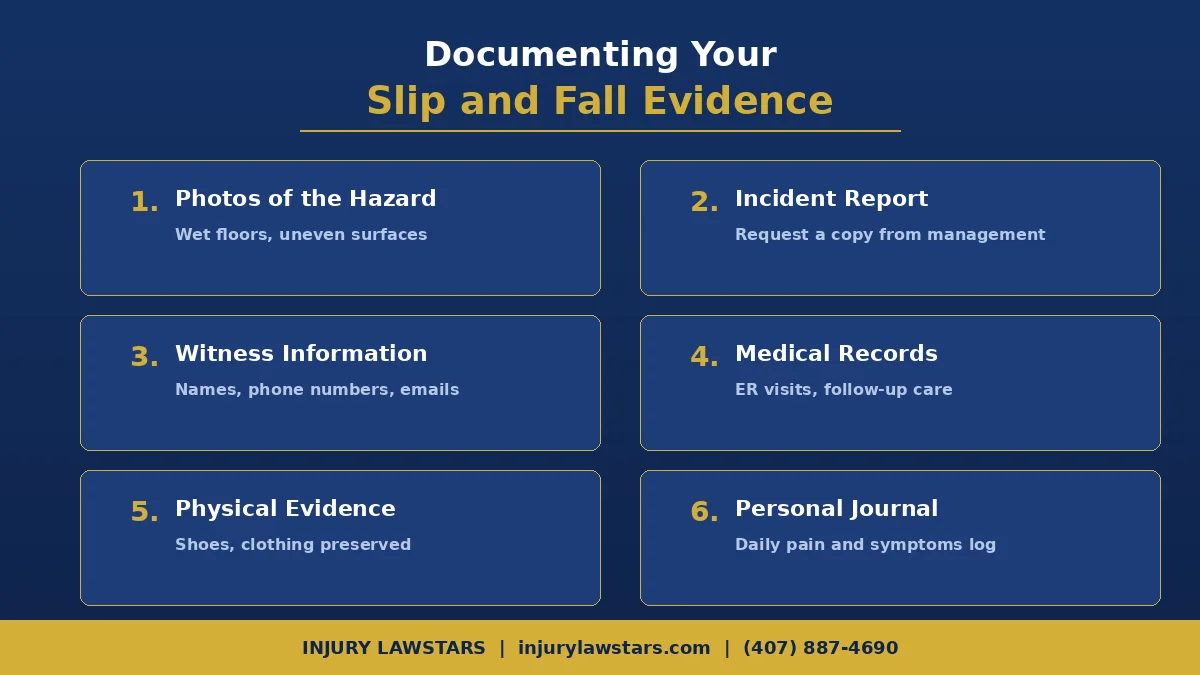
Step 4: Take Photos and Videos of the Accident Scene
Evidence from the accident scene is some of the most valuable proof in a slip and fall case. Property conditions change quickly. Spills get mopped up, broken tiles get repaired, and warning signs appear where none existed before. If you are physically able, document everything before conditions change.
Photograph and video:
- The hazard that caused your fall (wet floor, uneven pavement, loose carpet, debris, poor lighting, missing handrail, torn mat)
- The absence of warning signs or barriers
- The surrounding area, including lighting conditions and weather if outdoors
- Your visible injuries (bruises, cuts, swelling, scrapes)
- Your shoes and clothing
- Any surveillance cameras visible in the area (note their locations)
Additional documentation tips:
- Use your phone’s timestamp feature so each photo is dated and timed automatically.
- Take wide-angle shots showing the overall area and close-up shots of the specific hazard.
- If someone else is with you, ask them to take photos as well from different angles.
- Write down your own account of what happened while details are still fresh in your memory.
If you are unable to document the scene yourself because of your injuries, ask a friend, family member, or even a bystander for help.
Ask Management to Preserve Video Evidence
After documenting the scene with your own phone, your next move is to ensure the property owner saves their video footage. Most businesses in Florida, from large retail stores in Ocala to restaurants in The Villages, use surveillance cameras. This footage is an impartial witness, capable of showing exactly what caused your fall, how long the hazard existed, and whether staff had an opportunity to address it. Time is critical, as many businesses automatically delete recordings within a few days or weeks. When you report the incident to a manager, make a clear, direct request for them to preserve all video evidence from the area where you fell. While a verbal request is a good start, a formal letter from a premises liability lawyer is the most effective way to legally obligate them to save this crucial evidence before it’s gone for good.
Step 5: Collect Contact Info from Any Witnesses
Independent witnesses can be critical to the success of your claim. Their testimony can confirm what the dangerous condition looked like, how long it may have existed, and whether the property owner or employees were aware of it.
What to collect from witnesses:
- Full name
- Phone number
- Email address
- A brief description of what they saw
Witnesses may have noticed things you missed, like an employee walking past the spill without cleaning it, or a “Wet Floor” sign that had been moved before your fall. Their observations can fill in gaps and significantly strengthen your case.
Do not wait to follow up. People forget details quickly, and it becomes harder to locate witnesses as time passes.
Step 6: Keep Your Shoes and Damaged Clothing
Beyond photographs, you need to preserve physical items that may serve as evidence in your case.
Keep the following:
- The shoes you were wearing at the time of the fall (do not wash or discard them)
- The clothing you were wearing (store in a bag, unwashed)
- All medical records, discharge summaries, and bills
- Prescriptions and receipts for medications
- The incident report from the property owner
- Any correspondence with insurance companies
- A written journal documenting your symptoms, pain levels, and how the injury affects your daily life
Your personal injury journal is especially valuable. Courts and insurance adjusters consider daily documentation of pain, limitations, and emotional impact when calculating damages. Start writing in it the day of the accident and continue throughout your recovery.
Contact Injury LawStars today for a free consultation or call us at (407) 887-4690. You pay nothing unless we win your case.
Step 7: Avoid Giving a Recorded Statement to Insurers
After a slip and fall accident, the property owner’s insurance company may contact you quickly. Their adjuster may sound friendly and concerned, but their goal is to minimize the amount they pay on your claim.
Important rules to follow:
- Do not give a recorded statement without first consulting an attorney. Anything you say can be taken out of context and used to reduce or deny your claim.
- Do not accept an early settlement offer. First offers are almost always far below the true value of your case. They rarely account for ongoing medical treatment, lost wages, or long-term pain and suffering.
- Do not sign any documents from the insurance company, including medical release forms that give them broad access to your medical history.
- Do not post about the accident on social media. Insurance adjusters actively monitor platforms like Facebook, Instagram, and TikTok looking for posts they can use to undermine your claim.
If an insurance adjuster contacts you, politely decline to give a detailed statement and let them know your attorney will be in touch.
Florida’s Slip and Fall Laws: What You Need to Know
Florida’s premises liability laws govern slip and fall claims, and understanding them is essential to knowing whether you have a viable case.
Proving Fault: Understanding Florida Statute 768.0755
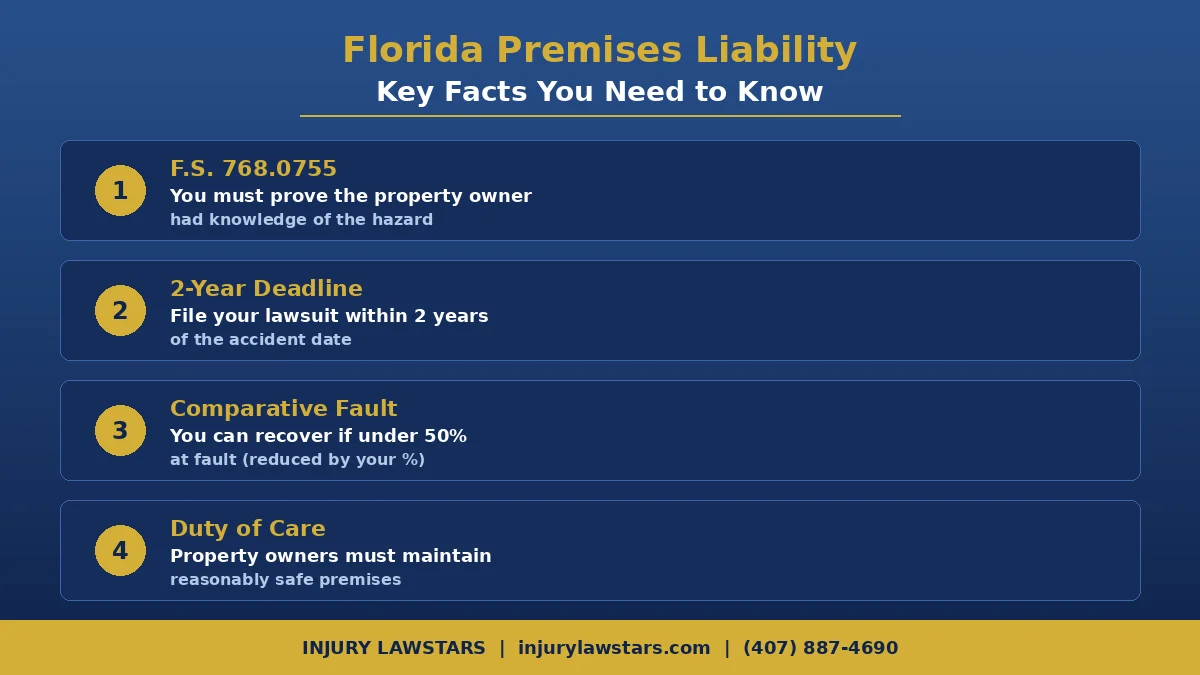
Under Florida Statute 768.0755, if you slip and fall on a transitory foreign substance in a business establishment, you must prove that the business had actual or constructive knowledge of the dangerous condition and should have taken action to remedy it.
Actual knowledge means the property owner or employees knew the hazard existed. For example, a grocery store employee who saw a spill but did not clean it up or place a warning sign.
Constructive knowledge can be proven through circumstantial evidence showing that:
- The dangerous condition existed for such a length of time that the business should have known about it (for example, a puddle from a leaking refrigerator that had been there for hours).
- The condition occurred with regularity and was therefore foreseeable (for example, a restaurant entrance that regularly becomes slippery during rainstorms but has no mats or warning signs).
This is where your evidence, including photographs, witness statements, and surveillance footage, becomes critical. The stronger your documentation, the easier it is to prove the property owner’s knowledge.
What Is a Property Owner’s “Duty of Care”?
Property owners in Florida have a legal obligation to maintain their premises in a reasonably safe condition for visitors. This includes:
- Regularly inspecting the property for potential hazards
- Promptly cleaning up spills and removing debris
- Repairing broken flooring, stairs, handrails, and walkways
- Providing adequate lighting in common areas
- Posting warning signs when a known hazard cannot be immediately fixed
Different standards of care apply depending on your legal status on the property. Business invitees (customers and visitors) receive the highest level of protection. Licensees (social guests) and trespassers receive progressively less protection under the law.
What if You’re Partially at Fault? Florida’s Negligence Rule
Florida uses a modified comparative negligence system. This means your compensation can be reduced by your percentage of fault for the accident. However, you can still recover damages as long as you are not more than 50 percent at fault.
Example: If you are awarded $100,000 in damages but the court finds you were 20 percent at fault (for example, you were looking at your phone while walking), your compensation would be reduced to $80,000.
This is why it is critical to avoid admitting any degree of fault at the scene of the accident. Insurance companies will look for any statement they can use to assign blame to you and reduce your settlement.
Common Defenses Property Owners Use
When you file a slip and fall claim, you should expect the property owner and their insurance company to push back. Their primary goal is to pay as little as possible, and they have a playbook of common arguments they use to shift blame away from themselves. They will scrutinize every detail of the accident, from the shoes you were wearing to your activities just before the fall. At Injury LawStars, we’ve seen these tactics used in cases from Clermont to The Villages, and we know how to build a strong case that anticipates and counters these defenses. Understanding their strategy is the first step in protecting your rights.
The “Obvious Danger” Argument
One of the most frequent defenses is the “open and obvious” doctrine. The property owner’s insurance company will argue that the hazard that caused your fall was so apparent that you should have seen it and avoided it. They might say a puddle of water was large and visible or a crack in the sidewalk was easy to spot. However, what seems obvious in hindsight is not always obvious in the moment. You may have been carrying groceries, looking for a specific item on a shelf, or simply walking in an area where you had a reasonable expectation of safety. A property owner’s duty to maintain a safe environment isn’t erased just because a hazard is visible.
The Distracted Victim Argument
Insurance companies often try to say the injured person was at fault. They will look for any reason to claim you were distracted and not paying attention to your surroundings. Were you looking at your phone? Talking to a friend? Rushing? They will use these arguments to assign a percentage of fault to you under Florida’s comparative negligence rule, hoping to reduce the amount they have to pay. While being distracted can impact your claim, it doesn’t automatically mean the property owner is off the hook. We often see this defense in pedestrian accident cases, and the same principle applies here: a property owner still has a duty to fix known dangers.
The “Eggshell Plaintiff” Rule in Florida
What if you had a pre-existing condition that made your injuries from the fall worse? Insurance companies may try to argue they shouldn’t be responsible for the full extent of your harm. However, Florida law follows the “eggshell plaintiff” rule. This rule protects people who might be more easily hurt. It means the at-fault party must take the victim as they find them. If you had a condition like osteoporosis that caused a simple fall to result in multiple fractures, the property owner is responsible for the full scope of those injuries, not just what a healthier person might have sustained. They can’t say you were too fragile to begin with. This is especially critical in cases involving a brain injury, where a prior concussion can make a new head injury catastrophic.
Where Do Most Slip and Fall Accidents Occur?
Slip and fall accidents in Florida happen in a wide range of locations. Understanding where these incidents most commonly occur can help you recognize when a property owner may have been negligent.
Falls at Stores, Malls, and Businesses
- Grocery stores and supermarkets: Wet floors from produce misters, spilled liquids, recently mopped aisles without warning signs
- Restaurants and bars: Grease on kitchen floors, spilled drinks, uneven outdoor patios
- Retail stores and shopping malls: Cluttered aisles, wet entrance areas, escalator and elevator malfunctions
- Hotels and resorts: Slippery pool decks, poorly maintained walkways, wet lobby floors
Accidents in Apartment Complexes or Private Homes
- Apartment complexes: Broken stairways, poor outdoor lighting, unmaintained parking lots, slippery pool areas
- Rental homes: Loose carpeting, broken steps, uneven flooring
Injuries on Government or Public Property
- Sidewalks and public walkways: Cracked or uneven pavement, tree root damage
- Government buildings: Wet floors, poor lighting, broken handrails
- Parks and recreation areas: Slippery surfaces, poorly maintained trails, inadequate signage
Important note about government property claims: If your slip and fall occurred on government property in Florida, you may face additional requirements, including shorter notice periods for filing a claim. Florida’s sovereign immunity rules require you to notify the government entity within a specific timeframe, and failure to do so may bar your claim entirely. Consult a premises liability attorney immediately if your fall occurred on public property.
Who Can Be Held Liable for a Slip and Fall?
After a fall, it might seem obvious who is at fault, but Florida law can be more complex. Liability doesn’t always fall on a single person or company. Depending on the circumstances, several parties could be responsible for the hazardous condition that caused your injuries. Identifying every liable party is a critical step in securing the full compensation you deserve, and it often requires a detailed investigation into property records, leases, and maintenance contracts.
Property Owners and Their Employees
The most straightforward liable party is usually the property owner. Property owners are generally expected to keep their property safe so people don’t get hurt. If an owner in a place like Eustis or Lady Lake knew about a danger but didn’t fix it or warn people, they might be held responsible. This duty applies to owners of all types of properties, from large shopping centers in The Villages to small, local businesses in Groveland. Our team of dedicated legal advocates can help determine if this duty was breached. This responsibility also extends to their employees. If a store employee sees a spill and fails to clean it up or put down a warning sign, the law holds the property owner liable for that employee’s negligence.
Other Potentially Liable Parties
It’s not always just the property owner who is at fault. In many cases, liability is shared among multiple parties. As one legal expert notes, “It could be the business owner (if they rent the space), a cleaning company, a contractor who did faulty work, or even the company that made a defective flooring material.” For example, if you fell because of a poorly installed handrail, both the property owner and the contractor who installed it could be held responsible. Uncovering all potential sources of liability is a crucial part of building a strong premises liability claim, which is why having an experienced legal team on your side is so important.
Business Renters and Tenants
In commercial spaces like malls or strip plazas, both the property owner (landlord) and the business renting the space (tenant) may have duties to keep the premises safe. The lease agreement between them often specifies who is responsible for maintenance in different areas. For instance, the landlord might be responsible for common areas like parking lots and sidewalks, while the tenant is responsible for keeping the area inside their store safe. In Florida, property owners must keep their places reasonably safe for visitors, but determining who failed in that duty—the owner or the tenant—is a key question in your case.
Third-Party Contractors or Maintenance Companies
Many property owners in areas like Ocala and Wildwood hire outside companies for services like cleaning, landscaping, security, and repairs. If one of these third-party contractors creates a dangerous condition, they can be held liable for any injuries that result. For example, if a cleaning company mops a floor but fails to put up a “Wet Floor” sign, or a landscaping crew leaves tools on a public walkway, that company can be named in a personal injury lawsuit. In these situations, both the contractor and the property owner who hired them may share responsibility for the accident.
Falls at a Friend’s or Neighbor’s Home
Suffering an injury at the home of a friend, neighbor, or family member can feel incredibly awkward. Many people hesitate to take action because they don’t want to sue someone they care about. However, it’s important to understand that a claim is typically filed against their homeowner’s or renter’s insurance policy, not their personal assets. As legal sources explain, “If you fall at someone else’s home, their homeowner’s or renter’s insurance usually covers it.” These policies exist for accidents just like this. To have a valid claim, you still must prove the homeowner was negligent—for example, they knew about a broken step in their Lake Panasoffkee home but failed to warn you, similar to how liability works in a dog bite case.
What Are the Most Common Injuries From a Slip and Fall?
The injuries from a slip and fall range from minor to life-altering. Understanding common injuries helps you communicate effectively with your doctor and your attorney about the full scope of your damages.
From Broken Bones to Brain Injuries
- Broken bones and fractures: Wrists, hips, ankles, and arms are the most commonly fractured in falls. Hip fractures are particularly dangerous for older adults and may require surgery and extended rehabilitation.
- Traumatic brain injuries (TBIs): Hitting your head during a fall can cause concussions or more severe brain injuries that affect memory, concentration, mood, and motor function. Even a “mild” concussion can have lasting effects.
- Spinal cord injuries: Falls can herniate discs, compress nerves, or cause spinal fractures. These injuries may result in chronic pain, limited mobility, or in severe cases, paralysis.
- Soft tissue injuries: Sprains, strains, torn ligaments, and tendon damage may not appear on X-rays but can cause significant pain and require months of physical therapy.
- Cuts, bruises, and abrasions: While often considered minor, deep lacerations may require stitches and can leave permanent scarring.
- Knee and shoulder injuries: Torn ACLs, meniscus tears, and rotator cuff injuries are common in falls and often require surgical intervention.
The Hidden Toll: Emotional and Mental Trauma
Slip and fall accidents can also cause significant emotional distress, including anxiety about returning to the location where the fall occurred, depression from limited mobility, and post-traumatic stress. These non-economic damages are compensable under Florida law.
How Much Is a Slip and Fall Claim Worth in Florida?
Every slip and fall case is unique, and settlement amounts vary significantly based on the specific facts of your situation. However, understanding the categories of damages you may be entitled to can help you set realistic expectations.
Calculating Economic Damages (Medical Bills, Lost Wages)
- Medical expenses: Emergency room visits, surgeries, hospital stays, physical therapy, medications, medical devices, and future anticipated treatment costs.
- Lost wages: Income lost during recovery, including vacation days and sick time used because of the injury.
- Loss of earning capacity: If your injuries prevent you from returning to your previous job or reduce your ability to work.
- Out-of-pocket costs: Transportation to medical appointments, home modifications, and assistance with daily tasks.
Valuing Non-Economic Damages (Pain and Suffering)
- Pain and suffering: Compensation for the physical pain and discomfort caused by your injuries.
- Emotional distress: Anxiety, depression, insomnia, and other psychological impacts of the accident.
- Loss of enjoyment of life: The inability to participate in hobbies, activities, and daily routines you enjoyed before the accident.
- Loss of consortium: If the injury has affected your relationship with your spouse or family members.
The Multiplier Method Explained
So, how do you put a number on something as personal as pain and suffering? Insurance companies and attorneys often use what’s called the “multiplier method” to estimate the value of your non-economic damages. The process involves adding up all your concrete financial losses—what we call economic damages, like medical bills and lost income—and multiplying that total by a number, typically between 1.5 and 5. This “multiplier” depends on the severity of your injuries and their impact on your life. A minor sprain might get a 1.5, while a permanent injury requiring multiple surgeries could warrant a 4 or 5. This method helps translate the real-world impact of your injury into a figure that can be used in settlement negotiations for premises liability claims.
What Factors Influence Your Settlement Value?
Several factors influence how much a slip and fall claim is worth:
- The severity and permanence of your injuries
- The total amount of your medical bills (current and projected future costs)
- The strength of your evidence proving the property owner’s negligence
- Whether you share any fault for the accident under Florida’s comparative negligence rules
- The property owner’s insurance policy limits
- The quality of your legal representation
While there is no guaranteed formula for calculating a settlement, working with an experienced premises liability lawyer gives you the best chance of securing full and fair compensation for your losses.
Average Settlement Amounts for Slip and Fall Cases
While it’s natural to wonder what a typical settlement looks like, there is no magic number because every case is different. Some legal guides suggest a broad average for slip and fall settlements is between $30,000 and $60,000, but this figure can be misleading. A case involving minor sprains might settle for less than $10,000. In contrast, a fall that results in a permanent disability, a traumatic brain injury, or requires multiple surgeries could lead to a settlement or verdict worth hundreds of thousands of dollars or more. The final value depends entirely on the severity of your injuries, the clarity of the property owner’s negligence, and the total economic and non-economic damages you have suffered.
Can You Get Punitive Damages?
Punitive damages are an additional form of compensation awarded to punish a defendant for extreme wrongdoing and deter similar behavior in the future. Unlike compensatory damages that cover your losses, punitive damages are a penalty. However, they are rare in slip and fall cases because Florida law sets a very high standard. To receive punitive damages, you must prove the property owner was guilty of intentional misconduct or gross negligence—not just simple carelessness. This means showing they knew about an extremely dangerous condition and made a conscious decision to disregard the safety of others, which is a difficult but not impossible standard to meet in court.
How Is a Final Settlement Divided?
It’s important to understand that the final settlement amount is not the same as the check you receive. Several deductions are made from the gross settlement total. For example, out of a $100,000 settlement, the first deduction is typically for attorney’s fees. Since we work on a contingency basis, this fee is a percentage of the settlement and is only paid if we win your case. Next, any outstanding medical bills or health insurance liens must be paid back. Finally, case costs, such as expert witness fees or court filing fees, are reimbursed. After all these deductions, the remaining amount is your net recovery. While it varies, plaintiffs often retain around 60% to 75% of the total settlement, and we ensure you understand every potential cost upfront.
How Long Does a Slip and Fall Case Take?
One of the first questions I hear from clients is, “How long will this take?” It’s a completely valid question. You’re dealing with injuries, medical bills are piling up, and you want to get back to your life. The honest answer is that every case is different, and the timeline depends on many factors, including the severity of your injuries and how willing the insurance company is to offer a fair settlement. While it’s not a fast process, patience is key to ensuring you don’t leave money on the table. The goal is to recover the full compensation you deserve, not just to get a quick check.
The Typical Settlement Timeline
The good news is that the vast majority of slip and fall cases—around 90%—are resolved without ever going to trial. For most of our clients in places like Ocala, Clermont, and The Villages, a settlement is typically reached within six to 18 months. This timeline allows for the crucial steps needed to build a strong claim. First, you need to complete your medical treatment or reach what’s called Maximum Medical Improvement (MMI). This tells us the full extent of your injuries and future medical needs. Then, we gather all your records, calculate your total damages, and send a detailed demand package to the insurance company. The negotiation phase that follows can take several months, but it’s where an experienced premises liability lawyer works to secure a fair outcome for you.
What if Your Case Goes to Trial?
If the insurance company refuses to negotiate in good faith, filing a lawsuit may be the only way to get the compensation you deserve. When a case goes to trial, the timeline extends significantly, often taking two to four years or even longer. This is because the formal litigation process involves lengthy procedures like discovery, depositions, expert witness preparations, and waiting for an available date on the court’s busy calendar. Slip and fall trials can be challenging because Florida law requires you to prove the property owner had “actual or constructive knowledge” of the hazard. This is a high bar to clear, which is why having a dedicated legal team that prepares every case as if it’s going to trial is so important. This thorough preparation is often what convinces the other side to offer a fair settlement before a trial becomes necessary.
Step 8: When to Contact a Florida Slip and Fall Attorney
Do not try to handle a slip and fall claim on your own. Property owners, businesses, and their insurance companies have legal teams dedicated to minimizing payouts. You deserve someone fighting just as hard on your side.
An experienced attorney can:
- Investigate the accident scene, request surveillance footage, and gather evidence before it disappears
- Obtain maintenance logs, inspection records, and cleaning schedules from the property owner
- Send a preservation letter to prevent the destruction of critical evidence
- Handle all communication with insurance adjusters so you do not accidentally hurt your case
- Calculate the full value of your damages, including future medical costs and long-term impacts
- Negotiate aggressively for a fair settlement or take your case to trial if necessary
Don’t Miss the Deadline: Florida’s Statute of Limitations
Under Florida Statute 95.11(3)(a), you have two years from the date of your slip and fall accident to file a personal injury lawsuit. This deadline was reduced from four years in 2023.
Two years may sound like a long time, but evidence deteriorates quickly. Surveillance footage is often overwritten within days or weeks. Witnesses move or forget important details. Medical records become harder to connect to the accident the longer you wait.
The sooner you contact an attorney, the stronger your case will be. At Injury LawStars, consultations are free, and you pay nothing unless we win your case. That is our commitment to every person we represent.
Why Hiring an Attorney Can Impact Your Settlement
It’s tempting to think you can manage a slip and fall claim on your own, especially when you’re just trying to get back on your feet. But going up against a business and its insurance provider is rarely a fair fight. Slip and fall cases are complex; winning isn’t just about proving you fell, but proving the property owner was negligent and that their negligence directly caused your injuries. This is where an experienced attorney makes a significant difference. Research shows that accident victims who hire a personal injury lawyer often receive settlements that are three to four times higher than those who represent themselves. An attorney knows how to gather critical evidence like maintenance logs and surveillance footage before it’s destroyed, handle aggressive insurance adjusters, and build a case that proves the full value of your claim. At Injury LawStars, we level the playing field, allowing you to focus on your recovery while we handle the legal complexities.
Common Mistakes That Can Hurt Your Slip and Fall Claim
Avoid these frequent errors that can weaken or destroy an otherwise strong case:
- Waiting too long to seek medical attention. Insurance companies will argue that if you did not see a doctor right away, your injuries must not be serious.
- Not reporting the accident. Without an incident report, the property owner may deny the fall ever happened on their premises.
- Admitting fault at the scene. Even casual statements like “I wasn’t paying attention” can be used against you.
- Posting about the accident or your injuries on social media. Adjusters will comb through your posts looking for anything they can use to minimize your claim.
- Accepting the first settlement offer. Initial offers are almost always too low and do not account for the full extent of your damages.
- Failing to preserve evidence. Throwing away the shoes you wore, washing clothing, or not taking photographs can eliminate key evidence.
- Giving a recorded statement without an attorney. Insurance adjusters are trained to get you to say things that hurt your case.
- Ignoring your doctor’s treatment plan. Gaps in treatment suggest to insurance companies that your injuries are not as severe as claimed.
Answering Your Questions About Slip and Fall Claims
Use this checklist to stay organized and protect your claim in the days and weeks following your slip and fall:
- Seek medical attention (within 24 hours, ideally same day)
- Report the incident and obtain a copy of the incident report
- Photograph the scene, hazard, injuries, shoes, and clothing
- Collect witness names and contact information
- Preserve physical evidence (shoes, clothing, documents)
- Start a personal injury journal documenting pain and daily impact
- Do not give recorded statements to insurance companies
- Do not post about the accident on social media
- Keep all medical records, bills, and receipts organized
- Contact a Florida slip and fall attorney for a free consultation
- Follow your doctor’s full treatment plan without gaps
- Request surveillance footage preservation from the property owner
Contact Injury LawStars today for a free consultation or call us at (407) 887-4690. You pay nothing unless we win your case.
Frequently Asked Questions About Slip and Fall Accidents in Florida
How long do I have to file a slip and fall lawsuit in Florida?
You have two years from the date of the accident to file a personal injury lawsuit under Florida Statute 95.11(3)(a). This deadline is strict. If you miss it, you will almost certainly lose your right to seek compensation, regardless of how strong your case is. Start the process early by contacting an attorney as soon as possible.
Can I still recover compensation if I was partially at fault for the fall?
Yes. Florida’s modified comparative negligence rule allows you to recover damages as long as you are not more than 50 percent at fault. Your compensation will be reduced by your percentage of responsibility. For example, if a jury awards $200,000 and finds you 30 percent at fault, you would receive $140,000.
What if the property owner says they did not know about the hazard?
Under Florida Statute 768.0755, you can prove the property owner’s liability through constructive knowledge. This means showing that the dangerous condition existed long enough that a reasonable property owner should have discovered and addressed it, or that it occurred with regularity and was foreseeable. Your attorney can help gather the evidence needed to establish this.
Do I need a lawyer for a slip and fall claim?
While you are not legally required to hire an attorney, slip and fall cases involve complex legal standards under Florida’s premises liability laws. Property owners and insurance companies will have experienced legal teams working to minimize or deny your claim. Having an attorney levels the playing field and typically results in significantly higher settlements.
How much is my slip and fall case worth?
The value of your case depends on factors including the severity of your injuries, your medical expenses, lost wages, the extent of the property owner’s negligence, and your degree of fault. Minor injuries may settle for a few thousand dollars, while cases involving broken bones, traumatic brain injuries, or spinal cord damage can result in settlements of hundreds of thousands of dollars or more.
What if my slip and fall happened at a government building or public sidewalk?
Claims against government entities in Florida have additional requirements, including shorter notice periods and specific filing procedures. You may need to file a notice of claim with the government agency before you can pursue a lawsuit. An experienced attorney can guide you through these additional steps and make sure you meet all deadlines.
Should I accept the insurance company’s first settlement offer?
Almost never. First offers from insurance companies are typically calculated to close the claim quickly and cheaply. They rarely reflect the full value of your damages, including future medical costs and long-term effects of your injuries. Let your attorney evaluate the offer and negotiate on your behalf.
What evidence is most important in a slip and fall case?
The strongest evidence typically includes photographs of the hazard and the scene, the incident report, medical records showing injuries connected to the fall, surveillance footage from the property, witness statements, and maintenance or inspection logs from the property owner. The more evidence you gather immediately after the fall, the stronger your case will be.
At Injury LawStars, Attorney Katie Miller was once an injury victim herself. She turned that experience into a mission: to protect people who are hurting and make sure no one goes through the legal process alone. If you have been injured in a slip and fall accident anywhere in Florida, including communities across Lake County, Marion County, Clermont, Ocala, The Villages, Orlando, Tampa, and Jacksonville, we are ready to fight for you.
Contact Injury LawStars today for a free consultation. You pay nothing unless we win your case.
If your slip and fall happened at your workplace, you may be entitled to benefits under Florida workers’ compensation laws rather than a premises liability claim.
Related Articles
- What to Do After a Slip and Fall Accident in Florida
- Premises Liability Florida: Complete Guide to Your Rights
- Slip and Fall Attorney in Miami: What You Must Know
- Why Hire a Slip and Fall Lawyer in Delray Beach?
About the Author
Katie Miller, Esq.
Managing Partner · Injury LawStars
Attorney Katie Miller was once an injury victim herself. After a car accident in 2016 that required spinal surgery and a 13-month recovery, she turned her experience into a mission: fighting for people who are hurting. With 17+ years of legal experience and over \$45 million recovered for clients, Katie brings both professional expertise and personal understanding to every case.