March 28, 2026
Types of Damages in Personal Injury Cases: A Complete Florida Guide
Key Takeaways
- Florida personal injury victims can recover three categories of damages: economic damages, non-economic damages, and punitive damages.
- Economic damages cover quantifiable financial losses like medical bills, lost wages, and property damage, while non-economic damages compensate for pain, suffering, and emotional distress.
- Punitive damages in Florida are rare and capped under HB 837 at three times compensatory damages or $500,000, whichever is greater.
- Florida’s modified comparative negligence rule (the 51% bar) can reduce or eliminate your damages if you share fault for the accident.
- Thorough documentation, including medical records, expert testimony, and life care plans, is critical to maximizing your damage award.
If you have been injured in an accident in Florida, understanding the types of damages in personal injury cases is one of the most important steps you can take to protect your financial future. The term “damages” refers to the monetary compensation the law allows you to pursue when someone else’s negligence causes you harm. These damages are designed to cover everything from your hospital bills and lost paychecks to the pain and emotional toll your injuries have taken on your life.
Florida law divides personal injury damages into three distinct categories: economic damages, non-economic damages, and punitive damages. Each serves a different purpose, and the total compensation available to you depends on the specific facts of your case, the severity of your injuries, and how well your losses are documented. Recent changes under Florida’s tort reform law, House Bill 837, have also introduced new rules that directly affect how damages are calculated and awarded.
Contact Injury LawStars today at (407) 887-4690 for a free consultation. Attorney Katie Miller and her team will evaluate your case and fight to recover every dollar of compensation you deserve.
What Are Damages in a Florida Personal Injury Case?
In a personal injury case, “damages” is the legal term for the financial compensation an injured person is entitled to receive. The fundamental goal of awarding damages is to restore the victim, as closely as possible, to the position they were in before the accident occurred. Florida courts recognize that no amount of money can truly undo the harm caused by a serious injury, but the legal system provides a structured framework for calculating fair compensation.
Personal injury damages in Florida fall into two broad categories: compensatory damages and punitive damages. Compensatory damages are further divided into economic damages (also called special damages) and non-economic damages (also called general damages). Understanding how each category works is essential to building a strong claim that accounts for every loss you have suffered.
What Are Economic Damages in a Personal Injury Case?
Economic damages are the measurable, quantifiable financial losses you incur as a direct result of your injury. These are the expenses and financial setbacks that can be verified with documentation like bills, receipts, pay stubs, and expert projections. Because they are based on hard numbers, economic damages are typically the most straightforward component of a personal injury claim to calculate.
Medical Bills and Healthcare Costs
Medical expenses are often the largest component of economic damages. This includes every healthcare cost related to your injury, from the initial ambulance ride and emergency room visit to ongoing treatment, surgeries, hospital stays, prescription medications, physical therapy, rehabilitation, and medical equipment like wheelchairs or braces. If your injuries require long-term care, you can also claim the cost of home health aides, nursing care, and assisted living.
Future Medical Care and Treatment
Many personal injury victims require medical treatment that extends months or even years beyond the initial accident. Future medical care damages account for anticipated costs including additional surgeries, ongoing physical therapy, pain management, follow-up appointments, and prescription medications. Calculating future medical expenses often requires testimony from medical experts and may involve a life care plan, which is a detailed document outlining all future medical needs and their projected costs. Victims of severe injuries like traumatic brain injuries often face decades of future medical expenses.
Lost Wages and Loss of Earning Capacity
When an injury prevents you from working, you are entitled to recover the income you lost during your recovery period. Lost wages include salary, hourly wages, bonuses, commissions, tips, and any other employment income you would have earned. If your injuries are severe enough to permanently limit your ability to work, or if you must accept a lower-paying position because of physical restrictions, you can also claim loss of earning capacity. An economist or vocational rehabilitation expert can calculate the difference between what you would have earned over your career and what you are now able to earn.
Property Damage
If your personal property was damaged in the accident, such as your vehicle in a car accident, you can recover the cost of repair or replacement. Property damage also covers personal items that were in the vehicle, including electronics, clothing, or child car seats.
Out-of-Pocket Expenses
Accident victims frequently incur miscellaneous expenses that add up quickly. Out-of-pocket costs may include transportation to and from medical appointments, parking fees at hospitals, costs of hiring help for household tasks you can no longer perform, home modifications for accessibility (like wheelchair ramps), and any other reasonable expenses directly related to your injury and recovery.
What Are Non-Economic Damages in a Personal Injury Case?
Non-economic damages compensate you for the intangible, non-financial losses that result from your injury. While these losses do not come with a receipt or an invoice, they are just as real as economic damages, and in many cases, they make up the largest portion of a personal injury settlement or verdict. Florida law recognizes several categories of non-economic damages.
Pain and Suffering
Pain and suffering damages compensate you for the physical pain and discomfort caused by your injuries. This includes the acute pain immediately following the accident, the pain endured during medical treatment and rehabilitation, and any chronic or ongoing pain you experience as a result of your injuries. Pain and suffering is a deeply personal experience, and its value depends on the nature, severity, and duration of your injuries. If you are dealing with pain and suffering from an accident, an experienced attorney can help you understand what your claim may be worth.
Emotional Distress and Mental Anguish
Serious injuries do not just affect your body. They can take an enormous toll on your mental health. Emotional distress damages cover conditions like anxiety, depression, post-traumatic stress disorder (PTSD), insomnia, fear, and other psychological impacts caused by the accident and your injuries. Medical records from mental health professionals, therapists, and psychiatrists are critical to documenting these claims.
Loss of Enjoyment of Life
When injuries prevent you from participating in hobbies, recreational activities, social events, or other aspects of life that you previously enjoyed, you may be entitled to loss of enjoyment of life damages. A person who can no longer play sports, travel, garden, or spend active time with their family because of accident-related injuries has suffered a genuine and compensable loss.
Loss of Consortium
Loss of consortium is a claim brought by the spouse or close family member of the injured person. It compensates for the loss of companionship, affection, intimacy, support, and the ability to maintain a normal marital or family relationship. In wrongful death cases, loss of consortium damages can be especially significant for surviving family members.
Scarring and Disfigurement
If your injuries result in permanent scarring, disfigurement, or the loss of a limb, you are entitled to additional non-economic damages that reflect the lasting physical and emotional impact of these visible injuries. The value of scarring and disfigurement damages depends on factors including the location and visibility of the scars, the victim’s age and occupation, whether corrective surgery is possible, and the psychological impact of living with permanent reminders of the accident.
Inconvenience and Loss of Independence
Injuries that limit your mobility, require you to depend on others for basic daily tasks, or force significant changes to your lifestyle can result in inconvenience damages. A victim who previously lived independently but now requires assistance with bathing, dressing, cooking, or driving has suffered a compensable loss of independence that goes beyond what medical bills and lost wages can capture.
Call Injury LawStars at (407) 887-4690 to discuss your non-economic damages with Attorney Katie Miller. We do not charge any fees unless we win your case.
How Are Personal Injury Damages Calculated in Florida?
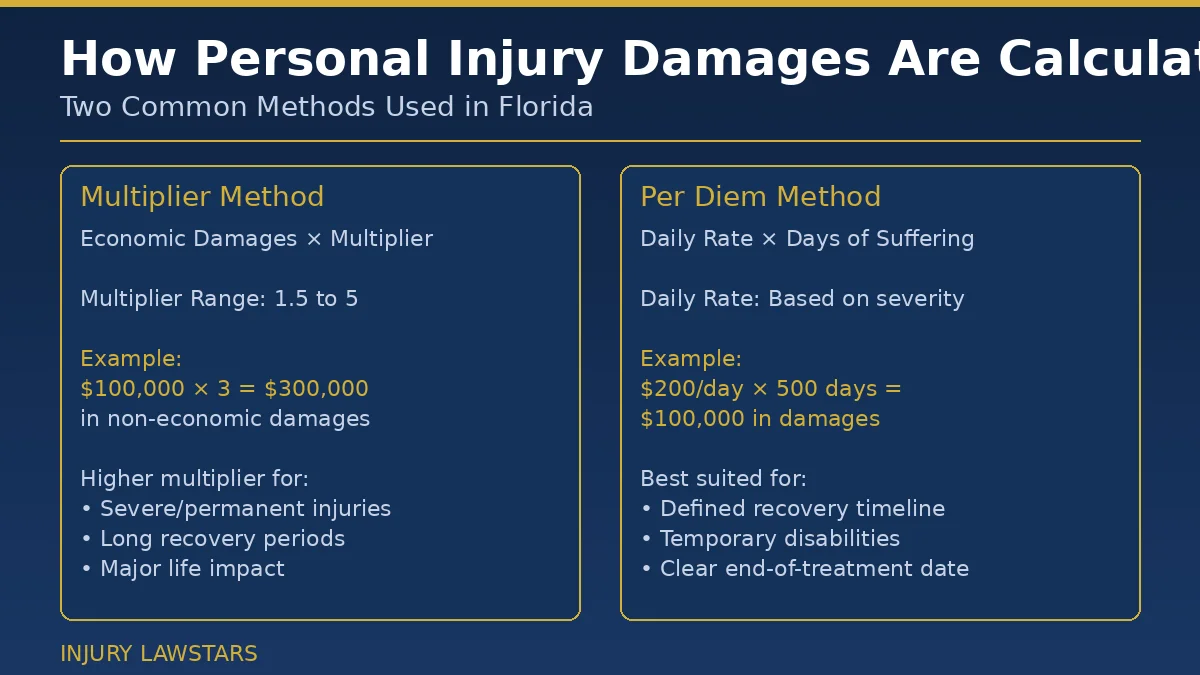
Calculating personal injury damages involves both objective financial analysis and subjective evaluation of intangible losses. Economic damages are relatively straightforward because they rely on documentation. Non-economic damages, however, require different approaches because there is no receipt for pain or a bill for emotional distress. Two widely used methods for calculating non-economic damages in Florida are the multiplier method and the per diem method. Understanding how these methods work can help you evaluate whether a settlement offer fairly reflects the true value of your claim.
The Multiplier Method
The multiplier method is the most common approach used by attorneys and insurance companies. It involves adding up the total economic damages and multiplying that figure by a number (the “multiplier”) typically ranging from 1.5 to 5. The multiplier selected depends on several factors, including the severity of your injuries, the length of your recovery, the impact on your daily life, and whether your injuries are permanent. For example, if your economic damages total $100,000 and a multiplier of 3 is applied, your non-economic damages would be calculated at $300,000, bringing the total compensatory damages to $400,000.
The Per Diem Method
The per diem (Latin for “per day”) method assigns a specific dollar amount to each day you live with pain and limitations caused by your injury. This daily rate is then multiplied by the number of days you are expected to suffer from the effects of your injury. For instance, if a daily rate of $200 is assigned and you are expected to experience pain and limitations for 500 days, the non-economic damages would be calculated at $100,000. The per diem method can be particularly effective for injuries with a defined recovery timeline.
What Are Punitive Damages in Florida?
Punitive damages serve a fundamentally different purpose than compensatory damages. While economic and non-economic damages are designed to compensate the victim, punitive damages are intended to punish the defendant for particularly egregious, reckless, or malicious behavior and to deter others from engaging in similar conduct. Punitive damages are not awarded in most personal injury cases. They are reserved for situations where the defendant’s actions go far beyond ordinary negligence.
When Are Punitive Damages Awarded?
Under Florida Statute § 768.72, a plaintiff must receive permission from the court before even presenting a claim for punitive damages to a jury. The plaintiff must demonstrate a reasonable basis for recovering punitive damages through evidence of the defendant’s intentional misconduct or gross negligence. Examples of conduct that may warrant punitive damages include:
- Drunk driving or driving under the influence of drugs
- Intentional acts of violence or road rage
- Gross negligence by a healthcare provider in medical malpractice cases
- A company knowingly selling a dangerous or defective product
- An employer deliberately ignoring workplace safety regulations
Punitive Damage Caps Under Florida HB 837
Florida’s tort reform law, House Bill 837, established caps on punitive damages. In most cases, punitive damages cannot exceed the greater of:
- Three times the amount of compensatory damages, or
- $500,000
However, there are important exceptions. If the defendant’s conduct was motivated by unreasonable financial gain and the defendant knew the conduct was likely to result in injury, the cap increases to the greater of four times compensatory damages or $2 million. In cases involving intentional misconduct where the defendant acted with specific intent to harm, there is no cap on punitive damages.
How Do Damage Caps and Limits Affect Your Florida Personal Injury Case?
While Florida does not impose a general cap on compensatory damages in most personal injury cases, there are specific situations where statutory limits apply.
Medical Malpractice Damage Caps
Florida has a complicated history with medical malpractice damage caps. The Florida Supreme Court struck down certain non-economic damage caps in medical malpractice cases as unconstitutional. However, the legislative landscape continues to evolve, and specific limitations may apply depending on the type of medical provider involved and whether the case involves wrongful death. If you believe you have a medical malpractice claim, consulting with an attorney who understands the current state of the law is essential.
Sovereign Immunity Caps (Claims Against the Government)
If your injury was caused by a government entity or government employee, Florida’s sovereign immunity waiver limits your recovery. Under Florida Statute § 768.28, the current caps are $200,000 per claim and $300,000 per incident. To recover amounts above these caps, you must petition the Florida Legislature through a special claims bill, which is a lengthy and uncertain process.
Workers’ Compensation Limitations
If you were injured on the job, workers’ compensation may be your exclusive remedy against your employer, and it does not allow recovery for pain and suffering. However, if a third party (someone other than your employer) contributed to your injury, you may be able to file a separate personal injury claim against that party and recover full damages, including non-economic losses.
How Does Comparative Negligence Reduce Your Damages in Florida?
Florida’s modified comparative negligence law, enacted under HB 837, significantly affects how damages are calculated when the injured person shares some fault for the accident. Under the 51% bar rule, if you are found to be 51% or more at fault for the accident, you are completely barred from recovering any damages.
If your share of fault is 50% or less, your total damage award is reduced by your percentage of fault. For example, if you are awarded $200,000 in damages but found to be 20% at fault, your recovery is reduced by 20%, and you would receive $160,000. Understanding how Florida’s comparative negligence law works is critical because insurance companies routinely try to shift blame onto the injured person to reduce or eliminate their payout.
This rule makes it especially important to work with an attorney who can build a strong case establishing the defendant’s liability and minimizing any allegations of shared fault on your part. Insurance companies frequently investigate accident victims’ backgrounds, review police reports for any suggestion of contributory fault, and hire accident reconstruction experts to support their arguments. Having your own legal team prepared to counter these tactics can protect your right to full compensation.
Do not let the insurance company reduce your compensation. Call Injury LawStars at (407) 887-4690 for a free case evaluation with Attorney Katie Miller.
How to Document Your Damages and Maximize Your Recovery
The strength of your personal injury claim depends heavily on the quality and completeness of your documentation. Insurance companies look for gaps in your records to argue that your injuries are not as severe as you claim or that certain expenses are unrelated to the accident. Here is how to protect the value of your case:
Medical Records and Documentation
Seek medical attention immediately after your accident and follow every treatment recommendation from your doctors. Keep copies of all medical records, bills, diagnostic reports, imaging results, prescription records, and discharge summaries. Consistent medical treatment creates a clear timeline linking your injuries to the accident.
Expert Testimony and Life Care Plans
For serious or permanent injuries, expert testimony is often essential. Medical experts can testify about the nature and extent of your injuries, your prognosis, and the treatment you will need in the future. Economists can project your future lost earning capacity. A life care plan, prepared by a qualified specialist, outlines every anticipated medical expense, assistive device, home modification, and therapeutic service you will require over your lifetime. Life care plans are particularly important in cases involving traumatic brain injuries, spinal cord injuries, and other catastrophic harm.
Financial Records
Gather pay stubs, tax returns, employment records, and any documentation that establishes your income before and after the accident. If you are self-employed, business financial statements and contracts can help prove lost income. Keep receipts for every out-of-pocket expense related to your injury.
Personal Journal and Impact Statements
Keeping a daily journal documenting your pain levels, emotional state, physical limitations, and how your injuries affect your daily activities can be powerful evidence for non-economic damages. Personal statements from family members describing the changes they have observed in you can further support your claim.
What Are Common Mistakes That Reduce Damage Awards?
Many personal injury victims unknowingly take actions that reduce the value of their claims. Avoiding these mistakes can make a significant difference in the compensation you ultimately receive:
- Delaying medical treatment: Waiting to see a doctor creates a gap in your medical records that insurance companies use to argue your injuries are not related to the accident or are not as serious as you claim.
- Giving recorded statements to insurance adjusters: Anything you say to the at-fault party’s insurance company can be used against you. Insurance adjusters are trained to ask questions that minimize your claim.
- Posting on social media: Photos, check-ins, and comments on social media are routinely used by defense attorneys and insurance companies to undermine injury claims. Even an innocent photo at a family gathering can be twisted to suggest your injuries are not severe.
- Failing to follow medical advice: If you skip appointments, stop treatment early, or ignore your doctor’s recommendations, the defense will argue that your injuries were not significant enough to warrant the damages you are seeking.
- Accepting a quick settlement offer: The first offer from an insurance company is almost always far below the true value of your claim. Accepting before you fully understand the extent of your injuries and future expenses can leave you significantly undercompensated.
- Missing the statute of limitations: Under Florida law, you have two years from the date of the accident to file a personal injury lawsuit. Missing this deadline means losing your right to seek any compensation.
- Not hiring an attorney: Handling a personal injury claim without legal representation puts you at a significant disadvantage against experienced insurance adjusters and defense lawyers.
Frequently Asked Questions About Personal Injury Damages in Florida
What is the difference between economic and non-economic damages?
Economic damages are financial losses you can verify with documentation, such as medical bills, lost wages, and property damage. Non-economic damages compensate for intangible losses like pain and suffering, emotional distress, and loss of enjoyment of life. Both types are part of compensatory damages designed to make the injured person whole.
Are there caps on personal injury damages in Florida?
Florida does not cap compensatory damages (economic and non-economic) in most personal injury cases. However, punitive damages are capped at three times compensatory damages or $500,000, whichever is greater, with exceptions for intentional misconduct. Claims against government entities are capped at $200,000 per claim and $300,000 per incident under sovereign immunity.
How are pain and suffering damages calculated?
Pain and suffering is most commonly calculated using the multiplier method, which multiplies your total economic damages by a factor of 1.5 to 5 based on the severity and impact of your injuries. The per diem method assigns a daily dollar value to your suffering and multiplies it by the number of days you are affected. Your attorney and the specific facts of your case will determine which approach is most appropriate.
Can I recover punitive damages in my Florida personal injury case?
Punitive damages are only available when the defendant’s conduct was intentionally harmful or grossly negligent. You must obtain court permission before presenting a punitive damages claim to a jury. Examples include drunk driving accidents, intentional acts of violence, and cases where a company knowingly endangered consumers. Punitive damages are rare but can significantly increase the total award.
What happens to my damages if I am partially at fault for the accident?
Under Florida’s modified comparative negligence law, your damage award is reduced by your percentage of fault. If you are found to be 20% at fault, you receive 80% of the total damages. However, if you are 51% or more at fault, you are completely barred from recovering any damages. This is why it is critical to work with an attorney who can counter any attempts to shift blame onto you.
How long do I have to file a personal injury lawsuit in Florida?
Under the changes enacted by HB 837, the statute of limitations for personal injury cases in Florida is two years from the date of the accident. If you miss this deadline, you lose the right to pursue compensation entirely. There are limited exceptions for cases involving minors or delayed discovery of an injury.
Do I need an attorney to recover damages in a personal injury case?
While you are not legally required to have an attorney, personal injury cases involve complex legal rules, aggressive insurance tactics, and detailed damage calculations. An experienced personal injury attorney can identify all categories of damages you are entitled to, properly document and value your claim, negotiate with insurance companies, and take your case to trial if necessary. At Injury LawStars, we work on a contingency basis, which means you pay nothing unless we win your case.