May 29, 2026
Truck Accident Black Box Florida Evidence Guide

After a Florida truck crash, critical electronic evidence can disappear before fault is settled. While an injured family faces treatment and insurance calls, the truck’s stored records may be overwritten or lost.
truck accident black box Florida evidence can show speed, braking, throttle use, and vehicle actions near impact. Victims protect that data by acting quickly, requesting a preservation letter, and securing logs, dashcam footage, maintenance records, and carrier communications before records are overwritten or disputed.
After a collision, the urgent question is how to keep records that can reveal what happened. Why truck accident black box Florida evidence matters fast explains the time pressure and the steps that may protect your proof. Here is how.
Why truck accident black box Florida evidence matters fast
A record beyond the crash scene
After a Florida semi-truck crash, memories can be blurred by pain, fear, and sudden change. Families may hear conflicting accounts while they are still managing treatment, missed work, and a damaged vehicle. An attorney handling Florida truck accidents can seek electronic evidence before those accounts harden into a dispute.
A truck’s black box is often called an electronic control module, or ECM. Related electronic records can help show what the truck was doing near the time of impact. That evidence does not feel pain or take sides. It can give investigators a starting point for testing what drivers, witnesses, and insurers say occurred.
Why the electronic record matters
In a truck accident black box Florida investigation, small details can change the full picture. The record may help an expert examine a driver’s actions, the truck’s movement, and the timing of key events. It can also guide a deeper review of logs, scene evidence, inspections, and witness accounts.
Federal guidance shows why the electronic trail cannot be dismissed. The Federal Motor Carrier Safety Administration states that an ELD provider must obtain retrievable ECM data. That duty applies when a means of retrieval exists. In a crash case, it supports asking early which records exist and how they can be secured.
The need to act before control is lost
The trucking company or its vendors may control the truck and its stored information after the crash. If no one promptly requests preservation, useful electronic records may be harder to recover later. This is why a preservation demand matters. It puts the company on notice that crash-related information should not be lost, changed, or discarded.
Prompt action is not about rushing an injured person through recovery. It is about protecting facts while the family focuses on medical care and immediate needs. A focused review of truck accident black box evidence can show how electronic data fits with photos, reports, witnesses, and physical damage.
What truck accident black box Florida records can show
Quick answer: Black box records can support a truck accident claim when they are preserved early and compared with logs, video, GPS, inspections, and witness accounts. No single file proves everything, but consistent records can make fault harder to dispute.
Truck accident black box Florida records may show speed, braking, throttle use, cruise-control status, fault codes, and other vehicle actions near impact. Those details can help experts compare the truck’s movement with driver logs, dashcam footage, witness accounts, and physical crash evidence.
A commercial truck’s “black box” is not a single standard device. The term often refers to the engine control module (ECM) or an event data recorder (EDR). These systems can store a short digital view of how the truck was operating around a crash.
ECM and EDR basics
The ECM manages engine functions and may retain operating data. An EDR is focused on an event, such as a sudden impact or hard stop. The exact download depends on the truck, its equipment, and the data settings in use.
This does not mean every truck stores every detail. For data tied to electronic logging rules, the Federal Motor Carrier Safety Administration says retrievable ECM data must be obtained when retrieval is possible. Accurate access to available records can matter in an investigation.
Data points investigators seek
After a serious Florida collision, an expert may inspect the available download for changes before impact. Depending on the system, the records sought may include:
- Vehicle speed and changes in speed near the crash.
- Brake application, sudden braking, or hard-stop events.
- Throttle position and engine revolutions per minute (RPM).
- Cruise-control use or a change in cruise-control status.
- Seat belt status, when recorded by that truck’s system.
- Fault codes or warning events affecting truck operation.
Fault codes are not proof that a defect caused a wreck. They can show a warning or operating issue that needs follow-up. Investigators compare them with inspection records, repair history, scene evidence, and witness accounts.
Crash reconstruction value
A download can help test what happened in the seconds near impact. Speed and brake data may show whether a driver slowed, braked late, or did not brake before contact. Throttle and cruise-control data may help show why the truck kept moving at a given pace.
Black box records do not stand alone. A reconstruction expert may align the download with skid marks, vehicle damage, photos, video, and road conditions. That check can show gaps between the physical scene and an account of the collision.
For a truck accident black box Florida claim, these records can become a key part of the evidence trail. They should be reviewed with other truck accident black box evidence needed to explain how the crash occurred.
How black box data compares with logs, dashcam video, and phone records
Different records, different answers
In a Florida truck crash case, the ECM is one record, not the full story. It may help show how the truck moved near impact. Other files may explain the driver, route, vehicle care, and first response. A review of truck accident black box evidence connects the records instead of reading one alone.
The records answer different questions. The Federal Motor Carrier Safety Administration says retrievable ECM data must be retrieved when a means exists. Its guidance also calls for an independent, accurate source when an ECM lacks required ELD information.
| Evidence source | What it may show | How it helps compare the account |
|---|---|---|
| ECM or black box | Vehicle data near impact | Tests claims about truck movement |
| ELD driver log | Recorded duty status | Checks the work time line |
| Dashcam video | Road and traffic view | Adds visual context |
| GPS, telematics, and dispatch | Route data and messages | Tests timing and instructions |
| Maintenance files | Service and repair history | Checks a vehicle issue claim |
| Phone records and police report | Timing and early observations | Tests distraction or first accounts |
How records test one another
An ECM time line may point to braking or a speed change. It does not show why a driver reacted. Dashcam footage may show traffic, lanes, weather, or impact angles. GPS and telematics may help match a location with the same period shown in the truck data.
ELD logs may add a record of a driver’s duty status. Dispatch messages may show when a route or task was sent. Maintenance files may help assess a claim about the truck’s condition. Phone records may address distraction when they can be obtained and read in the proper setting.
The police report plays a different role. It may record early observations, names, and statements gathered after the crash. Yet it cannot replace data taken from the truck or company systems. Differences between records can be as useful as details that match.
Building a fuller evidence picture
A strong claim does not rest on one download, log entry, or camera clip. It seeks ECM data, logs, footage, location records, dispatch messages, service files, phone records, and the report. That set lets an investigator compare time stamps, missing periods, and conflicting accounts.
This comparison matters in a truck accident black box Florida investigation because each source has limits. In a Florida truck accident case, prompt evidence requests can seek records that explain the vehicle and the choices around it. The combined record may offer a clearer crash sequence than any single file.
Talk to a Florida truck accident lawyer before the carrier controls the evidence timeline.
How a preservation letter protects black box evidence
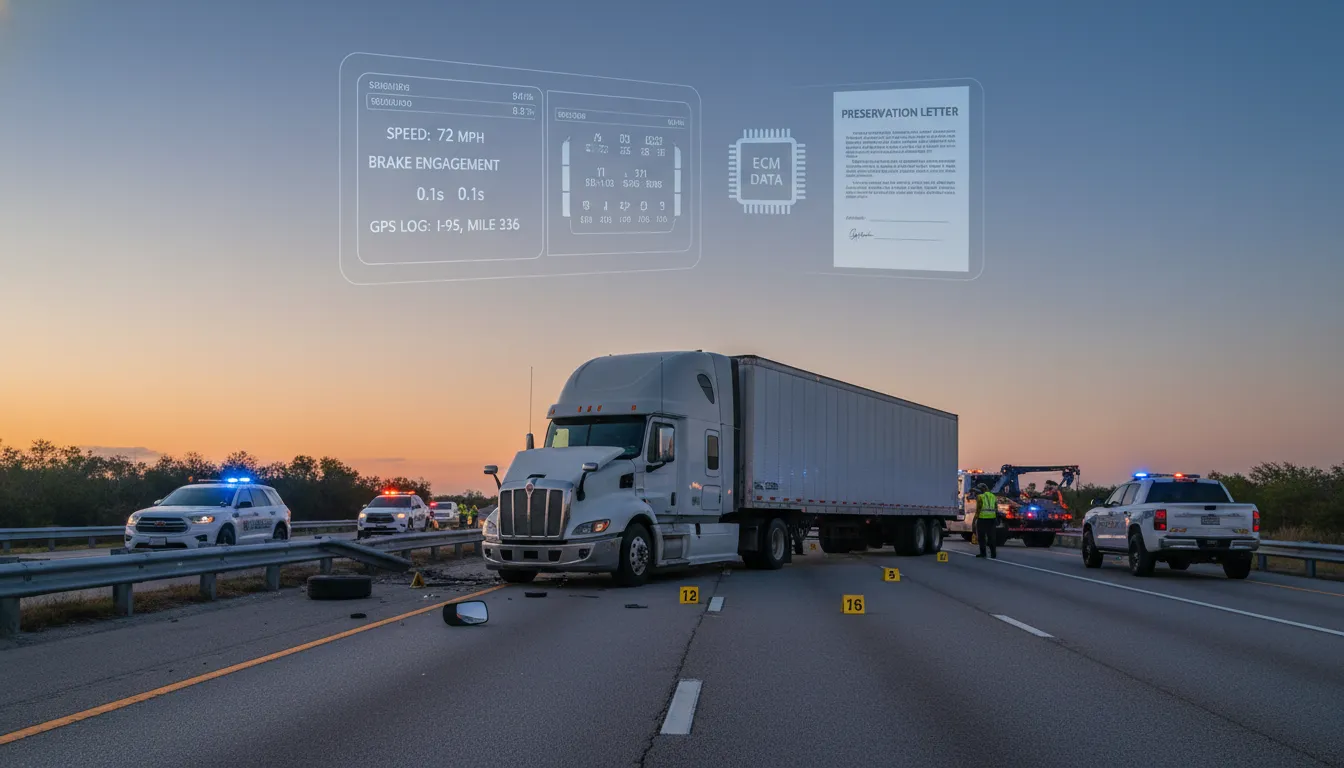
Quick answer: A preservation letter tells the trucking company and related parties to keep crash evidence. It should identify the vehicle, driver, date, ECM data, ELD logs, video, GPS records, inspections, maintenance files, and communications.
A written demand to preserve evidence
After a Florida truck crash, key proof may sit in systems controlled by the carrier or its vendors. A preservation letter gives written notice that evidence tied to the crash must be kept for a possible claim. Lawyers may also call this a spoliation letter or litigation hold notice.
The letter should identify the truck, trailer, driver, crash date, and records to preserve. That includes electronic control module (ECM) data, event data recorder files, and electronic logging device records. The request matters because a truck accident black box in Florida can help show what the vehicle did before impact.
Records that can be lost or changed
A carrier and its insurer may begin investigating soon after the crash. Trucks may return to service, video may cycle out, and electronic files may be handled under routine systems. A prompt letter asks that those ordinary steps not erase evidence tied to your case.
A thorough demand can cover more than ECM data. It can request driver logs, dashcam footage, dispatch messages, GPS records, inspection reports, repair files, maintenance records, and carrier communications. Each item can help lawyers compare the digital record with witness accounts and physical crash evidence.
Federal guidance also shows why technical data requests must be specific. The Federal Motor Carrier Safety Administration guidance on ECM data states that retrievable ECM information must be secured for ELD compliance. If required ECM information is not available, another accurate source may be needed under the rule.
Spoliation risk and next steps
Spoliation means relevant proof was destroyed, altered, or not kept after a party knew it could matter in a case. A preservation letter creates a clear paper trail. It shows what evidence was requested, when notice was given, and which parties received it.
The notice can be sent to the motor carrier, the truck owner, maintenance vendors, and insurance representatives, when involved. Lawyers may then seek downloads, copies, inspection access, or court orders through a commercial truck claim. This process helps protect data before disputes arise about missing files.
Preserving a file does not decide fault on its own. It gives both sides a chance to examine the same record. Your lawyer can then assess that record with crash photos, testimony, medical records, and expert review.
If a semi-truck crash injured you or your family in Florida, do not wait to ask about evidence. Injury LawStars can review the crash and send preservation demands when they fit the facts. Request a free, 24/7 consultation through the contact page so critical records can be addressed promptly.
What should victims do after a Florida truck accident?
A truck crash can leave you hurt, shaken, and unsure what needs attention first. Start with your health and safety, then protect the records tied to the crash. Injury LawStars understands the human cost of a semi-truck collision and helps people across Florida take clear next steps.
First steps at the crash and afterward
Digital truck records may matter later, but they are not the first priority at an unsafe scene. When the immediate danger has passed, these steps can help protect a commercial truck claim while you focus on recovery.
-
Get medical care. Call for emergency help if you are injured or in danger. Even if symptoms seem mild, prompt medical attention creates a record of your reported pain and treatment.
-
Report the crash. Call law enforcement and wait in a safe place if you can. Ask how to obtain the crash report number, and keep it with your medical and insurance papers.
-
Document what you safely can. If your condition allows, photograph vehicle positions, damage, road marks, signs, debris, and the truck’s identifying details. Gather witness contact information without arguing about fault.
-
Limit recorded statements. Notify your insurer as required by your policy, but be careful with requests for a recorded interview. You can ask for time to get advice before discussing injuries or the crash in detail.
-
Save every message and record. Keep emails, texts, claim letters, repair estimates, medical bills, work notes, and photos together. Do not delete social media messages or post guesses about how the collision happened.
-
Speak with counsel promptly. A lawyer can assess what records may exist and send requests to preserve relevant items. Those items may include truck data, driver logs, dispatch records, maintenance files, video, and physical evidence.
Preserving truck data in Florida
Commercial truck records can involve an engine control module or electronic logging device. The Federal Motor Carrier Safety Administration addresses retrievable ECM data. Its guidance says an ELD provider must use an available means to retrieve it.
A request to preserve records can help keep technical evidence in view while a Florida claim is reviewed. For a deeper look at those materials, read the firm’s guide to truck accident black box evidence. Each crash is different, so early advice should match the facts and your medical needs.
Talk to Injury LawStars before the trucking company controls the evidence timeline.
How black box evidence can prove negligence in a truck accident claim
Turning data into a crash timeline
In a truck accident black box Florida claim, the key question is often simple: what did the truck do before impact? ECM data may show changes in speed, throttle use, and braking. An accident reconstruction expert can match that record with skid marks, vehicle damage, and the crash scene.
This timeline may test a driver’s account against recorded events. It can show whether the truck slowed before a traffic backup or braked only at the last moment. Research on in-vehicle monitoring has found that such systems can record harsh vehicle moves, including sudden braking. The findings appear in a peer-reviewed commercial driving study.
Driver conduct and safety records
Black box evidence does not decide negligence by itself. It gives experts fixed data to compare with driver logs, dispatch records, inspection files, and witness accounts. A failure to brake in time may point to distraction, unsafe speed, or too little following distance.
Fatigue requires a broader review. A sudden response in ECM data may support questions about alertness, but hours worked come from logging and company records. Federal guidance also addresses ECM data that is retrievable for electronic logging use. It states that the provider must use an available retrieval method, as explained by the Federal Motor Carrier Safety Administration.
The same approach applies to maintenance. A braking pattern may raise questions, but it does not prove worn brakes or missed repairs. Experts compare the download with inspection reports, repair orders, brake condition, and the truck’s post-crash examination. That work can separate driver error from a mechanical problem.
Carrier negligence and claim value
ECM evidence may also reach beyond the driver. If records show repeated harsh events, a carrier’s training, supervision, and response may matter. If a company ignored warning signs or kept a truck on the road after known problems, its own choices may become part of the claim.
The data can also help challenge an account that places all blame on the injured person. A full investigation looks for agreement among digital records, physical evidence, medical proof, and testimony. Each piece has a role; no single download guarantees a finding of fault or a certain payment.
Settlement value depends on proof of fault, injuries, available coverage, and other case facts. For more background, read how evidence can affect a truck accident claim. The important point is not a promised result. It is preserving reliable proof before it can no longer be reviewed.
For more context on case value factors, see our guide to the average truck accident settlement in Florida. It explains why evidence, injuries, liability disputes, and insurance coverage all affect negotiations without promising a specific result.
Frequently Asked Questions
Who can access black box data after a truck accident?
Access to a commercial truck’s black box data usually depends on who controls the vehicle and whether the data is requested in a claim. The carrier may arrange a download, while an injured person’s lawyer may request inspection, copies, or court-ordered access. A qualified download and expert review help preserve the file and explain its limits alongside logs, video, and scene evidence.
Can black box data be erased by the trucking company?
Yes. A carrier’s routine data practices may overwrite or replace stored information unless relevant records are preserved. A preservation letter should identify the truck, ECM or EDR data, driver logs, dashcam footage, and related records as soon as possible. The goal is to put the right parties on notice before ordinary data handling becomes an evidence problem.
How does black box data help in a Florida truck accident case?
In a Florida truck accident case, black box data may show the truck’s speed, braking, throttle use, or related events near impact. Lawyers and reconstruction experts can compare that record with electronic driver logs, dashcam video, vehicle damage, and witness accounts. The comparison may confirm part of a crash sequence or expose conflicts, but black box data does not decide negligence by itself.
Ready to protect your Florida truck accident claim?
Critical truck evidence can become harder to secure while you wait to take the next step. Electronic control module data, driver logs, and video may matter when fault and losses are challenged. Starting now allows your legal team to identify records, send preservation notices, and build a clearer claim timeline.
Do not let uncertainty leave your commercial truck claim without the evidence it may need. You do not have to decide every part of a claim before asking what records should be protected. An early conversation can help you understand which steps may reduce the risk of avoidable evidence gaps. Ready to protect your rights and preserve key records? Schedule a free consultation to talk to a Florida truck accident lawyer about immediate evidence preservation steps.
About the Author
Katie Miller, Esq.
Managing Partner · Injury LawStars
Attorney Katie Miller was once an injury victim herself. After a car accident in 2016 that required spinal surgery and a 13-month recovery, she turned her experience into a mission: fighting for people who are hurting. With 17+ years of legal experience and over \$45 million recovered for clients, Katie brings both professional expertise and personal understanding to every case.