March 26, 2026
Premises Liability in Florida: A Complete Guide to Your Rights After an Injury on Someone Else’s Property
Every year, thousands of Floridians suffer serious injuries on property they do not own. A wet floor in a grocery store. A broken stairwell in an apartment complex. An assault in a poorly lit parking garage. A child who slips into an unsecured swimming pool. These are not just accidents. They are preventable incidents that happen because someone failed to keep their property safe.
Injured on someone else’s property in Florida? Contact Injury LawStars today for a free consultation. Call (407) 887-4690. You pay nothing unless we win.
As someone who was once an injury victim myself, I understand what it feels like to be hurt because of someone else’s negligence. That experience drove me to become a personal injury attorney, and it is why I fight relentlessly for people who are going through what I once went through. At Injury LawStars, we handle every type of premises liability case in Florida, and this guide will walk you through everything you need to know about your rights.
Key Takeaways
- Premises liability in Florida holds property owners legally responsible when their negligence causes injuries to visitors, guests, or in some cases even trespassers.
- Florida Statute 768.0755 governs slip and fall cases on business property and requires proving the owner had actual or constructive knowledge of the dangerous condition.
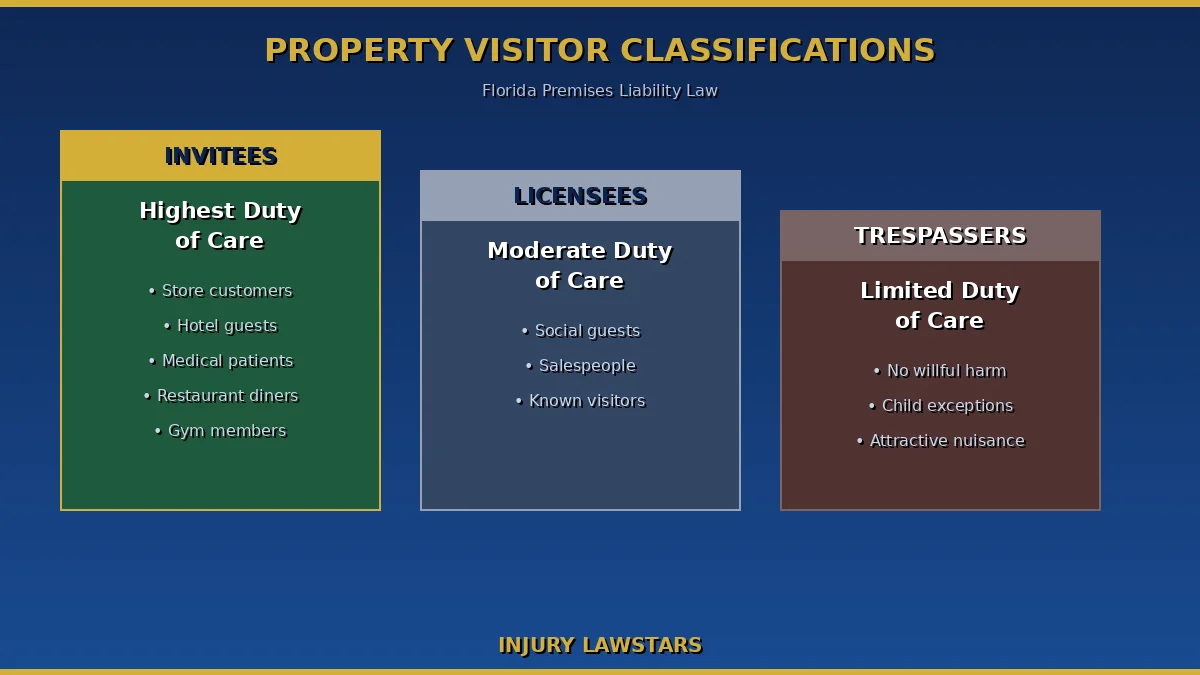
- The duty of care a property owner owes you depends on your legal status: invitees receive the highest protection, followed by licensees, with trespassers receiving the least.
- Premises liability covers far more than slip and fall accidents. It includes negligent security, swimming pool accidents, dog bites, elevator and escalator injuries, amusement park accidents, falling objects, and toxic exposure.
- Florida’s modified comparative negligence rule means you can recover compensation as long as you are not more than 50 percent at fault for the accident.
- You have two years from the date of your injury to file a premises liability lawsuit in Florida under the current statute of limitations.
- Damages available include medical expenses, lost wages, pain and suffering, and in some cases punitive damages.
What Is Premises Liability in Florida?
Premises liability is the area of personal injury law that holds property owners and occupiers responsible for injuries that occur on their property due to unsafe conditions. Understanding premises liability in Florida starts with a core principle: every property owner has a legal obligation to maintain their premises in a reasonably safe condition and to warn visitors of known dangers.
The foundation of premises liability law in Florida is negligence. When a property owner knows about a dangerous condition, or should have known about it through reasonable inspection, and fails to fix it or warn visitors about it, they can be held liable for any resulting injuries.
Florida Statute 768.0755 specifically addresses slip and fall cases involving transitory foreign substances (spills, debris, wet floors) on business premises. Under this statute, injured parties must prove that the business had actual or constructive knowledge of the hazardous condition. Constructive knowledge can be established by showing that the condition existed for a long enough time that the owner should have discovered it, or that the condition occurred with enough regularity to be foreseeable.
However, premises liability in Florida extends far beyond slip and fall accidents. It covers any situation where a property owner’s failure to maintain safe conditions leads to injury, from inadequate security to structural failures to hazardous chemical exposure.
Property Owner Duty of Care: Invitees, Licensees, and Trespassers
One of the most important concepts in Florida premises liability law is the classification of visitors. The level of care a property owner owes depends on why the injured person was on the property at the time of the accident.
Invitees: The Highest Level of Protection
An invitee is someone who enters the property for a purpose related to the owner’s business or for the mutual benefit of both parties. This includes:
- Customers in stores, restaurants, and shopping centers
- Patients visiting medical offices and hospitals
- Hotel and resort guests
- Clients meeting with professionals
- Members of gyms and fitness centers
Property owners owe invitees the highest duty of care. This means they must:
- Regularly inspect the property for hazards
- Promptly repair or remove dangerous conditions
- Warn invitees of known hazards that cannot be immediately fixed
- Take reasonable steps to discover hidden dangers
Licensees: Moderate Protection
A licensee is someone who enters the property with the owner’s permission but for their own purpose, not the owner’s business interest. Common examples include:
- Social guests visiting a friend’s home
- Door-to-door salespeople
- People using a shortcut across private property with the owner’s knowledge
Property owners must warn licensees about known dangers that the visitor would not reasonably discover on their own. However, they are not required to actively inspect for hidden hazards the way they would for invitees.
Trespassers: Limited Protection
A trespasser enters the property without permission or legal right. Property owners generally owe trespassers only the duty to refrain from causing willful or wanton harm. However, there are important exceptions:
- Discovered trespassers: If a property owner knows someone regularly trespasses in a specific area, they must warn of known dangers.
- Child trespassers: Under Florida’s attractive nuisance doctrine, property owners have a heightened duty to protect children from dangerous conditions that are likely to attract them, such as swimming pools, construction sites, and abandoned vehicles.
Types of Premises Liability Claims in Florida
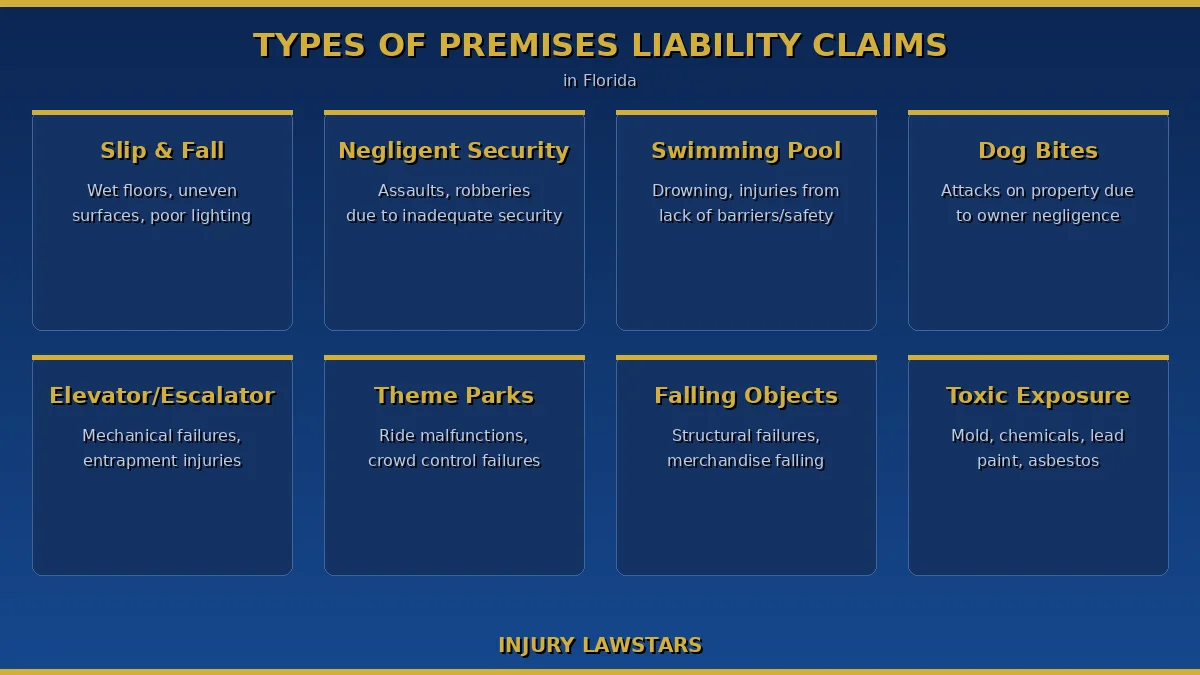
Premises liability in Florida encompasses a wide range of incidents. Understanding the different types of claims can help you determine whether your injury gives rise to a legal case.
Slip and Fall and Trip and Fall Accidents
Slip and fall accidents are the most common type of premises liability claim in Florida. These cases typically involve:
- Wet or freshly mopped floors without warning signs
- Spills in grocery stores, restaurants, and retail locations
- Uneven sidewalks, cracked pavement, or potholes
- Loose carpeting, torn mats, or unsecured rugs
- Poorly maintained stairs, missing handrails, or broken steps
- Inadequate lighting in walkways and parking areas
Under Florida Statute 768.0755, the burden of proof in slip and fall cases on business property requires demonstrating that the owner had actual or constructive knowledge of the hazard. This makes evidence like photographs, surveillance footage, witness testimony, and maintenance records critically important.
If you have been hurt in a slip and fall, our detailed guide on what to do after a slip and fall accident in Florida walks you through every step of the process.
Negligent Security
Negligent security claims arise when a property owner fails to provide adequate security measures, and that failure leads to a criminal act that injures someone on the property. These cases are among the most complex property injury claims and can involve:
- Assaults and battery in parking garages, apartment complexes, hotels, and nightclubs
- Robberies and muggings in shopping centers, gas stations, and ATM locations
- Sexual assaults at hotels, college campuses, and apartment buildings
- Shootings at bars, nightclubs, and entertainment venues
To succeed in a negligent security claim, you must typically prove that:
- The property owner knew or should have known about the risk of criminal activity (often demonstrated by prior similar incidents in the area)
- The owner failed to implement reasonable security measures (adequate lighting, surveillance cameras, security guards, functioning locks)
- The lack of security was a proximate cause of the criminal act and your injuries
Negligent security cases frequently occur in areas with a known history of crime. If an apartment complex has experienced multiple break-ins but refuses to install security cameras or repair broken gate locks, the owner may be liable when a resident is assaulted.
Swimming Pool Accidents
Florida’s warm climate means swimming pools are everywhere, from residential backyards to hotel resorts to community recreation centers. Unfortunately, this also means pool-related injuries and drownings are a significant concern.
Swimming pool accident liability in Florida may arise from:
- Lack of proper fencing or barriers around residential pools (Florida law requires barriers for residential pools under Section 515.27 of the Florida Building Code)
- Missing or broken pool drain covers that create entrapment hazards
- Slippery pool decks without non-slip surfaces or warning signs
- Absence of lifeguards at commercial pools where they are reasonably expected
- Defective diving boards or pool equipment
- Inadequate depth markings or lack of “No Diving” signs in shallow areas
- Chemical imbalances that cause burns or respiratory problems
The attractive nuisance doctrine plays a particularly important role in swimming pool cases involving children. A homeowner who fails to install a proper fence around their pool may be liable if a neighborhood child enters the property and is injured or drowns, even though the child was technically trespassing.
Dog Bites on Property
When a dog bite occurs on someone’s property, the case may involve both Florida’s dog bite statute (Section 767.01) and property owner liability law. Florida is a strict liability state for dog bites, meaning the dog owner is typically liable regardless of whether the dog has bitten before.
However, property owner negligence principles apply when the property owner is not the dog owner. For example, if a landlord knows that a tenant has a dangerous dog and fails to take action, the landlord may share liability for injuries caused by that animal on the property.
Factors that strengthen a property-based dog bite claim include:
- The property owner knew about the dog’s aggressive tendencies
- The owner failed to enforce pet policies or lease restrictions
- Inadequate fencing or barriers allowed the dog to reach visitors
- Warning signs were absent despite known danger
For a complete breakdown of dog bite liability in Florida, visit our dog bite lawyer page.
Elevator and Escalator Accidents
Elevator and escalator injuries can cause devastating harm, including crush injuries, amputations, broken bones, and brain injuries. These cases typically involve:
- Sudden stops or jerky movements that throw passengers off balance
- Doors closing on passengers due to malfunctioning sensors
- Misleveling (elevator stops above or below the floor, creating a tripping hazard)
- Free falls caused by mechanical failure
- Escalator entrapment of clothing, fingers, or feet
Property owners who operate elevators and escalators have a duty to properly maintain this equipment through regular inspections and timely repairs. They may also be required to comply with specific maintenance codes and inspection schedules mandated by Florida law.
Liability in elevator and escalator cases may extend to the property owner, the maintenance company, and in some cases the manufacturer of the equipment.
Amusement Park and Theme Park Injuries
Florida is home to some of the world’s largest theme parks, and with millions of visitors each year, injuries on these properties are more common than many people realize. Property owner liability claims against amusement parks may involve:
- Ride malfunctions or mechanical failures
- Slip and fall accidents on wet surfaces, uneven walkways, or in food court areas
- Inadequate crowd control leading to stampedes or crush injuries
- Food poisoning from improperly stored or prepared food
- Water park injuries from poorly maintained slides, wave pools, or lazy rivers
- Heat-related illnesses due to insufficient shade, water stations, or cooling areas
Florida has specific statutes governing amusement ride safety, and theme park operators are required to carry substantial insurance and comply with safety inspection requirements. However, Florida law also includes certain protections for theme parks when it comes to injuries involving “inherent risks” of rides.
Were you injured on someone else’s property? Contact Injury LawStars for a free case review. Call us at (407) 887-4690. You pay nothing unless we win your case.
Falling Objects and Structural Failures
When improperly stored merchandise falls from a shelf, a balcony railing gives way, or a ceiling collapses, the property owner may be liable for resulting injuries. These cases include:
- Merchandise falling from high shelves in retail stores and warehouses
- Construction debris falling from buildings or scaffolding
- Structural collapses due to poor maintenance, code violations, or age
- Falling signage, awnings, or fixtures
- Balcony or deck failures
- Ceiling or roof leaks that create slip hazards or lead to mold exposure
Structural failure cases often require expert testimony from engineers or building inspectors to establish that the owner failed to maintain the structure in compliance with Florida building codes.
Toxic Exposure and Hazardous Conditions
Property owners can also be held liable when visitors are exposed to toxic substances or hazardous conditions on their property. Common scenarios include:
- Mold exposure in apartments, hotels, and commercial buildings due to unaddressed water damage
- Lead paint exposure in older residential properties
- Asbestos exposure during renovations of older buildings
- Chemical spills or fumes in commercial or industrial settings
- Carbon monoxide leaks from faulty heating systems
- Contaminated water from plumbing failures
These cases can be challenging because symptoms of toxic exposure often develop gradually over time, making it harder to connect the exposure to a specific property. Medical documentation and environmental testing are critical evidence in these claims.
What Must You Prove in a Premises Liability Case?
To win a property injury case under Florida’s premises liability law, you must prove four essential elements:
1. Duty of Care
You must show that the property owner owed you a duty of care based on your legal status (invitee, licensee, or trespasser) at the time of the accident. For most commercial premises liability cases, this involves showing you were an invitee who was owed the highest level of care.
2. Breach of Duty
You must demonstrate that the property owner breached their duty by failing to maintain the property, failing to warn of a known hazard, or failing to discover a dangerous condition that a reasonable property owner would have found.
3. Causation
You must prove a direct connection between the property owner’s breach of duty and your injury. The dangerous condition must have been a substantial factor in causing your harm.
4. Damages
You must have suffered actual damages, which may include physical injuries, medical expenses, lost wages, pain and suffering, and emotional distress.
Florida’s Modified Comparative Negligence Rule
Florida follows a modified comparative negligence system under the tort reform enacted by HB 837 in 2023. Under this rule:
- Your compensation is reduced by your percentage of fault
- If you are 51 percent or more at fault, you cannot recover any compensation
- This applies to all premises liability cases
Example: You slip on a wet floor in a grocery store that had no warning signs. However, you were looking at your phone while walking. A jury finds you 30 percent at fault and the store 70 percent at fault. If your total damages are $200,000, your recovery is reduced to $140,000.
Insurance companies aggressively use comparative negligence to reduce payouts. They will look for any evidence that you contributed to your own injury, which is one reason why having an experienced premises liability attorney in Florida is so important.
For a deeper explanation of how comparative fault works, read our guide on Florida comparative negligence law explained.
What Defenses Do Property Owners Use?
Property owners and their insurance companies have several defenses they commonly raise in premises liability cases. Understanding these defenses can help you prepare a stronger claim.
Comparative Negligence
As discussed above, the defendant will argue that you share responsibility for your injuries. Common arguments include:
- You were distracted by your phone
- You were wearing inappropriate footwear
- You ignored warning signs or barriers
- You were in a restricted or off-limits area
- You were intoxicated at the time of the accident
Open and Obvious Doctrine
The property owner may argue that the dangerous condition was “open and obvious,” meaning any reasonable person would have seen and avoided it. However, this defense has limits in Florida. A condition being obvious does not automatically relieve the property owner of liability, particularly if there was no reasonable alternative path around the hazard.
Trespasser Defense
If you were on the property without permission, the owner may argue they owed you only a minimal duty of care. This defense does not apply in cases involving children under the attractive nuisance doctrine or when the property owner engaged in willful or wanton conduct.
Lack of Notice
The property owner may claim they had no actual or constructive knowledge of the dangerous condition. This is why evidence establishing how long a hazard existed before your accident is critical to your case.
Statute of Limitations for Premises Liability in Florida
Under the tort reform enacted by HB 837 in March 2023, the statute of limitations for premises liability claims in Florida is two years from the date of the injury. This is a significant reduction from the previous four-year window.
If you miss this deadline, you will almost certainly lose your right to file a lawsuit and recover compensation, regardless of how strong your case may be. There are limited exceptions for minors and individuals with certain disabilities, but the two-year deadline applies to the vast majority of cases.
Government property claims have even shorter deadlines. If your injury occurred on government-owned property, you must comply with Florida’s sovereign immunity notice requirements, which may require you to notify the government entity within a specific timeframe before filing suit. We discuss this in more detail below.
For more information on filing deadlines, read our article on how long after an accident you can sue for personal injury.
What Damages Are Available in Premises Liability Cases?
If you successfully prove your claim, you may be entitled to several categories of compensation.
Economic Damages
These are your calculable financial losses:
- Medical expenses: Emergency room visits, hospital stays, surgeries, physical therapy, prescription medications, medical devices, and anticipated future medical costs
- Lost wages: Income lost during recovery, including vacation and sick time used
- Loss of earning capacity: If your injuries permanently affect your ability to work or earn the same income
- Property damage: Damage to personal belongings (phone, glasses, clothing)
- Out-of-pocket expenses: Transportation to medical appointments, home modifications, and in-home care
Non-Economic Damages
These compensate for losses that cannot be easily quantified:
- Pain and suffering: Physical pain and discomfort from your injuries
- Emotional distress: Anxiety, depression, PTSD, and fear
- Loss of enjoyment of life: Inability to participate in activities you enjoyed before the injury
- Loss of consortium: Impact on your relationship with your spouse
For a detailed look at how pain and suffering is calculated, see our guide on pain and suffering settlement amounts.
Punitive Damages
In rare cases involving particularly egregious conduct, Florida courts may award punitive damages. These are designed to punish the property owner and deter similar behavior. Punitive damages are capped under Florida law at the greater of three times the compensatory damages or $500,000.
Settlement Ranges by Claim Type
Every premises liability case is unique, and settlement amounts vary significantly based on the severity of injuries, the strength of the evidence, and the defendant’s resources. However, general ranges based on typical Florida cases include:
- Minor slip and fall injuries (sprains, bruises): $10,000 to $50,000
- Moderate slip and fall injuries (fractures, torn ligaments): $50,000 to $200,000
- Severe slip and fall injuries (spinal cord injuries, TBI): $200,000 to $1,000,000+
- Negligent security cases (assaults, robberies): $100,000 to $500,000+
- Swimming pool accidents (near-drowning, drowning deaths): $200,000 to $1,000,000+
- Elevator and escalator injuries: $50,000 to $500,000+
- Toxic exposure cases: $100,000 to $1,000,000+ (depending on long-term health impact)
These are general ranges, not guarantees. The value of your case depends on your specific circumstances, and a premises liability lawyer can provide a more accurate assessment after reviewing the facts.
Government Property Claims: Sovereign Immunity and Notice Requirements
If your premises liability injury occurred on government-owned property, such as a public park, government building, public sidewalk, or school, your claim is subject to additional rules under Florida’s sovereign immunity laws.
What Is Sovereign Immunity?
Under Florida Statute 768.28, the state and its agencies can be held liable for negligence, but with significant limitations:
- Damage caps: Liability is capped at $200,000 per claim and $300,000 per incident against a single government agency.
- Pre-suit notice: You must provide written notice to the appropriate government entity before filing a lawsuit. For state agencies, notice goes to the Department of Financial Services and the head of the agency. For local governments, notice goes to the entity’s designated risk management office.
- Investigation period: The government entity has 180 days to investigate and respond to your claim before you can file suit.
- No punitive damages: You cannot recover punitive damages against a government entity in Florida.
Practical Impact
The damage caps on government claims mean that even catastrophic injuries are limited in recovery. However, injured parties can petition the Florida Legislature through a claims bill for compensation above the statutory cap, though this is a difficult and uncertain process.
The key takeaway is this: if you were injured on government property, time is of the essence. The notice requirements are strict, and failure to comply can bar your claim entirely.
When Should You Hire a Premises Liability Attorney?
Not every injury on someone else’s property requires an attorney. But in most cases involving significant injuries, hiring an experienced property liability lawyer in Florida can make a substantial difference in the outcome of your claim.
You should consider hiring an attorney when:
- Your injuries required medical treatment beyond basic first aid
- You missed work or will miss work due to your injuries
- The property owner or their insurance company disputes liability
- You were partially at fault and are concerned about comparative negligence
- Your injury occurred on government property
- The case involves negligent security, toxic exposure, or other complex liability issues
- The insurance company offers a settlement that does not cover your actual losses
- Your injuries may require ongoing or future medical treatment
At Injury LawStars, we work on a contingency basis, which means you pay nothing unless we win your case. Attorney Katie Miller was once an injury victim herself, and she understands the fear, stress, and frustration that comes with being hurt because of someone else’s negligence. That firsthand experience is the foundation of our firm and why we fight so hard for every client.
If you have been injured on someone else’s property in Florida, contact Injury LawStars today for a free, no-obligation consultation. We will review your case, explain your options, and help you understand what your claim may be worth.
If you have been injured on someone else’s property in Florida, contact Injury LawStars today for a free, no-obligation consultation. Call (407) 887-4690. We will review your case, explain your options, and help you understand what your claim may be worth.
Frequently Asked Questions
What is premises liability in Florida?
Premises liability is the legal principle that holds property owners responsible for injuries caused by unsafe conditions on their property. In Florida, owners must maintain their premises in a reasonably safe condition and warn visitors of known hazards. If negligence leads to an injury, the injured person may file a claim to recover compensation for medical bills, lost wages, pain and suffering, and other damages.
How do I prove a premises liability case?
To prove a case in Florida, you must establish four elements: (1) the property owner owed you a duty of care, (2) they breached that duty by failing to maintain safe conditions or warn of hazards, (3) their breach directly caused your injury, and (4) you suffered actual damages. Evidence such as photographs, surveillance footage, witness statements, maintenance records, and medical documentation strengthens your claim.
What is the statute of limitations for premises liability in Florida?
As of March 2023, the statute of limitations for premises liability claims in Florida is two years from the date of the injury. This was reduced from four years under HB 837. If you fail to file your lawsuit within this two-year window, you will likely lose your right to pursue compensation. Claims against government entities have additional notice requirements that may impose shorter deadlines.
Can I sue a property owner if I was trespassing?
In limited circumstances, yes. While property owners owe trespassers only the duty to avoid willful or wanton harm, there are exceptions. Under Florida’s attractive nuisance doctrine, property owners can be held liable for injuries to child trespassers if the property contained a condition likely to attract children (such as a swimming pool) and the owner failed to take reasonable precautions. Additionally, if a property owner knows that trespassers regularly enter a specific area, they may have a duty to warn of known dangers.
What types of accidents fall under premises liability?
Premises liability covers a broad range of accidents that occur on someone else’s property due to unsafe conditions. These include slip and fall accidents, trip and fall injuries, negligent security incidents (assaults, robberies), swimming pool accidents, dog bites, elevator and escalator malfunctions, amusement park injuries, falling objects, structural failures, toxic chemical exposure, mold-related illnesses, and injuries from inadequate property maintenance. Any situation where a property owner’s negligence creates a dangerous condition that causes injury can potentially give rise to a claim.