
March 31, 2026
Wrongful Death Settlements in Florida: What Families Can Expect
Key Takeaways
- The average wrongful death settlement in Florida ranges from $250,000 to over $5 million, depending on factors like the victim’s age, income, cause of death, and available insurance coverage.
- Florida law (F.S. §768.16-768.26) defines who can file and what damages are recoverable, including economic losses, non-economic suffering, and individual survivor claims.
- Only the personal representative of the deceased person’s estate can file a wrongful death lawsuit in Florida.
- The statute of limitations is two years from the date of death, with very limited exceptions.
- Most wrongful death cases settle within 6 months to 2 years, though complex cases involving litigation can take longer.
- Insurance company tactics like lowball offers and recorded statements are designed to minimize your recovery.
Losing a family member because of someone else’s negligence leaves you dealing with grief, confusion, and financial uncertainty all at once. If you are considering a wrongful death claim in Florida, one of the first questions on your mind is likely: How much is a wrongful death settlement worth?
When a fatal outcome may involve negligent medical treatment, our guide to medical malpractice in Florida explains the investigation steps and legal requirements families should know.
Call Injury LawStars at (407) 887-4690 for a free consultation. Attorney Katie Miller has personal experience with injury and fights to get families the compensation they deserve.
This guide breaks down wrongful death settlement values, timelines, the factors that affect your case, and what Florida families can realistically expect. It complements our guide to wrongful death claims in Florida, which covers the legal process in detail.
What Is the Average Wrongful Death Settlement in Florida?
There is no single “average” that accurately represents every wrongful death case. Settlement amounts vary dramatically based on the specific circumstances. However, research across publicly reported cases provides useful benchmarks.
According to data compiled from legal research databases tracking wrongful death cases between 2019 and 2024, the national average wrongful death settlement is approximately $973,054, while the median settlement of $294,728 better represents what most families actually receive. The median is a more reliable figure because a small number of multi-million-dollar verdicts skew the average upward.
In Florida specifically, civil litigation surveys indicate:
- Non-medical wrongful death cases: Median settlement around $750,000
- Medical malpractice wrongful death cases: Often exceed $1 million, especially when negligence is clear and dependents are involved
- Overall range: $250,000 to over $5 million, with exceptional cases reaching $10 million or more
It is important to understand the difference between the mean (total divided by number of cases) and the median (the middle value). If ten wrongful death claims range from $300,000 to $2 million, the mean might be around $850,000, but the median could be $600,000. The median gives you a more realistic picture of what a typical family receives.
How Do Settlement Amounts Vary by Cause of Death?
The circumstances surrounding the death significantly impact settlement value. Here are general ranges based on publicly reported data and national trends:
| Cause of Death | Typical Settlement Range | Key Factors |
|---|---|---|
| Fatal Car Accident | $500,000 – $2,000,000+ | Clear liability, insurance limits, number of dependents |
| Truck Accident Fatality | $1,000,000 – $5,000,000+ | Commercial insurance policies, corporate negligence, FMCSA violations |
| Medical Malpractice Death | $1,000,000 – $3,000,000+ | Standard of care violation, expert testimony, pre-suit requirements |
| Workplace Accident | $500,000 – $2,000,000+ | Third-party liability, OSHA violations, workers’ comp interaction |
| Nursing Home Negligence | $500,000 – $2,500,000+ | Staffing records, documentation of neglect, regulatory violations |
| Pedestrian or Bicycle Accident | $500,000 – $2,000,000+ | Driver fault, crosswalk/intersection factors, severity of impact |
| Drunk Driving Fatality | $750,000 – $3,000,000+ | Punitive damages often available, criminal conviction as evidence |
| Defective Product | $1,000,000 – $5,000,000+ | Product liability, manufacturer resources, recall history |
These ranges are general benchmarks, not guarantees. Every case depends on its unique facts, the strength of the evidence, and the skill of your legal team.
What Factors Affect the Value of a Wrongful Death Settlement?
Several key factors determine how much compensation a family may receive in a Florida wrongful death case:
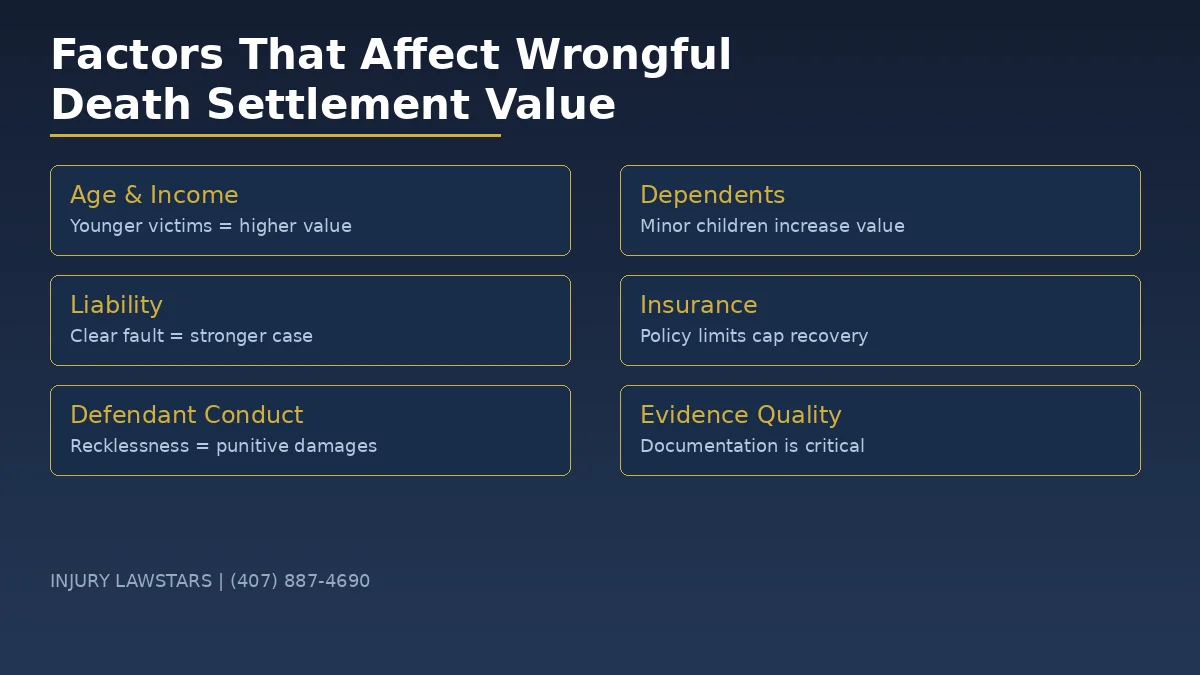
Age and Earning Capacity of the Deceased
Younger victims with higher income and longer expected working lives typically generate larger settlements. A 35-year-old earning $80,000 per year with young children represents significantly more in lost future income than an 80-year-old retiree. Courts and insurance adjusters calculate the present value of decades of lost earnings, benefits, and household services.
Number and Type of Dependents
Cases involving minor children who depended on the deceased for financial support, parental guidance, and daily care tend to result in higher settlements. The more dependents affected, the greater the total recoverable damages.
Strength of Liability Evidence
Clear, undisputed liability, such as a drunk driver running a red light, strengthens the case significantly. When fault is contested or the deceased shared some responsibility, Florida’s modified comparative fault system may reduce compensation. Under current Florida law, if the deceased was more than 50% at fault, the family cannot recover damages.
Available Insurance Coverage
The defendant’s insurance policy limits often cap the practical recovery. A negligent driver with only $10,000 in liability coverage presents a very different situation than a trucking company with a $5 million commercial policy. Multiple defendants or umbrella policies can increase the available pool of compensation.
Economic vs. Non-Economic Damages
Cases with well-documented economic losses, including high income, extensive medical bills before death, and significant household service value, tend to produce higher settlements. Non-economic damages like loss of companionship and mental suffering are inherently subjective and vary based on the jury pool and jurisdiction.
Severity of Defendant’s Conduct
Gross negligence, recklessness, or intentional misconduct can open the door to punitive damages in Florida. Drunk driving fatalities, for example, frequently involve punitive damage claims that can substantially increase the total recovery beyond compensatory amounts.
Every wrongful death case is different. Call Injury LawStars at (407) 887-4690 for a free case evaluation to understand what your family’s claim may be worth.
Who Can File a Wrongful Death Lawsuit in Florida?
Under the Florida Wrongful Death Act (F.S. §768.16-768.26), only the personal representative of the deceased person’s estate can file a wrongful death lawsuit. This person is either named in the deceased’s will or appointed by the probate court.
The personal representative files on behalf of the estate and all eligible statutory survivors, who include:
- Surviving spouse: Can recover damages for loss of companionship, protection, and mental pain and suffering
- Minor children (under age 25 per the Act): Can recover for lost parental companionship, instruction, guidance, and mental pain and suffering
- Adult children: May recover for mental pain and suffering if there is no surviving spouse
- Parents: Can recover for mental pain and suffering in the death of a minor child, or an adult child if no other survivors exist
- Dependent blood relatives or adoptive siblings: Those who were partly or wholly dependent on the deceased for support may qualify
Each survivor category has different rights and recoverable damages under Florida law. The personal representative must list all potential beneficiaries when filing the lawsuit, even if some may not ultimately receive compensation.
What Damages Can Families Recover in a Florida Wrongful Death Settlement?
Florida divides wrongful death damages into two categories: damages for individual survivors and damages recoverable by the estate.
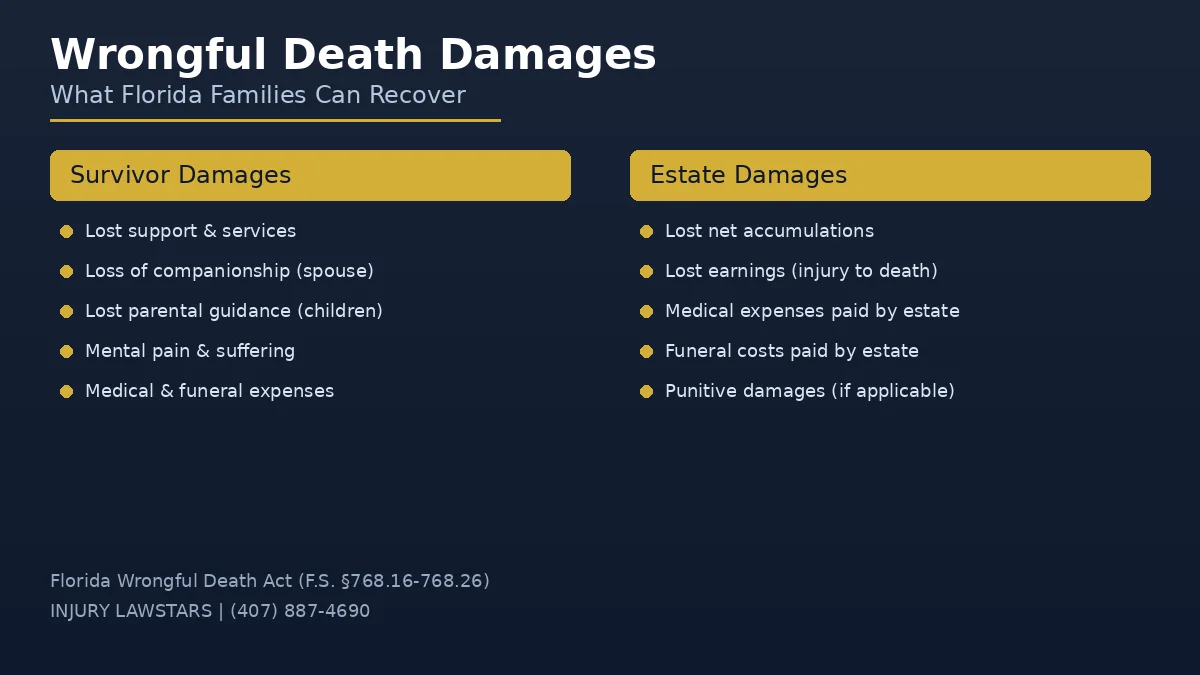
Survivor Damages
These are personal losses experienced by each eligible survivor:
- Lost support and services: The financial value of income, benefits, and household services the deceased would have provided
- Loss of companionship and protection (spouse)
- Loss of parental companionship, instruction, and guidance (minor children)
- Mental pain and suffering (varies by survivor type and whether other survivors exist)
- Medical and funeral expenses paid by the survivor
Estate Damages
The estate may recover:
- Lost net accumulations: The income the deceased would have saved and left as part of their estate after personal expenses
- Lost earnings: From the date of injury to the date of death
- Medical and funeral expenses paid by the estate
Punitive Damages
In cases involving intentional misconduct, gross negligence, or recklessness (such as drunk driving fatalities), the court may award punitive damages. These are designed to punish the defendant and deter similar behavior, and they can significantly increase the total settlement or verdict amount.
It is worth noting that most wrongful death settlement compensation is not taxable under federal law, as it compensates for physical injuries. However, portions allocated to punitive damages or interest may be subject to taxation. Consult with a tax professional regarding your specific situation.
What Is the Statute of Limitations for Wrongful Death in Florida?
Florida imposes a strict deadline: you have two years from the date of death to file a wrongful death lawsuit under Florida Statute §95.11(4)(d).
This deadline is firm. If you miss it, the court will almost certainly dismiss your case, regardless of how strong the evidence is.
Limited exceptions exist in certain circumstances:
- Medical malpractice cases: A discovery rule may apply when negligence was not immediately apparent, but even then, an outer limit of four years from the date of death applies
- Fraud or concealment: If the defendant actively concealed their wrongful conduct, the clock may start from the date of discovery
- Government entity claims: Claims against state or local government may require earlier notice (often within 3-6 months)
The two-year window sounds like enough time, but wrongful death investigations require gathering medical records, expert opinions, witness statements, and financial documentation. Starting early gives your attorney the best chance to build a strong case.
How Long Does a Wrongful Death Settlement Take?
Most wrongful death cases in Florida settle within 6 months to 2 years. However, the timeline depends on several factors:
- Complexity of the case: Medical malpractice cases often take longer due to pre-suit investigation requirements and expert testimony
- Number of defendants: Multiple at-fault parties can extend negotiations
- Insurance company cooperation: Some insurers negotiate in good faith; others delay and force litigation
- Whether litigation is necessary: Cases that go to trial can take 2-4 years or more, especially with appeals
- Discovery and investigation: Gathering evidence, deposing witnesses, and hiring experts takes time
The typical timeline looks like this:
| Phase | Typical Duration |
|---|---|
| Initial investigation and case evaluation | 1 – 3 months |
| Filing the lawsuit and discovery | 3 – 12 months |
| Mediation and settlement negotiations | 1 – 6 months |
| Trial (if no settlement reached) | Additional 6 – 18 months |
While faster resolution is often better for grieving families, rushing to settle can result in far less compensation than the case deserves. An experienced attorney balances the need for timely resolution with maximizing the settlement value.
How Do Insurance Companies Try to Minimize Wrongful Death Settlements?
Insurance companies are businesses focused on their bottom line. In wrongful death cases, they commonly use these tactics to reduce what they pay:
Lowball Early Offers
Insurers often extend a quick settlement offer shortly after the death, hoping grieving families will accept before fully understanding the value of their claim. These initial offers are almost always significantly below what the case is worth.
Requesting Recorded Statements
Insurance adjusters may ask family members for recorded statements, framing it as routine. In reality, they are looking for anything that can be used to reduce liability or minimize damages. You are not required to provide a recorded statement to the at-fault party’s insurer.
Disputing Liability or Comparative Fault
Under Florida’s modified comparative fault system, any percentage of fault attributed to the deceased directly reduces the settlement. Insurers aggressively argue that the deceased was partially responsible to lower their payout.
Delaying the Process
Extended delays in responding to demands, requesting unnecessary documentation, and dragging out negotiations are designed to pressure families into accepting less. Families under financial stress from lost income and mounting bills may feel forced to settle quickly.
Minimizing Non-Economic Damages
Insurers often challenge the value of loss of companionship, mental pain and suffering, and lost parental guidance. They may argue these damages are speculative or exaggerated, even when the emotional toll on the family is severe.
Having an experienced wrongful death attorney levels the playing field. Your lawyer can counter these tactics with strong evidence, expert testimony, and a credible threat of taking the case to trial.
Why Having an Attorney Matters for Your Wrongful Death Settlement
Wrongful death cases are among the most complex personal injury claims. An experienced attorney provides critical advantages:
- Accurate case valuation: An attorney accounts for all current and future economic losses, non-economic damages, and potential punitive damages to ensure you do not settle for less than your case is worth
- Evidence preservation: Critical evidence like surveillance footage, accident scene evidence, and electronic data can be lost or destroyed without prompt legal action
- Expert resources: Wrongful death attorneys work with economists, medical experts, accident reconstructionists, and life care planners who strengthen the case
- Insurance negotiation experience: Attorneys who regularly handle wrongful death cases understand insurer tactics and know how to counter them effectively
- Trial readiness: Insurance companies offer better settlements when they know your attorney is prepared and willing to go to trial
At Injury LawStars, Attorney Katie Miller was once an injury victim herself. That personal experience drives her commitment to fighting for families who are dealing with loss and uncertainty. The firm operates on a contingency fee basis, meaning there are no upfront costs and no fees unless you recover compensation.
If you lost a loved one due to someone else’s negligence, call Injury LawStars at (407) 887-4690 for a free case review. You deserve an attorney who understands your pain and will fight for the full value of your claim.
How Are Wrongful Death Settlements Paid Out?
Once a wrongful death settlement is reached, the personal representative distributes the funds among eligible survivors. Florida law requires that distribution be fair and equitable, and courts often oversee the process to ensure proper allocation.
Settlements can be structured in two ways:
- Lump sum payment: The entire settlement amount is paid at once. This gives families immediate access to funds but requires careful financial planning.
- Structured settlement: Payments are spread over time, often through an annuity. This can provide long-term financial security, especially when minor children are involved.
When minor children are beneficiaries, Florida courts typically require that their portion be placed in a protected account or structured settlement until they reach the age of majority. The personal representative may need to seek court approval for the distribution plan to protect the interests of all beneficiaries.
Frequently Asked Questions About Wrongful Death Settlements in Florida
What is the average wrongful death settlement in Florida?
The average varies widely, but most Florida wrongful death settlements range from $250,000 to over $5 million. The median for non-medical cases is approximately $750,000. Medical malpractice death cases often exceed $1 million. Your specific settlement depends on factors like the victim’s age, income, number of dependents, and the strength of liability evidence.
Are wrongful death settlements taxable in Florida?
Most wrongful death settlement compensation is not taxable under federal law because it compensates for physical injury or death. However, portions allocated to punitive damages or pre-judgment interest may be subject to federal income tax. Florida has no state income tax. Consult a tax professional for guidance on your specific situation.
How long do I have to file a wrongful death lawsuit in Florida?
Florida has a two-year statute of limitations from the date of death. Missing this deadline almost always results in losing your right to file. Limited exceptions exist for medical malpractice discovery and fraud or concealment situations.
How are wrongful death settlements divided among family members?
The personal representative distributes the settlement among eligible survivors based on Florida law and, in many cases, court approval. Each survivor receives compensation based on their relationship to the deceased and the specific damages they experienced, such as lost support, lost companionship, or mental pain and suffering.
Can I file a wrongful death claim if there was no criminal conviction?
Yes. A wrongful death lawsuit is a civil action with a lower burden of proof than a criminal case. You must prove negligence by a “preponderance of the evidence” (more likely than not), whereas criminal cases require proof “beyond a reasonable doubt.” Many successful wrongful death claims proceed even without criminal charges.
What if the deceased was partially at fault?
Florida uses a modified comparative fault system. If the deceased was partially responsible, the settlement is reduced by their percentage of fault. However, if the deceased was more than 50% at fault, the family cannot recover any damages under current Florida law (HB 837, effective March 2023).