March 31, 2026
Rideshare Accidents in Florida: Your Complete Uber & Lyft Claims Guide
Summary
Rideshare accidents involving Uber and Lyft are rising across Florida, and the legal process for filing a claim is more complicated than a standard car accident. Insurance coverage depends on what the driver was doing at the time of the crash, with three distinct phases of coverage under Florida Statute 627.748. During an active ride, Uber and Lyft carry up to $1 million in liability coverage. Florida’s no-fault insurance system, the 14-day PIP rule, and the two-year statute of limitations all affect your ability to recover compensation. If you were injured as a passenger, driver, or third party in a rideshare accident in Florida, understanding these rules is the first step toward protecting your rights.
Contact Injury LawStars today for a free consultation or call (407) 887-4690. We fight for rideshare accident victims across Florida on a contingency basis — you pay nothing unless we win.
How Do Rideshare Accidents Differ From Regular Car Accidents?
When a standard car accident happens in Florida, the process is relatively straightforward: you file a claim with the at-fault driver’s insurance or your own PIP coverage. Rideshare accidents involving Uber or Lyft add layers of complexity because multiple insurance policies may apply, the driver’s employment status is contested, and the rideshare company’s coverage changes depending on the driver’s activity at the time of the crash.
Uber and Lyft classify their drivers as independent contractors, not employees. This distinction matters because it limits the rideshare company’s direct liability for driver negligence under Florida law. However, Florida Statute 627.748 requires these companies to maintain specific insurance coverage that protects passengers and third parties, regardless of the driver’s employment classification.
If you have been involved in a rideshare accident in Florida, the single most important factor determining your available insurance coverage is what the driver was doing with the rideshare app when the crash occurred. This creates what attorneys call the “three phases” of rideshare insurance coverage.
How Does Rideshare Insurance Work in Florida? The Three Coverage Phases
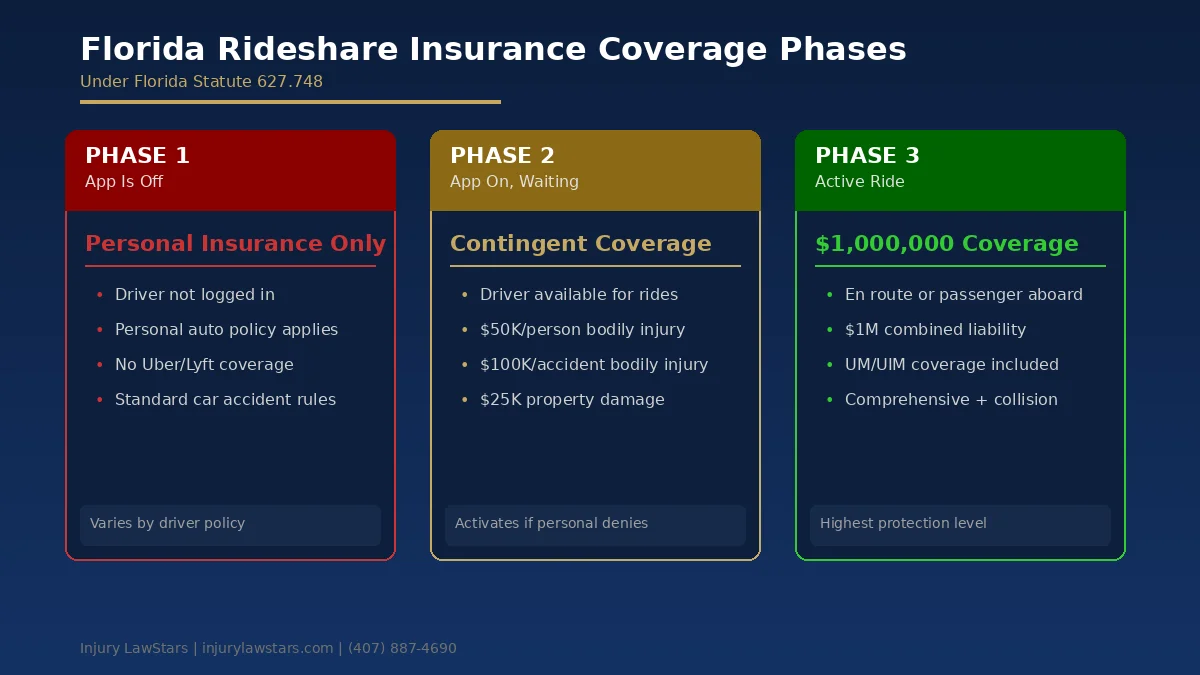
Florida Statute 627.748 establishes three distinct insurance coverage phases for rideshare drivers. Each phase carries different coverage limits and determines which insurance policy responds to your claim. Understanding these phases is essential for any rideshare accident claim.
Phase 1: App Is Off
When an Uber or Lyft driver is not logged into the rideshare app, they are considered off-duty. Only the driver’s personal auto insurance policy applies. Neither Uber nor Lyft provides any coverage during this phase. If you are hit by someone who happens to drive for a rideshare company but was off-duty at the time, the claim is handled like any other car accident in Florida.
Phase 2: App Is On, Waiting for a Ride Request
Once the driver logs into the Uber or Lyft app and is available to accept rides, Florida law requires the rideshare company to provide contingent liability coverage. The minimum coverage during this phase includes:
- $50,000 per person for bodily injury
- $100,000 per accident for bodily injury
- $25,000 for property damage
This coverage only activates if the driver’s personal auto insurance denies the claim or does not provide sufficient coverage. Many personal auto policies exclude coverage for commercial driving activity, which makes the rideshare company’s contingent coverage critically important during this phase.
Phase 3: En Route to Pickup or Passenger in Vehicle
This phase provides the highest level of protection. Once a driver accepts a ride request and is en route to pick up a passenger, or when a passenger is in the vehicle, both Uber and Lyft are required to carry:
- $1,000,000 in combined single-limit liability coverage
- Uninsured/underinsured motorist (UM/UIM) coverage
- Comprehensive and collision coverage (subject to a deductible)
The $1 million policy limit during active rides is significantly higher than most personal auto insurance policies and provides substantial protection for injured passengers and third parties. This is one of the primary reasons rideshare accident claims involving active rides can result in meaningful compensation for victims.
Who Is Liable in a Florida Rideshare Accident?
Determining liability in a rideshare accident requires identifying every party whose negligence contributed to the crash. Multiple parties can potentially be held responsible:
The Rideshare Driver
If the Uber or Lyft driver caused the accident through careless or reckless driving, the driver bears personal liability. Common causes include distracted driving (checking the app for ride requests), speeding, running red lights, drowsy driving during long shifts, or driving under the influence.
The Rideshare Company (Uber or Lyft)
While Uber and Lyft generally avoid direct liability by classifying drivers as independent contractors, the companies can be held responsible in certain situations. If the company failed to conduct adequate background checks, allowed a driver with a suspended license or serious traffic violations to remain on the platform, or negligently maintained the app in a way that distracted the driver, the company may share liability.
Third-Party Drivers
Another motorist may have caused or contributed to the rideshare accident. In that case, the third-party driver and their insurance become part of the claim. Under Florida’s modified comparative negligence rule (Florida Statute 768.81), each party is responsible for their percentage of fault.
Other Potentially Liable Parties
Depending on the circumstances, liability could extend to vehicle manufacturers (if a defective part caused the crash), government entities (if dangerous road conditions contributed), or employers (if a commercial vehicle was involved). An experienced accident attorney will investigate all potential sources of liability to maximize your recovery.
Don’t navigate rideshare insurance claims alone. Call Injury LawStars at (407) 887-4690 for a free case review with our Florida personal injury team.
How Does Florida’s No-Fault Insurance Affect Rideshare Claims?
Florida is a no-fault insurance state, which means that after any vehicle accident, including rideshare crashes, you must first turn to your own Personal Injury Protection (PIP) coverage for initial medical expenses and lost wages, regardless of who was at fault.
PIP coverage in Florida pays up to $10,000 for medical bills and 60% of lost wages. However, there is a critical deadline: you must seek medical treatment within 14 days of the accident to maintain your PIP eligibility under Florida Statute 627.736. Missing this deadline can forfeit your right to PIP benefits entirely.
If your injuries meet Florida’s “serious injury” threshold, which includes significant and permanent loss of an important bodily function, permanent injury, scarring or disfigurement, or death, you can step outside the no-fault system and pursue a liability claim against the at-fault party for full damages, including pain and suffering. To learn more about how Florida’s insurance system works, read our guide on Florida’s no-fault insurance and PIP.
What Should You Do After a Rideshare Accident in Florida?
The steps you take immediately after a rideshare accident can significantly impact your ability to recover compensation. Follow these steps to protect your health and your legal rights:
- Call 911 and ensure everyone’s safety. Move to a safe location if possible. A police report is essential evidence for your claim.
- Seek medical attention within 14 days. Even if you feel fine, some injuries take time to appear. This also preserves your PIP eligibility.
- Screenshot your ride details in the app. This is critical and unique to rideshare accidents. Capture the driver’s name, trip details, route, and fare information before it disappears from the app.
- Report the accident through the Uber or Lyft app. This creates an official record and triggers the rideshare company’s insurance process.
- Document the scene. Take photos and videos of vehicle damage, injuries, road conditions, traffic signals, and skid marks.
- Collect contact and insurance information from all drivers involved, including witnesses.
- Do not give recorded statements to insurance adjusters before speaking with an attorney. Anything you say can be used to reduce your claim.
- Contact a rideshare accident attorney. An experienced lawyer can protect your rights from the start and handle communications with multiple insurance companies.
What Are Common Injuries in Rideshare Accidents?
Rideshare passengers are particularly vulnerable in crashes because they are often seated in the back seat without the same safety protections as front-seat occupants. Common injuries in Florida Uber and Lyft accidents include:
- Whiplash and soft tissue injuries from sudden impact
- Traumatic brain injuries (TBI) from head impacts against windows, seats, or other surfaces. Learn more about brain injury claims in Florida.
- Spinal cord injuries and herniated discs that can cause chronic pain or paralysis
- Broken bones and fractures to arms, legs, ribs, and facial bones
- Internal bleeding and organ damage that may not be immediately apparent
- Lacerations and burns from broken glass or deployed airbags
- Psychological trauma including PTSD, anxiety, and depression
In the most tragic cases, rideshare accidents can result in wrongful death, leaving families to cope with devastating loss while navigating complex insurance claims.
What Factors Affect Rideshare Accident Settlements in Florida?
Every rideshare accident case is unique, and settlement amounts vary widely based on several factors:
- Severity and permanence of injuries: More serious injuries with long-term consequences generally result in higher settlements. Cases involving traumatic brain injury, spinal cord damage, or permanent disability carry the highest values.
- Which insurance phase applies: Claims during Phase 3 (active ride) have access to the $1 million policy, while Phase 2 claims are limited to lower coverage amounts.
- Medical expenses: Both past and projected future medical costs, including surgery, rehabilitation, therapy, and ongoing care.
- Lost income and earning capacity: Wages lost during recovery and any reduction in your ability to earn income in the future.
- Comparative fault: Under Florida’s modified comparative negligence standard, your compensation is reduced by your percentage of fault. If you are found more than 50% at fault, you cannot recover damages.
- Pain and suffering: Physical pain, emotional distress, loss of enjoyment of life, and impact on your daily activities.
- Insurance policy limits: The total available insurance coverage from all liable parties caps the realistic recovery amount.
- Evidence quality: Strong documentation, including the ride app data, police reports, medical records, and witness statements, supports higher settlements.
For more information about how settlements are calculated in personal injury cases, see our guide on average personal injury settlements.
Injured in an Uber or Lyft accident? Get the compensation you deserve. Call Injury LawStars at (407) 887-4690 today for your free consultation. No fees unless we win.
Who Can File a Rideshare Accident Claim in Florida?
Rideshare accidents can affect different people in different ways, and the claims process varies depending on your role at the time of the crash.
Rideshare Passengers
As a passenger, you are almost never at fault for the accident. This puts you in a strong legal position. You can file a claim against the at-fault driver’s insurance, the rideshare company’s insurance (based on the applicable phase), or both. During an active ride (Phase 3), you have access to the $1 million policy, which provides substantial coverage for serious injuries.
Rideshare Drivers
If you drive for Uber or Lyft and are injured in a crash caused by another driver, you can pursue a claim against the at-fault driver. Your available coverage depends on which phase you were in at the time of the accident. During Phase 3, you are covered by the rideshare company’s $1 million policy, including UM/UIM and comprehensive/collision coverage.
Third-Party Drivers and Pedestrians
If you were driving another vehicle, cycling, or walking when a rideshare driver hit you, you can file a claim against the rideshare driver and potentially against the rideshare company’s insurance. The coverage available depends on the driver’s app status at the time of the crash.
Florida Rideshare Regulations You Should Know
Florida has established specific regulations for rideshare companies under Florida Statute 627.748 and related statutes. Key provisions include:
- Mandatory insurance coverage at specified minimums for each phase of driver activity
- Background check requirements for all rideshare drivers, including criminal history and driving record checks
- Zero-tolerance drug and alcohol policies for drivers while on the platform
- Vehicle inspection requirements to ensure rideshare vehicles meet safety standards
- Fare transparency rules requiring upfront pricing or fare estimates before rides begin
- Two-year statute of limitations for personal injury lawsuits (reduced from four years under HB 837 in 2023)
These regulations are designed to protect passengers and the public. When rideshare companies or drivers fail to follow them, it can strengthen your accident claim.
When Should You Hire a Rideshare Accident Lawyer?
Rideshare accident claims are more complex than standard car accident cases. You are dealing with multiple insurance companies, each with their own adjusters working to minimize your payout. The rideshare company may dispute the driver’s app status. The driver’s personal insurer may deny coverage because the vehicle was being used commercially. These complications make experienced legal representation essential.
You should contact a rideshare accident attorney as soon as possible after the crash, especially if:
- You suffered injuries requiring medical treatment beyond basic first aid
- The insurance company is disputing liability or the driver’s app status
- You are receiving pressure to accept a quick settlement
- Multiple parties may be at fault
- You are unsure which insurance policies apply to your situation
- The rideshare company or its insurer has denied your claim
At Injury LawStars, Attorney Katie Miller understands the fear and frustration that comes after being injured, because she has been through it herself. That personal experience drives her commitment to fighting for every client. We handle rideshare accident claims across Florida, from Clermont and Orlando to Ocala, The Villages, Tampa, and beyond. Our firm works on a contingency basis, meaning you pay nothing unless we recover compensation for you.
Frequently Asked Questions About Rideshare Accidents in Florida
Can I sue Uber or Lyft directly after an accident in Florida?
Uber and Lyft classify their drivers as independent contractors, which generally shields them from direct vicarious liability. However, you can file a claim against the company’s insurance policy under Florida Statute 627.748. In some cases, if the company was negligent in its own right (such as failing to screen a dangerous driver), direct claims may be possible.
What is the statute of limitations for a rideshare accident claim in Florida?
You have two years from the date of the accident to file a personal injury lawsuit in Florida. This deadline was reduced from four years under HB 837, which took effect in March 2023. Additionally, you must seek medical treatment within 14 days to preserve your PIP benefits.
How much does it cost to hire a rideshare accident lawyer?
Most personal injury attorneys, including Injury LawStars, work on a contingency fee basis. This means you pay no upfront fees and owe nothing unless your attorney recovers compensation on your behalf. The initial consultation is free.
What if the rideshare driver was not at fault?
If another driver caused the accident, you can pursue a claim against that driver’s insurance. If the rideshare driver was in Phase 3 (active ride), the rideshare company’s UM/UIM coverage can also provide protection if the at-fault driver is uninsured or underinsured.
Does Florida’s comparative negligence rule apply to rideshare accidents?
Yes. Under Florida’s modified comparative negligence standard, your compensation is reduced by your percentage of fault. If you are more than 50% responsible for the accident, you cannot recover any damages. For rideshare passengers, fault is rarely an issue since you were not driving. Read more about Florida’s comparative negligence law.
Protect Your Rights After a Rideshare Accident in Florida
Rideshare accidents create a complicated web of insurance policies, liability questions, and tight legal deadlines. Whether you were a passenger, another driver, or a pedestrian, you deserve experienced legal guidance to navigate the process and fight for full compensation.
At Injury LawStars, we know what it takes to hold insurance companies accountable because Attorney Katie Miller has walked in your shoes. She was once an injury victim herself, and that firsthand experience fuels her relentless advocacy for every client. We serve rideshare accident victims throughout Florida, including Clermont, Orlando, Ocala, The Villages, Tampa, Jacksonville, and all surrounding areas.
Ready to take the first step? Contact Injury LawStars for a free, no-obligation consultation. Call (407) 887-4690 or reach out online today. Time is limited under Florida’s two-year statute of limitations, so don’t wait to protect your rights.