March 29, 2026
Florida Construction Accident Claim: A Guide

Florida’s construction industry is one of the nation’s largest, but that also means our job sites see some of the most severe injuries. When an accident happens, it’s rarely simple. The cause is often a chain of failures: a subcontractor cutting corners, a general contractor ignoring safety rules, or faulty equipment. While workers’ comp provides some benefits, it doesn’t always cover your full losses or hold every negligent party accountable. A successful construction accident claim is about identifying every person or company whose actions contributed to your harm. If you’ve been injured, this is your guide to looking beyond your direct employer to find all sources of recovery.
Injured on a construction site in Florida? Call Injury LawStars today at (407) 887-4690 for a free consultation. Attorney Katie Miller was once an injury victim herself and now fights relentlessly for workers like you.
Construction accident claims in Florida involve a complex intersection of workers’ compensation law, third-party liability, OSHA regulations, and product liability statutes. Unlike a standard car accident case, a construction accident lawyer in Florida must navigate multiple potential sources of compensation and identify every liable party to maximize your recovery. This comprehensive guide covers everything you need to know about pursuing a construction accident claim in Florida, from identifying the responsible parties to understanding how recent tort reform legislation affects your case.
Just How Dangerous Is Florida Construction Work?
Construction remains one of the most hazardous industries in the United States, and Florida is no exception. According to the Bureau of Labor Statistics, the construction industry accounts for approximately 21% of all workplace fatalities nationwide, despite employing only about 7% of the total workforce. In Florida specifically, dozens of construction workers lose their lives on job sites each year, with hundreds more suffering serious injuries that require hospitalization.
Several factors contribute to the elevated risk on Florida construction sites:
- Year-round construction season: Unlike northern states, Florida’s warm climate means construction projects operate 12 months a year, increasing cumulative exposure to hazards
- Rapid development: Florida’s population growth drives constant new construction, sometimes at the expense of thorough safety protocols
- Hurricane rebuilding: Post-storm reconstruction creates urgency that can lead to shortcuts in safety compliance
- Heat-related hazards: Florida’s extreme heat and humidity create additional dangers including heat stroke, dehydration, and impaired judgment
- Multi-story projects: High-rise construction in Tampa, Orlando, Jacksonville, and Miami creates elevated fall risks
The sheer volume of active construction sites across Lake County, Marion County, Sumter County, and the greater Central Florida region means that construction accidents affect communities from Clermont and Leesburg to Ocala and The Villages. Understanding the most common types of construction hazards is essential for any injured worker considering legal action.
Construction Accident Statistics in Florida
The statistics paint a clear picture of the risks involved. Nationally, the construction industry is responsible for a staggering 21% of all workplace fatalities, even though it employs only about 7% of the U.S. workforce, according to the Bureau of Labor Statistics. This disproportionate rate underscores the daily dangers workers face on job sites from Ocala to Leesburg. In Florida, the reality is just as sobering. Dozens of construction workers are killed annually, and hundreds more sustain serious injuries that require extensive medical treatment and often result in complicated workers’ compensation claims. These aren’t just numbers; they represent families in communities like The Villages and Clermont who are suddenly facing immense physical, emotional, and financial challenges after a preventable accident.
Meet OSHA’s “Fatal Four” Construction Hazards
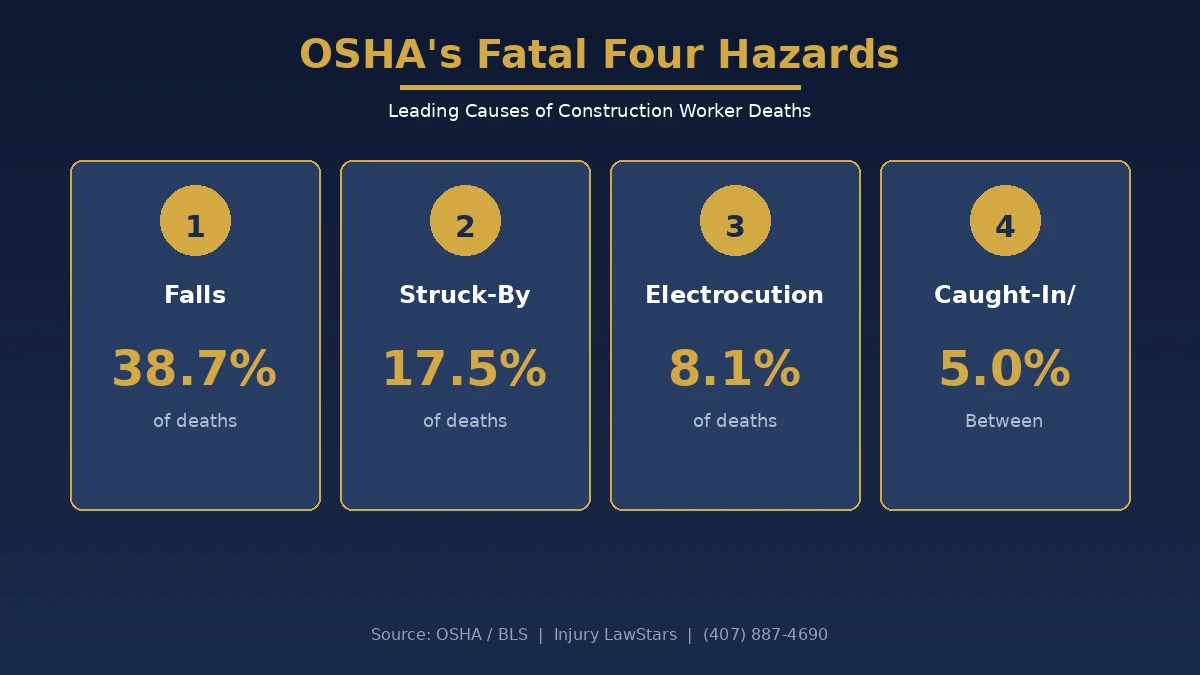
The Occupational Safety and Health Administration (OSHA) identifies four categories of hazards responsible for the majority of construction worker deaths each year. Known as the “Fatal Four,” these hazards are:
1. Falls: The #1 Killer on Construction Sites
Falls are the leading cause of death in the construction industry, accounting for nearly four out of every ten construction fatalities. On Florida construction sites, falls commonly occur from:
- Scaffolding that is improperly erected or maintained
- Ladders that are damaged, unsecured, or placed on unstable surfaces
- Rooftops lacking proper guardrails or fall protection systems
- Elevated platforms and aerial lifts
- Open floor holes and unprotected edges in multi-story buildings
OSHA requires employers to provide fall protection for workers at heights of six feet or more in the construction industry. When employers fail to install guardrails, safety nets, or personal fall arrest systems, they may be held liable for resulting injuries. A Florida construction accident attorney can investigate whether proper fall protection was in place at the time of your accident.
2. Struck-By Incidents: A Major On-Site Danger
Struck-by accidents occur when a worker is hit by a moving object on the construction site. Common struck-by hazards include:
- Falling tools, materials, or debris from elevated work areas
- Vehicles and heavy equipment operating on the job site
- Swinging crane loads and boom arms
- Collapsing structures or building components
- Flying particles from power tools, saws, and nail guns
3. Electrocution: A Silent but Deadly Threat
Electrical hazards on construction sites are particularly dangerous because they often result in fatal or catastrophic injuries. Workers face electrocution risks from:
- Contact with overhead power lines during crane or boom lift operations
- Improperly grounded electrical equipment
- Damaged or exposed wiring in buildings under construction
- Working with electrical systems in wet or damp conditions
- Faulty tools or extension cords
4. Caught-In/Between: Trapped by Heavy Equipment
Caught-in or caught-between accidents happen when a worker is compressed, pinched, or crushed by equipment, materials, or collapsing structures. These accidents are common in:
- Trench and excavation work where cave-ins occur
- Operating or working near heavy machinery with unguarded moving parts
- Working between a moving vehicle and a fixed object
- Structural collapses during demolition or renovation
Trench collapses deserve special attention in Florida. The state’s sandy soil composition makes excavation work particularly hazardous. OSHA mandates that trenches deeper than five feet must have protective systems in place, including sloping, shoring, or trench boxes. Despite these requirements, trench collapses continue to kill and seriously injure Florida construction workers every year.
What Safety Standards Must Your Employer Follow?
Federal and state regulations impose significant safety obligations on construction employers. Under OSHA’s construction safety standards (29 CFR 1926), employers must:
- Provide a safe workplace: Employers must identify and correct recognized hazards that could cause serious injury or death
- Supply personal protective equipment (PPE): Hard hats, safety glasses, fall harnesses, steel-toed boots, and other PPE must be provided at no cost to workers
- Conduct regular safety training: Workers must receive training on hazard recognition, equipment operation, and emergency procedures in a language they understand
- Maintain equipment: All tools, machinery, scaffolding, and safety systems must be regularly inspected and maintained
- Display OSHA postings: The OSHA Job Safety and Health poster must be displayed at every construction site
- Report serious incidents: Employers must report any workplace fatality within 8 hours and any amputation, loss of eye, or inpatient hospitalization within 24 hours
Florida-specific construction safety regulations add additional layers of protection. The Florida Building Code establishes structural standards that affect construction site safety, and the Florida Department of Business and Professional Regulation oversees contractor licensing and compliance. When an employer violates these regulations and a worker is injured as a result, that violation becomes powerful evidence in a construction accident claim.
Hurt on a job site because of safety violations? Call (407) 887-4690 now. Injury LawStars holds negligent employers and contractors accountable for construction injuries across Florida.
Workers’ Comp vs. Third-Party Claims: What’s the Difference?
One of the most misunderstood aspects of Florida construction accident law is the relationship between workers’ compensation and third-party liability claims. Many injured construction workers assume that workers’ compensation is their only legal option, but that is often not the case.
What Does Workers’ Comp Actually Cover?
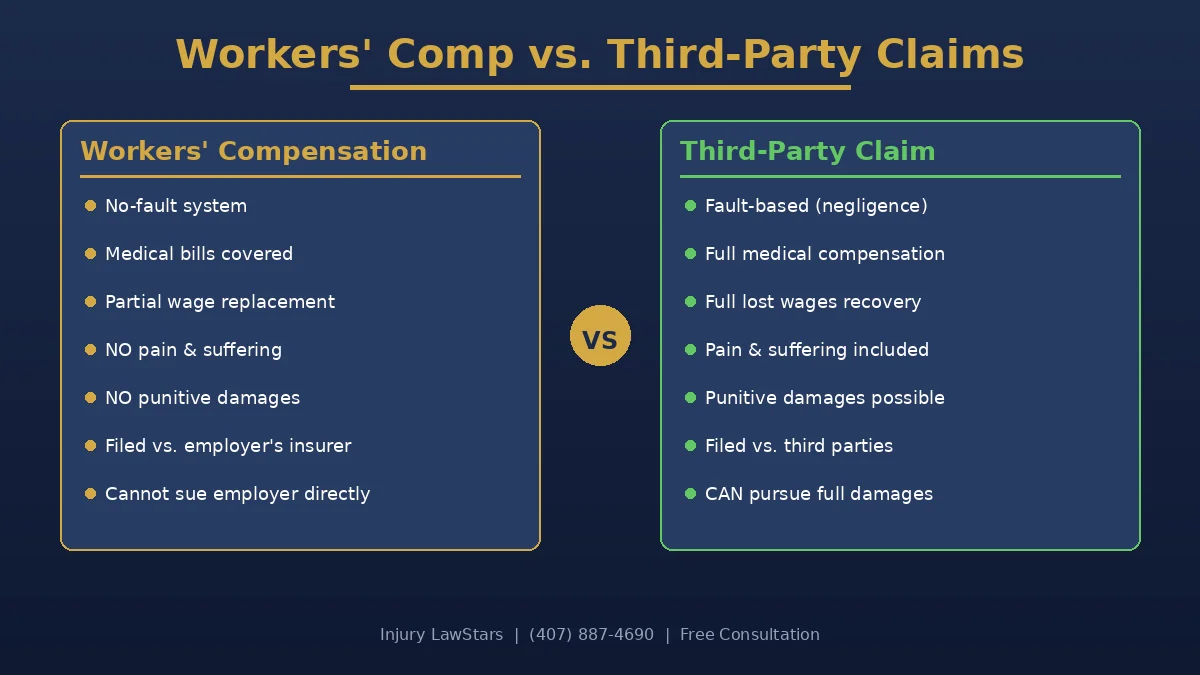
Florida’s workers’ compensation system is a no-fault insurance program that provides benefits to employees injured on the job, regardless of who caused the accident. Construction employers in Florida are required to carry workers’ compensation insurance for every employee, making the construction industry’s threshold stricter than other industries (which require coverage only for four or more employees). For a detailed overview of the claims process and benefit calculations, see our guide on how workers’ compensation works in Florida.
Workers’ compensation benefits include:
- Medical treatment: All reasonable and necessary medical care related to the work injury
- Temporary disability benefits: A portion of lost wages during recovery (typically two-thirds of your average weekly wage)
- Permanent disability benefits: Compensation for lasting impairments that reduce your earning capacity
- Vocational rehabilitation: Retraining and job placement assistance if you cannot return to your previous position
However, workers’ compensation has significant limitations. It does not cover pain and suffering, emotional distress, loss of enjoyment of life, or full lost wages. It also prevents you from suing your employer directly in most circumstances.
Going Beyond Workers’ Comp with a Third-Party Claim
This is where the real opportunity for full compensation lies. While you generally cannot sue your direct employer, you can pursue negligence claims against third parties whose negligence contributed to your construction accident. Third-party claims allow you to recover damages that workers’ compensation does not cover, including:
- Full lost wages (past and future), not just the two-thirds provided by workers’ comp
- Pain and suffering
- Emotional distress and mental anguish
- Loss of enjoyment of life
- Loss of consortium (for spouses)
- Punitive damages in cases of gross negligence
A skilled construction accident lawyer will investigate your case to identify all potential third-party defendants and pursue the maximum compensation available under Florida law.
Who Can Be Held Responsible for Your Accident?
Construction sites involve multiple parties working together, and liability can extend to any entity whose negligence contributed to the accident. Potentially liable parties include:
The General Contractor’s Role in Site Safety
General contractors have overall responsibility for job site safety. Under OSHA’s multi-employer worksite policy, a controlling employer can be cited for hazards affecting workers they do not directly employ. If the general contractor knew about or should have known about dangerous conditions and failed to correct them, they may be liable for worker injuries.
When a Subcontractor Is at Fault
Other subcontractors working on the same site can be held liable if their negligent actions or safety violations cause injury to workers from different companies. For example, if an electrical subcontractor leaves exposed wiring that electrocutes a plumber, the electrical subcontractor may face a third-party claim.
The Property Owner’s Duty to Keep a Site Safe
The property owner who hired the construction project may be liable, particularly if they retained control over safety conditions, knew about hazards on the property, or failed to warn workers about known dangers. Under Florida’s premises liability laws, property owners owe certain duties of care to workers on their property.
Holding Equipment Makers Accountable for Defects
When defective construction equipment causes an injury, the manufacturer, distributor, or retailer of that equipment can be held strictly liable under Florida product liability law. Common defective equipment claims involve:
- Malfunctioning power tools
- Defective scaffolding components
- Faulty safety harnesses or fall protection equipment
- Cranes with design or manufacturing defects
- Improperly designed or manufactured protective gear
Liability for Design Flaws and Engineering Errors
Design professionals can be liable if their negligent designs or specifications create unsafe working conditions. For instance, if an architect’s structural design fails during construction, causing a collapse that injures workers, the architect and their firm may face liability.
When Companies Can Be Held Criminally Responsible
While most construction accident cases are civil matters focused on financial compensation, a company can face criminal charges in the most extreme circumstances. This isn’t for simple mistakes; it’s reserved for situations where an employer willfully violates an OSHA safety standard, and that violation directly causes a worker’s death. Think of it as a step beyond gross negligence. In Florida, to bypass an employer’s usual immunity from lawsuits and approach this level of liability, it must be proven that their actions were “substantially certain to result in injury or death.” This means showing the employer knew about a life-threatening hazard—like an unstable trench in the sandy soil of Lake County—and intentionally exposed a worker to it anyway. While our team at Injury LawStars focuses on securing justice through civil construction accident claims, understanding this distinction highlights the severity with which the law can treat the most egregious safety failures.
Common Accidents That Cause Severe Injuries
While every construction accident has the potential to cause life-changing harm, certain types of incidents consistently produce the most severe injuries:
Falls from Scaffolding and Ladders
Scaffolding collapses and ladder falls are among the most common sources of catastrophic construction injuries. Workers who fall from significant heights often suffer traumatic brain injuries, spinal cord damage resulting in paralysis, multiple fractures, and internal organ damage. Scaffolding accidents frequently result from improper assembly, overloading, failure to install guardrails, and use of damaged components.
The Dangers of Crane Operations
Crane accidents are often fatal. When a crane tips over, drops a load, or contacts power lines, the resulting injuries can be catastrophic. These accidents may involve multiple liable parties, including the crane operator, the crane owner, the general contractor, and the crane manufacturer if a mechanical defect was involved.
Trench Collapses and Excavation Dangers
Trench collapses are particularly deadly because workers buried under soil can suffocate within minutes. Florida’s sandy, unstable soil makes trenching especially hazardous. A single cubic yard of soil weighs approximately 3,000 pounds, meaning even a partial collapse can cause fatal crushing injuries. OSHA requires competent person inspections and protective systems for all trenches over five feet deep.
Injuries from Faulty Tools and Equipment
When a power tool malfunctions, a safety harness fails, or a protective barrier gives way, the consequences can be devastating. Product liability claims against equipment manufacturers do not require proof of negligence; under Florida’s strict liability standards, manufacturers can be held responsible for injuries caused by defective products regardless of whether they acted negligently in the design or manufacturing process.
What to Expect When Filing a Construction Accident Claim
Filing a construction accident claim can feel overwhelming, especially when you’re focused on recovering from a serious injury. The legal process involves several distinct stages, from the initial evidence-gathering phase to settlement negotiations or even a trial. Knowing what to expect can help demystify the process and empower you to take the right steps. While every case is unique, the path generally follows a structured timeline designed to uncover the facts, identify all responsible parties, and determine the full extent of your damages. An experienced attorney guides you through each phase, handling the complex legal work so you can concentrate on your health and family.
The Initial Investigation: Gathering Evidence
The first step your legal team will take is to launch a comprehensive investigation into your accident. This goes far beyond simply filing a workers’ compensation claim. A thorough investigation aims to identify every person or company whose negligence may have contributed to your injuries. Your lawyer will look for other parties who might be at fault, such as the property owner, the general contractor overseeing the site, other subcontractors whose actions created a hazard, or the manufacturers of faulty equipment. This process is critical because it opens the door to third-party claims, which allow you to seek compensation for damages like pain and suffering that workers’ comp doesn’t cover.
What a Thorough Investigation Includes
A detailed investigation involves several key actions. Your attorney will likely visit the construction site in places like Ocala or The Villages to document the scene, take photographs, and identify any remaining hazards. They will interview eyewitnesses, including coworkers, to get a clear picture of what happened. They will also obtain and review crucial documents, such as OSHA reports, police records, medical records, and the construction company’s safety logs. If defective machinery was involved, your legal team will take steps to preserve the equipment as evidence for expert analysis. This meticulous evidence-gathering is the foundation of a strong personal injury claim.
The Legal Steps: From Complaint to Discovery
Once the investigation has identified the at-fault parties, your attorney will file a formal complaint with the court. This legal document officially begins the lawsuit. It outlines who you are suing, explains the basis for your claim, and details the damages you are seeking. After the complaint is filed, the case enters the “discovery” phase. During discovery, both sides exchange information and evidence. This process includes written questions (interrogatories), requests for documents, and depositions, which are formal, out-of-court interviews where witnesses provide testimony under oath. Discovery ensures that both parties have a full understanding of the facts before proceeding.
Negotiations and Trial
After the discovery phase, both sides have a clear view of the case’s strengths and weaknesses. At this point, serious settlement negotiations often begin. Your attorney will present the evidence and argue for a fair settlement that covers all your damages, including medical bills, lost income, and pain and suffering. The vast majority of personal injury cases are resolved through a settlement at this stage. However, if the opposing side refuses to offer a fair amount, your lawyer will be prepared to take your case to trial, where a judge or jury will hear the evidence and decide the outcome.
Understanding Strict Liability in Construction Cases
In some construction accident cases, a legal principle called “strict liability” can apply, particularly when defective equipment is involved. Under Florida’s product liability laws, if you were injured by a malfunctioning tool, a faulty safety harness, or defective scaffolding, you may not need to prove that the manufacturer was negligent. Instead, you only need to show that the product had a defect that caused your injury. The manufacturer, distributor, or even the retailer can be held strictly liable for the harm caused. This is a powerful tool that a Florida construction accident lawyer can use to hold equipment makers accountable.
Special Considerations When Suing a Government Entity
If your construction accident occurred on a public project in a place like Leesburg or Tavares, you might need to file a claim against a government entity. Suing a city, county, or state agency in Florida involves a different set of rules and much shorter deadlines than claims against private companies. For instance, you must provide a formal notice of your claim to the government agency within a very strict timeframe, sometimes as short as 90 days from the date of the accident. Failing to meet this deadline can permanently bar you from recovering any compensation. Because of these special requirements, it is crucial to speak with an attorney immediately if you believe a government entity may be responsible for your injuries.
Partially at Fault? How Florida’s Negligence Law Affects Your Claim
In 2023, Florida enacted House Bill 837 (HB 837), which made significant changes to the state’s tort reform laws that directly impact construction accident claims. The most important change was Florida’s shift from pure comparative negligence to a modified comparative negligence system with a 51% threshold.
Under the new law:
- If you are found to be 50% or less at fault for your construction accident, you can still recover damages, but your award will be reduced by your percentage of fault
- If you are found to be 51% or more at fault, you are barred from recovering any damages in a negligence claim
This change makes it even more critical to work with an experienced construction accident attorney in Florida who can build a strong case establishing that the defendant’s negligence, not your own actions, was the primary cause of your injuries. Insurance companies and defense attorneys will aggressively try to shift blame onto injured workers by arguing that they failed to follow safety protocols or took unnecessary risks.
It is important to note that comparative negligence applies to third-party claims, not to workers’ compensation benefits. Because workers’ comp is a no-fault system, your own negligence does not reduce your workers’ compensation benefits.
How Long Do You Have to File a Construction Accident Claim in Florida?
Time limits apply to both workers’ compensation claims and third-party lawsuits in Florida:
- Workers’ compensation: You must report your injury to your employer within 30 days. The statute of limitations to file a workers’ compensation claim is generally two years from the date of the accident or one year from the last date benefits were provided
- Personal injury lawsuits (third-party claims): Under Florida’s revised statute of limitations (also modified by HB 837), you have two years from the date of the accident to file a personal injury lawsuit
- Wrongful death claims: If a construction accident results in death, the decedent’s survivors have two years from the date of death to file a wrongful death action
- Product liability claims: Claims against equipment manufacturers are generally subject to the two-year statute of limitations, with a 12-year statute of repose from the date of product delivery
Missing these deadlines can permanently bar you from recovering compensation. Do not wait to speak with a construction accident lawyer if you have been injured on a Florida job site.
What Is Your Construction Accident Claim Worth?
When a third-party claim is viable, the potential damages far exceed what workers’ compensation provides. Recoverable damages in a Florida construction accident lawsuit include:
- Economic damages: Full past and future medical expenses, lost wages, loss of earning capacity, vocational rehabilitation costs, and out-of-pocket expenses
- Non-economic damages: Pain and suffering, emotional distress, mental anguish, loss of enjoyment of life, scarring and disfigurement, and loss of consortium
- Punitive damages: In cases involving gross negligence or intentional misconduct, the court may award punitive damages to punish the defendant and deter similar behavior (Florida caps punitive damages at three times the compensatory damages or $500,000, whichever is greater)
For workers who suffer catastrophic injuries such as traumatic brain injuries, spinal cord damage, amputations, or severe burns, the total value of a third-party claim can be substantially higher than workers’ compensation benefits alone. Understanding the types of damages available in personal injury cases can help you evaluate the full scope of your legal options. An experienced attorney will calculate the full lifetime cost of your injuries, including future medical procedures, ongoing rehabilitation, home modifications for disability access, and projected loss of earning capacity over your remaining work life, when determining the appropriate demand.
Do not settle for workers’ comp alone. Call Injury LawStars at (407) 887-4690 for a free case review. We fight to get you the full compensation you deserve, with no fees unless we win.
Example Compensation for Specific Injuries
The value of your claim depends entirely on the severity of your injuries and their long-term impact on your life. For a construction worker in Ocala who suffers a spinal cord injury from a fall, compensation could cover a lifetime of medical care, home modifications, and lost earning potential. You might be able to recover money for a wide range of damages, including past and future medical bills, all lost wages, and compensation for non-economic losses like pain and suffering, emotional distress, and permanent disability. For instance, a traumatic brain injury can lead to cognitive and emotional challenges, and the compensation should reflect the profound effect this has on your quality of life and ability to work. An experienced attorney will work with medical and financial experts to calculate the full, long-term cost of your injuries to ensure no expense is overlooked.
How a Settlement Payout Is Distributed
It’s important to understand that when you agree to a settlement amount, that number isn’t what you’ll receive in your bank account. Think of the settlement as a gross amount from which several required costs must be paid first. Before you receive your portion of the funds, the settlement check is used to cover legal fees, case expenses, and any outstanding medical bills or liens related to your injury. This process ensures that all financial obligations tied to your case are resolved properly. For example, if you reach a $100,000 settlement for an accident in The Villages, a significant portion of that will go toward these other costs. Understanding this distribution is key to managing your financial expectations and seeing the true value of your net recovery.
Attorney Fees and Case Costs
Most personal injury firms, including Injury LawStars, operate on a contingency fee basis. This means you pay no upfront costs, and we only get paid if we successfully recover money for you. If your case settles before a lawsuit is filed or before trial, the attorney’s fee is typically a percentage of the total settlement, often around 33%. So, from that $100,000 settlement, about $33,000 would go toward attorney fees. In addition to fees, there are case costs, which are the expenses required to build your case. These can include fees for filing court documents, hiring expert witnesses, and obtaining medical records. These costs are also deducted from the settlement before you receive your final amount.
Medical Liens and Repayments
If you used health insurance, Medicare, or Medicaid to pay for your medical treatment after the construction accident, that insurance provider has a legal right to be reimbursed from your settlement. This is called a medical lien. Essentially, the insurer paid for your care with the expectation that if a third party was responsible for your injuries, that party (or their insurer) would ultimately cover the cost. Your attorney is legally required to identify and pay back any valid liens from the settlement funds. This is a critical step in the process, as failing to satisfy a lien can lead to legal trouble and even the loss of your future insurance benefits.
How an Attorney Can Increase Your Take-Home Amount
This is where a skilled attorney provides immense value beyond just winning your case. While liens and medical bills must be paid, the amounts are often negotiable. An experienced construction accident lawyer will challenge unreasonable charges and negotiate with medical providers and insurance companies to reduce the amount you have to pay back. By successfully lowering these liens and bills, your attorney directly increases the final amount of money that goes into your pocket. For many clients in communities from Clermont to Leesburg, this negotiation process can make a substantial difference, often resulting in a higher net recovery than they could have achieved on their own, even after accounting for attorney fees.
What to Do Immediately After a Construction Accident
The actions you take immediately following a construction accident can significantly impact the success of your claim. Time is not on your side: evidence disappears, witnesses forget details, and the statute of limitations begins running from the date of your injury. Workers throughout Lake County, Marion County, Sumter County, and greater Central Florida should follow these critical steps to protect their legal rights:
- Seek medical attention immediately: Your health is the top priority. Even if injuries seem minor, get a thorough medical evaluation. Some injuries, particularly brain injuries and internal damage, may not show symptoms right away
- Report the accident to your employer: Notify your supervisor or employer in writing within 30 days to preserve your workers’ compensation rights. Request a copy of the accident report
- Document everything: Take photographs of the accident scene, your injuries, any equipment involved, and the overall site conditions. Note the names of witnesses and any safety violations you observed
- Preserve evidence: Do not discard or repair any equipment, clothing, or tools involved in the accident
- Do not give recorded statements: Insurance adjusters may contact you quickly. Do not provide recorded statements without legal representation
- Contact a construction accident attorney: An experienced construction accident lawyer in Florida can begin investigating your case, preserving evidence, and identifying all liable parties before evidence is lost or destroyed
Frequently Asked Questions About Construction Accident Claims in Florida
Can I sue my employer for a construction accident in Florida?
In most cases, workers’ compensation is the exclusive remedy against your direct employer, meaning you cannot file a personal injury lawsuit against them. However, you can pursue third-party claims against other parties whose negligence contributed to your injury, such as general contractors, subcontractors, property owners, and equipment manufacturers. There are limited exceptions for employer liability, such as cases involving intentional harm or gross negligence that goes beyond ordinary workplace hazards.
What if I was partially at fault for my construction accident?
Under Florida’s modified comparative negligence system (HB 837), you can recover damages as long as you are 50% or less at fault. Your compensation will be reduced by your percentage of fault. For example, if you are awarded $500,000 but found 20% at fault, you would receive $400,000. If you are 51% or more at fault, you cannot recover damages in a third-party lawsuit. However, workers’ compensation benefits are not affected by your degree of fault.
How long do I have to file a construction accident claim in Florida?
For workers’ compensation, you must report the injury to your employer within 30 days and file a claim within two years. For third-party personal injury lawsuits, Florida’s statute of limitations gives you two years from the date of the accident to file suit. Wrongful death claims also carry a two-year statute of limitations from the date of death. Acting quickly is critical because evidence can be lost and memories fade over time.
What is the difference between workers’ comp and a personal injury lawsuit?
Workers’ compensation is a no-fault insurance system that provides medical benefits and partial wage replacement, regardless of who caused the accident. A personal injury lawsuit (third-party claim) is a fault-based legal action against a negligent party that can recover full damages, including pain and suffering, full lost wages, and potentially punitive damages. You may be eligible for both simultaneously, with workers’ comp covering immediate needs while a third-party lawsuit pursues full compensation.
Who pays for my medical treatment after a construction accident?
Your employer’s workers’ compensation insurance should cover all reasonable and necessary medical treatment related to your work injury. If a third-party is liable, their insurance may also be responsible for medical costs. It is important to follow your authorized treating physician’s recommendations and attend all appointments to protect both your health and your claim.
Can undocumented workers file construction accident claims in Florida?
Yes. Florida law does not require proof of citizenship or legal residency to file a workers’ compensation claim or a third-party personal injury lawsuit. All workers, regardless of immigration status, have the right to seek compensation for workplace injuries. Employers cannot retaliate against workers who file claims based on their immigration status.
What should I do if my workers’ compensation claim is denied?
If your workers’ compensation claim is denied, you have the right to appeal the decision. The first step is to file a Petition for Benefits with the Florida Office of the Judges of Compensation Claims (OJCC). A workers’ compensation attorney can guide you through the appeals process, gather additional evidence, and represent you at hearings. Many initially denied claims are successfully overturned with proper legal representation.
How much is my construction accident case worth?
The value of a construction accident case depends on many factors, including the severity of your injuries, the extent of your medical treatment, your lost wages and future earning capacity, the degree of negligence involved, the number of liable parties, and the available insurance coverage. Catastrophic injuries such as traumatic brain injuries, spinal cord damage, and amputations typically result in higher settlements and verdicts. An experienced attorney can provide a more accurate estimate after reviewing the specific facts of your case.
Warning: Do Not Sign Documents from an Insurance Company
Shortly after your accident, an insurance adjuster will likely contact you. They might seem concerned and helpful, but it’s critical to remember their job is to minimize the insurance company’s payout. They will almost certainly ask you to provide a recorded statement or sign medical release forms. Do not do either without speaking to an attorney first. Any statement you make can be twisted and used against you later to devalue or deny your claim. Signing a medical release gives them broad access to your entire health history, which they can use to argue that a pre-existing condition caused your injuries. Agreeing to a quick settlement or signing any document could prevent you from recovering the full compensation you need, especially if you have a valid construction accident claim against a third party.
Key Takeaways
- Look beyond workers’ compensation: While workers’ comp covers initial medical care and a portion of lost wages, it won’t compensate you for pain and suffering. A separate third-party claim against a negligent general contractor, subcontractor, or equipment maker is often necessary to recover the full value of your damages.
- Identify every responsible party: Construction accidents are rarely simple; liability can extend to the property owner for unsafe conditions, another company for creating a hazard, or a manufacturer for a defective tool. A thorough investigation is crucial to holding all at-fault parties accountable.
- Strict deadlines require immediate action: In Florida, you have a limited time to act. You must report your injury to your employer within 30 days for workers’ comp and file any personal injury lawsuit within two years of the accident. Delaying can permanently damage your ability to get compensation.
Related Articles
- How Does Workers’ Comp Work in Florida? | Injury Law Stars
- Florida Car Accident Lawyer | We Know What You’re Facing
About the Author
Katie Miller, Esq.
Managing Partner · Injury LawStars
Attorney Katie Miller was once an injury victim herself. After a car accident in 2016 that required spinal surgery and a 13-month recovery, she turned her experience into a mission: fighting for people who are hurting. With 17+ years of legal experience and over \$45 million recovered for clients, Katie brings both professional expertise and personal understanding to every case.