March 29, 2026
The Complete Florida Boating Accident Guide

Florida is the world’s boating capital, but that title comes with a serious risk. When a fun day on the water ends in a Florida boating accident, the aftermath is often confusing and overwhelming. You’re left dealing with not just physical recovery, but a tangled web of unique maritime laws. Who can be held responsible for your injuries? What are your rights if the at-fault boater has no insurance? You shouldn’t have to face these questions alone. This guide breaks down what you need to know to protect yourself and pursue the compensation you deserve.
Contact Injury LawStars today at (407) 887-4690 for a free, no-obligation consultation with an experienced Florida boating accident lawyer. You pay nothing unless we win your case.
This comprehensive guide covers Florida boating accident laws, common causes, liability rules, available damages, and the critical deadlines every victim should know.
Key Takeaways
- Florida leads the nation in boating fatalities with over 1 million registered vessels and an estimated 1 million unregistered boats actively using state waterways.
- Multiple parties can be held liable for a boating accident in Florida, including the boat operator, the boat owner, rental companies, and even manufacturers of defective equipment.
- You have a limited time to file a claim. Under current Florida law, the statute of limitations for most personal injury claims is two years from the date of the accident. Federal maritime claims may have a three-year deadline.
- Florida’s comparative negligence rules mean your compensation may be reduced if you share some fault, and you cannot recover anything if you are found more than 50% at fault.
- An experienced Florida boating accident lawyer can protect your rights and help you navigate the complex intersection of state and federal maritime law.
Florida Boating Accidents: Just How Bad Is the Problem?
Florida has more registered boats than any other state in the country. With over 1,030,053 registered vessels and a mild climate that allows year-round boating, the state’s waterways see heavy traffic from recreational boaters, commercial vessels, and tourists alike.
According to the FWC’s 2024 Boating Accident Statistical Report, the numbers paint a concerning picture:
- 685 reportable boating accidents occurred statewide
- 81 people lost their lives, a 35% increase from 59 fatalities in 2023
- 394 people suffered injuries requiring medical treatment
- $21.5 million in property damage was reported
- 65% of operators involved in fatal accidents had no formal boating education
- Collision with a fixed object was the leading accident type, accounting for 31% of all incidents
The top counties for boating accidents include Miami-Dade (75 incidents), Monroe (69), Palm Beach (45), Pinellas (42), and Okaloosa (37). Central Florida counties like Lake, Marion, and Sumter County also see their share of incidents on the state’s many lakes and rivers.
These statistics are not just numbers. Each one represents a person whose life was changed by a preventable accident. As someone who knows what it means to have your life upended by an injury, Attorney Katie Miller understands the fear and confusion that follows. That personal experience drives our firm’s commitment to fighting for every boating accident victim in Florida.
Understanding FWC Accident Reports
Accessing Historical Boating Data
The Florida Fish and Wildlife Conservation Commission (FWC) is the official record-keeper for boating incidents in our state. Each year, they release a detailed Boating Accident Statistical Report that gives us a clear, if sobering, look at what’s happening on our waters. The most recent report revealed 685 boating accidents, which tragically led to 81 deaths—a shocking 35% jump from the year before—and left 394 people injured. These reports are an invaluable public resource for understanding the real risks associated with boating in places like Lake County, The Villages, and other popular waterways.
These FWC reports are more than just a snapshot of a single year. They offer a deep well of historical data, allowing us to see patterns and common causes of accidents over time. Inside, you’ll find breakdowns by accident type, the level of boater education for those involved, and the financial toll, which recently topped $21.5 million in property damage alone. This kind of detailed information is often critical for understanding the factors that led to an incident and can be a key part of building a strong boating accident claim. For anyone wanting to explore these statistics further, you can access the Boating Accident Statistical Reports directly on the FWC website.
Florida’s Boating Laws You Need to Know
Understanding the laws that govern boating in Florida is essential for any accident claim. Florida Statutes Chapter 327 establishes the rules for vessel operation, safety equipment, and operator responsibilities on the state’s waterways.
Registering Your Boat in Florida
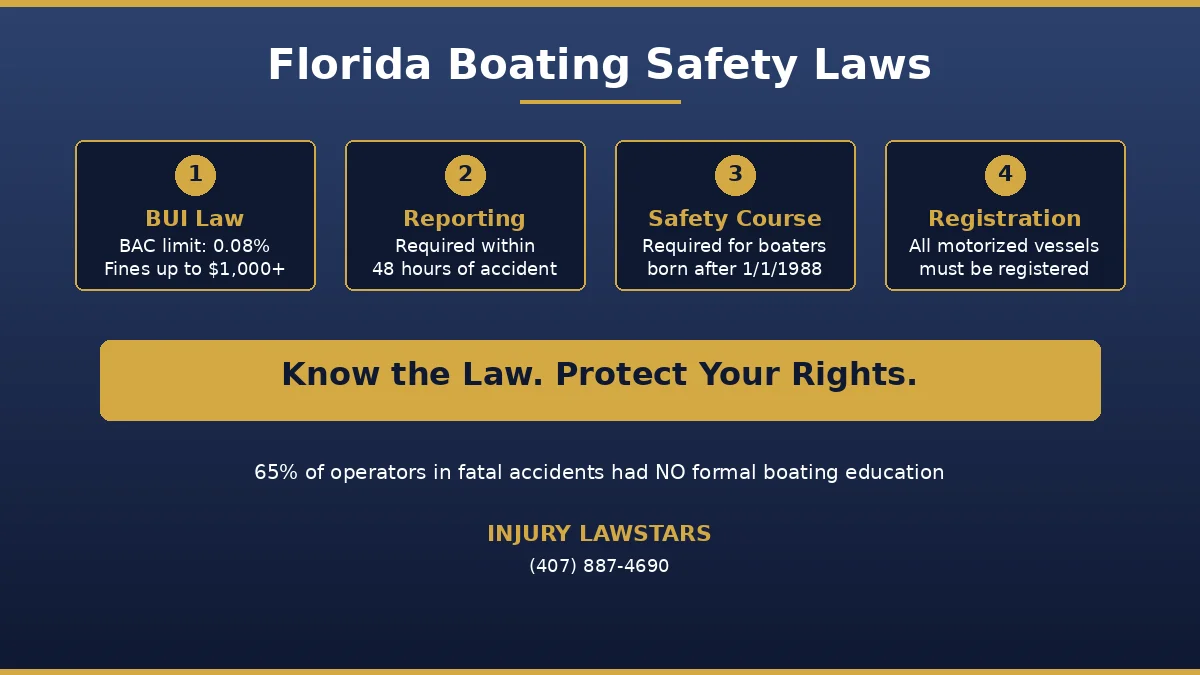
Florida law requires all vessels with motors to be registered with the Florida Department of Highway Safety and Motor Vehicles (DHSMV). This includes motorboats, sailboats with auxiliary motors, and personal watercraft like jet skis. Non-motorized vessels such as canoes and kayaks are exempt from registration, though they must still comply with safety equipment requirements.
Despite registration requirements, the FWC estimates that close to 1 million unregistered vessels are actively used on Florida waters. This creates significant enforcement challenges and increases the risk of accidents involving uninsured and unidentified operators.
Who Needs a Boating Safety Card?
Florida requires a boating safety education course for anyone born on or after January 1, 1988, who operates a vessel with 10 horsepower or more. This requirement reflects the state’s effort to reduce accidents caused by inexperienced operators.
However, the data shows the education gap remains a serious problem. In 2024, 65% of operators involved in fatal boating accidents had received no formal boater education. Completing a boating safety course is not just a legal requirement for many boaters; it is a basic step that could prevent tragedies.
Understanding Florida’s Strict BUI Laws
Operating a vessel while impaired is illegal under Florida Statute §327.35. The legal blood alcohol concentration (BAC) limit for boat operators is 0.08%, the same standard applied to motor vehicle drivers. However, boating under the influence can be even more dangerous than driving a car because of the additional environmental factors, including sun exposure, wave motion, wind, and engine vibration, that amplify the effects of alcohol.
Penalties for BUI in Florida include:
- First offense: Up to six months in jail, fines between $500 and $1,000
- Second offense: Up to nine months in jail, fines between $1,000 and $2,000
- Third offense within 10 years: Up to 12 months in jail; third offense outside 10 years is a felony with up to five years in prison
- BUI causing serious bodily injury: Third-degree felony with up to five years in prison
- BUI causing death: May be charged as BUI manslaughter, a second-degree felony with up to 15 years in prison
If an impaired boat operator causes your accident, their intoxication can serve as strong evidence of negligence in your personal injury claim. Learn more about how impaired driving affects communities across Florida.
Essential Boating Safety and Prevention Tips
While you can’t control the actions of every other boater on the water, you can take proactive steps to protect yourself and your passengers. Following basic safety protocols significantly reduces your risk of being involved in a preventable accident. Simple measures like wearing a life jacket and ensuring you have reliable communication tools can make the difference between a close call and a tragedy. Even the most experienced boaters in places like Lake County or The Villages should never become complacent. Safety is an active, ongoing responsibility every time you leave the dock.
The Importance of Properly Using Life Jackets
A personal flotation device (PFD), or life jacket, is the single most important piece of safety equipment on any vessel. Florida law requires that all recreational vessels have a U.S. Coast Guard-approved, wearable PFD for each person on board. For children under the age of six, they must be worn at all times on any vessel less than 26 feet in length. However, it’s a smart practice for everyone to wear one. In the chaos of a boating accident, you may not have time to locate and put on a stowed life jacket. An unexpected fall overboard or a collision can leave even a strong swimmer disoriented, injured, or unconscious. A properly fitted life jacket keeps your head above water, making you visible to rescuers and preventing drowning.
Using Float Plans and Emergency Radios
Before you head out, always file a float plan. This doesn’t have to be a complicated document; it simply means letting a reliable person on shore know your plans. Tell them where you’re going, who is with you, what your boat looks like, and when you expect to return. If you don’t check in by the designated time, that person can alert the authorities, giving search and rescue teams a critical head start. Once on the water, your cell phone isn’t enough. Service can be unreliable on larger bodies of water like the Harris Chain of Lakes or Lake Weir. A VHF radio is your most dependable lifeline. Keep it tuned to channel 16, the national distress and hailing frequency, to communicate with other vessels and the Coast Guard in an emergency.
What Causes Most Boating Accidents in Florida?
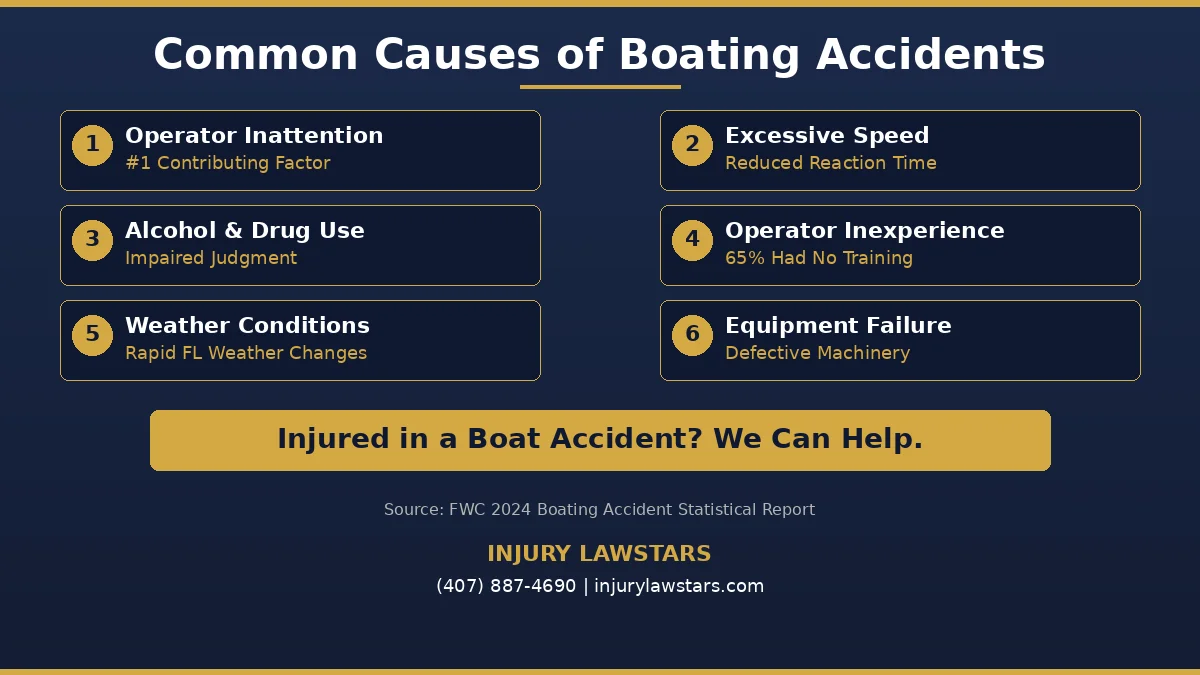
Understanding what causes boating accidents helps establish liability in a legal claim. Based on FWC data and years of handling these cases, the most common causes include:
Distracted Boating: A Leading Cause
Operator inattention consistently ranks as the leading contributing factor in Florida boating accidents. Unlike roadways, waterways have no lane markings, traffic signals, or stop signs. Operators must constantly scan for other vessels, swimmers, debris, and changing water conditions. A moment of distraction can lead to a devastating collision.
The Dangers of Speeding on the Water
Speed is a major factor in boating accidents, particularly in congested waterways, narrow channels, and areas with limited visibility. Florida law requires operators to maintain a safe speed at all times considering conditions like weather, traffic density, proximity to navigational hazards, and the vessel’s maneuverability.
High-Speed Risks and Illegal Boat Racing
The thrill of open water can tempt some operators to push their vessels to dangerous speeds, sometimes even engaging in illegal boat races. This reckless behavior turns a recreational outing into a life-threatening situation in an instant. On busy waterways like the Harris Chain of Lakes in Lake County or the lakes around The Villages, a speeding boat leaves no room for error. As a tragic crash in the Caloosahatchee River demonstrated, where a boat was allegedly racing at over 75 mph before flipping, the consequences are devastating. This type of behavior is a clear example of negligence. If you were injured by an operator who was speeding or racing, they can be held accountable for their actions. Proving this often requires a thorough investigation, and an experienced boating accident lawyer can help gather the necessary evidence to build a strong case.
How Alcohol and Drugs Impair Judgment
Alcohol is involved in a significant percentage of fatal boating accidents nationally. The combination of alcohol, heat, sun, and the rocking motion of a boat creates a dangerous level of impairment that affects judgment, balance, and reaction time.
When Inexperience Leads to Accidents
As noted in the FWC data, the majority of operators involved in fatal accidents had no formal training. Inexperienced operators are more likely to misjudge distances, misread navigational markers, fail to maintain a proper lookout, and make critical errors when conditions change unexpectedly.
The Risks of Boating in Bad Weather
Florida’s weather can change rapidly, particularly during the summer months when afternoon thunderstorms develop quickly. High winds, lightning, reduced visibility, and rough water conditions catch unprepared boaters off guard. Failure to monitor weather forecasts and respond appropriately is a form of negligence.
Sudden Storms and Unpredictable Conditions
Anyone who has spent time in places like Lake County or The Villages knows how quickly a sunny afternoon can turn into a severe thunderstorm. On the water, these sudden changes are incredibly dangerous. A pop-up storm can bring high winds, blinding rain, and choppy waves that can easily capsize a small vessel or throw passengers overboard. Lightning is another serious threat, especially on open water. A boat operator has a responsibility to check weather forecasts before and during their trip. Ignoring storm warnings or failing to head for shore when conditions worsen isn’t just risky—it’s a form of negligence. If you were injured because an operator made a poor decision in bad weather, you have legal options. Successfully pursuing boating accident claims in these situations hinges on proving that the operator’s actions were negligent.
When Your Boat or Equipment Fails
Defective or poorly maintained engines, steering systems, fuel systems, and safety equipment can cause or worsen boating accidents. When equipment failure contributes to an accident, the boat owner, a maintenance provider, or even the equipment manufacturer may share liability.
Engine Failure in Rough Waters
Imagine being out on the water near Lake County or The Villages when one of Florida’s infamous afternoon thunderstorms rolls in. The sky darkens, the wind picks up, and the water gets choppy. Now, imagine your engine suddenly cuts out. Without power, your vessel is helpless against the waves, pushed around by the wind and current. This loss of control can quickly lead to the boat capsizing, colliding with a fixed object like a channel marker, or being swamped by waves, putting everyone on board in grave danger. Determining who is responsible—whether it’s the owner for neglecting maintenance or the operator for ignoring weather warnings—is a critical step in any resulting injury claim. An experienced boating accident lawyer can investigate the circumstances to hold the right parties accountable.
Common Injuries from Boating Accidents
Boating accidents take many forms, and each type can cause serious or fatal injuries. The most common types of boating accidents and injuries seen in Florida include:
Boat-on-Boat Collisions
Two boats colliding on the water is one of the most common accident types. These collisions often happen in congested areas, at night, or when one or both operators fail to maintain a proper lookout. The impact of a boat collision can throw passengers overboard, cause traumatic brain injuries, spinal cord damage, and broken bones.
Hitting Docks, Bridges, or Debris
The FWC’s 2024 report identified collision with a fixed object as the single most common accident type, responsible for 31% of all reportable incidents. Fixed objects include docks, piers, bridge pilings, channel markers, seawalls, and submerged structures. These collisions often occur at high speed and can be catastrophic.
What Happens When a Boat Capsizes?
When a vessel overturns (capsizes) or takes on water (swamping), everyone aboard is at immediate risk of drowning. Capsizing accidents are particularly deadly when passengers are not wearing life jackets. Causes include overloading, improper weight distribution, sharp turns at speed, and sudden weather changes.
The Dangers of Man Overboard Incidents
Falling overboard is one of the leading causes of boating fatalities in Florida. Passengers who fall from a moving vessel face the risk of drowning, hypothermia, and being struck by the boat’s propeller. The absence of railings on many recreational boats and the effects of alcohol increase the risk.
The Danger of an Uncontrolled Boat
An uncontrolled boat is one of the most frightening scenarios on the water. When an operator loses control, a vessel can become a high-speed, unpredictable hazard. This is a major reason why collision with a fixed object was the leading type of boating accident in Florida last year, accounting for nearly a third of all incidents. These aren’t gentle bumps; they are often violent impacts with docks, seawalls, and bridge pilings in places like Lake County and Marion County, capable of causing catastrophic damage and severe injuries. The operator’s inability to manage the vessel puts everyone on board and in the surrounding water at immediate risk.
A recent, terrifying incident in Biscayne Bay showed just how dangerous this can be when a boat began spinning wildly out of control, throwing two people into the water who were then struck by their own vessel. This kind of accident can lead to devastating propeller injuries, broken bones, and severe traumatic brain injuries. The situation underscores a critical point: the danger isn’t just from other boats, but from the very vessel you are on if the operator is not in command. When negligence leads to such a terrifying event, the responsible party must be held accountable for the harm they cause.
So, what causes an operator to lose control? Often, it comes down to a lack of experience. The FWC found that a staggering 65% of operators involved in fatal accidents had no formal boating education. Without proper training, an operator may not know how to react in an emergency, handle a mechanical failure, or manage the boat in rough conditions on the lakes in The Villages or the waterways near Ocala. This inexperience can turn a fun day on the water into a tragedy, highlighting the importance of holding untrained and reckless operators responsible.
Understanding Propeller Strike Injuries
Contact with a boat’s propeller can cause devastating lacerations, amputations, and fatal injuries. Propeller strikes most commonly occur during water sports activities, when swimmers are near an operating vessel, or when a person falls overboard from the boat.
Running Aground: What It Means for You
A vessel running aground in shallow water can cause hull damage, throw passengers forward, and leave occupants stranded. Grounding incidents are common in Florida’s shallow coastal waters and are often caused by operator inexperience or failure to use navigational charts.
Were you or a loved one injured in a boating accident? Call Injury LawStars at (407) 887-4690 for a free case evaluation. We handle boating accident cases on a contingency basis, so you pay nothing unless we win.
Who’s at Fault in a Florida Boating Accident?
Determining liability after a boat accident in Florida requires examining who acted negligently and whose negligence contributed to the accident. Multiple parties can potentially be held responsible.
The Operator’s Responsibility
The person operating the vessel at the time of the accident is the most obvious potential defendant. Boat operators owe a duty of care to passengers, other boaters, and swimmers. If the operator was inattentive, speeding, impaired, inexperienced, or violating any boating safety regulation, they can be held liable for resulting injuries.
When Is the Boat Owner Liable?
Florida law holds boat owners to a high standard. Under the dangerous instrumentality doctrine, a boat owner who allows another person to operate their vessel can be held vicariously liable for injuries caused by the operator’s negligence. This is true even if the owner was not on the boat at the time of the accident.
This means that if someone borrows a friend’s boat and causes an accident, the boat owner may also be financially responsible for the victims’ injuries. This doctrine is a critical tool in boating accident cases because the operator may not have sufficient insurance or assets to cover the damages.
Can You Sue a Boat Rental Company?
Boat rental companies in Florida have a duty to maintain their vessels in safe condition, provide adequate safety equipment, and verify that renters have the required boating education or experience. If a rental company rents a defective vessel, fails to provide safety instructions, or rents to an obviously intoxicated or inexperienced person, the company can be held liable.
Holding Manufacturers Accountable
If a defect in the boat’s design, manufacturing, or a component part caused or contributed to the accident, the manufacturer may be liable under Florida’s product liability laws. Common defects include faulty steering systems, engine malfunctions, defective hull designs, and inadequate safety features.
Employer Liability in Commercial Boating
When a boating accident involves a commercial vessel, the employer may be liable for the actions of its employees under the doctrine of respondeat superior. Additionally, injured crew members on commercial vessels may have claims under the Jones Act, which provides unique protections for maritime workers.
Can a Government Agency Be at Fault?
If a boating accident is caused by a poorly maintained navigational channel, an unmarked hazard, or a defective public dock or boat ramp, the government entity responsible for maintaining the waterway may bear liability. Claims against government entities involve specific notice requirements and shorter deadlines.
When Multiple Parties Share Fault
It’s rarely a simple case of one person being at fault in a boating accident. Florida law recognizes that multiple parties can share responsibility. For example, while the boat operator’s actions are the first thing to examine, the boat’s owner can also be held liable under the “dangerous instrumentality doctrine.” This legal concept means that if an owner lends their boat to a friend who then causes an accident, the owner can be financially responsible for the injuries, even if they were miles away. Rental companies also have a duty to maintain their vessels and provide proper safety equipment. If they fail, they can be held accountable. Furthermore, if a defective part like a faulty steering system contributed to the crash, the manufacturer could be liable. A thorough investigation is crucial to identify every party whose negligence played a role in your injuries and to protect your rights.
What if You’re Partially at Fault for the Accident?
Florida follows a modified comparative negligence system under the tort reform changes enacted by HB 837 in 2023. Under this system:
- Your compensation is reduced by your percentage of fault. If you are found 20% at fault for the boating accident, your damages are reduced by 20%.
- If you are found more than 50% at fault, you cannot recover any damages. This is a significant change from Florida’s prior pure comparative negligence system, where you could recover even if you were 99% at fault.
In boating accident cases, the defense may argue that the injured party was partially at fault for not wearing a life jacket, for being intoxicated, or for engaging in risky behavior. An experienced attorney can counter these arguments and work to minimize any allocation of fault to you. Learn more about whether you can get compensation if the accident was partially your fault.
State vs. Federal Law: Which Applies to Your Case?
One of the complexities of boating accident cases in Florida is that both state law and federal maritime law may apply, depending on where the accident occurred and the type of vessel involved.
Understanding Federal Jurisdiction
Federal admiralty and maritime law governs accidents that occur on “navigable waters,” which includes:
- The Atlantic Ocean and Gulf of Mexico beyond Florida’s state water boundaries
- Bays, harbors, and coastal waterways
- Navigable rivers and lakes that could support interstate commerce
Even some Florida waterways that seem entirely inland may be classified as navigable waters for purposes of federal jurisdiction.
Important Federal Maritime Laws to Know
The Jones Act (46 U.S.C. §30104): This federal statute allows crew members of commercial vessels to sue their employers for injuries caused by the employer’s or a co-worker’s negligence. Jones Act claims are significant because they allow recovery even when the employer’s negligence was relatively minor.
General Maritime Law: This body of law provides remedies for passengers and others injured on navigable waters. General maritime law allows claims for maintenance and cure (medical expenses and living expenses for injured seamen) and unseaworthiness (holding vessel owners liable when a vessel is not reasonably fit for its intended use).
The Limitation of Liability Act (46 U.S.C. §30523): This federal law allows boat owners to attempt to limit their liability to the value of the vessel after the accident. Rental companies and vessel owners may try to invoke this defense to reduce the compensation available to victims. An experienced Florida boating accident lawyer can challenge these attempts.
Why the Right Jurisdiction Matters
Where your accident occurred directly affects which laws apply and which court will hear your case. Florida state courts handle claims arising on state waters under Florida negligence law. Federal courts have jurisdiction over maritime cases on navigable waters.
The statute of limitations also depends on jurisdiction:
- Florida state waters: Two years from the date of the accident (under current Florida law for incidents after March 24, 2023)
- Federal maritime/admiralty waters: Three years from the date of the accident
- Wrongful death claims: Two years from the date of death under both Florida law and general maritime law
Because the jurisdictional analysis directly impacts your rights and deadlines, it is critical to consult with an attorney who understands both state and federal maritime law. Learn more about how long you have to file a personal injury lawsuit in Florida.
Legal Consequences and the Investigation Process
When a serious boating accident happens, the aftermath involves more than just medical care and insurance claims. A parallel process begins, involving law enforcement investigations and potentially serious criminal charges for the at-fault operator. Understanding this process is crucial for victims, as the findings from a criminal investigation can significantly impact a civil personal injury claim. The evidence gathered by agencies like the Florida Fish and Wildlife Conservation Commission (FWC) can become a cornerstone for proving negligence and securing the compensation you need to recover from your injuries and losses.
Potential Criminal Charges Beyond BUI
While Boating Under the Influence (BUI) is a well-known offense, it’s far from the only criminal charge an operator can face after a crash. Florida’s boating laws establish clear “rules of the road” for the water, and violating them can lead to severe legal trouble, especially when someone gets hurt. These criminal proceedings are separate from your civil claim for damages, but they can provide powerful evidence of the operator’s recklessness. An operator’s decision-making before, during, and after a collision can result in a range of charges that carry heavy fines and the possibility of significant prison time.
Violations of Navigational Rules
Think of navigational rules as the traffic laws of the water. They govern everything from speed limits in certain zones to who has the right-of-way when two boats approach each other. When an operator ignores these rules—by failing to maintain a proper lookout, for example—and causes a crash, they can be charged criminally. In one recent high-profile Clearwater case, an operator faced 16 separate charges for breaking a navigation rule that led to a collision with a ferry. These aren’t just minor tickets; they are serious offenses that demonstrate a clear disregard for the safety of others on the water.
Leaving the Scene of an Accident Involving Injury
Just like a hit-and-run on the highway, leaving the scene of a boating accident where someone is injured is a felony in Florida. The law requires an operator involved in a collision to stop their vessel, provide assistance to anyone who is hurt, and exchange information with the other parties. Fleeing the scene is not only a cowardly act but also a serious crime that can add years to a potential prison sentence. In the same Clearwater case, the operator was charged with eight counts of leaving the scene of an accident with injuries after officials reported he left the crash and had to be stopped by police later.
Severe Penalties and Prison Sentences
The combination of charges from a single boating incident can result in devastating legal consequences for the at-fault operator. When you add up charges for violating navigational rules, leaving the scene, and BUI causing serious injury or death, the potential prison time can be staggering. For instance, the operator in the Clearwater ferry crash could face around 23 years in prison if convicted. This highlights the gravity with which the legal system treats reckless boating. For victims, this criminal accountability is important, but it doesn’t pay for medical bills or lost wages—that’s where a separate civil claim becomes essential.
How Modern Accidents are Investigated
After a serious boating accident, law enforcement and FWC investigators begin a meticulous process to piece together what happened. This isn’t just about interviewing witnesses; it involves a highly technical reconstruction of the event. Investigators treat the waterway like a crime scene, collecting physical evidence, documenting damage to the vessels, and analyzing environmental factors. Their goal is to create a clear and accurate timeline of the events leading up to the collision. This official investigation is critical, as its findings often form the basis for both criminal charges and civil liability claims.
Reconstructing Accidents with GPS and Engine Data
Modern boats are equipped with sophisticated technology that can tell a detailed story of their final moments before a crash. Investigators now regularly pull data from GPS units and engine control modules to reconstruct an accident with incredible precision. This “black box” data can reveal the vessel’s speed, course, throttle position, and steering inputs right up to the point of impact. In a recent fatal speedboat crash in Florida, investigators relied on this type of data to understand what happened. This objective, electronic evidence is often undeniable and can be instrumental in proving an operator was speeding or driving erratically.
The Complexity of Boating Accident Cases
Boating accident cases are rarely straightforward. They often involve multiple victims, complex questions of jurisdiction between state and federal law, and extensive investigations. The sheer volume of evidence and the number of people involved can make these cases incredibly challenging to manage. For example, in the Clearwater ferry crash case, the state expected to call between 40 and 50 witnesses, with the trial projected to last for three weeks. This level of complexity shows why you need a dedicated legal team that has the resources and experience to handle every detail. At Injury LawStars, our team is prepared to manage these intricate cases, ensuring your rights are protected throughout the entire process. We handle the legal burdens so you can focus on your recovery.
How to Report a Boating Accident in Florida
Florida law requires boating accidents to be reported to the Florida Fish and Wildlife Conservation Commission (FWC) under certain conditions. Under Florida Statute §327.30, you must file a report if any of the following apply:
- A person dies as a result of the accident
- A person disappears from a vessel under circumstances suggesting death or injury
- A person is injured and requires medical treatment beyond first aid
- Property damage exceeds $2,000
The report must be filed within 48 hours of the accident. Failing to report a boating accident when required can result in legal penalties and may also complicate your ability to pursue a personal injury claim later.
Beyond the legal requirement, filing a report creates an official record of the accident that can be valuable evidence in your case. The report documents the conditions at the time of the accident, the parties involved, any witnesses, and the investigating officer’s observations.
Understanding Boat Insurance After an Accident
Unlike auto insurance, Florida does not require boat owners to carry liability insurance. This creates potential complications for accident victims seeking compensation.
- Marine liability insurance: Many boat owners carry this voluntarily, and it typically covers bodily injury and property damage caused by the insured vessel.
- Homeowner’s insurance: Some homeowner policies provide limited coverage for smaller watercraft, though coverage limits are often low.
- Uninsured/underinsured boater coverage: If available on your own policy, this can protect you when the at-fault party lacks adequate insurance.
- Marina and rental company insurance: Commercial operators typically carry commercial marine insurance with higher limits.
When the at-fault party has no insurance or insufficient coverage, identifying all potentially liable parties becomes even more important. The dangerous instrumentality doctrine, product liability claims, and employer liability under the Jones Act can open additional avenues for recovery.
What Compensation Can You Get After a Boating Accident?
If you were injured in a boating accident in Florida due to someone else’s negligence, you may be entitled to compensation for both economic and non-economic damages.
Covering Medical Bills and Lost Wages
These are quantifiable financial losses, including:
- Medical expenses: Emergency treatment, hospitalization, surgery, rehabilitation, physical therapy, prescription medications, and future medical care
- Lost wages: Income lost while recovering from your injuries
- Lost earning capacity: Reduced ability to earn income in the future due to permanent injuries
- Property damage: Repair or replacement costs for your vessel and personal property
Compensation for Your Pain and Suffering
These compensate for losses that are real but harder to quantify:
- Pain and suffering: Physical pain and emotional distress caused by the accident and resulting injuries. Learn more about pain and suffering settlement amounts in personal injury cases.
- Mental anguish: Anxiety, depression, PTSD, and other psychological effects
- Loss of enjoyment of life: Inability to participate in activities you enjoyed before the accident
- Loss of consortium: Impact on your relationship with your spouse
- Scarring and disfigurement: Permanent physical changes resulting from the accident
When Are Punitive Damages Awarded?
In cases involving egregious conduct, such as a boating accident caused by an extremely intoxicated operator, Florida courts may award punitive damages. These are designed to punish the wrongdoer and deter similar conduct, not to compensate the victim. Punitive damages require clear and convincing evidence of intentional misconduct or gross negligence.
Filing a Claim After a Fatal Accident
When a boating accident results in death, the victim’s surviving family members may file a wrongful death claim. Florida’s Wrongful Death Act allows recovery for funeral and burial expenses, lost financial support, loss of companionship and guidance, and mental pain and suffering of the survivors.
Do not wait to protect your rights. Call Injury LawStars at (407) 887-4690 for a free consultation with an experienced Florida boating accident attorney. We fight for maximum compensation on a contingency basis, so there is no fee unless we win.
Your Next Steps After a Florida Boating Accident
The steps you take immediately after a boat accident in Florida can significantly impact your health, safety, and legal rights. Here is what you should do:
- Seek medical attention immediately. Even if you feel fine, some injuries such as concussions, internal bleeding, and spinal injuries may not show symptoms right away. A medical evaluation creates a record that links your injuries to the accident.
- Call 911 and report the accident. Contact law enforcement and emergency services. The FWC or local marine patrol will investigate and create an official accident report.
- Document everything. Take photos and videos of the accident scene, vessel damage, injuries, weather conditions, and any hazards. Collect the names, contact information, and insurance details of all parties involved.
- Get witness information. If other boaters or bystanders saw the accident, get their names and contact information. Witness testimony can be critical evidence.
- Do not admit fault. Avoid making statements about who caused the accident. Anything you say can be used against you later.
- Preserve evidence. Do not repair your vessel or dispose of any equipment before consulting with an attorney. Physical evidence from the boat can be crucial.
- Contact a Florida boating accident lawyer. An experienced attorney can protect your rights from day one, handle communications with insurance companies, and begin building your case. Contact Injury LawStars today for a free consultation.
Frequently Asked Questions About Boating Accidents in Florida
What should I do immediately after a boating accident in Florida?
Seek immediate medical attention, call 911 to report the accident, document the scene with photos and videos, collect witness information, and contact a Florida boating accident lawyer as soon as possible. Do not admit fault or give recorded statements to insurance companies without legal representation.
How is fault determined in a boating accident?
Liability depends on the circumstances. The boat operator, the boat owner (under Florida’s dangerous instrumentality doctrine), boat rental companies, equipment manufacturers, employers of commercial vessel workers, and government entities responsible for maintaining waterways can all potentially be held liable. Multiple parties may share responsibility.
How much is a boating accident claim worth in Florida?
The value depends on the severity of your injuries, the extent of your medical treatment, lost income, the impact on your quality of life, and the degree of the defendant’s negligence. Boating accident claims involving serious injuries such as traumatic brain injuries, spinal cord damage, or wrongful death can result in significant compensation. Each case is unique, and an attorney can provide a more accurate assessment based on your specific situation.
Does Florida require boat insurance?
No. Unlike auto insurance, Florida does not require boat owners to carry liability insurance. However, many boat owners carry marine liability insurance voluntarily, and lenders or marinas often require it. If the at-fault boater is uninsured, your own uninsured/underinsured boater coverage may apply. This lack of mandatory insurance makes identifying all liable parties especially important in boating accident cases.
How long do I have to file a boating accident claim in Florida?
For accidents occurring after March 24, 2023, the statute of limitations for personal injury claims under Florida law is two years from the date of the accident. If federal maritime law applies (accidents on navigable waters), you generally have three years. Wrongful death claims must be filed within two years of the date of death. These deadlines are strict. Missing the filing deadline almost always means losing your right to compensation.
What is the Jones Act and does it apply to my boating accident?
The Jones Act (46 U.S.C. §30104) is a federal law that allows crew members of commercial vessels to sue their employers for injuries caused by negligence. It applies if you were working as a crew member on a commercial vessel when injured. The Jones Act does not typically apply to recreational boating accidents, but general maritime law may still provide additional protections depending on where the accident occurred.
Can I still recover compensation if I was partially at fault for the boating accident?
Yes, but your recovery will be reduced. Under Florida’s modified comparative negligence system (enacted by HB 837 in 2023), your compensation is reduced by your percentage of fault. However, if you are found more than 50% at fault, you cannot recover any damages. An experienced boating accident attorney can help minimize the fault attributed to you and maximize your recovery.
How to Protect Your Rights After a Boating Accident
A boating accident can change your life in an instant. The physical pain, emotional trauma, and financial burden can feel overwhelming. But you do not have to face it alone.
At Injury LawStars, we understand what accident victims go through because we have been there ourselves. Attorney Katie Miller was once an injury victim, and that lived experience fuels her determination to fight for every client. We handle boating accident cases on a contingency basis, which means you pay nothing unless we recover compensation for you.
If you or a loved one was injured in a boat accident in Florida, do not wait. The sooner you speak with an experienced attorney, the better we can protect your evidence, your rights, and your future.
Contact Injury LawStars today at (407) 887-4690 for a free consultation. We are here to help you get the justice you deserve.
Why You Need an Experienced Boating Accident Attorney
After a boating accident, figuring out your next steps can feel like trying to find your way through a storm. The legal side of things is often far more complicated than people realize, involving a unique mix of state and federal laws that don’t apply to typical accidents on land. Trying to handle this alone while recovering from an injury is an immense burden. An experienced attorney takes on these legal complexities for you, from investigating the accident and gathering evidence to dealing with insurance companies and building a strong case. This allows you to focus on what truly matters: your health and recovery.
How a Lawyer Can Help with Complex Cases
Working through the aftermath of a boating accident is challenging because it often involves a tangled web of state and federal maritime laws. Depending on where the accident happened—whether on a lake in Lake County or offshore in the Gulf—different rules and deadlines can apply. An experienced Florida boating accident lawyer understands this intricate legal landscape. They determine the correct jurisdiction for your claim, ensuring your case is filed properly and that your rights are protected under the applicable laws from the very beginning. This single step is critical, as a mistake in jurisdiction can jeopardize your entire case.
Identifying who is responsible is another critical step where an attorney’s help is invaluable. It’s not always just the person driving the boat. Liability could extend to the boat’s owner, a rental company that failed to maintain the vessel, or even the manufacturer of a defective part. A thorough investigation is necessary to uncover every party whose negligence contributed to your injuries. Your lawyer will work to identify all potential sources of compensation, which is crucial for ensuring you can cover your medical bills, lost wages, and other damages from every responsible party.
Insurance companies often try to shift blame to reduce their payout, which is especially dangerous under Florida’s modified comparative negligence rule. This law states that if you are found to be more than 50% at fault for the accident, you cannot recover any compensation. An attorney acts as your advocate, gathering evidence and building a strong case to counter any unfair attempts to place blame on you. Their goal is to protect your right to recovery and maximize the compensation you receive for your injuries and losses, ensuring you understand how fault affects your claim.
Related Articles
- Strict Liability vs. Negligence: Key Differences
- Injury LawStars | Boating Accidents In Clermont, FL
- Injury LawStars | Florida Personal Injury Lawyer
About the Author
Katie Miller, Esq.
Managing Partner · Injury LawStars
Attorney Katie Miller was once an injury victim herself. After a car accident in 2016 that required spinal surgery and a 13-month recovery, she turned her experience into a mission: fighting for people who are hurting. With 17+ years of legal experience and over \$45 million recovered for clients, Katie brings both professional expertise and personal understanding to every case.