
March 29, 2026
Florida Boating Accident Laws: What Every Victim Needs to Know
Florida is the boating capital of the world, but that title comes with a heavy cost. In 2024, the Florida Fish and Wildlife Conservation Commission (FWC) reported 685 boating accidents across the state, resulting in 81 fatalities and 394 injuries. That is a 35% increase in deaths compared to the previous year. If you or someone you love was hurt in a boat accident in Florida, you need to understand the laws that protect you, who can be held responsible, and how to pursue the compensation you deserve.
Contact Injury LawStars today at (407) 887-4690 for a free, no-obligation consultation with an experienced Florida boating accident lawyer. You pay nothing unless we win your case.
This comprehensive guide covers Florida boating accident laws, common causes, liability rules, available damages, and the critical deadlines every victim should know.
Key Takeaways
- Florida leads the nation in boating fatalities with over 1 million registered vessels and an estimated 1 million unregistered boats actively using state waterways.
- Multiple parties can be held liable for a boating accident in Florida, including the boat operator, the boat owner, rental companies, and even manufacturers of defective equipment.
- You have a limited time to file a claim. Under current Florida law, the statute of limitations for most personal injury claims is two years from the date of the accident. Federal maritime claims may have a three-year deadline.
- Florida’s comparative negligence rules mean your compensation may be reduced if you share some fault, and you cannot recover anything if you are found more than 50% at fault.
- An experienced Florida boating accident lawyer can protect your rights and help you navigate the complex intersection of state and federal maritime law.
How Serious Is Florida’s Boating Accident Crisis?
Florida has more registered boats than any other state in the country. With over 1,030,053 registered vessels and a mild climate that allows year-round boating, the state’s waterways see heavy traffic from recreational boaters, commercial vessels, and tourists alike.
According to the FWC’s 2024 Boating Accident Statistical Report, the numbers paint a concerning picture:
- 685 reportable boating accidents occurred statewide
- 81 people lost their lives, a 35% increase from 59 fatalities in 2023
- 394 people suffered injuries requiring medical treatment
- $21.5 million in property damage was reported
- 65% of operators involved in fatal accidents had no formal boating education
- Collision with a fixed object was the leading accident type, accounting for 31% of all incidents
The top counties for boating accidents include Miami-Dade (75 incidents), Monroe (69), Palm Beach (45), Pinellas (42), and Okaloosa (37). Central Florida counties like Lake, Marion, and Sumter County also see their share of incidents on the state’s many lakes and rivers.
These statistics are not just numbers. Each one represents a person whose life was changed by a preventable accident. As someone who knows what it means to have your life upended by an injury, Attorney Katie Miller understands the fear and confusion that follows. That personal experience drives our firm’s commitment to fighting for every boating accident victim in Florida.
What Are Florida’s Key Boating Laws and Regulations?
Understanding the laws that govern boating in Florida is essential for any accident claim. Florida Statutes Chapter 327 establishes the rules for vessel operation, safety equipment, and operator responsibilities on the state’s waterways.
Vessel Registration Requirements
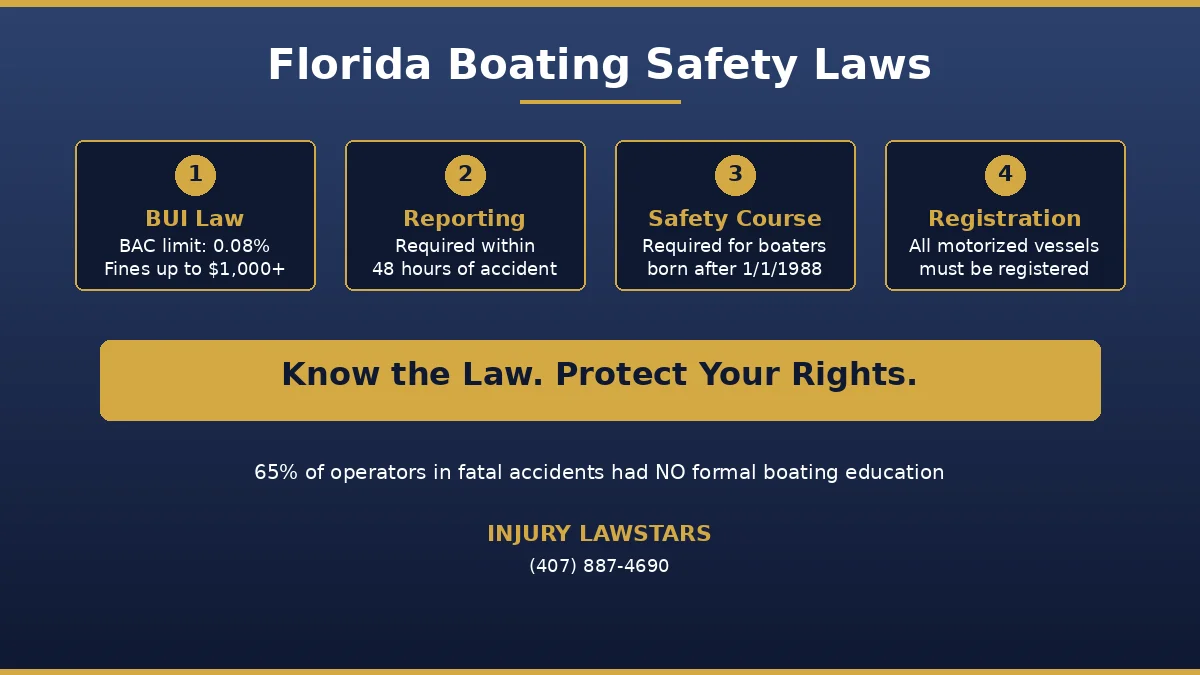
Florida law requires all vessels with motors to be registered with the Florida Department of Highway Safety and Motor Vehicles (DHSMV). This includes motorboats, sailboats with auxiliary motors, and personal watercraft like jet skis. Non-motorized vessels such as canoes and kayaks are exempt from registration, though they must still comply with safety equipment requirements.
Despite registration requirements, the FWC estimates that close to 1 million unregistered vessels are actively used on Florida waters. This creates significant enforcement challenges and increases the risk of accidents involving uninsured and unidentified operators.
Boating Safety Education
Florida requires a boating safety education course for anyone born on or after January 1, 1988, who operates a vessel with 10 horsepower or more. This requirement reflects the state’s effort to reduce accidents caused by inexperienced operators.
However, the data shows the education gap remains a serious problem. In 2024, 65% of operators involved in fatal boating accidents had received no formal boater education. Completing a boating safety course is not just a legal requirement for many boaters; it is a basic step that could prevent tragedies.
Boating Under the Influence (BUI)
Operating a vessel while impaired is illegal under Florida Statute §327.35. The legal blood alcohol concentration (BAC) limit for boat operators is 0.08%, the same standard applied to motor vehicle drivers. However, boating under the influence can be even more dangerous than driving a car because of the additional environmental factors, including sun exposure, wave motion, wind, and engine vibration, that amplify the effects of alcohol.
Penalties for BUI in Florida include:
- First offense: Up to six months in jail, fines between $500 and $1,000
- Second offense: Up to nine months in jail, fines between $1,000 and $2,000
- Third offense within 10 years: Up to 12 months in jail; third offense outside 10 years is a felony with up to five years in prison
- BUI causing serious bodily injury: Third-degree felony with up to five years in prison
- BUI causing death: May be charged as BUI manslaughter, a second-degree felony with up to 15 years in prison
If an impaired boat operator causes your accident, their intoxication can serve as strong evidence of negligence in your personal injury claim. Learn more about how impaired driving affects communities across Florida.
What Are the Most Common Causes of Boating Accidents?
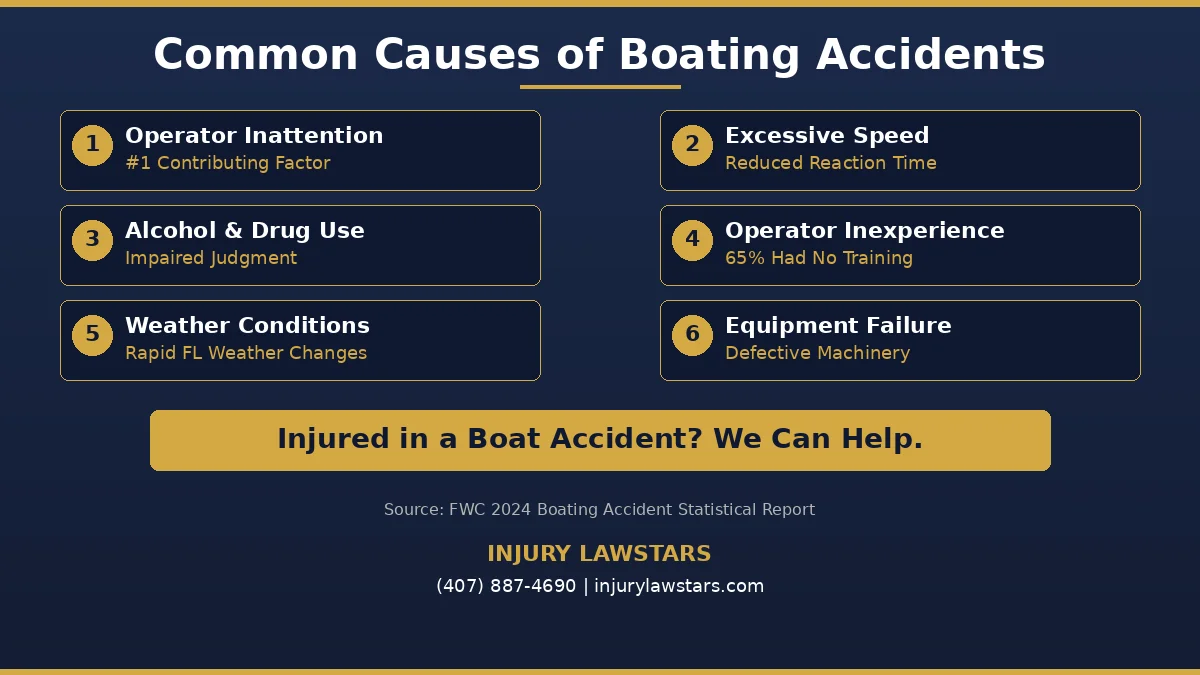
Understanding what causes boating accidents helps establish liability in a legal claim. Based on FWC data and years of handling these cases, the most common causes include:
Operator Inattention
Operator inattention consistently ranks as the leading contributing factor in Florida boating accidents. Unlike roadways, waterways have no lane markings, traffic signals, or stop signs. Operators must constantly scan for other vessels, swimmers, debris, and changing water conditions. A moment of distraction can lead to a devastating collision.
Excessive Speed
Speed is a major factor in boating accidents, particularly in congested waterways, narrow channels, and areas with limited visibility. Florida law requires operators to maintain a safe speed at all times considering conditions like weather, traffic density, proximity to navigational hazards, and the vessel’s maneuverability.
Alcohol and Drug Use
Alcohol is involved in a significant percentage of fatal boating accidents nationally. The combination of alcohol, heat, sun, and the rocking motion of a boat creates a dangerous level of impairment that affects judgment, balance, and reaction time.
Operator Inexperience
As noted in the FWC data, the majority of operators involved in fatal accidents had no formal training. Inexperienced operators are more likely to misjudge distances, misread navigational markers, fail to maintain a proper lookout, and make critical errors when conditions change unexpectedly.
Weather Conditions
Florida’s weather can change rapidly, particularly during the summer months when afternoon thunderstorms develop quickly. High winds, lightning, reduced visibility, and rough water conditions catch unprepared boaters off guard. Failure to monitor weather forecasts and respond appropriately is a form of negligence.
Mechanical and Equipment Failure
Defective or poorly maintained engines, steering systems, fuel systems, and safety equipment can cause or worsen boating accidents. When equipment failure contributes to an accident, the boat owner, a maintenance provider, or even the equipment manufacturer may share liability.
What Types of Injuries Do Boating Accidents Cause?
Boating accidents take many forms, and each type can cause serious or fatal injuries. The most common types of boating accidents and injuries seen in Florida include:
Vessel-to-Vessel Collisions
Two boats colliding on the water is one of the most common accident types. These collisions often happen in congested areas, at night, or when one or both operators fail to maintain a proper lookout. The impact of a boat collision can throw passengers overboard, cause traumatic brain injuries, spinal cord damage, and broken bones.
Collisions with Fixed Objects
The FWC’s 2024 report identified collision with a fixed object as the single most common accident type, responsible for 31% of all reportable incidents. Fixed objects include docks, piers, bridge pilings, channel markers, seawalls, and submerged structures. These collisions often occur at high speed and can be catastrophic.
Capsizing and Swamping
When a vessel overturns (capsizes) or takes on water (swamping), everyone aboard is at immediate risk of drowning. Capsizing accidents are particularly deadly when passengers are not wearing life jackets. Causes include overloading, improper weight distribution, sharp turns at speed, and sudden weather changes.
Falls Overboard
Falling overboard is one of the leading causes of boating fatalities in Florida. Passengers who fall from a moving vessel face the risk of drowning, hypothermia, and being struck by the boat’s propeller. The absence of railings on many recreational boats and the effects of alcohol increase the risk.
Propeller Strike Injuries
Contact with a boat’s propeller can cause devastating lacerations, amputations, and fatal injuries. Propeller strikes most commonly occur during water sports activities, when swimmers are near an operating vessel, or when a person falls overboard from the boat.
Grounding
A vessel running aground in shallow water can cause hull damage, throw passengers forward, and leave occupants stranded. Grounding incidents are common in Florida’s shallow coastal waters and are often caused by operator inexperience or failure to use navigational charts.
Were you or a loved one injured in a boating accident? Call Injury LawStars at (407) 887-4690 for a free case evaluation. We handle boating accident cases on a contingency basis, so you pay nothing unless we win.
Who Can Be Held Liable for a Boating Accident in Florida?
Determining liability after a boat accident in Florida requires examining who acted negligently and whose negligence contributed to the accident. Multiple parties can potentially be held responsible.
The Boat Operator
The person operating the vessel at the time of the accident is the most obvious potential defendant. Boat operators owe a duty of care to passengers, other boaters, and swimmers. If the operator was inattentive, speeding, impaired, inexperienced, or violating any boating safety regulation, they can be held liable for resulting injuries.
The Boat Owner
Florida law holds boat owners to a high standard. Under the dangerous instrumentality doctrine, a boat owner who allows another person to operate their vessel can be held vicariously liable for injuries caused by the operator’s negligence. This is true even if the owner was not on the boat at the time of the accident.
This means that if someone borrows a friend’s boat and causes an accident, the boat owner may also be financially responsible for the victims’ injuries. This doctrine is a critical tool in boating accident cases because the operator may not have sufficient insurance or assets to cover the damages.
Boat Rental Companies
Boat rental companies in Florida have a duty to maintain their vessels in safe condition, provide adequate safety equipment, and verify that renters have the required boating education or experience. If a rental company rents a defective vessel, fails to provide safety instructions, or rents to an obviously intoxicated or inexperienced person, the company can be held liable.
Boat and Equipment Manufacturers
If a defect in the boat’s design, manufacturing, or a component part caused or contributed to the accident, the manufacturer may be liable under Florida’s product liability laws. Common defects include faulty steering systems, engine malfunctions, defective hull designs, and inadequate safety features.
Employers (Commercial Boating Operations)
When a boating accident involves a commercial vessel, the employer may be liable for the actions of its employees under the doctrine of respondeat superior. Additionally, injured crew members on commercial vessels may have claims under the Jones Act, which provides unique protections for maritime workers.
Government Entities
If a boating accident is caused by a poorly maintained navigational channel, an unmarked hazard, or a defective public dock or boat ramp, the government entity responsible for maintaining the waterway may bear liability. Claims against government entities involve specific notice requirements and shorter deadlines.
How Does Florida’s Comparative Negligence Law Apply to Boating Cases?
Florida follows a modified comparative negligence system under the tort reform changes enacted by HB 837 in 2023. Under this system:
- Your compensation is reduced by your percentage of fault. If you are found 20% at fault for the boating accident, your damages are reduced by 20%.
- If you are found more than 50% at fault, you cannot recover any damages. This is a significant change from Florida’s prior pure comparative negligence system, where you could recover even if you were 99% at fault.
In boating accident cases, the defense may argue that the injured party was partially at fault for not wearing a life jacket, for being intoxicated, or for engaging in risky behavior. An experienced attorney can counter these arguments and work to minimize any allocation of fault to you. Learn more about whether you can get compensation if the accident was partially your fault.
When Does Federal Maritime Law Apply to Florida Boating Accidents?
One of the complexities of boating accident cases in Florida is that both state law and federal maritime law may apply, depending on where the accident occurred and the type of vessel involved.
When Federal Maritime Law Applies
Federal admiralty and maritime law governs accidents that occur on “navigable waters,” which includes:
- The Atlantic Ocean and Gulf of Mexico beyond Florida’s state water boundaries
- Bays, harbors, and coastal waterways
- Navigable rivers and lakes that could support interstate commerce
Even some Florida waterways that seem entirely inland may be classified as navigable waters for purposes of federal jurisdiction.
Key Federal Maritime Laws
The Jones Act (46 U.S.C. §30104): This federal statute allows crew members of commercial vessels to sue their employers for injuries caused by the employer’s or a co-worker’s negligence. Jones Act claims are significant because they allow recovery even when the employer’s negligence was relatively minor.
General Maritime Law: This body of law provides remedies for passengers and others injured on navigable waters. General maritime law allows claims for maintenance and cure (medical expenses and living expenses for injured seamen) and unseaworthiness (holding vessel owners liable when a vessel is not reasonably fit for its intended use).
The Limitation of Liability Act (46 U.S.C. §30523): This federal law allows boat owners to attempt to limit their liability to the value of the vessel after the accident. Rental companies and vessel owners may try to invoke this defense to reduce the compensation available to victims. An experienced Florida boating accident lawyer can challenge these attempts.
How Jurisdiction Affects Your Claim
Where your accident occurred directly affects which laws apply and which court will hear your case. Florida state courts handle claims arising on state waters under Florida negligence law. Federal courts have jurisdiction over maritime cases on navigable waters.
The statute of limitations also depends on jurisdiction:
- Florida state waters: Two years from the date of the accident (under current Florida law for incidents after March 24, 2023)
- Federal maritime/admiralty waters: Three years from the date of the accident
- Wrongful death claims: Two years from the date of death under both Florida law and general maritime law
Because the jurisdictional analysis directly impacts your rights and deadlines, it is critical to consult with an attorney who understands both state and federal maritime law. Learn more about how long you have to file a personal injury lawsuit in Florida.
What Are Florida’s Boating Accident Reporting Requirements?
Florida law requires boating accidents to be reported to the Florida Fish and Wildlife Conservation Commission (FWC) under certain conditions. Under Florida Statute §327.30, you must file a report if any of the following apply:
- A person dies as a result of the accident
- A person disappears from a vessel under circumstances suggesting death or injury
- A person is injured and requires medical treatment beyond first aid
- Property damage exceeds $2,000
The report must be filed within 48 hours of the accident. Failing to report a boating accident when required can result in legal penalties and may also complicate your ability to pursue a personal injury claim later.
Beyond the legal requirement, filing a report creates an official record of the accident that can be valuable evidence in your case. The report documents the conditions at the time of the accident, the parties involved, any witnesses, and the investigating officer’s observations.
What Insurance Considerations Apply to Boating Accidents?
Unlike auto insurance, Florida does not require boat owners to carry liability insurance. This creates potential complications for accident victims seeking compensation.
- Marine liability insurance: Many boat owners carry this voluntarily, and it typically covers bodily injury and property damage caused by the insured vessel.
- Homeowner’s insurance: Some homeowner policies provide limited coverage for smaller watercraft, though coverage limits are often low.
- Uninsured/underinsured boater coverage: If available on your own policy, this can protect you when the at-fault party lacks adequate insurance.
- Marina and rental company insurance: Commercial operators typically carry commercial marine insurance with higher limits.
When the at-fault party has no insurance or insufficient coverage, identifying all potentially liable parties becomes even more important. The dangerous instrumentality doctrine, product liability claims, and employer liability under the Jones Act can open additional avenues for recovery.
What Damages Can You Recover After a Boating Accident in Florida?
If you were injured in a boating accident in Florida due to someone else’s negligence, you may be entitled to compensation for both economic and non-economic damages.
Economic Damages
These are quantifiable financial losses, including:
- Medical expenses: Emergency treatment, hospitalization, surgery, rehabilitation, physical therapy, prescription medications, and future medical care
- Lost wages: Income lost while recovering from your injuries
- Lost earning capacity: Reduced ability to earn income in the future due to permanent injuries
- Property damage: Repair or replacement costs for your vessel and personal property
Non-Economic Damages
These compensate for losses that are real but harder to quantify:
- Pain and suffering: Physical pain and emotional distress caused by the accident and resulting injuries. Learn more about pain and suffering settlement amounts in personal injury cases.
- Mental anguish: Anxiety, depression, PTSD, and other psychological effects
- Loss of enjoyment of life: Inability to participate in activities you enjoyed before the accident
- Loss of consortium: Impact on your relationship with your spouse
- Scarring and disfigurement: Permanent physical changes resulting from the accident
Punitive Damages
In cases involving egregious conduct, such as a boating accident caused by an extremely intoxicated operator, Florida courts may award punitive damages. These are designed to punish the wrongdoer and deter similar conduct, not to compensate the victim. Punitive damages require clear and convincing evidence of intentional misconduct or gross negligence.
Wrongful Death Claims
When a boating accident results in death, the victim’s surviving family members may file a wrongful death claim. Florida’s Wrongful Death Act allows recovery for funeral and burial expenses, lost financial support, loss of companionship and guidance, and mental pain and suffering of the survivors.
Do not wait to protect your rights. Call Injury LawStars at (407) 887-4690 for a free consultation with an experienced Florida boating accident attorney. We fight for maximum compensation on a contingency basis, so there is no fee unless we win.
What Steps Should You Take After a Boating Accident in Florida?
The steps you take immediately after a boat accident in Florida can significantly impact your health, safety, and legal rights. Here is what you should do:
- Seek medical attention immediately. Even if you feel fine, some injuries such as concussions, internal bleeding, and spinal injuries may not show symptoms right away. A medical evaluation creates a record that links your injuries to the accident.
- Call 911 and report the accident. Contact law enforcement and emergency services. The FWC or local marine patrol will investigate and create an official accident report.
- Document everything. Take photos and videos of the accident scene, vessel damage, injuries, weather conditions, and any hazards. Collect the names, contact information, and insurance details of all parties involved.
- Get witness information. If other boaters or bystanders saw the accident, get their names and contact information. Witness testimony can be critical evidence.
- Do not admit fault. Avoid making statements about who caused the accident. Anything you say can be used against you later.
- Preserve evidence. Do not repair your vessel or dispose of any equipment before consulting with an attorney. Physical evidence from the boat can be crucial.
- Contact a Florida boating accident lawyer. An experienced attorney can protect your rights from day one, handle communications with insurance companies, and begin building your case. Contact Injury LawStars today for a free consultation.
Frequently Asked Questions About Boating Accidents in Florida
What should I do immediately after a boating accident in Florida?
Seek immediate medical attention, call 911 to report the accident, document the scene with photos and videos, collect witness information, and contact a Florida boating accident lawyer as soon as possible. Do not admit fault or give recorded statements to insurance companies without legal representation.
Who is liable for a boating accident in Florida?
Liability depends on the circumstances. The boat operator, the boat owner (under Florida’s dangerous instrumentality doctrine), boat rental companies, equipment manufacturers, employers of commercial vessel workers, and government entities responsible for maintaining waterways can all potentially be held liable. Multiple parties may share responsibility.
How much is a boating accident claim worth in Florida?
The value depends on the severity of your injuries, the extent of your medical treatment, lost income, the impact on your quality of life, and the degree of the defendant’s negligence. Boating accident claims involving serious injuries such as traumatic brain injuries, spinal cord damage, or wrongful death can result in significant compensation. Each case is unique, and an attorney can provide a more accurate assessment based on your specific situation.
Does Florida require boat insurance?
No. Unlike auto insurance, Florida does not require boat owners to carry liability insurance. However, many boat owners carry marine liability insurance voluntarily, and lenders or marinas often require it. If the at-fault boater is uninsured, your own uninsured/underinsured boater coverage may apply. This lack of mandatory insurance makes identifying all liable parties especially important in boating accident cases.
How long do I have to file a boating accident claim in Florida?
For accidents occurring after March 24, 2023, the statute of limitations for personal injury claims under Florida law is two years from the date of the accident. If federal maritime law applies (accidents on navigable waters), you generally have three years. Wrongful death claims must be filed within two years of the date of death. These deadlines are strict. Missing the filing deadline almost always means losing your right to compensation.
What is the Jones Act and does it apply to my boating accident?
The Jones Act (46 U.S.C. §30104) is a federal law that allows crew members of commercial vessels to sue their employers for injuries caused by negligence. It applies if you were working as a crew member on a commercial vessel when injured. The Jones Act does not typically apply to recreational boating accidents, but general maritime law may still provide additional protections depending on where the accident occurred.
Can I still recover compensation if I was partially at fault for the boating accident?
Yes, but your recovery will be reduced. Under Florida’s modified comparative negligence system (enacted by HB 837 in 2023), your compensation is reduced by your percentage of fault. However, if you are found more than 50% at fault, you cannot recover any damages. An experienced boating accident attorney can help minimize the fault attributed to you and maximize your recovery.
Protect Your Rights After a Boat Accident in Florida
A boating accident can change your life in an instant. The physical pain, emotional trauma, and financial burden can feel overwhelming. But you do not have to face it alone.
At Injury LawStars, we understand what accident victims go through because we have been there ourselves. Attorney Katie Miller was once an injury victim, and that lived experience fuels her determination to fight for every client. We handle boating accident cases on a contingency basis, which means you pay nothing unless we recover compensation for you.
If you or a loved one was injured in a boat accident in Florida, do not wait. The sooner you speak with an experienced attorney, the better we can protect your evidence, your rights, and your future.
Contact Injury LawStars today at (407) 887-4690 for a free consultation. We are here to help you get the justice you deserve.