
March 29, 2026
Bicycle Accident Laws and Claims in Florida: A Complete Legal Guide
Every year, thousands of cyclists are struck by motor vehicles on Florida roads, and the consequences are often devastating. Florida consistently ranks among the deadliest states for bicyclists, with the National Highway Traffic Safety Administration reporting that the state accounts for roughly 16% of all cyclist fatalities nationwide despite having only about 7% of the U.S. population. If you or a loved one has been hurt in a bicycle crash, understanding Florida’s bicycle accident laws is the first step toward protecting your rights and recovering the compensation you deserve.
Call Injury LawStars today at (407) 887-4690 for a free consultation to discuss your bicycle accident claim with an experienced Florida attorney who will fight for the compensation you deserve.
Florida Statute 316.2065 defines the rights and responsibilities of cyclists on the road, and knowing these rules can make or break your injury claim. From helmet requirements to insurance coverage, the legal landscape for bicycle accidents differs significantly from typical car crash cases. This guide covers everything you need to know about bicycle accident laws, common collision types, insurance challenges, and how to pursue a successful claim in Florida.
What Are Florida’s Bicycle Traffic Laws Under F.S. 316.2065?
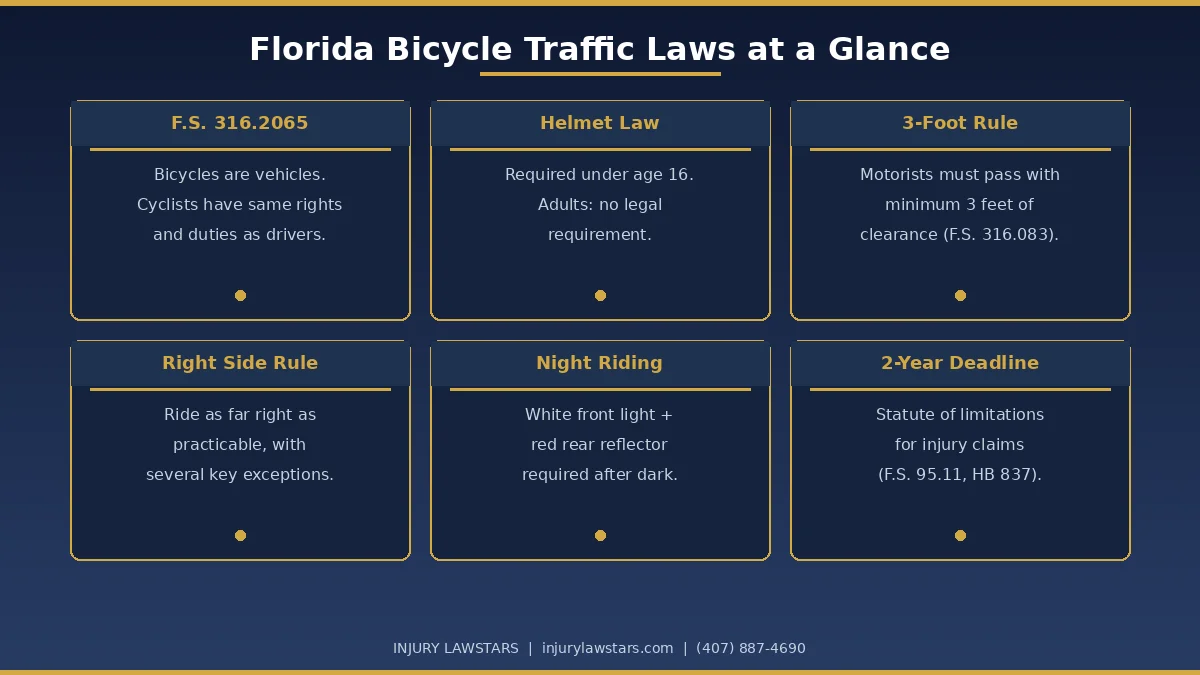
Florida law treats bicycles as vehicles, which means cyclists have the same rights and duties as drivers of motor vehicles under most circumstances. Florida Statute 316.2065 is the primary law governing bicycle operation, and it outlines several key rules that apply to every cyclist on the road.
Cyclist Rights and Duties
Under Florida law, cyclists are entitled to use public roads and must follow the same traffic signals, signs, and lane markings that apply to motor vehicles. Specifically, F.S. 316.2065 establishes that:
- Cyclists must ride in the same direction as traffic and obey all traffic control devices
- Cyclists traveling below the normal speed of traffic must ride as close as practicable to the right-hand curb or edge of the roadway, except when passing, making a left turn, avoiding hazards, or when the lane is too narrow to safely share
- Cyclists must use hand signals when turning or stopping
- Cyclists riding at night must have a white front light visible from 500 feet and a red rear reflector visible from 600 feet
- No more than two cyclists may ride side by side in a single lane, and they must not impede the normal flow of traffic
These rules are critical in accident claims because a violation by either the cyclist or the driver can be used to establish negligence. If a motorist fails to yield the right-of-way to a cyclist who is lawfully using the road, that driver can be held liable for resulting injuries.
Helmet Laws in Florida
Florida’s helmet law is more limited than many people realize. Under F.S. 316.2065(3)(d), only cyclists under the age of 16 are required to wear a properly fitted bicycle helmet. Adult cyclists have no legal obligation to wear a helmet, though doing so is strongly recommended.
From a legal standpoint, the absence of a helmet on an adult cyclist generally cannot be used to reduce their compensation in an accident claim. However, for riders under 16 who are not wearing a helmet at the time of a crash, the defense may argue that the failure to wear a helmet contributed to the severity of head injuries.
Lane Sharing and Road Positioning Rules
One of the most contentious issues in bicycle accident cases involves lane positioning. Florida’s “as far right as practicable” rule does not mean cyclists must hug the curb at all times. The law provides several exceptions where a cyclist may legally take the full lane:
- When passing another vehicle or cyclist
- When preparing for a left turn
- When avoiding road hazards such as debris, potholes, drain grates, or parked cars
- When the lane is too narrow for a bicycle and a vehicle to travel safely side by side (substandard-width lanes)
Florida also requires motorists to maintain a minimum of three feet of clearance when passing a cyclist under F.S. 316.083. Drivers who pass too closely and cause an accident can face both criminal and civil liability.
What Are the Most Common Causes of Bicycle-Car Collisions?
Understanding how bicycle accidents happen is essential for building a strong injury claim. While every crash is unique, certain collision patterns appear repeatedly in Florida bicycle accident cases. Identifying the specific type of collision helps establish fault and determine which party violated traffic laws.
Dooring Accidents
Dooring occurs when a driver or passenger in a parked car opens their door directly into the path of an oncoming cyclist. These accidents happen with little to no warning and can throw a cyclist into traffic. Under F.S. 316.2005, no person shall open a vehicle door unless it is reasonably safe to do so and can be done without interfering with traffic, including bicyclists.
Right Hook Collisions
A right hook collision happens when a motorist makes a right turn directly in front of a cyclist who is traveling straight in a bike lane or along the right side of the road. The driver either fails to see the cyclist or misjudges their speed, cutting them off. These collisions are particularly dangerous because the cyclist often has no time to react or stop.
Left Cross Collisions
Left cross accidents occur when an oncoming vehicle turns left across the path of a cyclist traveling in the opposite direction. The driver typically fails to yield the right-of-way, often because they underestimate the cyclist’s speed or do not see them at all. Left cross collisions tend to involve high-impact forces because both the vehicle and cyclist are moving toward each other.
Rear-End Collisions
Rear-end collisions happen when a vehicle strikes a cyclist from behind. These are among the most dangerous types of bicycle accidents because the cyclist has no opportunity to brace for impact. Common causes include distracted driving, speeding, driving under the influence, and poor visibility conditions. Florida’s three-foot passing law was specifically enacted to reduce these types of crashes.
Intersection Failures
Intersections are statistically the most dangerous locations for cyclists. Drivers who run red lights, fail to stop at stop signs, or make turns without checking for cyclists in crosswalks or bike lanes cause a significant portion of bicycle-car collisions. Cyclists who are lawfully proceeding through an intersection with a green light or right-of-way have strong claims when struck by a negligent driver.
How Does Florida’s Vulnerable Road User Statute Protect Cyclists?
Florida enacted the Vulnerable Road User statute (F.S. 316.187) to provide additional legal protections for cyclists, pedestrians, and other non-motorized road users. This law recognizes that cyclists face disproportionate risk when sharing the road with motor vehicles.
Under this statute, motorists who commit a moving violation that causes serious bodily injury or death to a vulnerable road user, including pedestrians and cyclists, face enhanced penalties. These can include mandatory community service, completion of a driver improvement course, and additional fines. While these are criminal penalties, the existence of an enhanced violation can strengthen a civil injury claim by helping to establish that the driver was clearly at fault.
The vulnerable road user law also reinforces that cyclists have a legitimate and legally protected right to use Florida roads. When defense attorneys try to argue that a cyclist “shouldn’t have been on the road” or was at fault simply for riding a bicycle, the vulnerable road user statute provides a powerful counterargument.
If you were injured while cycling in Florida, do not wait to get legal help. Call Injury LawStars at (407) 887-4690 for a free case evaluation and learn what your claim may be worth.
What Happens with Hit-and-Run Bicycle Accidents in Florida?
Hit-and-run accidents are alarmingly common in bicycle crashes. When a driver strikes a cyclist and flees the scene, the situation becomes both legally and emotionally devastating. Florida law under F.S. 316.062 requires any driver involved in an accident resulting in injury to stop, provide identification, and render aid. Leaving the scene of an accident involving injury is a felony.
For cyclists who are victims of hit-and-run accidents, the legal process involves several steps:
- File a police report immediately with any details you can remember about the vehicle (color, make, model, license plate, direction of travel)
- Seek witness statements from anyone who saw the accident
- Check for surveillance cameras near the crash scene that may have captured the incident
- Contact your own insurance company about uninsured motorist (UM) coverage, which may apply even in bicycle accident cases
If the hit-and-run driver is identified, they face both criminal charges and civil liability for your injuries. If they are never found, your own uninsured motorist coverage through an auto insurance policy may provide compensation. This is one of many reasons cyclists who also own vehicles should carry robust UM/UIM coverage. For more information on Florida’s hit-and-run laws, read our guide on Florida hit-and-run accident laws and your legal options.
How Does Insurance Work for Bicycle Accident Claims in Florida?
Insurance coverage for bicycle accidents in Florida is more complicated than most people realize. The key distinction is whether the cyclist was riding a bicycle independently or was struck by a motor vehicle, because the insurance rules differ dramatically.
PIP Coverage and Bicycle Accidents
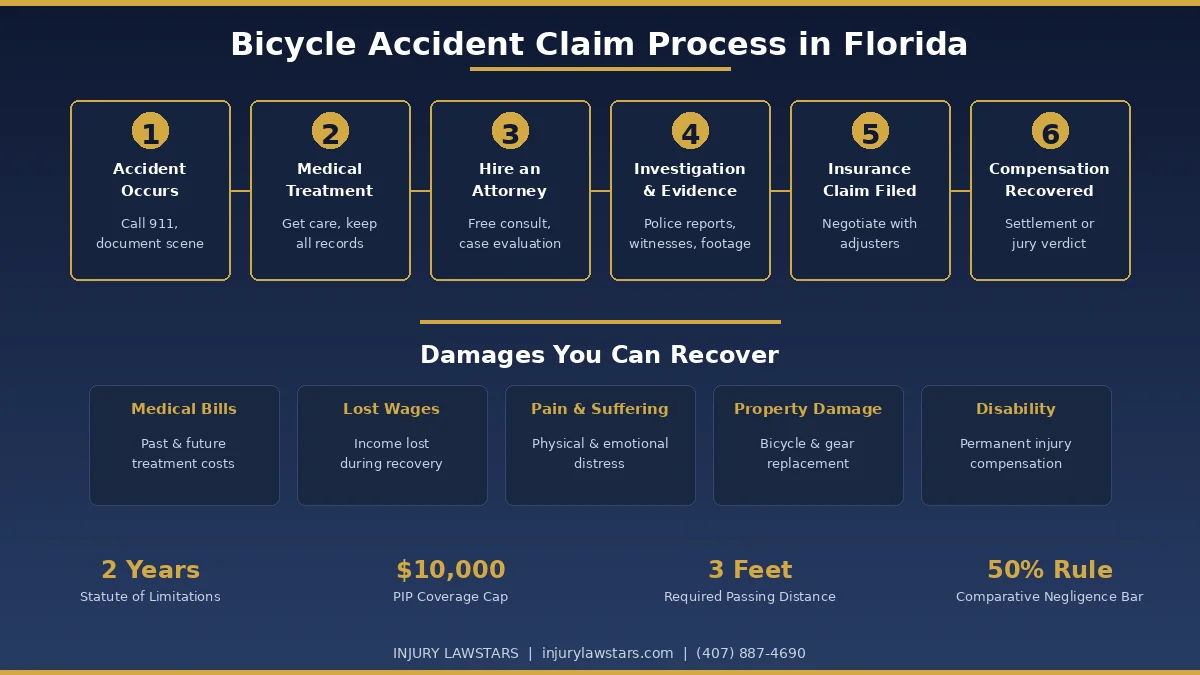
Florida is a no-fault insurance state, which means that motor vehicle owners are required to carry Personal Injury Protection (PIP) coverage under F.S. 627.736. PIP covers medical expenses and lost wages regardless of who caused the accident, up to $10,000.
Here is the critical distinction for cyclists:
- Cyclists who are struck by a motor vehicle may be able to access PIP benefits through the at-fault driver’s auto insurance policy or through their own auto insurance policy if they own a vehicle
- Bicycles are not motor vehicles under Florida law, so cyclists are not required to carry PIP insurance on their bicycles
- If a cyclist owns a car and has an auto insurance policy with PIP coverage, that coverage may extend to injuries sustained in a bicycle accident, even when the cyclist was not driving
For a deeper understanding of how Florida’s no-fault system works, see our detailed guide on Florida no-fault insurance and PIP explained.
Filing a Third-Party Claim
Beyond PIP, injured cyclists can file a third-party liability claim against the at-fault driver. This is where the majority of compensation in serious bicycle accident cases comes from. A third-party claim can recover:
- Full medical expenses (past and future)
- Lost wages and diminished earning capacity
- Pain and suffering
- Permanent disability or disfigurement
- Loss of enjoyment of life
To pursue a third-party claim, the cyclist must demonstrate that the driver was negligent and that this negligence caused their injuries. An experienced bicycle accident lawyer in Florida can investigate the crash, gather evidence, and negotiate with the insurance company to maximize your recovery.
How Does Comparative Negligence Under HB 837 Affect Bicycle Accident Claims?
Florida’s comparative negligence system underwent a major change in 2023 with the passage of House Bill 837 (HB 837). The state shifted from a pure comparative negligence system to a modified comparative negligence standard. This change has significant implications for bicycle accident claims.
Under the new system:
- If you are found to be more than 50% at fault for the accident, you are completely barred from recovering any compensation
- If you are 50% or less at fault, your compensation is reduced by your percentage of fault
For cyclists, this means that defensive arguments about helmet use, lane positioning, visibility, or failure to signal can have a direct impact on your recovery. For example, if a jury determines that a cyclist was 30% at fault for not wearing reflective gear at dusk and the total damages are $200,000, the cyclist’s recovery would be reduced to $140,000.
This is why documenting the accident scene, preserving evidence, and hiring a skilled attorney are more important than ever. Insurance companies will aggressively try to shift blame onto the cyclist to reduce or eliminate their liability. Learn more about how this law affects injury claims in our guide on Florida’s comparative negligence law explained.
What Types of Injuries Do Bicycle Accident Victims Suffer?
Bicycle accidents often result in catastrophic injuries because cyclists have virtually no physical protection against the force of a motor vehicle. Even at relatively low speeds, the impact can cause life-altering harm. Understanding the types of injuries common in bicycle accidents helps establish the full scope of damages in your claim.
Traumatic Brain Injuries (TBI)
Traumatic brain injuries are among the most serious consequences of bicycle accidents. Even with a helmet, a cyclist who strikes their head on a vehicle or the pavement can suffer concussions, brain contusions, or severe diffuse axonal injuries. TBIs can cause cognitive impairment, memory loss, personality changes, and permanent disability. If you or a family member has suffered a brain injury in a cycling crash, our Florida brain injury attorneys can help you understand the full value of your claim.
Spinal Cord Injuries
The force of a bicycle-vehicle collision can damage the spinal cord, leading to partial or complete paralysis. Spinal cord injuries require extensive medical treatment, rehabilitation, and often lifelong care. The financial impact of these injuries can reach into the millions of dollars over a victim’s lifetime.
Bone Fractures
Broken bones are extremely common in bicycle accidents. Cyclists frequently suffer fractures of the clavicle, wrist, hip, pelvis, and ribs. Compound fractures may require surgical repair with pins, plates, or screws, and recovery can take months. Some fractures result in permanent hardware or ongoing pain.
Road Rash and Soft Tissue Injuries
When a cyclist is thrown from their bike and slides across the pavement, the result is road rash, which ranges from superficial abrasions to deep tissue damage requiring skin grafts. Severe road rash can cause permanent scarring, nerve damage, and infection. Soft tissue injuries such as torn ligaments, tendons, and muscles are also common and can significantly limit mobility.
Internal Injuries
The blunt force trauma from a vehicle collision can cause internal bleeding, organ damage, and ruptured spleens or kidneys. These injuries are particularly dangerous because symptoms may not appear immediately after the accident, which is why seeking medical attention right away is critical.
What Damages Can You Recover in a Florida Bicycle Accident Claim?
Florida law allows injured cyclists to pursue both economic and non-economic damages when another party’s negligence caused the accident. The specific damages available depend on the severity of your injuries and the circumstances of the crash.
Economic Damages
- Medical expenses: Emergency room visits, surgery, hospitalization, physical therapy, prescription medications, medical devices, and future medical care
- Lost wages: Income lost during recovery, including sick days and vacation time used
- Diminished earning capacity: If your injuries prevent you from returning to your previous occupation or working at the same level
- Property damage: Repair or replacement of your bicycle, helmet, electronics, and other personal property damaged in the crash
- Out-of-pocket expenses: Transportation to medical appointments, home modifications, and hired help for tasks you can no longer perform
Non-Economic Damages
- Pain and suffering: Physical pain and emotional distress caused by the accident and your injuries
- Mental anguish: Anxiety, depression, PTSD, and fear of cycling or being near traffic
- Loss of enjoyment of life: Inability to participate in activities you previously enjoyed, including cycling
- Permanent disability or disfigurement: Scarring, amputations, or chronic conditions resulting from the accident
- Loss of consortium: Impact on your relationship with your spouse or partner
In cases involving wrongful death, the surviving family members may also pursue wrongful death damages including funeral expenses, loss of financial support, and loss of companionship.
Do not let insurance companies undervalue your bicycle accident claim. Contact Injury LawStars at (407) 887-4690 today for a free consultation with an attorney who knows how to fight for maximum compensation.
Which Florida Roads and Intersections Are Most Dangerous for Cyclists?
Florida has some of the most dangerous roads in the nation for cyclists. High-speed arterial roads with minimal bicycle infrastructure, poor lighting, and heavy traffic create hazardous conditions. While dangerous intersections exist throughout the state, several corridors and areas consistently appear in bicycle crash data:
- US-19 in Pinellas and Pasco Counties: One of the deadliest roads in America for all road users, including cyclists
- International Drive in Orlando: Heavy tourist traffic, wide lanes, and limited cycling infrastructure contribute to frequent bicycle collisions
- A1A along the coast: Popular with recreational cyclists but features narrow shoulders and fast-moving traffic
- US-192 in Osceola County: High traffic volume, numerous commercial driveways, and limited bike lanes
- SR-436 in Seminole County: Consistently ranked among the most dangerous roads for pedestrians and cyclists
In Central Florida, corridors through Lake County, including routes near Clermont, Eustis, and Tavares, see bicycle traffic from both commuters and recreational riders. The mix of rural roads with limited shoulders and increasing vehicle traffic creates collision risks, especially during early morning and evening hours. Cyclists riding in Ocala, The Villages, and surrounding Marion and Sumter County communities face similar challenges on state roads that were not designed with bicycle infrastructure in mind.
What Is the Statute of Limitations for Bicycle Accident Claims in Florida?
Under Florida’s revised statute of limitations (F.S. 95.11), you have two years from the date of the accident to file a personal injury lawsuit for a bicycle accident. This deadline was shortened from four years as part of the HB 837 tort reform package enacted in 2023.
Missing this deadline almost always means losing your right to pursue compensation entirely. The court will dismiss your case regardless of how strong your evidence is or how severe your injuries are. There are very limited exceptions to this rule, such as cases involving minors or situations where the injury was not discoverable until later.
Beyond the legal deadline, there are practical reasons to act quickly:
- Evidence deteriorates: Surveillance footage is deleted, witnesses forget details, and physical evidence at the crash scene disappears
- Medical records are clearer: A direct link between the accident and your injuries is easier to establish when treatment begins immediately
- Insurance companies move fast: The at-fault driver’s insurer will begin building their defense immediately. You need an attorney working on your behalf just as quickly
If you are approaching the two-year mark, contact an experienced Florida bicycle accident lawyer immediately to preserve your right to file a claim.
How Can a Bicycle Accident Lawyer Help Your Case?
Bicycle accident cases involve unique legal challenges that require specialized knowledge. A skilled bicycle accident lawyer provides critical support at every stage of your case:
- Investigating the accident: Gathering police reports, interviewing witnesses, obtaining surveillance footage, and working with accident reconstruction experts to establish exactly how the crash occurred
- Documenting your injuries: Coordinating with medical providers to ensure your injuries are fully documented and that future treatment needs are accounted for
- Calculating full damages: Going beyond initial medical bills to include future medical costs, lost earning potential, pain and suffering, and other non-economic losses
- Negotiating with insurers: Handling all communication with insurance companies, pushing back on lowball offers, and countering attempts to blame the cyclist
- Litigating when necessary: If the insurance company refuses to offer fair compensation, taking your case to trial and presenting it before a jury
Attorney Katie Miller at Injury LawStars knows what it is like to be an injury victim. She uses that firsthand experience to fight for every cyclist who walks through our doors. Our firm handles bicycle accident cases on a contingency basis, meaning you pay nothing unless we win your case.
Frequently Asked Questions About Florida Bicycle Accidents
Do I need a lawyer for a bicycle accident in Florida?
While you are not legally required to hire a lawyer, having experienced legal representation significantly increases your chances of receiving fair compensation. Insurance companies routinely undervalue bicycle accident claims and may try to blame the cyclist. A lawyer levels the playing field by investigating the crash, documenting your damages, and negotiating aggressively on your behalf.
Can I still recover compensation if I was not wearing a helmet?
Yes. Florida only requires helmets for cyclists under 16, so adult riders cannot be penalized for not wearing one. The defense may try to argue that your head injuries would have been less severe with a helmet, but this argument has limited legal weight for adults who had no legal duty to wear one.
What should I do immediately after a bicycle accident?
Call 911 to report the accident and request medical assistance. Document the scene with photos and videos if you are able. Get contact information from the driver, passengers, and any witnesses. Do not admit fault or apologize. Seek medical treatment even if you feel fine, as some injuries have delayed symptoms. Then contact a bicycle accident attorney as soon as possible.
How long do I have to file a bicycle accident lawsuit in Florida?
You have two years from the date of the accident to file a personal injury lawsuit under Florida’s statute of limitations (F.S. 95.11). For wrongful death cases, the two-year clock starts from the date of death. Missing this deadline will almost certainly bar you from recovering any compensation.
Does the driver’s car insurance cover my bicycle accident injuries?
Yes. If a motorist caused the accident, you can file a claim against their liability insurance. Additionally, if you own a vehicle with PIP and uninsured/underinsured motorist coverage, those policies may also apply to your bicycle accident injuries. An attorney can help you identify all available insurance sources.
What if the driver left the scene after hitting me?
File a police report immediately with every detail you can recall about the vehicle. Check for nearby security cameras. If the driver is found, they face felony charges and civil liability. If they are not identified, your own uninsured motorist coverage (if you have an auto policy) may cover your injuries. Read more about Florida’s hit-and-run laws to understand your options.
How much is my bicycle accident case worth?
The value of a bicycle accident claim depends on the severity of your injuries, the cost of medical treatment, lost income, the impact on your quality of life, and the degree of the driver’s negligence. Cases involving traumatic brain injuries, spinal cord damage, or permanent disability typically result in higher settlements. An attorney can provide a more accurate estimate after reviewing the specific facts of your case.
Are electric bicycle (e-bike) riders covered by the same laws?
Florida law treats e-bikes similarly to traditional bicycles for most purposes. E-bike riders have the same rights and duties as cyclists under F.S. 316.2065 and are not required to have a driver’s license, registration, or insurance for the e-bike. However, the specific classification of the e-bike (Class 1, 2, or 3) may affect where you can ride.
Can I sue the city or county if a road defect caused my bicycle accident?
Yes, but claims against government entities have additional requirements and shorter deadlines. Florida’s sovereign immunity statute requires you to provide written notice to the government entity within three years but has other procedural hurdles. Road defects such as potholes, missing signage, or poorly designed intersections can form the basis of a premises liability or negligence claim. Consult an attorney immediately because these cases have strict procedural requirements.