March 26, 2026
What to Do After a Slip and Fall Accident in Florida: A Complete Step-by-Step Guide
A slip and fall accident can change your life in a single moment. One second you are walking through a grocery store, restaurant, or parking lot, and the next you are on the ground in pain, unsure of what happened or what comes next.
Contact Injury LawStars today for a free consultation or call us at (407) 887-4690. You pay nothing unless we win your case.
Injured in a slip and fall? Contact Injury LawStars for a free consultation today. You pay nothing unless we win.
As someone who was once an injury victim myself, I understand the fear and confusion that follows an unexpected accident. That experience is exactly why I became a personal injury attorney. At Injury LawStars, we fight for people who are hurting, because I know firsthand what it feels like to be overwhelmed, in pain, and unsure who to trust.
If you have been injured in a slip and fall in Florida, the steps you take in the minutes, hours, and days after your accident can make or break your ability to recover compensation. This guide walks you through everything you need to know, from protecting your health to building a strong legal claim under Florida’s premises liability laws.
Key Takeaways
- Seek medical attention immediately after a slip and fall, even if you feel fine. Some injuries, like concussions and internal bleeding, may not show symptoms right away.
- Document everything at the scene: photographs, witness contact information, and an incident report are critical evidence.
- Florida Statute 768.0755 requires you to prove the property owner had actual or constructive knowledge of the dangerous condition that caused your fall.
- You have two years from the date of your accident to file a personal injury lawsuit in Florida under the current statute of limitations.
- Do not give recorded statements to insurance companies or accept early settlement offers without first speaking to a premises liability lawyer in Florida.
- Modified comparative negligence in Florida means you can still recover compensation even if you were partially at fault, as long as your share of fault does not exceed 50 percent.
Step 1: Check Yourself for Injuries and Stay Calm
The moments after a slip and fall are disorienting. Adrenaline may mask the pain from serious injuries like fractures, torn ligaments, or head trauma. Before you try to stand up, take a moment to assess your body.
What to do:
- Stay still for a few seconds and check for obvious pain in your back, hips, knees, wrists, or head.
- If you feel severe pain, numbness, or dizziness, do not attempt to move. Ask someone nearby to call 911.
- If you can move safely, carefully get to a seated or standing position while avoiding further injury.
Even if you feel relatively fine, do not dismiss the fall. Many slip and fall injuries, including soft tissue damage, hairline fractures, and concussions, often do not produce noticeable symptoms until hours or even days later.
Step 2: Seek Medical Attention Immediately
This is the single most important step you can take after a slip and fall accident. Getting prompt medical care protects your health and creates the official documentation your case will need later.
Why immediate medical treatment matters:
- It connects your injuries directly to the fall, establishing a clear medical timeline.
- It prevents insurance companies from arguing that your injuries were pre-existing or unrelated.
- It demonstrates that you took your injuries seriously, which strengthens your credibility.
Visit an emergency room, urgent care center, or your primary care physician as soon as possible. If emergency responders arrive at the scene, allow them to evaluate you even if you think your injuries are minor.
The 14-Day Rule for Medical Treatment in Florida
Florida law has a critical deadline that many accident victims do not know about. Under the state’s Personal Injury Protection (PIP) insurance rules, you must seek medical treatment within 14 days of your accident to qualify for PIP benefits. If you wait longer than 14 days, your PIP insurer may deny coverage for your medical bills.
While PIP is primarily associated with auto accidents, this timeline highlights the importance of seeking care immediately after any injury. For slip and fall cases, early medical records are some of the strongest evidence you can present.
Follow-up care is equally important. Attend all recommended appointments, follow your doctor’s treatment plan, and keep copies of every medical record, bill, and prescription. Gaps in treatment give insurance companies ammunition to question the severity of your injuries. This applies to all personal injury cases, whether from a fall, a car accident, or a workplace incident.
Step 3: Report the Accident to the Property Owner or Manager
After addressing your immediate medical needs, report the accident to the person in charge of the property where you fell. This might be a store manager, a restaurant supervisor, a landlord, or a government office.
When reporting:
- Ask that a formal incident report be completed.
- Request a copy of the report for your records (you are entitled to one).
- Stick to the basic facts: where you fell, what you slipped or tripped on, and when it happened.
- Do not admit fault or say things like “I should have been watching where I was going” or “It was probably my fault.” These statements can be used against you later.
- Do not speculate about the cause of the fall. Let the evidence speak for itself.
The incident report creates an official record that the fall occurred on the property. Property owners and businesses are required to keep records of these incidents, and the report becomes an important piece of your claim file.
Step 4: Document the Scene Thoroughly
Evidence from the accident scene is some of the most valuable proof in a slip and fall case. Property conditions change quickly. Spills get mopped up, broken tiles get repaired, and warning signs appear where none existed before. If you are physically able, document everything before conditions change.
Photograph and video:
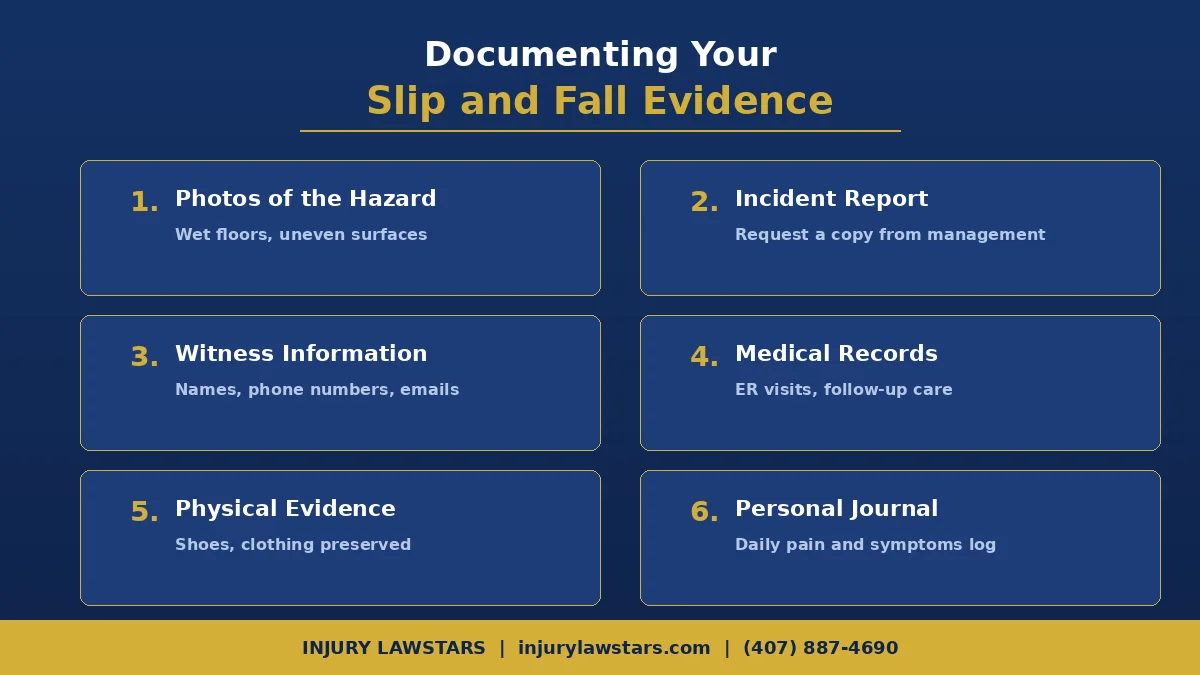
- The hazard that caused your fall (wet floor, uneven pavement, loose carpet, debris, poor lighting, missing handrail, torn mat)
- The absence of warning signs or barriers
- The surrounding area, including lighting conditions and weather if outdoors
- Your visible injuries (bruises, cuts, swelling, scrapes)
- Your shoes and clothing
- Any surveillance cameras visible in the area (note their locations)
Additional documentation tips:
- Use your phone’s timestamp feature so each photo is dated and timed automatically.
- Take wide-angle shots showing the overall area and close-up shots of the specific hazard.
- If someone else is with you, ask them to take photos as well from different angles.
- Write down your own account of what happened while details are still fresh in your memory.
If you are unable to document the scene yourself because of your injuries, ask a friend, family member, or even a bystander for help.
Step 5: Get Witness Contact Information
Independent witnesses can be critical to the success of your claim. Their testimony can confirm what the dangerous condition looked like, how long it may have existed, and whether the property owner or employees were aware of it.
What to collect from witnesses:
- Full name
- Phone number
- Email address
- A brief description of what they saw
Witnesses may have noticed things you missed, like an employee walking past the spill without cleaning it, or a “Wet Floor” sign that had been moved before your fall. Their observations can fill in gaps and significantly strengthen your case.
Do not wait to follow up. People forget details quickly, and it becomes harder to locate witnesses as time passes.
Step 6: Preserve All Physical Evidence
Beyond photographs, you need to preserve physical items that may serve as evidence in your case.
Keep the following:
- The shoes you were wearing at the time of the fall (do not wash or discard them)
- The clothing you were wearing (store in a bag, unwashed)
- All medical records, discharge summaries, and bills
- Prescriptions and receipts for medications
- The incident report from the property owner
- Any correspondence with insurance companies
- A written journal documenting your symptoms, pain levels, and how the injury affects your daily life
Your personal injury journal is especially valuable. Courts and insurance adjusters consider daily documentation of pain, limitations, and emotional impact when calculating damages. Start writing in it the day of the accident and continue throughout your recovery.
Contact Injury LawStars today for a free consultation or call us at (407) 887-4690. You pay nothing unless we win your case.
Step 7: Do Not Give Recorded Statements to Insurance Companies
After a slip and fall accident, the property owner’s insurance company may contact you quickly. Their adjuster may sound friendly and concerned, but their goal is to minimize the amount they pay on your claim.
Important rules to follow:
- Do not give a recorded statement without first consulting an attorney. Anything you say can be taken out of context and used to reduce or deny your claim.
- Do not accept an early settlement offer. First offers are almost always far below the true value of your case. They rarely account for ongoing medical treatment, lost wages, or long-term pain and suffering.
- Do not sign any documents from the insurance company, including medical release forms that give them broad access to your medical history.
- Do not post about the accident on social media. Insurance adjusters actively monitor platforms like Facebook, Instagram, and TikTok looking for posts they can use to undermine your claim.
If an insurance adjuster contacts you, politely decline to give a detailed statement and let them know your attorney will be in touch.
What Are Florida’s Premises Liability Laws for Slip and Fall Cases?
Florida’s premises liability laws govern slip and fall claims, and understanding them is essential to knowing whether you have a viable case.
Florida Statute 768.0755: The Burden of Proof
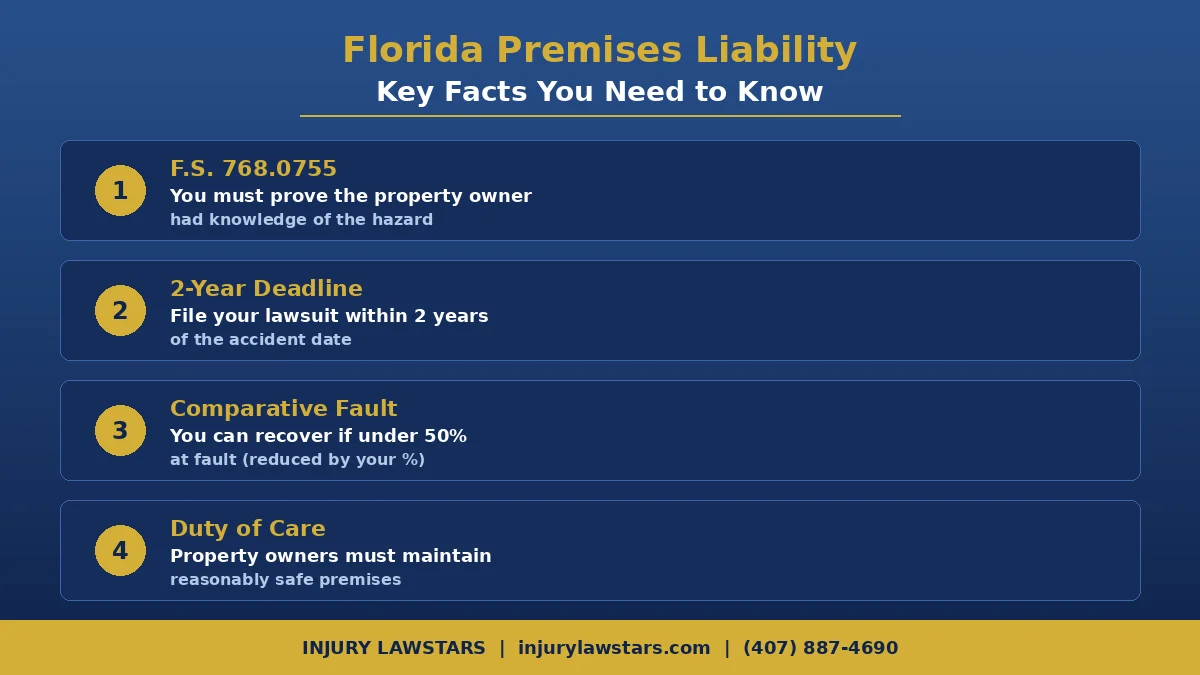
Under Florida Statute 768.0755, if you slip and fall on a transitory foreign substance in a business establishment, you must prove that the business had actual or constructive knowledge of the dangerous condition and should have taken action to remedy it.
Actual knowledge means the property owner or employees knew the hazard existed. For example, a grocery store employee who saw a spill but did not clean it up or place a warning sign.
Constructive knowledge can be proven through circumstantial evidence showing that:
- The dangerous condition existed for such a length of time that the business should have known about it (for example, a puddle from a leaking refrigerator that had been there for hours).
- The condition occurred with regularity and was therefore foreseeable (for example, a restaurant entrance that regularly becomes slippery during rainstorms but has no mats or warning signs).
This is where your evidence, including photographs, witness statements, and surveillance footage, becomes critical. The stronger your documentation, the easier it is to prove the property owner’s knowledge.
The Property Owner’s Duty of Care
Property owners in Florida have a legal obligation to maintain their premises in a reasonably safe condition for visitors. This includes:
- Regularly inspecting the property for potential hazards
- Promptly cleaning up spills and removing debris
- Repairing broken flooring, stairs, handrails, and walkways
- Providing adequate lighting in common areas
- Posting warning signs when a known hazard cannot be immediately fixed
Different standards of care apply depending on your legal status on the property. Business invitees (customers and visitors) receive the highest level of protection. Licensees (social guests) and trespassers receive progressively less protection under the law.
Modified Comparative Negligence in Florida
Florida uses a modified comparative negligence system. This means your compensation can be reduced by your percentage of fault for the accident. However, you can still recover damages as long as you are not more than 50 percent at fault.
Example: If you are awarded $100,000 in damages but the court finds you were 20 percent at fault (for example, you were looking at your phone while walking), your compensation would be reduced to $80,000.
This is why it is critical to avoid admitting any degree of fault at the scene of the accident. Insurance companies will look for any statement they can use to assign blame to you and reduce your settlement.
Step 9: Know Where Slip and Fall Accidents Commonly Happen
Slip and fall accidents in Florida happen in a wide range of locations. Understanding where these incidents most commonly occur can help you recognize when a property owner may have been negligent.
Commercial Properties
- Grocery stores and supermarkets: Wet floors from produce misters, spilled liquids, recently mopped aisles without warning signs
- Restaurants and bars: Grease on kitchen floors, spilled drinks, uneven outdoor patios
- Retail stores and shopping malls: Cluttered aisles, wet entrance areas, escalator and elevator malfunctions
- Hotels and resorts: Slippery pool decks, poorly maintained walkways, wet lobby floors
Residential Properties
- Apartment complexes: Broken stairways, poor outdoor lighting, unmaintained parking lots, slippery pool areas
- Rental homes: Loose carpeting, broken steps, uneven flooring
Government and Public Properties
- Sidewalks and public walkways: Cracked or uneven pavement, tree root damage
- Government buildings: Wet floors, poor lighting, broken handrails
- Parks and recreation areas: Slippery surfaces, poorly maintained trails, inadequate signage
Important note about government property claims: If your slip and fall occurred on government property in Florida, you may face additional requirements, including shorter notice periods for filing a claim. Florida’s sovereign immunity rules require you to notify the government entity within a specific timeframe, and failure to do so may bar your claim entirely. Consult a premises liability attorney immediately if your fall occurred on public property.
What Are the Most Common Injuries From a Slip and Fall?
The injuries from a slip and fall range from minor to life-altering. Understanding common injuries helps you communicate effectively with your doctor and your attorney about the full scope of your damages.
Physical Injuries
- Broken bones and fractures: Wrists, hips, ankles, and arms are the most commonly fractured in falls. Hip fractures are particularly dangerous for older adults and may require surgery and extended rehabilitation.
- Traumatic brain injuries (TBIs): Hitting your head during a fall can cause concussions or more severe brain injuries that affect memory, concentration, mood, and motor function. Even a “mild” concussion can have lasting effects.
- Spinal cord injuries: Falls can herniate discs, compress nerves, or cause spinal fractures. These injuries may result in chronic pain, limited mobility, or in severe cases, paralysis.
- Soft tissue injuries: Sprains, strains, torn ligaments, and tendon damage may not appear on X-rays but can cause significant pain and require months of physical therapy.
- Cuts, bruises, and abrasions: While often considered minor, deep lacerations may require stitches and can leave permanent scarring.
- Knee and shoulder injuries: Torn ACLs, meniscus tears, and rotator cuff injuries are common in falls and often require surgical intervention.
Emotional and Psychological Impact
Slip and fall accidents can also cause significant emotional distress, including anxiety about returning to the location where the fall occurred, depression from limited mobility, and post-traumatic stress. These non-economic damages are compensable under Florida law.
How Much Is a Slip and Fall Claim Worth in Florida?
Every slip and fall case is unique, and settlement amounts vary significantly based on the specific facts of your situation. However, understanding the categories of damages you may be entitled to can help you set realistic expectations.
Economic Damages (Calculable Losses)
- Medical expenses: Emergency room visits, surgeries, hospital stays, physical therapy, medications, medical devices, and future anticipated treatment costs.
- Lost wages: Income lost during recovery, including vacation days and sick time used because of the injury.
- Loss of earning capacity: If your injuries prevent you from returning to your previous job or reduce your ability to work.
- Out-of-pocket costs: Transportation to medical appointments, home modifications, and assistance with daily tasks.
Non-Economic Damages (Quality of Life Losses)
- Pain and suffering: Compensation for the physical pain and discomfort caused by your injuries.
- Emotional distress: Anxiety, depression, insomnia, and other psychological impacts of the accident.
- Loss of enjoyment of life: The inability to participate in hobbies, activities, and daily routines you enjoyed before the accident.
- Loss of consortium: If the injury has affected your relationship with your spouse or family members.
Factors That Affect Settlement Amounts
Several factors influence how much a slip and fall claim is worth:
- The severity and permanence of your injuries
- The total amount of your medical bills (current and projected future costs)
- The strength of your evidence proving the property owner’s negligence
- Whether you share any fault for the accident under Florida’s comparative negligence rules
- The property owner’s insurance policy limits
- The quality of your legal representation
While there is no guaranteed formula for calculating a settlement, working with an experienced premises liability lawyer gives you the best chance of securing full and fair compensation for your losses.
Step 12: Contact a Florida Slip and Fall Attorney
Do not try to handle a slip and fall claim on your own. Property owners, businesses, and their insurance companies have legal teams dedicated to minimizing payouts. You deserve someone fighting just as hard on your side.
An experienced attorney can:
- Investigate the accident scene, request surveillance footage, and gather evidence before it disappears
- Obtain maintenance logs, inspection records, and cleaning schedules from the property owner
- Send a preservation letter to prevent the destruction of critical evidence
- Handle all communication with insurance adjusters so you do not accidentally hurt your case
- Calculate the full value of your damages, including future medical costs and long-term impacts
- Negotiate aggressively for a fair settlement or take your case to trial if necessary
How the Statute of Limitations Affects Your Case
Under Florida Statute 95.11(3)(a), you have two years from the date of your slip and fall accident to file a personal injury lawsuit. This deadline was reduced from four years in 2023.
Two years may sound like a long time, but evidence deteriorates quickly. Surveillance footage is often overwritten within days or weeks. Witnesses move or forget important details. Medical records become harder to connect to the accident the longer you wait.
The sooner you contact an attorney, the stronger your case will be. At Injury LawStars, consultations are free, and you pay nothing unless we win your case. That is our commitment to every person we represent.
Common Mistakes That Can Hurt Your Slip and Fall Claim
Avoid these frequent errors that can weaken or destroy an otherwise strong case:
- Waiting too long to seek medical attention. Insurance companies will argue that if you did not see a doctor right away, your injuries must not be serious.
- Not reporting the accident. Without an incident report, the property owner may deny the fall ever happened on their premises.
- Admitting fault at the scene. Even casual statements like “I wasn’t paying attention” can be used against you.
- Posting about the accident or your injuries on social media. Adjusters will comb through your posts looking for anything they can use to minimize your claim.
- Accepting the first settlement offer. Initial offers are almost always too low and do not account for the full extent of your damages.
- Failing to preserve evidence. Throwing away the shoes you wore, washing clothing, or not taking photographs can eliminate key evidence.
- Giving a recorded statement without an attorney. Insurance adjusters are trained to get you to say things that hurt your case.
- Ignoring your doctor’s treatment plan. Gaps in treatment suggest to insurance companies that your injuries are not as severe as claimed.
Your Post-Accident Checklist
Use this checklist to stay organized and protect your claim in the days and weeks following your slip and fall:
- Seek medical attention (within 24 hours, ideally same day)
- Report the incident and obtain a copy of the incident report
- Photograph the scene, hazard, injuries, shoes, and clothing
- Collect witness names and contact information
- Preserve physical evidence (shoes, clothing, documents)
- Start a personal injury journal documenting pain and daily impact
- Do not give recorded statements to insurance companies
- Do not post about the accident on social media
- Keep all medical records, bills, and receipts organized
- Contact a Florida slip and fall attorney for a free consultation
- Follow your doctor’s full treatment plan without gaps
- Request surveillance footage preservation from the property owner
Contact Injury LawStars today for a free consultation or call us at (407) 887-4690. You pay nothing unless we win your case.
Frequently Asked Questions About Slip and Fall Accidents in Florida
How long do I have to file a slip and fall lawsuit in Florida?
You have two years from the date of the accident to file a personal injury lawsuit under Florida Statute 95.11(3)(a). This deadline is strict. If you miss it, you will almost certainly lose your right to seek compensation, regardless of how strong your case is. Start the process early by contacting an attorney as soon as possible.
Can I still recover compensation if I was partially at fault for the fall?
Yes. Florida’s modified comparative negligence rule allows you to recover damages as long as you are not more than 50 percent at fault. Your compensation will be reduced by your percentage of responsibility. For example, if a jury awards $200,000 and finds you 30 percent at fault, you would receive $140,000.
What if the property owner says they did not know about the hazard?
Under Florida Statute 768.0755, you can prove the property owner’s liability through constructive knowledge. This means showing that the dangerous condition existed long enough that a reasonable property owner should have discovered and addressed it, or that it occurred with regularity and was foreseeable. Your attorney can help gather the evidence needed to establish this.
Do I need a lawyer for a slip and fall claim?
While you are not legally required to hire an attorney, slip and fall cases involve complex legal standards under Florida’s premises liability laws. Property owners and insurance companies will have experienced legal teams working to minimize or deny your claim. Having an attorney levels the playing field and typically results in significantly higher settlements.
How much is my slip and fall case worth?
The value of your case depends on factors including the severity of your injuries, your medical expenses, lost wages, the extent of the property owner’s negligence, and your degree of fault. Minor injuries may settle for a few thousand dollars, while cases involving broken bones, traumatic brain injuries, or spinal cord damage can result in settlements of hundreds of thousands of dollars or more.
What if my slip and fall happened at a government building or public sidewalk?
Claims against government entities in Florida have additional requirements, including shorter notice periods and specific filing procedures. You may need to file a notice of claim with the government agency before you can pursue a lawsuit. An experienced attorney can guide you through these additional steps and make sure you meet all deadlines.
Should I accept the insurance company’s first settlement offer?
Almost never. First offers from insurance companies are typically calculated to close the claim quickly and cheaply. They rarely reflect the full value of your damages, including future medical costs and long-term effects of your injuries. Let your attorney evaluate the offer and negotiate on your behalf.
What evidence is most important in a slip and fall case?
The strongest evidence typically includes photographs of the hazard and the scene, the incident report, medical records showing injuries connected to the fall, surveillance footage from the property, witness statements, and maintenance or inspection logs from the property owner. The more evidence you gather immediately after the fall, the stronger your case will be.
At Injury LawStars, Attorney Katie Miller was once an injury victim herself. She turned that experience into a mission: to protect people who are hurting and make sure no one goes through the legal process alone. If you have been injured in a slip and fall accident anywhere in Florida, including communities across Lake County, Marion County, Clermont, Ocala, The Villages, Orlando, Tampa, and Jacksonville, we are ready to fight for you.
Contact Injury LawStars today for a free consultation. You pay nothing unless we win your case.