March 25, 2026
How a Motorcycle Accident Claim Works in Florida

Florida’s roads are some of the most dangerous in the nation for motorcyclists. If you’ve been in a crash, filing a motorcycle accident claim here is more complex than you might think. You’re not just dealing with injuries; you’re up against a tricky helmet law, a PIP insurance gap, and aggressive insurance tactics. A recent change to the comparative negligence rule means a single misstep could cost you thousands. This guide explains exactly how these claims work in Florida, what affects your settlement, and how to protect your rights from the very beginning.
Injured in a motorcycle accident? Call Injury LawStars today at (407) 887-4690 or contact us online for a free consultation with a Florida motorcycle accident lawyer.
Key Takeaways
- Florida has the highest motorcycle fatality rate in the country, with 9,420 crashes, 578 deaths, and 8,106 injuries reported in 2024 according to the Florida Highway Safety and Motor Vehicles (FHSMV) Crash Dashboard.
- Motorcyclists are excluded from Florida’s no-fault PIP system, meaning you must file your motorcycle accident claim directly against the at-fault driver’s liability insurance rather than relying on Personal Injury Protection.
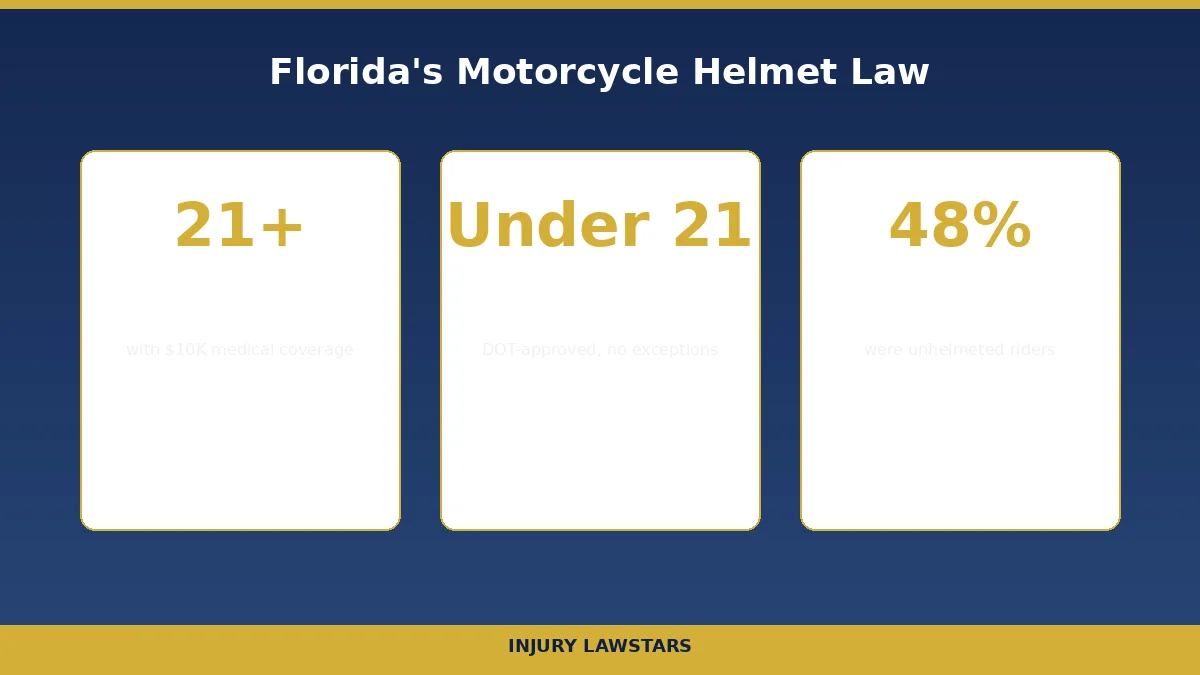
- Riders over 21 can legally ride without a helmet if they carry at least $10,000 in medical benefits coverage, but choosing not to wear a helmet can reduce your motorcycle accident injury claim.
- Florida’s modified comparative negligence rule (2023) bars you from recovering any compensation if you are found 51% or more at fault. Your damages are reduced by your percentage of fault if it is 50% or less.
- An experienced motorcycle accident lawyer can protect your rights, handle insurance company tactics, and fight for the full value of your motorcycle accident claim.
What Makes Florida So Dangerous for Motorcyclists?
For three consecutive years, Florida has held the unwanted distinction of leading the nation in motorcycle deaths. The numbers tell a sobering story:
- 2024: 9,420 crashes, 578 fatalities, 8,106 injuries
- 2023: 621 fatalities
- 2022: 631 fatalities (topping California’s 634 and Texas’s 564)
Motorcycle fatalities account for roughly 18.5% of all traffic deaths in Florida, even though motorcycles represent just 3% of registered vehicles in the state. Several factors contribute to this grim reality.
The Downside of Perfect Riding Weather
Florida’s warm climate means motorcyclists ride 12 months a year. Northern states see fewer crashes in winter, but Florida riders face constant exposure to road hazards regardless of the season.
How Tourists and Big Events Increase Rider Risk
Florida welcomes over 131 million visitors annually. Events like Daytona Bike Week bring 300,000 to 400,000 riders to already-congested roads. Unfamiliar riders navigating unfamiliar roads create additional risk.
Sharing the Road with Distracted & Uninsured Drivers
Florida has one of the highest uninsured motorist rates in the country. Distracted driving, especially from cell phone use, continues to rise. When a distracted or uninsured driver hits a motorcyclist, the consequences are almost always severe.
Why Florida’s Roads Can Be a Rider’s Nightmare
Certain Florida roadways are especially hazardous for riders. Interstate 4 between Daytona Beach and Tampa ranks among the nation’s most dangerous highways for motorcyclists. High-traffic intersections throughout Central Florida, including corridors along the I-4, I-95, and Florida Turnpike, see a disproportionate number of motorcycle crashes.
For riders in Lake County, Marion County, and Sumter County, busy roads connecting communities like Clermont, Ocala, The Villages, and Leesburg carry particular risks during peak travel times and seasonal events.
Key Motorcycle Accident Statistics
Who Is at Fault in Most Multi-Vehicle Crashes?
One of the most frustrating realities for riders is that in crashes involving a motorcycle and another vehicle, the other driver is most often at fault. We’ve all heard the excuse: “I just didn’t see the motorcycle.” This often happens because car and truck drivers fail to check their blind spots, misjudge a motorcycle’s speed when making a left turn, or are simply not paying attention. Despite this, insurance companies frequently try to shift blame onto the rider, suggesting they were speeding or weaving through traffic. This is why it’s so important to have a strong advocate who can gather evidence to protect your rights and prove who was truly responsible for the crash.
The Increased Risk of Severe Injury for Riders
Without the protection of a steel frame, airbags, or seatbelts, motorcyclists are incredibly exposed. Statistics show that riders are about 10 times more likely to suffer a severe injury in a crash compared to occupants of a passenger car. This vulnerability means that even a low-speed collision can result in catastrophic harm, such as road rash, broken bones, spinal cord damage, or a traumatic brain injury. The severity of these injuries directly impacts the value of a claim, which can range from thousands for minor issues to millions for life-altering disabilities. The high stakes involved make it essential to document every medical expense and future care need to ensure you receive fair compensation.
What Are the Most Common Causes of Motorcycle Accidents in Florida?
Understanding why crashes happen helps establish fault in your motorcycle accident claim. These are the most frequent causes.
The Dangers of Oncoming Left Turns
Left-turn accidents are the single deadliest type of motorcycle crash, accounting for 36% of motorcycle fatalities. These happen when a vehicle making a left turn fails to see an oncoming motorcycle or misjudges its speed. The motorcycle hits the turning vehicle or is hit broadside, often at full speed with no time to react.
When Other Drivers Aren’t Paying Attention
Drivers who are texting, scrolling, eating, or otherwise not watching the road are a constant threat to motorcyclists. A car driver who drifts into a motorcycle’s lane even briefly can cause a catastrophic collision. Motorcycles are smaller and harder to see, making them especially vulnerable to distracted drivers.
The High Cost of Excessive Speed
Both motorcyclists and other drivers contribute to speed-related crashes. For a motorcyclist with no protective frame, the difference between a 35 mph and a 55 mph crash can mean broken bones versus death.
The Threat of Drunk or Drugged Drivers
Florida recorded 1,024 DUI-related motorcycle crashes in 2024 alone. Alcohol and drugs impair reaction time, judgment, and coordination for both motorcyclists and other drivers on the road.
Unsafe Lane Changes and Merging
Motorcycles sit in the blind spots of cars, trucks, and SUVs. A driver who fails to check before changing lanes can sideswipe a motorcyclist without warning, especially on Florida’s highways and multi-lane roads.
Potholes, Debris, and Other Road Dangers
Potholes, loose gravel, oil slicks, and debris are minor annoyances for car drivers but can be deadly for motorcyclists. Florida’s frequent rain creates wet, slippery surfaces that reduce tire grip by 20-30%, making even routine road hazards potentially fatal.
Why Do Motorcycle Accidents Cause More Severe Injuries?
The injuries motorcyclists suffer are fundamentally different from those in car accidents. Without a steel frame, airbags, or seatbelts, riders absorb the full force of every collision. This is a major reason motorcycle accident claims tend to involve higher settlement values than car accident claims.
The Risk of Traumatic Brain Injuries (TBI)
Head injuries are the leading cause of death among motorcyclists. Even with a helmet, the violent forces of a crash can cause the brain to collide with the inside of the skull. TBIs range from concussions that resolve in weeks to severe injuries that permanently alter cognition, memory, personality, and physical function.
The long-term cost of a severe TBI can extend far beyond initial hospital bills, often requiring years of rehabilitation, cognitive therapy, and ongoing medical care. If you have suffered a brain injury in a motorcycle crash, a brain injury attorney can help you pursue compensation that accounts for these long-term needs.
Life-Altering Spinal Cord Injuries
When a rider is thrown from a motorcycle or struck with significant force, the spine can twist, compress, or fracture. Damage to the spinal cord can result in paraplegia or tetraplegia. The financial impact of spinal cord injuries extends over decades, with long-term care costs, medical equipment, home modifications, and lost earning capacity totaling millions of dollars over a lifetime.
More Than Just a Scrape: The Reality of Road Rash
Road rash develops when a rider’s skin makes forceful contact with asphalt during a slide. While the term sounds minor, severe cases can tear through multiple layers of skin and underlying tissue, damaging nerves and muscles. Severe road rash often requires skin grafts, causes permanent scarring, and carries significant infection risk.
Understanding “Biker’s Arm” and Nerve Damage
When a rider instinctively extends their arm to break a fall, the impact can stretch or sever nerves in the shoulder, arm, and hand. This condition, known as biker’s arm, can cause permanent loss of muscle control and sensation. It is one of the most common and most underestimated motorcycle-specific injuries.
The Impact of Broken Bones and Internal Injuries
Without a protective frame, motorcyclists are susceptible to fractures in the legs, arms, ribs, pelvis, and collarbone. Crush injuries can lead to chronic pain, nerve damage, and in severe cases, amputation. Internal organ damage from the forceful impact of a collision may not be immediately apparent, making prompt medical evaluation after any motorcycle crash critical.
How Are Motorcycle Accident Claims Different from Car Accident Claims?
If you have been in a car accident before, you might assume the claims process works the same for motorcycles. It does not. There are several critical differences that directly affect the value and strategy of your motorcycle accident claim.
Why Florida’s No-Fault Law Doesn’t Apply to You
Florida’s no-fault system requires car drivers to carry Personal Injury Protection (PIP) insurance. PIP covers a portion of your medical bills and lost wages regardless of who caused the crash. But Florida Statute 627.736 specifically excludes motorcycles from PIP requirements.
This means:
- Most motorcycle insurance policies do not include PIP
- You cannot turn to your own insurance for immediate medical bill coverage the way a car driver would
- Having PIP on your car insurance policy does not automatically cover you in a motorcycle crash
You Can Pursue a Claim from Day One
The silver lining is that motorcyclists skip the PIP process entirely and can immediately file a motorcycle accident claim against the negligent driver for the full scope of damages, including:
- Medical expenses (current and future)
- Lost wages and reduced earning capacity
- Pain and suffering
- Permanent disability or disfigurement
- Property damage to the motorcycle
Unlike car accident victims, motorcyclists in Florida do not need to meet a “serious injury” threshold before claiming non-economic damages like pain and suffering. You can pursue full compensation from day one.
Overcoming the Unfair Bias Against Motorcyclists
Insurance adjusters and juries sometimes carry anti-motorcycle bias, assuming the rider was reckless or at fault simply because they chose to ride a motorcycle. This bias does not exist in car-on-car collisions and must be proactively addressed in your claim.
Do not let the insurance company take advantage of you. Call Injury LawStars at (407) 887-4690 for a free case review with an experienced motorcycle accident lawyer.
How Jury Bias Can Affect a Trial
Even with a strong case, motorcyclists often face an unfair hurdle in the courtroom: jury bias. Many people hold a stereotype that riders are reckless, aggressive, and thrill-seeking. This prejudice can cause a jury to unfairly assign more fault to you, even when the evidence clearly shows another driver was negligent. In communities throughout Lake County, Marion County, and Sumter County, where most people rely on cars, this bias can be subtle but powerful. Under Florida’s strict comparative fault law, if a jury decides you are 51% or more to blame, you recover nothing. This means a juror’s preconceived notion about bikers could cost you your entire settlement.
Insurance companies are fully aware of this anti-motorcycle bias and often use it as a core part of their defense strategy. They will try to paint you as a risk-taker to deflect blame from their insured driver and reduce their payout. An experienced attorney’s job is to dismantle this narrative before it takes root. By presenting clear, objective evidence from accident reconstruction experts, using witness testimony to establish the facts, and highlighting your clean driving record, a skilled lawyer can force the jury to focus on the evidence, not on stereotypes. Successfully countering this bias is critical to protecting the true value of your motorcycle accident claim.
How Florida’s Helmet Law Affects Your Accident Claim
Florida’s helmet law is one of the most misunderstood statutes in the state. Here is exactly what Florida Statute 316.211 says and how it affects your motorcycle accident injury claim.
What the Law Generally Requires
All motorcycle operators and passengers must wear protective headgear that meets Federal Motorcycle Vehicle Safety Standard 218 (FMVSS 218), set by the U.S. Department of Transportation. Eye protection is also required for operators.
The Insurance Exception for Riders Over 21
Since July 1, 2000, riders who are 21 years of age or older may ride without a helmet if they carry an insurance policy providing at least $10,000 in medical benefits for injuries from a motorcycle crash. The rider must carry proof of this medical benefits coverage.
Helmets Are Mandatory if You’re Under 21
If you are under 21, you must wear a DOT-approved helmet at all times when operating or riding on a motorcycle. There are no exceptions.
Can Riding Without a Helmet Reduce Your Settlement?
Choosing not to wear a helmet is legal for qualifying riders, but it can still reduce your motorcycle accident claim. Insurance companies and defense attorneys routinely argue that an unhelmeted rider’s head or brain injuries would have been less severe had they worn a helmet. Under Florida’s comparative negligence system, this argument can reduce the compensation you receive.
Consider the statistics: 48% of motorcyclists killed in Florida crashes were not wearing helmets. If you sustain a traumatic brain injury in a crash while riding without a helmet, the insurance company will almost certainly use that fact against you.
How Shared Fault Can Impact Your Motorcycle Claim
Florida’s comparative negligence law changed significantly in 2023, directly impacting every motorcycle accident claim filed in the state.
Understanding the 2023 Changes to Florida Law
In March 2023, Governor DeSantis signed HB 837 into law, shifting Florida from a pure comparative negligence state to a modified comparative negligence state. This is one of the most significant legal changes for injured motorcyclists in decades.
What Is the 51% Bar to Recovery?
Under the current law, if you are found to be 51% or more at fault for the accident, you cannot recover any compensation from the other party. If your fault is 50% or less, you can still recover damages, but your award is reduced by your percentage of fault.
Example: You are injured in a motorcycle crash and your total damages are $200,000. A jury finds you were 30% at fault because you were exceeding the speed limit. Your recovery is reduced by 30%, leaving you with $140,000. But if that same jury found you 51% at fault, you would receive nothing.
What This Means for Your Motorcycle Accident Claim
Insurance companies know this rule and use it aggressively. After a motorcycle crash, adjusters look for every possible way to shift blame onto the rider. Common tactics include:
- Arguing you were speeding or riding aggressively
- Claiming you were not wearing a helmet (even if legal)
- Suggesting you failed to take evasive action
- Questioning your lane position or visibility
The goal is simple: push your fault percentage above 50% so the insurance company pays nothing. This is why having a motorcycle accident lawyer who understands these tactics is critical.
What Is a Typical Motorcycle Accident Settlement?
One of the most common questions riders ask is how much their motorcycle accident claim is worth. While every case is unique, understanding typical settlement ranges by injury severity provides a useful starting point.
How Injury Severity Shapes Your Settlement
| Injury Category | Typical Settlement Range | Examples |
|---|---|---|
| Minor injuries | $10,000 – $50,000 | Sprains, minor fractures, road rash requiring outpatient treatment |
| Moderate injuries | $50,000 – $200,000 | Multiple fractures, moderate TBI, herniated discs, significant road rash requiring surgery |
| Severe injuries | $200,000 – $750,000 | Severe TBI, spinal cord damage, multiple surgeries, lengthy rehabilitation |
| Catastrophic injuries | $750,000 – $3,000,000+ | Paralysis, permanent brain damage, amputation, permanent disability |
| Wrongful death | $500,000 – $5,000,000+ | Fatal motorcycle crashes; family members pursue survival and wrongful death claims |
These ranges are general estimates based on Florida case outcomes and should not be treated as guarantees. Your actual settlement depends on the specific facts and circumstances of your case.
Why Online Settlement Calculators Are Misleading
Many websites advertise a motorcycle accident claim calculator that promises to estimate your settlement in minutes. These tools are extremely misleading. Here is why:
- They cannot account for comparative negligence. A calculator does not know what percentage of fault will be assigned to you, which directly determines your recovery under Florida law.
- They ignore insurance policy limits. Your settlement is capped by the available insurance coverage. A calculator has no way to know the at-fault driver’s policy limits or whether you carry UM/UIM coverage.
- They oversimplify pain and suffering. Non-economic damages are subjective and depend on how your injuries affect your daily life, relationships, career, and mental health. No formula captures this.
- They do not factor in anti-motorcycle bias. The prejudice riders face from adjusters and juries can significantly impact claim outcomes in ways no calculator can predict.
The only reliable way to estimate the value of your motorcycle accident claim is to have an experienced attorney review your specific case, including your medical records, insurance policies, liability evidence, and long-term prognosis.
Key Factors That Affect Your Claim’s Value
Several elements can push your motorcycle accident claim toward the higher end of these ranges:
- Documented permanent impairment with a permanent impairment rating from your treating physician
- Strong liability evidence clearly establishing the other driver’s fault (dashcam footage, witness statements, police reports)
- High available insurance limits including your own UM/UIM coverage
- Consistent medical treatment showing you followed your doctor’s treatment plan
- Detailed pain and suffering documentation including a daily journal of symptoms, limitations, and emotional impacts
Understanding the Types of Damages You Can Recover
In a Florida motorcycle accident claim, “damages” refers to the compensation you can recover for your losses. These are separated into three main categories: economic, non-economic, and, in rare cases, punitive damages. Understanding what you can claim is the first step toward building a strong case and pursuing the full compensation you need to recover from your injuries and move forward with your life.
Economic Damages for Financial Losses
Economic damages cover the specific, calculable financial losses you have suffered because of the crash. Think of these as the bills and lost income that have a clear dollar amount attached. You can get money for these clear costs, which include all past, present, and future medical bills—from the initial emergency room visit to ongoing physical therapy. This category also covers lost wages from time you missed at work and any reduction in your future earning capacity if your injuries prevent you from returning to your previous job. Finally, it includes the cost to repair or replace your damaged motorcycle and riding gear.
Non-Economic Damages for Personal Suffering
Non-economic damages are for the less tangible, but equally real, personal losses you endure. These damages compensate you for the human cost of the accident, such as the physical pain and suffering from your injuries, emotional distress, and mental anguish. This category also includes compensation for permanent scarring or disfigurement, which can have a profound impact on your self-esteem and quality of life. If your injuries prevent you from enjoying hobbies, activities, or relationships as you did before the crash, you can claim damages for loss of enjoyment of life. In cases of severe injury, a spouse may also have a claim for loss of consortium.
When Punitive Damages May Be Awarded
Punitive damages are different from the other two categories because they are not meant to compensate you for a loss. Instead, their purpose is to punish the at-fault party for extremely reckless or intentional misconduct and to deter similar behavior in the future. In rare cases, if the other person was extremely careless or did something very wrong, a judge might make them pay this extra money. This might apply in a crash caused by a drunk driver with multiple prior DUIs or a driver who engaged in an act of road rage. Florida law places strict caps on punitive damages, and they are only awarded in the most egregious cases.
How Payouts Are Calculated and Distributed
After a settlement is reached or a verdict is won, many people are surprised to learn that the total settlement amount is not what they receive in their bank account. The final payout is the amount left after several important deductions are made. It is crucial to understand this process to have realistic expectations about your financial recovery.
Average Settlement Statistics
While it’s helpful to look at averages, remember that they are just a guide. According to some legal sources, the average payout for motorcycle accident lawsuits that go to trial is around $73,700, with most settlements falling between $10,000 and $100,000. However, these numbers can be misleading because they don’t account for the unique factors of your case. A minor injury claim might settle for $25,000, while a catastrophic injury claim involving a brain injury or paralysis could be worth millions. The value of your claim depends entirely on your specific injuries, the available insurance coverage, and the strength of the evidence, not on national averages.
Understanding Your Final “Take-Home” Amount
The money you actually receive after a settlement is usually less than the total amount. This is because attorney fees, case costs, and medical liens must be paid first. Most personal injury lawyers work on a contingency fee basis, which is typically a percentage of the total settlement. Case costs, which include expenses like court filing fees, expert witness fees, and deposition transcripts, are also deducted. Finally, any outstanding medical bills or liens from health insurance companies that covered your treatment must be repaid from the settlement funds. An experienced attorney will work to negotiate these medical liens down to maximize the amount of money you ultimately keep.
The Insurance Gap: A Common Challenge for Riders
Without PIP coverage, how your medical bills get paid after a motorcycle crash is one of the most immediate concerns in your motorcycle accident claim.
Paying for Medical Care Without PIP Insurance
After a motorcycle crash, medical bills are typically covered through a combination of:
- Health insurance — often the fastest path to continued medical treatment
- MedPay (Medical Payments Coverage) — an optional motorcycle insurance add-on that covers medical expenses regardless of fault
- At-fault driver’s liability insurance — pursued through the injury claim
- UM/UIM coverage — when the at-fault driver is uninsured or underinsured
What Happens When the At-Fault Driver Has No Insurance?
Florida has one of the highest rates of uninsured drivers in the nation. Florida’s minimum bodily injury liability limits are also dangerously low: $10,000 per person and $20,000 per accident. For a serious motorcycle crash with six-figure medical bills, these minimums are exhausted almost immediately.
This is why uninsured/underinsured motorist (UM/UIM) coverage is essential for every Florida motorcyclist. UM/UIM coverage protects you when the at-fault driver has no insurance or insufficient coverage to pay for your damages. Without it, you may be left covering catastrophic medical costs out of pocket.
An attorney helps coordinate these payment sources to ensure you receive uninterrupted medical care while your motorcycle accident claim is being resolved.
What Should You Do After a Motorcycle Accident?
Taking the right steps immediately after a crash can make or break your motorcycle accident claim. Here is exactly what to do.
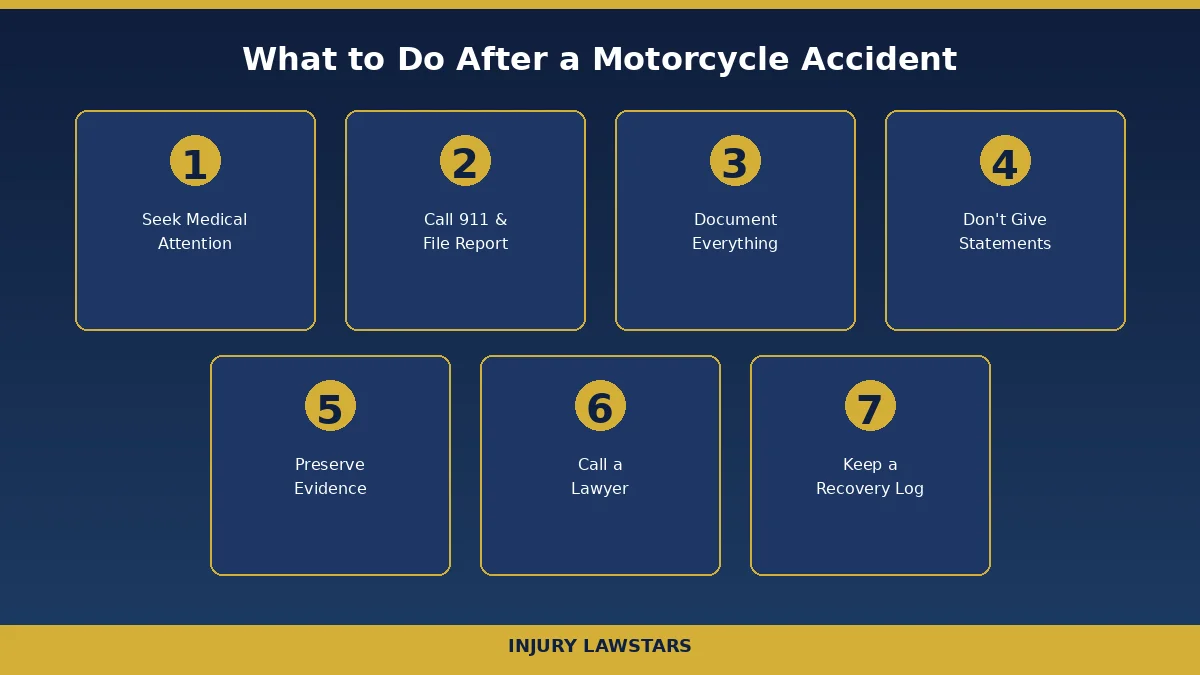
Step 1: Prioritize Your Health and Safety
Even if you feel fine, get a medical evaluation right away. Many motorcycle injuries, including internal bleeding, concussions, and spinal injuries, may not show symptoms immediately. A same-day medical record creates a direct link between the accident and your injuries that insurers cannot dispute.
Step 2: Report the Accident to the Police
A police report is one of the most important pieces of evidence in a motorcycle accident claim. It documents the officer’s observations, statements from both parties, and often an initial determination of fault.
Step 3: Gather Evidence at the Scene
If you are physically able, take photos and video of the crash scene, vehicle damage, road conditions, traffic signals, skid marks, and your injuries. Get witness names and contact information. Write down everything you remember while it is fresh.
Step 4: Be Careful What You Say to Insurers
The at-fault driver’s insurance adjuster will contact you quickly, looking for you to say something that reduces or denies your claim. Politely decline recorded statements and direct all communications to your attorney.
Step 5: Keep Your Damaged Gear and Records
Save all medical records, bills, prescription receipts, and documentation of missed work. Keep the damaged motorcycle, helmet, and riding gear as evidence. Do not post about the accident on social media, as insurance companies routinely monitor your accounts.
Step 6: Talk to an Experienced Motorcycle Accident Lawyer
The earlier you involve an attorney, the better your outcome is likely to be. An experienced Florida motorcycle accident lawyer can preserve critical evidence, handle all insurance communications, and build the strongest possible case on your behalf.
At Injury LawStars, Attorney Katie Miller was once an injury victim herself. She knows the fear, stress, and frustration that follows a serious accident. That firsthand experience drives her to fight relentlessly for every client. The firm operates on a contingency basis, meaning you pay no fees unless they win your case.
Step 7: Document Your Recovery Journey
Maintain a journal describing your pain levels, limitations, emotional impacts, and how the injuries affect your daily life. This documentation supports your pain and suffering claim and can significantly increase your settlement.
The Insurance Claim and Repair Process
While you focus on recovering from your injuries, a separate process begins for your damaged motorcycle. The property damage portion of your motorcycle accident claim runs parallel to your injury claim. It involves working with an insurance adjuster to assess the damage and determine whether your bike will be repaired or declared a total loss. Even though this part of the claim seems straightforward, the insurance company’s goal is always to pay as little as possible. Understanding the steps involved helps you protect the value of your bike and ensure you receive a fair outcome for your property.
Working with the Claims Representative
Shortly after you report the accident, a claims representative will be assigned to your case. This person, often called an adjuster, will manage the property damage claim. It is essential to remember that the claims representative works for the insurance company, not for you. Their job is to resolve the claim for the lowest possible cost to their employer. While you need to cooperate with them regarding the inspection of your motorcycle, you should be cautious about what you discuss. Avoid giving a recorded statement or discussing the details of your injuries, as anything you say can be used to diminish your personal injury claim later.
The Motorcycle Damage Inspection
The claims representative will arrange for an inspector to examine your motorcycle and assess the extent of the damage. This inspection is a critical step, as it forms the basis of the insurance company’s initial repair estimate. You can typically choose where the inspection happens—at your home in Clermont, your workplace in Ocala, or a repair shop in The Villages. The inspector will create a detailed report listing the necessary repairs and their estimated costs. It is always a good idea to get your own independent estimate from a trusted mechanic to compare with the insurer’s assessment, as they often overlook damage or use cheaper parts in their calculations.
Your Right to Choose a Repair Shop
The insurance company cannot force you to use a specific repair shop. While they may recommend shops from their “preferred network,” you have the absolute right to take your motorcycle to any mechanic you trust. Insurers often have arrangements with their preferred shops to use aftermarket parts or keep labor costs low. Choosing your own reputable shop, especially one that specializes in your motorcycle’s brand, ensures that the repairs are done correctly with quality parts. You simply provide the insurer with the estimate from your chosen shop and they will coordinate payment from there.
What Happens if You Don’t Repair Your Bike?
You are not obligated to repair your motorcycle, even if the insurance company approves the repairs. If you decide you would rather not fix the bike, the insurer will issue you a payment for the estimated cost of repairs, minus your policy’s deductible. This is sometimes called “cashing out.” You are then free to use that money however you wish—you could sell the damaged bike for parts, attempt the repairs yourself, or put the money toward a new motorcycle. This option gives you flexibility, especially if the cosmetic damage doesn’t bother you or if you plan on getting a different bike anyway.
What if Your Motorcycle is a “Total Loss”?
Because motorcycles have a lower overall value compared to cars and are easily damaged in a crash, they are frequently declared a “total loss” by insurance companies. This doesn’t mean the bike is completely destroyed, but rather that the cost to repair it is more than it’s worth. When this happens, the insurance company will pay you for the value of the motorcycle instead of paying for repairs. The process involves calculating your bike’s pre-accident value and settling the property damage portion of your motorcycle accident claim with a single payment.
How Insurers Define a Total Loss
An insurance company will declare your motorcycle a total loss when the estimated cost of repairs exceeds its actual cash value (ACV). In Florida, insurers follow a “total loss threshold.” This means if the repair costs meet or exceed 80% of the motorcycle’s ACV, it is typically deemed totaled. For example, if your bike was worth $10,000 before the crash and the repair estimate is $8,000 or more, the insurer will likely write it off as a total loss. This threshold prevents insurers from spending more to fix a vehicle than it would cost to replace it.
Determining Your Motorcycle’s Actual Cash Value (ACV)
The actual cash value is what your motorcycle was worth the moment before the accident occurred. To determine this figure, insurance adjusters look at several factors, including the bike’s make, model, year, mileage, overall condition, and any custom parts or upgrades. They will also reference pricing guides like Kelley Blue Book and look at what similar motorcycles are selling for in your local area, whether that’s Marion County or Sumter County. Their initial ACV offer is often low, and you have the right to negotiate it by providing your own evidence of the bike’s value, such as maintenance records and listings for comparable bikes.
Your Option to Keep a Totaled Motorcycle
Even if your motorcycle is declared a total loss, you may have the option to keep it. If you choose this route, the insurance company will pay you the bike’s actual cash value minus its “salvage value”—the amount the insurer would have received by selling the damaged bike to a salvage yard. If you keep the bike, the state of Florida will issue it a “salvage title.” This means you cannot legally ride it on public roads until it has been repaired and passed a specific inspection to be re-titled as “rebuilt,” which can be a complex process.
Insurance Coverage for Property Damage
If another driver was at fault for the accident, their property damage liability insurance is responsible for covering the ACV of your totaled motorcycle. However, if the at-fault driver is uninsured or their policy limits are too low to cover your bike’s full value, you will need to turn to your own policy. This is where having collision coverage or uninsured motorist property damage (UMPD) coverage becomes critical. Without this coverage on your own policy, you could be left with no way to recover the value of your motorcycle after a crash with an uninsured driver.
The Legal Process and Dealing with Insurers
While the property damage claim is being handled, the most important part of your case—the personal injury claim—moves forward. This process is far more complex and adversarial. Insurance companies are businesses focused on profits, and they employ teams of adjusters and lawyers trained to minimize or deny injury claims. They will use specific tactics to pay you as little as possible for your medical bills, lost income, and suffering. This is why having a dedicated legal advocate on your side is not just helpful, but essential for protecting your rights and securing the compensation you deserve.
Common Tactics Insurance Adjusters Use
Insurance adjusters are trained negotiators who use several common tactics to devalue your claim. They may try to shift blame by arguing you were somehow at fault for the crash, even when the evidence says otherwise. A frequent strategy is to offer a quick, lowball settlement before you know the full extent of your injuries, hoping you’ll accept out of financial desperation. They will also request a recorded statement to try and get you to say something that hurts your case or ask for a blanket medical authorization to dig through your entire medical history for pre-existing conditions they can use against you. An experienced attorney recognizes these tactics and shields you from them.
The Role of a Formal Demand Letter
After you have completed your primary medical treatment, your attorney will prepare and send a formal demand letter to the insurance company. This is a comprehensive legal document that officially starts the settlement negotiation process. The letter details the facts of the accident, establishes the other party’s liability, and provides a full accounting of your damages. This includes all of your medical expenses, lost wages, and a calculated value for your pain and suffering. The demand letter concludes with a specific monetary amount that you are demanding to settle the claim, setting the stage for negotiations.
Why Filing a Lawsuit Can Be a Necessary Step
The vast majority of motorcycle accident claims are settled out of court. However, if the insurance company refuses to negotiate in good faith or makes an offer that is unfairly low, filing a lawsuit is the next logical step. Initiating a lawsuit does not mean your case will automatically go to trial. In fact, filing suit often motivates the insurer to make a more reasonable settlement offer, as the potential costs of litigation and a jury verdict become more real. It is a powerful tool that shows the insurance company you are serious about fighting for the full value of your claim. At Injury LawStars, we prepare every case as if it’s going to trial, ensuring we are always in the strongest position to negotiate or litigate on your behalf.
Don’t Miss Your Deadline to File a Claim in Florida
Florida law gives you a limited window to file a personal injury lawsuit after a motorcycle accident. Under the 2023 tort reform changes, the statute of limitations for negligence-based personal injury claims is now two years from the date of the accident. If a wrongful death is involved, the family has two years from the date of death to file.
Missing this deadline almost always means losing your right to compensation. Insurance companies are aware of these deadlines and may delay the process intentionally. Starting the legal process early protects your rights.
How We Fight for Florida Motorcyclists
Motorcycle accident claims in Florida are more complex than most people realize. Between the helmet law debates, the PIP coverage gap, the modified comparative negligence rule, and aggressive insurance company tactics, injured riders face an uphill battle from the moment the crash happens.
At Injury LawStars, we understand what you are going through because our managing partner, Attorney Katie Miller, has been through it herself. She was once an injury victim, and that experience shaped her mission: to protect people who are hurting, hold insurance companies accountable, and make sure no one goes through the process alone.
Whether your crash happened on I-4, along the Florida Turnpike, on a back road in Lake County, or at a busy intersection in Ocala or Clermont, our team is ready to fight for the compensation you deserve. We handle every aspect of your motorcycle accident claim so you can focus on healing.
Ready to fight for the compensation you deserve? Call Injury LawStars now at (407) 887-4690 or schedule your free consultation online. There are no fees unless we win.
Frequently Asked Questions
How much is a motorcycle accident claim worth?
The value of a motorcycle accident claim depends on your injury severity, medical costs, lost income, pain and suffering, available insurance coverage, and your percentage of fault under Florida’s comparative negligence law. Minor injury claims may settle for $10,000 to $50,000, while severe or catastrophic injury claims can reach $750,000 to several million dollars. No online calculator can give you an accurate estimate because every case involves unique facts. The best way to understand your claim’s value is to have an experienced attorney review your specific medical records, insurance policies, and liability evidence.
Who is at fault in a motorcycle accident?
Fault in a motorcycle accident is determined by examining the evidence: police reports, witness statements, traffic camera footage, accident reconstruction analysis, and applicable traffic laws. In Florida, multiple parties can share fault under the modified comparative negligence system. The at-fault party is typically the driver who violated a traffic law or acted negligently, such as a driver who made a left turn without seeing an oncoming motorcycle or changed lanes without checking their blind spot. An attorney can investigate your crash and identify all liable parties to maximize your recovery.
Do I need PIP for a motorcycle in Florida?
No. Florida’s Personal Injury Protection (PIP) requirement does not apply to motorcycles under Florida Statute 627.736. Most motorcycle insurance policies do not include PIP coverage. This means you cannot rely on your own insurance for immediate medical bill coverage after a crash the way a car driver would. Instead, you must file your motorcycle accident claim directly against the at-fault driver’s bodily injury liability insurance, supplemented by your health insurance, MedPay, or UM/UIM coverage.
What should I do after a motorcycle accident?
Seek medical attention immediately, even if you feel fine. Call 911 and file a police report. Document the scene with photos and video if possible. Get witness contact information. Do not admit fault or give recorded statements to the other driver’s insurance company. Preserve your damaged motorcycle, helmet, and gear as evidence. Keep records of all medical bills and missed work. Contact an experienced motorcycle accident lawyer as soon as possible to protect your rights and begin building your claim.
How long do I have to file a motorcycle accident claim in Florida?
Under current Florida law, the statute of limitations for personal injury claims is two years from the date of the accident. For wrongful death claims, the family has two years from the date of death. Missing this deadline typically means losing your right to pursue compensation permanently. Insurance companies are aware of these time limits and may delay the process intentionally, which is another reason to consult with an attorney as soon as possible after a motorcycle crash.
Related Articles
- Motorcycle Accident Claims in Florida | Injury LawStars
- How Much Is a Motorcycle Accident Settlement in Florida? | Injury LawStars
- Why Hire a Motorcycle Accident Attorney? 5 Key Reasons
About the Author
Katie Miller, Esq.
Managing Partner · Injury LawStars
Attorney Katie Miller was once an injury victim herself. After a car accident in 2016 that required spinal surgery and a 13-month recovery, she turned her experience into a mission: fighting for people who are hurting. With 17+ years of legal experience and over \$45 million recovered for clients, Katie brings both professional expertise and personal understanding to every case.