
March 25, 2026
Motorcycle Accident Claims in Florida: Laws, Settlement Factors, and How to Protect Your Rights
Florida leads the nation in motorcycle fatalities, with 578 riders killed and over 8,000 injured in 2024 alone. Filing a motorcycle accident claim in this state is more complex than most riders realize. Between the helmet law, the PIP insurance gap, aggressive insurance tactics, and the modified comparative negligence rule that took effect in 2023, a single mistake can cost you thousands of dollars or your entire case. This guide explains exactly how motorcycle accident claims work in Florida, what affects your settlement value, and how to protect your rights from the moment the crash happens.
Injured in a motorcycle accident? Call Injury LawStars today at (407) 887-4690 or contact us online for a free consultation with a Florida motorcycle accident lawyer.
Key Takeaways
- Florida has the highest motorcycle fatality rate in the country, with 9,420 crashes, 578 deaths, and 8,106 injuries reported in 2024 according to the Florida Highway Safety and Motor Vehicles (FHSMV) Crash Dashboard.
- Motorcyclists are excluded from Florida’s no-fault PIP system, meaning you must file your motorcycle accident claim directly against the at-fault driver’s liability insurance rather than relying on Personal Injury Protection.
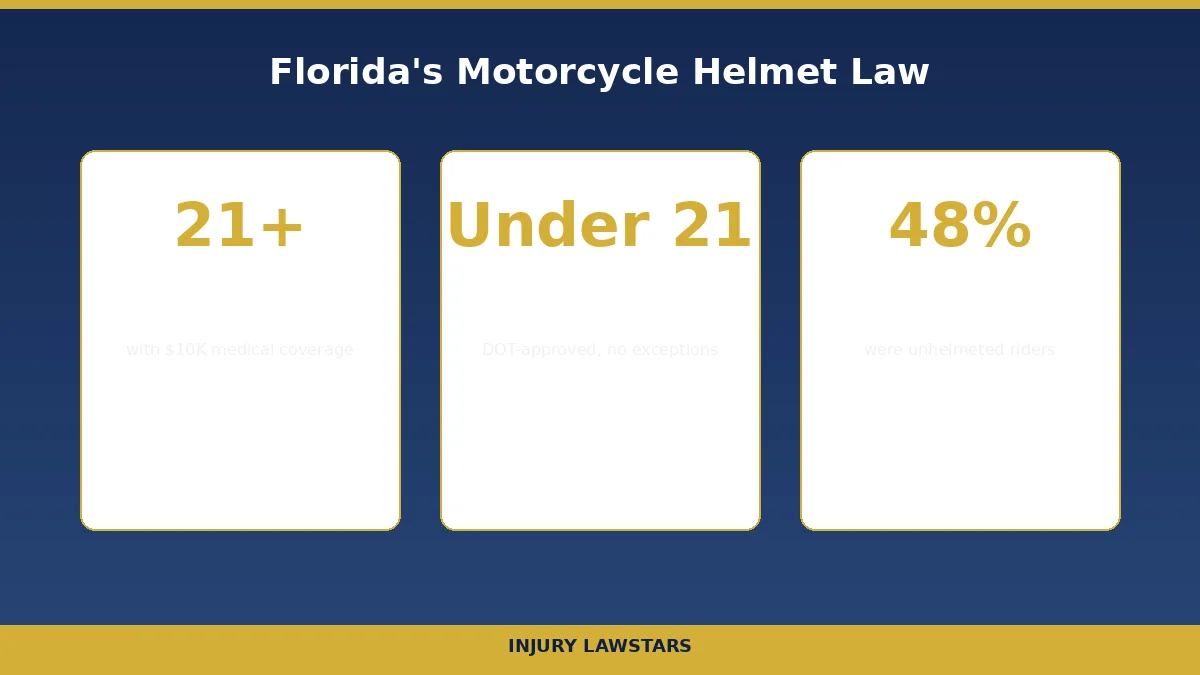
- Riders over 21 can legally ride without a helmet if they carry at least $10,000 in medical benefits coverage, but choosing not to wear a helmet can reduce your motorcycle accident injury claim.
- Florida’s modified comparative negligence rule (2023) bars you from recovering any compensation if you are found 51% or more at fault. Your damages are reduced by your percentage of fault if it is 50% or less.
- An experienced motorcycle accident lawyer can protect your rights, handle insurance company tactics, and fight for the full value of your motorcycle accident claim.
Why Florida Is the Most Dangerous State for Motorcyclists
For three consecutive years, Florida has held the unwanted distinction of leading the nation in motorcycle deaths. The numbers tell a sobering story:
- 2024: 9,420 crashes, 578 fatalities, 8,106 injuries
- 2023: 621 fatalities
- 2022: 631 fatalities (topping California’s 634 and Texas’s 564)
Motorcycle fatalities account for roughly 18.5% of all traffic deaths in Florida, even though motorcycles represent just 3% of registered vehicles in the state. Several factors contribute to this grim reality.
Year-Round Riding Weather
Florida’s warm climate means motorcyclists ride 12 months a year. Northern states see fewer crashes in winter, but Florida riders face constant exposure to road hazards regardless of the season.
Tourism and Seasonal Events
Florida welcomes over 131 million visitors annually. Events like Daytona Bike Week bring 300,000 to 400,000 riders to already-congested roads. Unfamiliar riders navigating unfamiliar roads create additional risk.
High Rates of Distracted and Uninsured Drivers
Florida has one of the highest uninsured motorist rates in the country. Distracted driving, especially from cell phone use, continues to rise. When a distracted or uninsured driver hits a motorcyclist, the consequences are almost always severe.
Dangerous Roads and Intersections
Certain Florida roadways are especially hazardous for riders. Interstate 4 between Daytona Beach and Tampa ranks among the nation’s most dangerous highways for motorcyclists. High-traffic intersections throughout Central Florida, including corridors along the I-4, I-95, and Florida Turnpike, see a disproportionate number of motorcycle crashes.
For riders in Lake County, Marion County, and Sumter County, busy roads connecting communities like Clermont, Ocala, The Villages, and Leesburg carry particular risks during peak travel times and seasonal events.
What Are the Most Common Causes of Motorcycle Accidents in Florida?
Understanding why crashes happen helps establish fault in your motorcycle accident claim. These are the most frequent causes.
Left-Turn Collisions
Left-turn accidents are the single deadliest type of motorcycle crash, accounting for 36% of motorcycle fatalities. These happen when a vehicle making a left turn fails to see an oncoming motorcycle or misjudges its speed. The motorcycle hits the turning vehicle or is hit broadside, often at full speed with no time to react.
Distracted Driving
Drivers who are texting, scrolling, eating, or otherwise not watching the road are a constant threat to motorcyclists. A car driver who drifts into a motorcycle’s lane even briefly can cause a catastrophic collision. Motorcycles are smaller and harder to see, making them especially vulnerable to distracted drivers.
Speeding
Both motorcyclists and other drivers contribute to speed-related crashes. For a motorcyclist with no protective frame, the difference between a 35 mph and a 55 mph crash can mean broken bones versus death.
Impaired Driving
Florida recorded 1,024 DUI-related motorcycle crashes in 2024 alone. Alcohol and drugs impair reaction time, judgment, and coordination for both motorcyclists and other drivers on the road.
Lane Changes and Merging
Motorcycles sit in the blind spots of cars, trucks, and SUVs. A driver who fails to check before changing lanes can sideswipe a motorcyclist without warning, especially on Florida’s highways and multi-lane roads.
Road Hazards
Potholes, loose gravel, oil slicks, and debris are minor annoyances for car drivers but can be deadly for motorcyclists. Florida’s frequent rain creates wet, slippery surfaces that reduce tire grip by 20-30%, making even routine road hazards potentially fatal.
Why Do Motorcycle Accidents Cause More Severe Injuries?
The injuries motorcyclists suffer are fundamentally different from those in car accidents. Without a steel frame, airbags, or seatbelts, riders absorb the full force of every collision. This is a major reason motorcycle accident claims tend to involve higher settlement values than car accident claims.
Traumatic Brain Injuries (TBI)
Head injuries are the leading cause of death among motorcyclists. Even with a helmet, the violent forces of a crash can cause the brain to collide with the inside of the skull. TBIs range from concussions that resolve in weeks to severe injuries that permanently alter cognition, memory, personality, and physical function.
The long-term cost of a severe TBI can extend far beyond initial hospital bills, often requiring years of rehabilitation, cognitive therapy, and ongoing medical care. If you have suffered a brain injury in a motorcycle crash, a brain injury attorney can help you pursue compensation that accounts for these long-term needs.
Spinal Cord Injuries and Paralysis
When a rider is thrown from a motorcycle or struck with significant force, the spine can twist, compress, or fracture. Damage to the spinal cord can result in paraplegia or tetraplegia. The financial impact of spinal cord injuries extends over decades, with long-term care costs, medical equipment, home modifications, and lost earning capacity totaling millions of dollars over a lifetime.
Severe Road Rash
Road rash develops when a rider’s skin makes forceful contact with asphalt during a slide. While the term sounds minor, severe cases can tear through multiple layers of skin and underlying tissue, damaging nerves and muscles. Severe road rash often requires skin grafts, causes permanent scarring, and carries significant infection risk.
Biker’s Arm
When a rider instinctively extends their arm to break a fall, the impact can stretch or sever nerves in the shoulder, arm, and hand. This condition, known as biker’s arm, can cause permanent loss of muscle control and sensation. It is one of the most common and most underestimated motorcycle-specific injuries.
Broken Bones, Crush Injuries, and Internal Organ Damage
Without a protective frame, motorcyclists are susceptible to fractures in the legs, arms, ribs, pelvis, and collarbone. Crush injuries can lead to chronic pain, nerve damage, and in severe cases, amputation. Internal organ damage from the forceful impact of a collision may not be immediately apparent, making prompt medical evaluation after any motorcycle crash critical.
How Do Motorcycle Accident Claims Differ from Car Accident Claims?
If you have been in a car accident before, you might assume the claims process works the same for motorcycles. It does not. There are several critical differences that directly affect the value and strategy of your motorcycle accident claim.
No PIP Coverage for Motorcycles
Florida’s no-fault system requires car drivers to carry Personal Injury Protection (PIP) insurance. PIP covers a portion of your medical bills and lost wages regardless of who caused the crash. But Florida Statute 627.736 specifically excludes motorcycles from PIP requirements.
This means:
- Most motorcycle insurance policies do not include PIP
- You cannot turn to your own insurance for immediate medical bill coverage the way a car driver would
- Having PIP on your car insurance policy does not automatically cover you in a motorcycle crash
Direct Liability Claims from Day One
The silver lining is that motorcyclists skip the PIP process entirely and can immediately file a motorcycle accident claim against the negligent driver for the full scope of damages, including:
- Medical expenses (current and future)
- Lost wages and reduced earning capacity
- Pain and suffering
- Permanent disability or disfigurement
- Property damage to the motorcycle
Unlike car accident victims, motorcyclists in Florida do not need to meet a “serious injury” threshold before claiming non-economic damages like pain and suffering. You can pursue full compensation from day one.
Higher Bias Against Riders
Insurance adjusters and juries sometimes carry anti-motorcycle bias, assuming the rider was reckless or at fault simply because they chose to ride a motorcycle. This bias does not exist in car-on-car collisions and must be proactively addressed in your claim.
Do not let the insurance company take advantage of you. Call Injury LawStars at (407) 887-4690 for a free case review with an experienced motorcycle accident lawyer.
Florida’s Motorcycle Helmet Law and Its Impact on Your Claim
Florida’s helmet law is one of the most misunderstood statutes in the state. Here is exactly what Florida Statute 316.211 says and how it affects your motorcycle accident injury claim.
The Basic Rule
All motorcycle operators and passengers must wear protective headgear that meets Federal Motorcycle Vehicle Safety Standard 218 (FMVSS 218), set by the U.S. Department of Transportation. Eye protection is also required for operators.
The Exception for Riders Over 21
Since July 1, 2000, riders who are 21 years of age or older may ride without a helmet if they carry an insurance policy providing at least $10,000 in medical benefits for injuries from a motorcycle crash. The rider must carry proof of this medical benefits coverage.
Riders Under 21
If you are under 21, you must wear a DOT-approved helmet at all times when operating or riding on a motorcycle. There are no exceptions.
How Helmet Choice Affects Your Claim Value
Choosing not to wear a helmet is legal for qualifying riders, but it can still reduce your motorcycle accident claim. Insurance companies and defense attorneys routinely argue that an unhelmeted rider’s head or brain injuries would have been less severe had they worn a helmet. Under Florida’s comparative negligence system, this argument can reduce the compensation you receive.
Consider the statistics: 48% of motorcyclists killed in Florida crashes were not wearing helmets. If you sustain a traumatic brain injury in a crash while riding without a helmet, the insurance company will almost certainly use that fact against you.
Florida’s Modified Comparative Negligence and Your Motorcycle Accident Claim
Florida’s comparative negligence law changed significantly in 2023, directly impacting every motorcycle accident claim filed in the state.
The 2023 Tort Reform (HB 837)
In March 2023, Governor DeSantis signed HB 837 into law, shifting Florida from a pure comparative negligence state to a modified comparative negligence state. This is one of the most significant legal changes for injured motorcyclists in decades.
The 51% Rule
Under the current law, if you are found to be 51% or more at fault for the accident, you cannot recover any compensation from the other party. If your fault is 50% or less, you can still recover damages, but your award is reduced by your percentage of fault.
Example: You are injured in a motorcycle crash and your total damages are $200,000. A jury finds you were 30% at fault because you were exceeding the speed limit. Your recovery is reduced by 30%, leaving you with $140,000. But if that same jury found you 51% at fault, you would receive nothing.
Why This Matters for Motorcycle Accident Claims
Insurance companies know this rule and use it aggressively. After a motorcycle crash, adjusters look for every possible way to shift blame onto the rider. Common tactics include:
- Arguing you were speeding or riding aggressively
- Claiming you were not wearing a helmet (even if legal)
- Suggesting you failed to take evasive action
- Questioning your lane position or visibility
The goal is simple: push your fault percentage above 50% so the insurance company pays nothing. This is why having a motorcycle accident lawyer who understands these tactics is critical.
Average Motorcycle Accident Settlement Ranges
One of the most common questions riders ask is how much their motorcycle accident claim is worth. While every case is unique, understanding typical settlement ranges by injury severity provides a useful starting point.
Settlement Ranges by Injury Severity
| Injury Category | Typical Settlement Range | Examples |
|---|---|---|
| Minor injuries | $10,000 – $50,000 | Sprains, minor fractures, road rash requiring outpatient treatment |
| Moderate injuries | $50,000 – $200,000 | Multiple fractures, moderate TBI, herniated discs, significant road rash requiring surgery |
| Severe injuries | $200,000 – $750,000 | Severe TBI, spinal cord damage, multiple surgeries, lengthy rehabilitation |
| Catastrophic injuries | $750,000 – $3,000,000+ | Paralysis, permanent brain damage, amputation, permanent disability |
| Wrongful death | $500,000 – $5,000,000+ | Fatal motorcycle crashes; family members pursue survival and wrongful death claims |
These ranges are general estimates based on Florida case outcomes and should not be treated as guarantees. Your actual settlement depends on the specific facts and circumstances of your case.
Why a Motorcycle Accident Claim Calculator Cannot Give You an Accurate Number
Many websites advertise a motorcycle accident claim calculator that promises to estimate your settlement in minutes. These tools are extremely misleading. Here is why:
- They cannot account for comparative negligence. A calculator does not know what percentage of fault will be assigned to you, which directly determines your recovery under Florida law.
- They ignore insurance policy limits. Your settlement is capped by the available insurance coverage. A calculator has no way to know the at-fault driver’s policy limits or whether you carry UM/UIM coverage.
- They oversimplify pain and suffering. Non-economic damages are subjective and depend on how your injuries affect your daily life, relationships, career, and mental health. No formula captures this.
- They do not factor in anti-motorcycle bias. The prejudice riders face from adjusters and juries can significantly impact claim outcomes in ways no calculator can predict.
The only reliable way to estimate the value of your motorcycle accident claim is to have an experienced attorney review your specific case, including your medical records, insurance policies, liability evidence, and long-term prognosis.
Factors That Increase Your Settlement Value
Several elements can push your motorcycle accident claim toward the higher end of these ranges:
- Documented permanent impairment with a permanent impairment rating from your treating physician
- Strong liability evidence clearly establishing the other driver’s fault (dashcam footage, witness statements, police reports)
- High available insurance limits including your own UM/UIM coverage
- Consistent medical treatment showing you followed your doctor’s treatment plan
- Detailed pain and suffering documentation including a daily journal of symptoms, limitations, and emotional impacts
The Insurance Challenge: Why Motorcyclists Face a Coverage Gap
Without PIP coverage, how your medical bills get paid after a motorcycle crash is one of the most immediate concerns in your motorcycle accident claim.
How Medical Bills Get Paid Without PIP
After a motorcycle crash, medical bills are typically covered through a combination of:
- Health insurance — often the fastest path to continued medical treatment
- MedPay (Medical Payments Coverage) — an optional motorcycle insurance add-on that covers medical expenses regardless of fault
- At-fault driver’s liability insurance — pursued through the injury claim
- UM/UIM coverage — when the at-fault driver is uninsured or underinsured
The Uninsured and Underinsured Driver Problem
Florida has one of the highest rates of uninsured drivers in the nation. Florida’s minimum bodily injury liability limits are also dangerously low: $10,000 per person and $20,000 per accident. For a serious motorcycle crash with six-figure medical bills, these minimums are exhausted almost immediately.
This is why uninsured/underinsured motorist (UM/UIM) coverage is essential for every Florida motorcyclist. UM/UIM coverage protects you when the at-fault driver has no insurance or insufficient coverage to pay for your damages. Without it, you may be left covering catastrophic medical costs out of pocket.
An attorney helps coordinate these payment sources to ensure you receive uninterrupted medical care while your motorcycle accident claim is being resolved.
What Should You Do After a Motorcycle Accident?
Taking the right steps immediately after a crash can make or break your motorcycle accident claim. Here is exactly what to do.
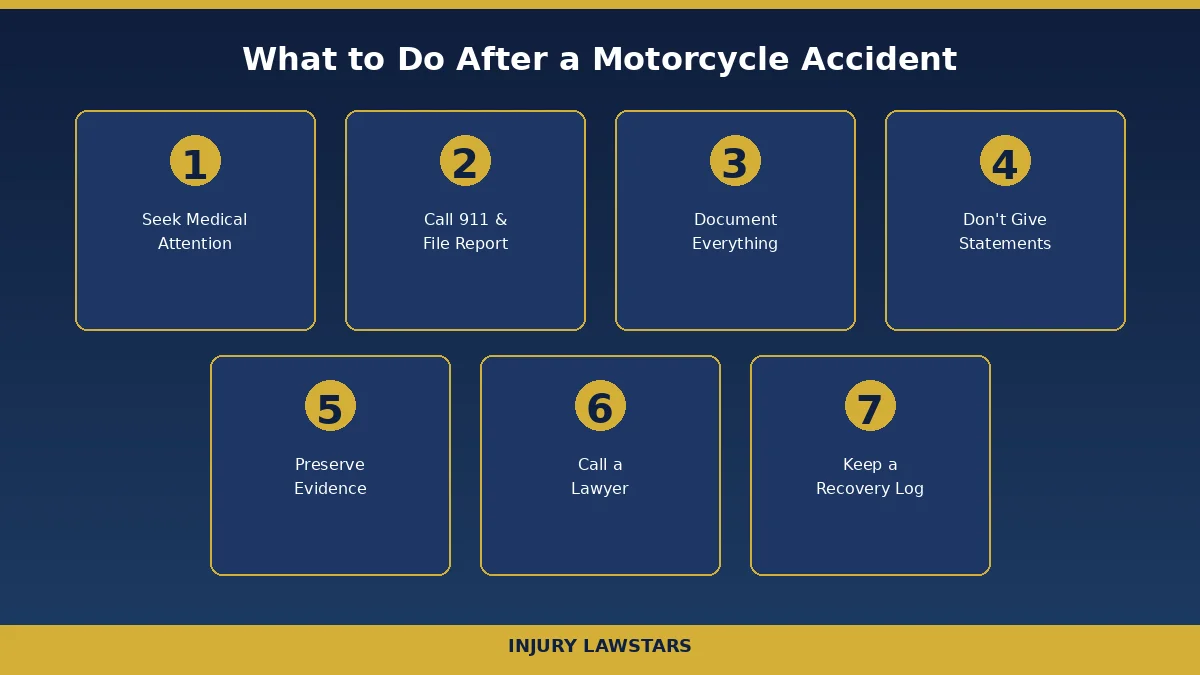
Step 1: Seek Medical Attention Immediately
Even if you feel fine, get a medical evaluation right away. Many motorcycle injuries, including internal bleeding, concussions, and spinal injuries, may not show symptoms immediately. A same-day medical record creates a direct link between the accident and your injuries that insurers cannot dispute.
Step 2: Call 911 and File a Police Report
A police report is one of the most important pieces of evidence in a motorcycle accident claim. It documents the officer’s observations, statements from both parties, and often an initial determination of fault.
Step 3: Document Everything at the Scene
If you are physically able, take photos and video of the crash scene, vehicle damage, road conditions, traffic signals, skid marks, and your injuries. Get witness names and contact information. Write down everything you remember while it is fresh.
Step 4: Do Not Give Recorded Statements to Insurance Companies
The at-fault driver’s insurance adjuster will contact you quickly, looking for you to say something that reduces or denies your claim. Politely decline recorded statements and direct all communications to your attorney.
Step 5: Preserve All Evidence
Save all medical records, bills, prescription receipts, and documentation of missed work. Keep the damaged motorcycle, helmet, and riding gear as evidence. Do not post about the accident on social media, as insurance companies routinely monitor your accounts.
Step 6: Contact a Motorcycle Accident Lawyer
The earlier you involve an attorney, the better your outcome is likely to be. An experienced Florida motorcycle accident lawyer can preserve critical evidence, handle all insurance communications, and build the strongest possible case on your behalf.
At Injury LawStars, Attorney Katie Miller was once an injury victim herself. She knows the fear, stress, and frustration that follows a serious accident. That firsthand experience drives her to fight relentlessly for every client. The firm operates on a contingency basis, meaning you pay no fees unless they win your case.
Step 7: Keep a Daily Record of Your Recovery
Maintain a journal describing your pain levels, limitations, emotional impacts, and how the injuries affect your daily life. This documentation supports your pain and suffering claim and can significantly increase your settlement.
Florida Statute of Limitations: Do Not Wait Too Long
Florida law gives you a limited window to file a personal injury lawsuit after a motorcycle accident. Under the 2023 tort reform changes, the statute of limitations for negligence-based personal injury claims is now two years from the date of the accident. If a wrongful death is involved, the family has two years from the date of death to file.
Missing this deadline almost always means losing your right to compensation. Insurance companies are aware of these deadlines and may delay the process intentionally. Starting the legal process early protects your rights.
Why Injury LawStars Fights for Florida Motorcyclists
Motorcycle accident claims in Florida are more complex than most people realize. Between the helmet law debates, the PIP coverage gap, the modified comparative negligence rule, and aggressive insurance company tactics, injured riders face an uphill battle from the moment the crash happens.
At Injury LawStars, we understand what you are going through because our managing partner, Attorney Katie Miller, has been through it herself. She was once an injury victim, and that experience shaped her mission: to protect people who are hurting, hold insurance companies accountable, and make sure no one goes through the process alone.
Whether your crash happened on I-4, along the Florida Turnpike, on a back road in Lake County, or at a busy intersection in Ocala or Clermont, our team is ready to fight for the compensation you deserve. We handle every aspect of your motorcycle accident claim so you can focus on healing.
Ready to fight for the compensation you deserve? Call Injury LawStars now at (407) 887-4690 or schedule your free consultation online. There are no fees unless we win.
Frequently Asked Questions
How much is a motorcycle accident claim worth?
The value of a motorcycle accident claim depends on your injury severity, medical costs, lost income, pain and suffering, available insurance coverage, and your percentage of fault under Florida’s comparative negligence law. Minor injury claims may settle for $10,000 to $50,000, while severe or catastrophic injury claims can reach $750,000 to several million dollars. No online calculator can give you an accurate estimate because every case involves unique facts. The best way to understand your claim’s value is to have an experienced attorney review your specific medical records, insurance policies, and liability evidence.
Who is at fault in a motorcycle accident?
Fault in a motorcycle accident is determined by examining the evidence: police reports, witness statements, traffic camera footage, accident reconstruction analysis, and applicable traffic laws. In Florida, multiple parties can share fault under the modified comparative negligence system. The at-fault party is typically the driver who violated a traffic law or acted negligently, such as a driver who made a left turn without seeing an oncoming motorcycle or changed lanes without checking their blind spot. An attorney can investigate your crash and identify all liable parties to maximize your recovery.
Do I need PIP for a motorcycle in Florida?
No. Florida’s Personal Injury Protection (PIP) requirement does not apply to motorcycles under Florida Statute 627.736. Most motorcycle insurance policies do not include PIP coverage. This means you cannot rely on your own insurance for immediate medical bill coverage after a crash the way a car driver would. Instead, you must file your motorcycle accident claim directly against the at-fault driver’s bodily injury liability insurance, supplemented by your health insurance, MedPay, or UM/UIM coverage.
What should I do after a motorcycle accident?
Seek medical attention immediately, even if you feel fine. Call 911 and file a police report. Document the scene with photos and video if possible. Get witness contact information. Do not admit fault or give recorded statements to the other driver’s insurance company. Preserve your damaged motorcycle, helmet, and gear as evidence. Keep records of all medical bills and missed work. Contact an experienced motorcycle accident lawyer as soon as possible to protect your rights and begin building your claim.
How long do I have to file a motorcycle accident claim in Florida?
Under current Florida law, the statute of limitations for personal injury claims is two years from the date of the accident. For wrongful death claims, the family has two years from the date of death. Missing this deadline typically means losing your right to pursue compensation permanently. Insurance companies are aware of these time limits and may delay the process intentionally, which is another reason to consult with an attorney as soon as possible after a motorcycle crash.