
March 26, 2026
Medical Malpractice in Florida: What Victims Need to Know in 2026
If you trusted a doctor, surgeon, or hospital to care for you and something went terribly wrong, you may have a medical malpractice claim under Florida law. Medical malpractice cases in Florida are among the most complex personal injury claims you can file. They involve strict pre-suit requirements, tight filing deadlines, mandatory expert witness testimony, and procedural rules that do not exist in standard negligence cases.
Suspect medical malpractice? Contact Injury LawStars at (407) 887-4690 for a free case review. No fees unless we win.
Florida ranks among the top states in the nation for medical malpractice filings, and the consequences of medical errors can be devastating. Patients suffer permanent disabilities, require additional surgeries, lose the ability to work, and in the worst cases, lose their lives. When a healthcare provider’s negligence causes that kind of harm, Florida law gives victims and their families a path to compensation, but only if they follow every procedural step correctly and act within the required timeframe.
In this guide, Attorney Katie Miller of Injury LawStars explains what constitutes medical malpractice in Florida, the legal requirements you must meet before you can even file a lawsuit, the types of compensation available, and the critical deadlines that could make or break your case.
Key Takeaways
- Medical malpractice occurs when a healthcare provider violates the accepted standard of care, causing injury to a patient. Florida Statutes Chapter 766 governs these claims.
- Florida requires a mandatory 90-day pre-suit investigation period before you can file a medical malpractice lawsuit. You must send a formal Notice of Intent and include a verified expert medical opinion.
- The statute of limitations is two years from the date you discovered (or should have discovered) the malpractice, with an absolute four-year statute of repose. Fraud or concealment can extend this to seven years.
- Florida’s caps on non-economic damages in medical malpractice cases have been ruled unconstitutional by the Florida Supreme Court, meaning there is currently no statutory cap on pain and suffering damages.
- Expert witness testimony is mandatory. You cannot proceed with a medical malpractice claim in Florida without a qualified medical expert supporting your case.
- Common types of malpractice include surgical errors, misdiagnosis, medication errors, birth injuries, and anesthesia complications, all of which can result in life-altering harm.
- Contacting a Florida medical malpractice attorney as early as possible is critical because of the pre-suit requirements and tight deadlines.
What Constitutes Medical Malpractice in Florida?
Medical malpractice is not simply a bad outcome from medical treatment. Under Florida law, medical malpractice occurs when a healthcare provider fails to meet the prevailing professional standard of care and that failure directly causes injury to a patient.
Florida Statute § 766.102 defines the standard of care as “that level of care, skill, and treatment which, in light of all relevant surrounding circumstances, is recognized as acceptable and appropriate by reasonably prudent similar healthcare providers.” This means the care you received is measured against what other qualified healthcare professionals in the same specialty would have done under similar circumstances.
To prove a medical malpractice claim in Florida, you must establish four elements:
- Duty of care. A doctor-patient relationship existed, creating a legal obligation for the healthcare provider to treat you competently.
- Breach of the standard of care. The healthcare provider failed to act in accordance with the accepted standard for their specialty.
- Causation. The provider’s breach directly caused your injury. It is not enough to show that the provider made an error; you must prove that error caused harm that would not have occurred otherwise.
- Damages. You suffered actual, measurable harm as a result, including medical expenses, lost wages, pain and suffering, or other losses.
Each element must be supported by evidence, and in Florida, that evidence must include testimony from a qualified medical expert. This is one of the key differences between medical malpractice claims and standard personal injury claims.
Who Can Be Held Liable?
Medical malpractice claims in Florida can be brought against a wide range of healthcare providers, including:
- Physicians and surgeons
- Nurses and nurse practitioners
- Anesthesiologists
- Radiologists and pathologists
- Dentists and oral surgeons
- Pharmacists
- Hospitals and healthcare facilities
- Urgent care centers and clinics
- Nursing homes and assisted living facilities
Hospitals can be held liable for the negligence of their employees under the legal doctrine of vicarious liability. Whether a hospital is also responsible for the errors of independent contractor physicians depends on the specific circumstances of the case, including whether the patient had the ability to choose the provider.
What Are Florida’s Pre-Suit Investigation Requirements?
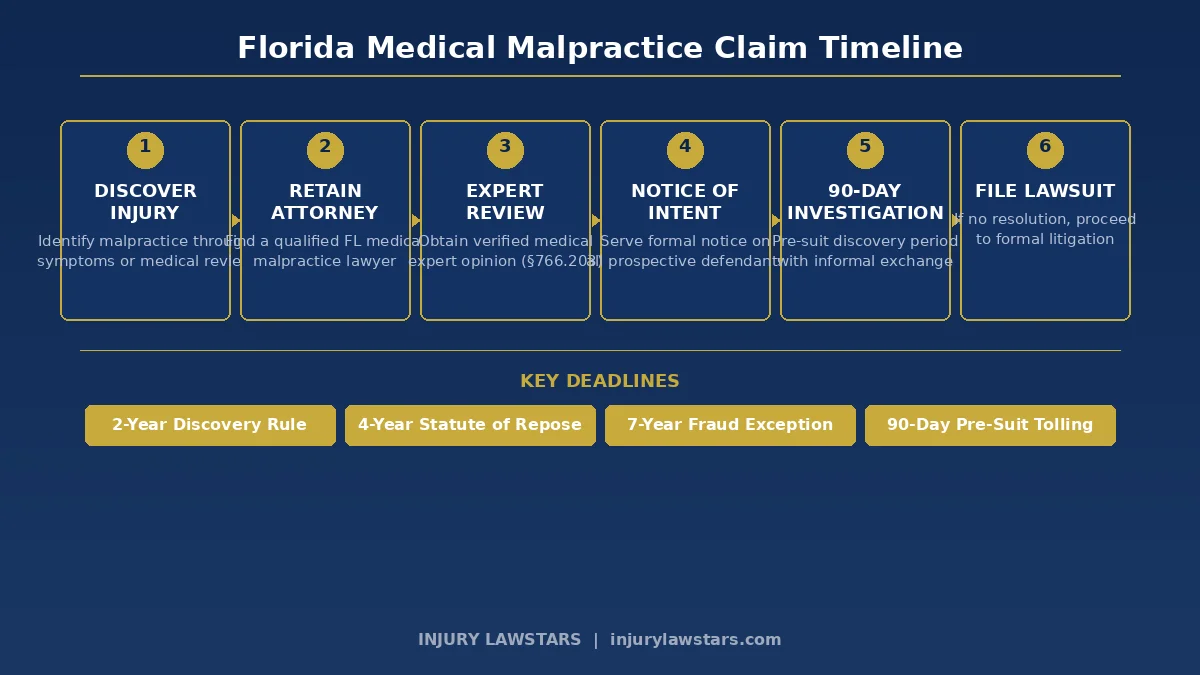
One of the most significant differences between medical malpractice claims and other personal injury cases in Florida is the mandatory pre-suit process. Under Florida Statute § 766.106, you cannot file a medical malpractice lawsuit without first completing a pre-suit investigation.
The Notice of Intent to Initiate Litigation
Before filing suit, the claimant (or their attorney) must send a formal Notice of Intent to Initiate Litigation to every prospective defendant. This notice must include:
- An identification of the claimant and the claimant’s attorney
- A list of all healthcare providers who treated the claimant for the injury
- A statement of the legal basis for the claim
- A verified written medical expert opinion from a qualified physician, corroborating that there are reasonable grounds to believe the healthcare provider breached the standard of care
This notice triggers a 90-day investigation period during which the statute of limitations is paused (tolled). During this window:
- The claimant and the defendant conduct informal discovery, including exchanging medical records
- The defendant’s insurance company or legal team evaluates the claim
- Both sides may take unsworn statements from fact and expert witnesses
How the Defendant Must Respond
By the end of the 90-day investigation period, the defendant must respond with one of the following:
- A rejection of the claim. The defendant denies liability and the claimant is free to file a lawsuit.
- An offer to settle. The defendant makes a monetary offer to resolve the claim without litigation.
- An admission of liability with a dispute over damages. The defendant accepts fault but disputes the amount of compensation owed.
If the defendant fails to respond within the 90-day period, the claimant may proceed to file the lawsuit. This pre-suit process exists to encourage early resolution of claims and reduce unnecessary litigation, but it also adds significant complexity and time to the process.
Why You Need an Attorney Before the Pre-Suit Process Begins
The pre-suit requirements mean you effectively need to begin building your case well before you file a lawsuit. You need a qualified medical expert to review your records and provide a verified opinion. You need to identify every potential defendant. You need to prepare for informal discovery.
All of this takes time, and it must be completed while the statute of limitations clock is still running (the 90-day pre-suit period tolls the statute, but only after the notice is properly served). This is why contacting a Florida medical malpractice attorney as soon as you suspect malpractice is so important.
Don’t let filing deadlines slip away. Call Injury LawStars at (407) 887-4690 or schedule your free consultation today.
How Long Do You Have to File a Medical Malpractice Claim in Florida?
Florida’s statute of limitations for medical malpractice is governed by Florida Statute § 95.11(4)(b) and the special provisions in Chapter 766. The rules are more complex than the standard personal injury statute of limitations.
The Two-Year Discovery Rule
You have two years from the date you discovered, or should have discovered through reasonable diligence, that the injury was caused by medical malpractice to file your claim. This is called the “discovery rule,” and it differs from most personal injury claims where the clock starts on the date of the incident.
The discovery rule exists because many medical errors are not immediately apparent. A surgeon may leave a sponge inside a patient, a misdiagnosis may not become evident until the condition worsens, or a medication error may cause gradual organ damage. In these situations, the patient may not know they have been harmed until months or years after the malpractice occurred.
For a deeper look at Florida’s personal injury filing deadlines, see our guide on how long after an accident can you sue for personal injury.
The Four-Year Statute of Repose
Regardless of when you discover the malpractice, Florida imposes an absolute four-year deadline from the date the malpractice occurred. This is known as the “statute of repose.” Even if you had no way of knowing about the malpractice, the four-year repose period will bar your claim in most circumstances.
Exceptions to the Statute of Repose
Florida law recognizes limited exceptions that can extend the filing deadline beyond four years:
- Fraud, concealment, or intentional misrepresentation. If the healthcare provider actively concealed the malpractice or made false statements to prevent you from discovering the error, the statute of repose is extended to seven years from the date the malpractice occurred. (Florida Statute § 95.11(4)(b))
- Minors. For children under the age of eight at the time of the malpractice, the statute of limitations does not expire until the child’s eighth birthday, regardless of when the malpractice occurred.
- Wrongful death. If the malpractice results in the patient’s death, the personal representative of the estate has two years from the date of death to file a wrongful death claim.
The Pre-Suit Tolling Effect
When you serve the Notice of Intent to Initiate Litigation, the statute of limitations is tolled for the duration of the 90-day pre-suit investigation period. This tolling only applies once the notice is properly served, so you must act well in advance of your deadline to ensure you have time to complete the pre-suit process.
| Scenario | Filing Deadline |
|---|---|
| Standard medical malpractice | 2 years from discovery, max 4 years from incident |
| Fraud or concealment by provider | 2 years from discovery, max 7 years from incident |
| Minor under age 8 | Until the child’s 8th birthday |
| Wrongful death from malpractice | 2 years from the date of death |
What Are the Most Common Types of Medical Malpractice?
Medical malpractice takes many forms. Below are the most common types of claims filed in Florida.
Surgical Errors
Surgical mistakes are among the most serious forms of malpractice. These include:
- Operating on the wrong body part or the wrong patient
- Leaving surgical instruments, sponges, or other foreign objects inside the patient
- Performing an unnecessary surgery
- Making errors during the procedure that cause nerve damage, organ perforation, or excessive bleeding
- Post-operative failures, including inadequate monitoring and failure to recognize complications
Some surgical errors are classified as “never events” because they should never occur under any circumstances. When they do, they represent clear evidence of a breach in the standard of care.
Misdiagnosis and Delayed Diagnosis
A failure to correctly diagnose a medical condition, or an unreasonable delay in reaching the correct diagnosis, can allow a treatable condition to progress to a dangerous or fatal stage. Common misdiagnosis claims in Florida involve:
- Cancer misdiagnosis or delayed cancer diagnosis
- Heart attack or stroke misdiagnosis
- Failure to diagnose infections that progress to sepsis
- Misdiagnosis of appendicitis or other acute conditions
- Failure to order appropriate diagnostic tests
The key question in a misdiagnosis case is whether a reasonably competent physician in the same specialty would have made the correct diagnosis under the same circumstances.
Medication Errors
Medication errors can occur at any stage of the prescribing and dispensing process, including:
- Prescribing the wrong medication
- Prescribing the wrong dosage
- Failing to check for dangerous drug interactions
- Administering medication to the wrong patient
- Pharmacy errors in filling prescriptions
According to research published by the National Institutes of Health, medication errors affect more than 7 million patients nationwide each year, making this one of the most common forms of medical negligence.
Birth Injuries
Birth injuries caused by medical negligence can affect both the mother and the child. Common birth injury claims include:
- Failure to monitor fetal distress during labor and delivery
- Delayed or improper use of Cesarean section (C-section)
- Excessive use of vacuum extraction or forceps
- Failure to diagnose and treat conditions like preeclampsia or gestational diabetes
- Injuries resulting in cerebral palsy, Erb’s palsy, or brain damage
Birth injury claims often involve catastrophic, lifelong consequences for the child, making them among the highest-value medical malpractice cases in Florida.
Anesthesia Errors
Anesthesia requires precise dosing and constant monitoring. Errors by anesthesiologists can result in:
- Administering too much or too little anesthesia
- Failure to review the patient’s medical history for allergies or contraindications
- Defective intubation causing airway obstruction
- Failure to monitor vital signs during surgery
- Awareness during surgery (anesthesia awareness), where the patient is conscious but unable to move or communicate
Anesthesia errors can cause brain damage, cardiac arrest, and death, making them among the most severe types of medical malpractice.
What Damages Can You Recover in a Florida Medical Malpractice Case?
If you prove that a healthcare provider’s negligence caused your injuries, Florida law entitles you to compensation for both economic and non-economic damages.
Economic Damages
Economic damages are the measurable financial losses caused by the malpractice. These include:
- Past and future medical expenses. This covers all costs related to treating the injury caused by malpractice, including surgeries, hospital stays, rehabilitation, medications, medical devices, and ongoing care.
- Lost wages and lost earning capacity. If the malpractice caused you to miss work or permanently reduced your ability to earn income, you can recover compensation for those losses.
- Life care costs. In cases involving catastrophic injuries like brain damage or paralysis, a life care plan may project the full cost of care the victim will require for the rest of their life.
There is no cap on economic damages in Florida medical malpractice cases.
Non-Economic Damages
Non-economic damages compensate for losses that are real but not easily assigned a dollar value. These include:
- Pain and suffering
- Emotional distress
- Loss of enjoyment of life
- Loss of consortium (the impact on the victim’s spouse and family relationships)
- Mental anguish and psychological trauma
For more information about how these damages are calculated, see our guide on pain and suffering settlement amounts.
Are There Caps on Damages in Florida?
Florida Statute § 766.118 previously established caps on non-economic damages in medical malpractice cases, limiting recovery to $500,000 per claimant against practitioners and $750,000 per claimant against hospitals, with higher limits of $1,000,000 in cases resulting in death or a permanent vegetative state.
However, the Florida Supreme Court struck down these caps as unconstitutional. In Estate of McCall v. United States (2014), the court ruled that the non-economic damage caps in wrongful death medical malpractice cases violated the equal protection clause of the Florida Constitution. In North Broward Hospital District v. Kalitan (2017), the court extended this ruling to personal injury medical malpractice cases.
As a result, there is currently no enforceable cap on non-economic damages in Florida medical malpractice cases. While the statutory language remains on the books, it is not applied by Florida courts. However, legislative changes could alter this landscape, which is why working with a knowledgeable Florida medical malpractice attorney is essential.
Wrongful Death Damages
When medical malpractice results in the patient’s death, the personal representative of the patient’s estate may file a wrongful death claim on behalf of the estate and surviving family members. Wrongful death damages in Florida can include:
- Medical and funeral expenses
- Loss of the deceased’s expected net income
- Loss of the deceased’s companionship, guidance, and support
- Mental pain and suffering of surviving family members
What Are the Expert Witness Requirements in Florida?
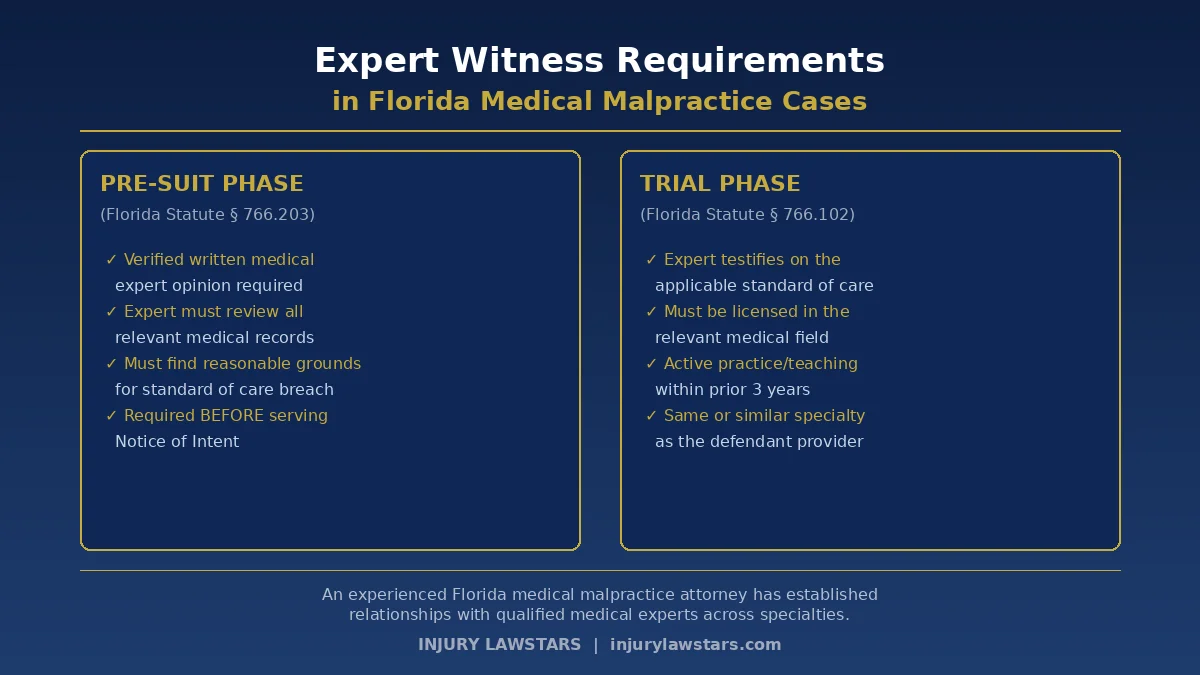
Florida imposes strict requirements regarding expert witnesses in medical malpractice cases. Under Florida Statute § 766.102, the standard of care must be established through testimony from a qualified medical expert.
Who Qualifies as an Expert Witness?
To testify as an expert witness in a Florida medical malpractice case, the witness must:
- Be licensed as a healthcare provider in the relevant field
- Have been actively practicing or teaching in the relevant specialty within the three years preceding the date of the alleged malpractice
- Be familiar with the standard of care in the relevant specialty
- If the defendant is a specialist, the expert must be a specialist in the same or similar specialty
When Is Expert Testimony Required?
Expert testimony is required at two critical stages of a Florida medical malpractice case:
- Pre-suit phase. Before you can serve the Notice of Intent, you must obtain a verified written medical expert opinion from a qualified physician who has reviewed your medical records and concluded that there are reasonable grounds to believe the standard of care was breached. (Florida Statute § 766.203)
- At trial. Expert witnesses testify about what the standard of care required, how the defendant deviated from that standard, and how that deviation caused the patient’s injuries.
The cost and complexity of retaining qualified medical experts is one reason medical malpractice cases are among the most expensive personal injury claims to litigate. An experienced medical malpractice attorney will have established relationships with qualified medical experts across various specialties.
What Defenses Do Healthcare Providers Use?
Healthcare providers and their insurance companies have several defenses available to fight medical malpractice claims.
No Breach of the Standard of Care
The most common defense is that the healthcare provider met the standard of care. The defendant will present their own expert witnesses to testify that the treatment provided was appropriate and consistent with accepted medical practice.
The Injury Was Not Caused by the Provider
Even if the provider made an error, the defense may argue that the error did not cause the patient’s injury. For example, if a patient had a pre-existing condition that was already progressing, the defense may argue the outcome would have been the same regardless of any error.
Comparative Negligence
Florida follows a modified comparative negligence standard for most personal injury claims under the 2023 tort reform (HB 837). However, medical malpractice claims are specifically exempt from this change. Medical malpractice cases in Florida continue to operate under the prior pure comparative negligence standard, meaning a patient’s recovery is reduced by their percentage of fault but is not barred entirely, even if the patient is more than 50% at fault.
This is a significant distinction. In a standard negligence case in Florida, if you are found more than 50% at fault, you cannot recover any damages. In a medical malpractice case, even a patient who bears some responsibility for their outcome can still recover damages, reduced by their share of fault.
Statute of Limitations Defense
If the claimant did not file within the applicable statute of limitations or statute of repose, the defendant will move to dismiss the case as time-barred. This is a complete defense that, if successful, ends the case regardless of the merits.
Assumption of Risk / Informed Consent
If the patient signed an informed consent form acknowledging the specific risk that occurred, the defense may argue the patient assumed that risk. However, informed consent does not protect a provider who performed the procedure negligently. The consent covers known risks of a properly performed procedure, not risks created by substandard care.
Florida Medical Malpractice by the Numbers
Understanding the scope of medical malpractice in Florida helps put these claims in perspective:
- Florida consistently ranks among the top five states in the nation for medical malpractice lawsuit filings, reflecting both the state’s large population and its high concentration of healthcare facilities.
- According to data from the National Practitioner Data Bank, medical malpractice payouts nationwide exceed $4 billion annually, with Florida accounting for a significant share.
- The most common types of medical malpractice claims nationwide involve diagnosis-related errors (approximately 33% of claims), followed by surgical errors (approximately 23%) and treatment-related errors (approximately 18%).
- Birth injury claims and cases involving anesthesia errors account for a smaller percentage of total claims but represent a disproportionately high share of large verdicts and settlements due to the severity and lifelong nature of the injuries involved.
These statistics underscore why Florida’s pre-suit requirements and expert witness rules exist: medical malpractice claims involve high stakes for both patients and providers, and the legal system demands rigorous proof.
What Steps Should You Take If You Suspect Medical Malpractice?
- Seek medical treatment. Your health comes first. Get the treatment you need for the injury caused by the malpractice.
- Preserve your medical records. Request complete copies of all medical records related to your treatment, including imaging, lab results, operative notes, and discharge summaries.
- Document everything. Keep a detailed record of your symptoms, medical appointments, medications, and how the injury has affected your daily life and ability to work.
- Do not sign anything from the healthcare provider or their insurer. You may be asked to sign releases or settlement offers. Do not sign without legal counsel.
- Contact a Florida medical malpractice attorney. The pre-suit requirements, expert witness obligations, and filing deadlines make legal representation essential. An experienced attorney can evaluate your case, retain the necessary experts, and ensure every procedural requirement is met.
At Injury LawStars, Attorney Katie Miller understands the physical, emotional, and financial devastation that medical malpractice causes. As someone who was once an injury victim herself, Katie knows what it feels like to be vulnerable and unsure of your next step. She and her team fight to hold negligent healthcare providers accountable and to secure the compensation victims need to rebuild their lives.
Ready to hold a negligent healthcare provider accountable? Contact Injury LawStars at (407) 887-4690 for a free, no-obligation consultation.
Frequently Asked Questions About Medical Malpractice in Florida
What qualifies as medical malpractice in Florida?
Medical malpractice in Florida occurs when a healthcare provider fails to meet the prevailing professional standard of care and that failure directly causes injury to a patient. Under Florida Statute § 766.102, the standard of care is defined as the level of care, skill, and treatment recognized as acceptable by reasonably prudent similar healthcare providers. You must prove that a duty of care existed, the provider breached that duty, the breach caused your injury, and you suffered actual damages as a result. Simply having a bad medical outcome does not automatically qualify as malpractice; the provider’s actions must have fallen below the accepted standard.
How long do I have to file a medical malpractice claim in Florida?
Florida gives you two years from the date you discovered (or should have discovered) the malpractice to file a claim, subject to a four-year statute of repose from the date the malpractice actually occurred. If the healthcare provider committed fraud or intentionally concealed the error, the repose period extends to seven years. Special rules apply to minors under eight and wrongful death cases. Because of the mandatory 90-day pre-suit investigation period, you need to contact an attorney well before your deadline to ensure there is enough time to complete the required process. Learn more about Florida’s personal injury filing deadlines.
What is the pre-suit notice requirement in Florida medical malpractice cases?
Before you can file a medical malpractice lawsuit in Florida, you must serve a formal Notice of Intent to Initiate Litigation on all prospective defendants. This notice must include a verified written opinion from a qualified medical expert confirming that there are reasonable grounds to believe the standard of care was breached. The notice triggers a 90-day investigation period during which both sides conduct informal discovery, exchange medical records, and attempt to resolve the claim. The defendant must respond with a rejection, a settlement offer, or an admission of liability with a dispute over damages. This entire process is mandatory under Florida Statute § 766.106.
How much is a medical malpractice case worth in Florida?
The value of a medical malpractice case depends on the severity of the injury, the cost of past and future medical treatment, lost income and earning capacity, and the impact on your quality of life. Florida does not currently impose enforceable caps on non-economic damages (pain and suffering) in medical malpractice cases following the Florida Supreme Court’s rulings in McCall v. United States (2014) and North Broward Hospital District v. Kalitan (2017). Cases involving birth injuries, brain damage, or wrongful death tend to produce the highest settlements and verdicts due to the catastrophic and lifelong nature of the harm. For more context on settlement values, see our guide on average personal injury settlements.
Do I need an expert witness for a medical malpractice case in Florida?
Yes. Florida law requires expert witness testimony in medical malpractice cases at two critical stages. First, before you can serve the required pre-suit Notice of Intent, you must obtain a verified written opinion from a qualified medical expert who has reviewed your records and found reasonable grounds to believe the standard of care was breached (Florida Statute § 766.203). Second, at trial, expert witnesses must testify about the applicable standard of care, how the defendant deviated from it, and how that deviation caused your injuries. If the defendant is a specialist, the expert must practice in the same or similar specialty. Retaining qualified experts is one of the reasons having an experienced Florida medical malpractice attorney is so important.
Injury LawStars is a Florida-based personal injury firm dedicated to protecting the rights of those hurt by medical negligence. Managing Partner Attorney Katie Miller was once an injury victim herself and now uses that firsthand experience to fight relentlessly for others. With no fees unless we win, Injury LawStars delivers powerful advocacy and compassionate guidance when you need it most.