
March 27, 2026
Golf Cart Accidents in Florida: Laws, Liability, and What You Need to Know
Golf carts are everywhere in Florida. From The Villages to Clermont, from gated retirement communities to beachside neighborhoods, these small vehicles have become a primary mode of transportation for hundreds of thousands of Floridians. But their popularity comes with a serious downside: golf cart accidents are rising at an alarming rate, and the injuries they cause can be life-changing.
Injured in a golf cart accident? Call Injury LawStars at (407) 887-4690 for a free consultation, or contact us online. No fees unless we win.
Florida leads the nation in golf cart-related fatalities. According to the U.S. Department of Transportation, Florida recorded 10 golf cart deaths in 2023 alone, with the state accounting for a disproportionate share of all golf cart fatalities nationwide. The Consumer Product Safety Commission (CPSC) reports over 15,000 golf cart-related emergency room visits each year across the United States, with Florida’s retirement communities and resorts seeing some of the highest numbers.
If you or a loved one has been injured in a golf cart accident, you need to understand your rights under Florida law. This guide covers Florida’s golf cart laws, who can be held liable, insurance requirements, and the compensation you may be entitled to.
What Are Florida’s Golf Cart Laws and Regulations?
Understanding Florida’s golf cart laws starts with knowing how the state classifies these vehicles. Florida law draws a clear distinction between a standard golf cart and a low-speed vehicle (LSV), and that classification determines everything from where you can drive to whether you need insurance.
Golf Cart vs. Low-Speed Vehicle (LSV)
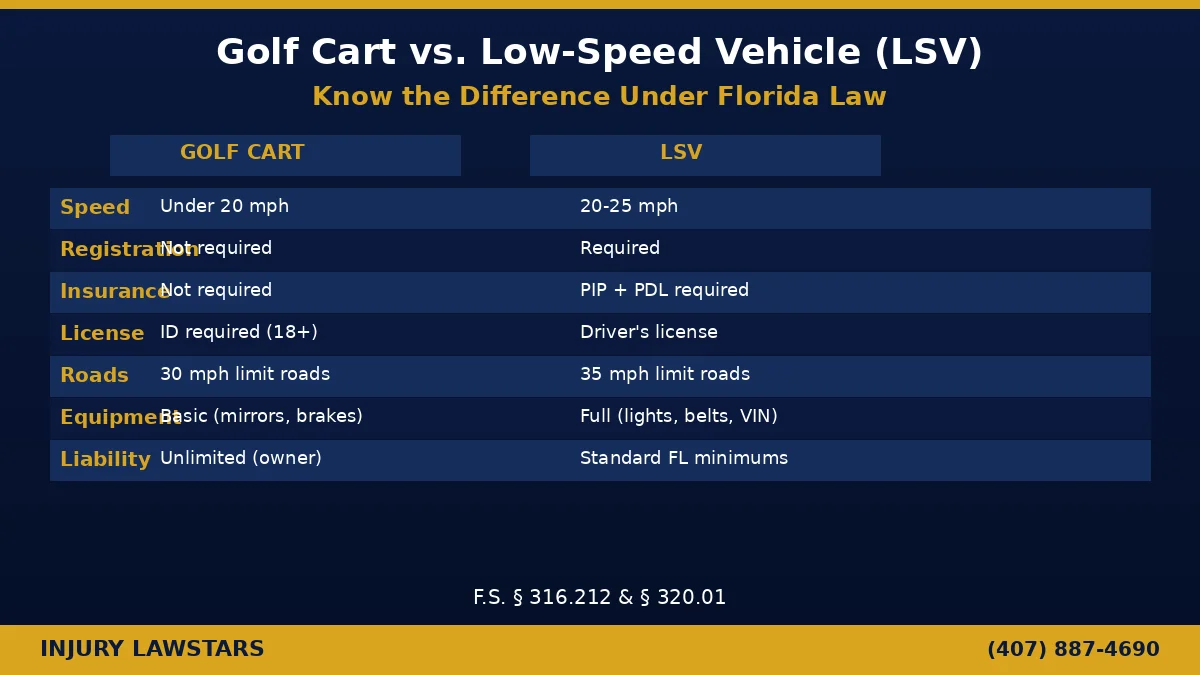
Under Florida Statute § 320.01(22), a golf cart is defined as “a motor vehicle that is designed and manufactured for operation on a golf course for sporting or recreational purposes and that is not capable of exceeding speeds of 20 miles per hour.”
A low-speed vehicle (LSV), defined under F.S. § 320.01(41), is “any four-wheeled vehicle whose top speed is greater than 20 miles per hour, but not greater than 25 miles per hour.”
This distinction matters because:
- Golf carts do not require registration, titling, or insurance
- LSVs must be registered, titled, and insured just like a regular motor vehicle
- Golf carts can only operate on designated roads with speed limits of 30 mph or less
- LSVs can operate on roads with posted speed limits of 35 mph or less
If your golf cart has been modified to exceed 20 mph, it is legally reclassified as an LSV and must meet all LSV requirements, including registration and insurance.
Where Can You Drive a Golf Cart in Florida?
Under Florida Statute § 316.212, golf carts are generally prohibited on public roads, with these exceptions:
- Designated county roads and municipal streets where local government has approved golf cart use
- Crossing a state highway at approved intersections or midblock crossings near golf courses
- State park roads with speed limits of 35 mph or less (with Division of Recreation and Parks authorization)
- Mobile home park crossings for residents and guests
All designated golf cart roads must have signs posted indicating golf carts are permitted. Golf carts can only be operated between sunrise and sunset, unless the local government has authorized nighttime operation and the cart is equipped with headlights, brake lights, turn signals, and a windshield.
Required Safety Equipment
Every golf cart operated on Florida’s public roads must have:
- Efficient brakes
- Reliable steering
- Safe tires
- A rearview mirror
- Red reflectorized warning devices in both the front and rear
LSVs have additional requirements, including headlamps, tail lamps, stop lamps, turn signals, seat belts, a windshield, a parking brake, and a vehicle identification number (VIN).
New Florida Golf Cart Laws: HB 949
In 2023, Governor Ron DeSantis signed House Bill 949 into law, making significant changes to Florida’s golf cart regulations. Effective October 1, 2023, the law addressed growing safety concerns, particularly involving young drivers.
Key Changes Under HB 949
- Drivers under 18 must now have a valid learner’s permit (age 15+) or driver’s license (age 16+) to operate a golf cart on public roads
- Drivers 18 and older must carry a valid government-issued photo ID
- Previously, anyone 14 or older could operate a golf cart without a license or permit
The new law was prompted by a disturbing pattern of accidents involving minors. According to the American Academy of Pediatrics, more than 6,500 children are injured by golf carts every year in the United States. A study of Florida pediatric trauma centers found that golf cart injuries among children increased during the study period, with 34% of pediatric golf cart injuries resulting in intracranial injuries.
The Florida Sheriff’s Association supported the legislation, with law enforcement officials noting the increasing number of golf cart communities across the state creating dangerous situations with unlicensed young drivers.
Additional Legislative Developments
Florida continues to refine its golf cart regulations. House Bill 519, filed in 2026, proposes expanding where golf carts can cross highways at signalized intersections under certain conditions. This reflects Florida’s ongoing effort to balance golf cart accessibility with road safety.
What Causes Golf Cart Accidents in Florida?
Golf cart accidents happen for many of the same reasons as car accidents, but the lack of safety features makes the consequences more severe. Here are the most common causes:
1. Rollovers
Rollovers are the leading cause of fatal golf cart accidents. Golf carts have a high center of gravity relative to their narrow wheelbase, making them prone to tipping during sharp turns, when driving on slopes, or when traveling at even moderate speeds. The CPSC has found that rollovers account for the majority of golf cart fatalities, with occupant ejection being the primary mechanism of injury.
2. Ejection From the Cart
Because most golf carts lack seat belts, doors, or any significant structural protection, occupants are frequently ejected during accidents. Research published in the journal Trauma Surgery & Acute Care Open found that ejection from a golf cart increases the likelihood of injury by nearly 17 times. Approximately 38% of all golf cart injuries involve someone falling or being thrown from the cart.
3. Collisions With Motor Vehicles
When golf carts share roads with standard motor vehicles, the size and speed disparity creates enormous risk. A golf cart offers virtually no crash protection in a collision with a car or truck. These collisions often result in the most serious injuries, including traumatic brain injuries and fatalities.
4. Distracted Driving
Driver inattention or distraction is a factor in over half of golf cart accidents. Because golf carts feel casual and recreational, drivers may not give them the same attention as driving a car. Texting, talking to passengers, or simply not watching the road can lead to collisions with fixed objects, other vehicles, or pedestrians.
5. Speeding
Golf carts are designed for low speeds, but many drivers push them beyond safe limits. Speeding is particularly dangerous because golf carts lack the suspension, braking power, and stability to handle higher speeds safely. Modified carts that exceed manufacturer speed ratings are especially risky.
6. Driving Under the Influence
Alcohol is a factor in approximately 7% of all golf cart incidents, according to NEISS data. In some communities, this number is significantly higher. Golf cart DUI is a serious offense in Florida, as we discuss below.
7. Inexperienced or Underage Drivers
Despite the new age requirements under HB 949, inexperienced drivers remain a leading cause of accidents. Children under 16 account for 31% of all golf cart injuries, making them the most vulnerable group.
Golf Cart Accidents in The Villages and Florida Communities
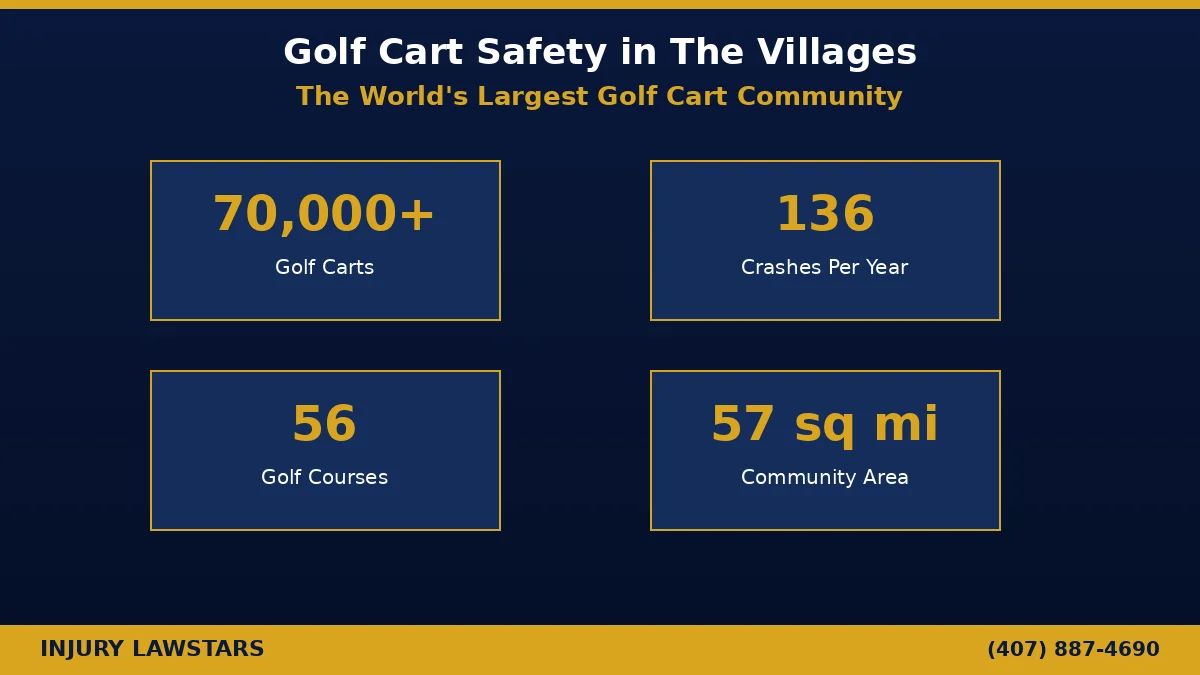
The Villages, located in Sumter and Marion Counties, is the largest golf cart community in the world. With over 70,000 golf carts traversing 56 golf courses and 57 square miles of residential and commercial roads, it is also ground zero for golf cart accidents in Florida.
A 2020 study found that The Villages recorded an average of 136 golf cart crashes per year, resulting in approximately one death annually. Most ejections in The Villages involved carts without seat belts or front-wheel brakes.
Why The Villages Sees So Many Accidents
- Volume: Tens of thousands of golf carts share roads with motor vehicles, bicycles, and pedestrians daily
- Demographics: Many drivers are retirees who may face age-related declines in reaction time and vision
- Infrastructure: While The Villages has extensive golf cart paths, many routes require crossing or sharing public roads
- Casual attitude: The community atmosphere can lead to a relaxed approach to golf cart safety, including operating without required equipment or after consuming alcohol
- Nighttime driving: The Villages allows nighttime golf cart operation, increasing accident risk
Other High-Risk Florida Communities
Golf cart accidents are not limited to The Villages. Communities throughout Lake County, including Clermont, Lady Lake, and Leesburg, see regular golf cart incidents. Ocala and Marion County, parts of Sumter County around Wildwood and Bushnell, and communities like Sun City Center in Hillsborough County all have significant golf cart traffic and accident rates.
If you live in a Florida golf cart community and have been injured in an accident, having a golf cart accident lawyer who understands the unique risks of these communities can make a real difference in your case.
Have you been hurt in a golf cart accident in The Villages, Clermont, or anywhere in Florida? Call Injury LawStars at (407) 887-4690 for a free case review. We fight for golf cart accident victims on a no-fee-unless-we-win basis.
Golf Cart DUI Laws in Florida
Many people assume that DUI laws do not apply to golf carts. This is wrong. Under Florida law, you can absolutely get a DUI on a golf cart, and the penalties are the same as for driving a car while impaired.
How Florida DUI Law Applies to Golf Carts
Florida’s DUI statute, F.S. § 316.193, applies to anyone operating a “vehicle” while under the influence. Florida law defines a golf cart as a “motor vehicle,” which means DUI laws apply in full.
Penalties for Golf Cart DUI
The penalties for a golf cart DUI conviction mirror those of a standard DUI:
- First offense: Fines up to $1,000, up to 6 months in jail, license suspension for 180 days to 1 year, possible ignition interlock device, probation, community service, and DUI school
- Second offense: Fines up to $2,000, up to 9 months in jail (up to 12 months if within 5 years of a prior conviction), and mandatory ignition interlock
- Third offense within 10 years: Felony charge, fines up to $5,000, up to 5 years in prison, mandatory ignition interlock, and 10-year license revocation
- DUI causing serious bodily injury: Third-degree felony, up to 5 years in prison and $5,000 in fines
- DUI manslaughter: Second-degree felony, up to 15 years in prison
Golf cart DUI arrests are more common than people realize, particularly in Florida’s retirement communities. In one recent case in Port St. Lucie, a 62-year-old woman was arrested for DUI after her husband fell from the golf cart she was driving, struck his head, and later died at a nearby hospital.
Who Is Liable for a Golf Cart Accident in Florida?
Determining liability in a golf cart accident can be complex because multiple parties may share responsibility. Florida follows a modified comparative negligence system under F.S. § 768.81, which means you can recover compensation as long as you are 50% or less at fault for the accident.
The Golf Cart Driver
The most common liable party is the negligent driver. If the driver was speeding, distracted, impaired, or violating traffic laws, they bear responsibility for resulting injuries.
The Golf Cart Owner
Florida’s dangerous instrumentality doctrine makes golf cart owners liable for injuries caused by anyone they permit to use their cart, even if the owner was not driving. This was dramatically illustrated in the case of Gonzalez v. Chiong, where a Miami-Dade County court awarded over $50 million in damages against a golf cart owner whose 16-year-old niece caused a rollover accident that left a 12-year-old passenger with catastrophic brain injuries.
Unlike standard motor vehicles, golf carts are not covered by the liability caps in F.S. § 324.021(9)(b)3, meaning golf cart owners face unlimited vicarious liability. This is one of the most important, and least understood, aspects of Florida golf cart law.
Another Vehicle’s Driver
When a golf cart is struck by a car, truck, or other motor vehicle, the driver of that vehicle may be liable if they were negligent. Speed differentials between golf carts and regular traffic make these collisions particularly devastating.
The Golf Course or Property Owner
Golf courses and property owners can be liable under premises liability theories if they fail to maintain safe conditions. This includes:
- Poorly maintained cart paths
- Inadequate signage or warnings
- Failure to enforce safety rules
- Dangerous terrain or obstacles
The Municipality or Government Entity
If a government-designated golf cart road is poorly designed, lacks proper signage, or has dangerous conditions, the municipality may bear responsibility. Claims against government entities require compliance with Florida’s sovereign immunity notice requirements.
The Golf Cart Manufacturer
If a defect in the golf cart’s design or manufacturing caused or contributed to the accident, the manufacturer may be liable under Florida’s product liability laws. Common defects include brake failures, steering malfunctions, and inadequate stability.
Do You Need Insurance for a Golf Cart in Florida?
Golf cart insurance in Florida depends entirely on how your vehicle is classified.
Standard Golf Carts (Under 20 MPH)
Florida law does not require insurance for standard golf carts. However, going without insurance is risky. Given that golf cart owners face unlimited liability under the dangerous instrumentality doctrine, a single serious accident could result in financial devastation.
Homeowners insurance may provide limited coverage for golf cart accidents that occur on your property, but this coverage often excludes accidents on public roads. Specialized golf cart insurance policies are available and typically cost $75 to $150 per year for basic liability coverage.
Low-Speed Vehicles (20-25 MPH)
LSVs must carry insurance to be legally operated on Florida roads. The minimum requirements are:
- Personal Injury Protection (PIP): $10,000 minimum
- Property Damage Liability (PDL): $10,000 minimum
These are the same minimums required for standard automobiles in Florida. Operating an uninsured LSV on public roads can result in fines, vehicle impoundment, and license suspension.
Why You Should Carry Golf Cart Insurance Even if Not Required
Florida has one of the highest uninsured motorist rates in the country, with roughly 20% of drivers lacking proper insurance. If an uninsured driver hits your golf cart, your own coverage may be the only source of compensation. Consider adding:
- Bodily injury liability coverage
- Uninsured/underinsured motorist coverage
- Medical payments coverage
- Comprehensive and collision coverage
What Injuries Can a Golf Cart Accident Cause?
Despite their slow speeds, golf cart accidents cause serious injuries. The open design, lack of seat belts, and absence of structural protection leave occupants extremely vulnerable.
Traumatic Brain Injuries (TBI)
Head injuries are the most dangerous consequence of golf cart accidents. Research shows that head trauma leads to 72% of golf cart fatalities. Without seat belts or roll cages, occupants who are ejected or involved in rollovers frequently strike their heads on pavement or other hard surfaces. Brain injuries from golf cart accidents range from concussions to severe traumatic brain injuries requiring lifelong care.
Fractures
Fractures are the most common golf cart injury, accounting for approximately 25% of all emergency room visits. Arms, legs, ribs, and pelvic fractures are particularly common, especially in rollover accidents or when passengers are ejected from the cart.
Spinal Cord Injuries
The impact from a golf cart crash, particularly ejection injuries, can cause spinal cord damage resulting in partial or complete paralysis. These are among the most costly injuries in terms of medical treatment and long-term care.
Lacerations and Soft Tissue Injuries
Contact with the cart’s frame, the road surface, or other objects during a crash commonly causes deep lacerations, sprains, and strains. While less severe than TBI or spinal injuries, these can still require surgery and extended recovery.
Fatal Injuries
Golf cart accidents do cause deaths. Florida recorded 10 golf cart fatalities in 2023, and nationally, approximately 600 golf cart deaths occur each year. Wrongful death claims from golf cart accidents are a tragic but necessary recourse for surviving family members.
What to Do After a Golf Cart Accident in Florida
The steps you take immediately after a golf cart accident can significantly affect your ability to recover compensation. Here is what you should do:
1. Move to Safety
If possible, move away from the golf cart and any road traffic. If the cart has rolled over, move at least 10 feet away to avoid additional injury.
2. Call 911
Report the accident to law enforcement immediately, even if injuries seem minor. A police report creates an official record of the incident that is critical for any future insurance claim or lawsuit.
3. Seek Medical Attention
Get medical treatment right away, even if you feel fine initially. Golf cart injuries, especially concussions and internal injuries, may not show symptoms immediately. Under Florida’s no-fault insurance system, you must seek medical treatment within 14 days of the accident to preserve your PIP benefits (if applicable).
4. Document the Scene
Take photos and videos of:
- The golf cart and any damage
- The accident scene, including road conditions, signage, and obstacles
- Your injuries
- Any other vehicles involved
- Weather and lighting conditions
5. Collect Information
Get the names, contact information, and insurance details from all parties involved, including witnesses. If the accident occurred on a golf course or community property, get the property manager’s information.
6. Do Not Admit Fault
Avoid making statements about who caused the accident. Florida’s comparative negligence law means that any admission of fault can reduce your compensation.
7. Contact a Personal Injury Attorney
Golf cart accident cases involve unique legal issues, from the dangerous instrumentality doctrine to complex insurance coverage questions. An experienced Florida personal injury attorney can protect your rights and help you navigate the claims process. Contact Injury LawStars at (407) 887-4690 for a free consultation.
8. File Your Claim Promptly
Florida has a two-year statute of limitations for personal injury lawsuits. This means you have two years from the date of the accident to file suit. Waiting too long can permanently bar your claim. For more information on filing deadlines, read our guide on how long after an accident you can sue for personal injury.
Golf Cart Accident Settlements and Compensation
The value of a golf cart accident claim depends on the severity of your injuries, the circumstances of the accident, and the available insurance coverage.
Types of Compensation Available
If you are injured in a golf cart accident in Florida, you may be entitled to:
- Medical expenses: Emergency treatment, surgery, hospitalization, rehabilitation, and ongoing medical care
- Lost wages: Income lost during recovery, including future earning capacity if your injuries are permanent
- Pain and suffering: Physical pain, emotional distress, and reduced quality of life
- Property damage: Repair or replacement of your golf cart and personal belongings
- Loss of consortium: Compensation for the impact on your relationship with your spouse
- Wrongful death damages: If a loved one was killed, surviving family members may recover funeral costs, lost support, and emotional damages
For a deeper understanding of how pain and suffering is valued, read our guide on pain and suffering settlement amounts.
Settlement Ranges
While every case is different, golf cart accident settlements in Florida generally fall within these ranges:
- Minor injuries (sprains, bruises, minor lacerations): $10,000 to $50,000
- Moderate injuries (fractures, soft tissue damage requiring treatment): $50,000 to $200,000
- Serious injuries (TBI, spinal injuries, multiple fractures): $200,000 to $1,000,000+
- Catastrophic injuries or wrongful death: $1,000,000 to $50,000,000+
The $50 million verdict in Gonzalez v. Chiong demonstrates that golf cart accident damages can reach extraordinary amounts when injuries are severe and liability is clear.
Factors That Affect Your Claim Value
- Severity and permanence of your injuries
- Total medical costs (past and future)
- Impact on your ability to work
- Your age and life expectancy
- The degree of the defendant’s negligence
- Available insurance coverage
- Whether the golf cart owner has personal assets
- Your percentage of fault under comparative negligence
Frequently Asked Questions
What should I do after a golf cart accident in Florida?
Move to safety, call 911, seek medical attention within 14 days, document the scene with photos, collect information from all parties and witnesses, do not admit fault, and contact a personal injury attorney. Florida’s two-year statute of limitations means you should act quickly to protect your rights.
Are golf carts street legal in Florida?
Golf carts can be operated on public roads that have been specifically designated for golf cart use by local government, typically on roads with speed limits of 30 mph or less. They cannot be driven on highways or non-designated roads. LSVs (modified golf carts capable of 20-25 mph) can be driven on roads with speed limits of 35 mph or less but must be registered, titled, and insured.
Do I need insurance for a golf cart in Florida?
If you have a standard golf cart (under 20 mph), Florida law does not require insurance. However, insurance is strongly recommended because golf cart owners face unlimited liability under Florida’s dangerous instrumentality doctrine. If your golf cart qualifies as an LSV (20-25 mph), you must carry at least $10,000 in PIP and $10,000 in PDL insurance.
Can I get a DUI on a golf cart?
Yes. Florida’s DUI law applies to golf carts because they are classified as motor vehicles. The penalties are the same as for a standard DUI, including fines up to $1,000, jail time, license suspension, and mandatory DUI school. Subsequent offenses carry increasingly severe penalties, including felony charges.
Who is liable for a golf cart accident?
Multiple parties can be liable, including the golf cart driver, the golf cart owner (even if not driving, under Florida’s dangerous instrumentality doctrine), another motor vehicle driver, the golf course or property owner, the municipality, or the golf cart manufacturer. Florida’s comparative negligence system allows multiple parties to share fault.
How much is a golf cart accident claim worth?
The value depends on your specific injuries and circumstances. Minor injury claims may settle for $10,000 to $50,000, while serious injury cases can reach $200,000 to over $1,000,000. Catastrophic injuries have resulted in verdicts exceeding $50 million. Factors include medical costs, lost wages, pain and suffering, the severity of negligence, and available insurance coverage.
Injured in a Golf Cart Accident? Injury LawStars Can Help.
Golf cart accidents are more dangerous than most people realize, and navigating the legal aftermath can be overwhelming. At Injury LawStars, our golf cart accident lawyers understand what you are going through. Attorney Katie Miller has been an injury victim herself. She turned that experience into a mission: fighting for people who are hurt and holding negligent parties accountable.
If you or a loved one has been injured in a golf cart accident in Florida, whether in The Villages, Clermont, Ocala, Lake County, Marion County, or anywhere across the state, we are here to help. There are no fees unless we win your case.
Call Injury LawStars today at (407) 887-4690 for a free consultation, or contact us online to get started.