
March 24, 2026
Florida Statute of Limitations for Personal Injury Claims: What You Need to Know in 2026
If you have been injured in an accident in Florida, the clock is already ticking on your right to file a lawsuit. Under the current Florida statute of limitations for personal injury, you have just two years from the date of your injury to take legal action. Miss that deadline by even a single day, and a court will almost certainly dismiss your case, no matter how serious your injuries or how clearly someone else was at fault.
This two-year window is relatively new. Until March 2023, Florida gave accident victims four years to file a negligence-based personal injury lawsuit. House Bill 837 cut that deadline in half, making it one of the most significant changes to Florida personal injury law in decades. Many people are still unaware of this change, and that lack of awareness is costing some victims their right to compensation.
If you have been injured in an accident, call Injury LawStars at (407) 887-4690 for a free consultation before your time runs out.
In this guide, Attorney Katie Miller of Injury LawStars breaks down everything Florida residents need to know about the statute of limitations for personal injury claims, including how the law changed, which deadlines apply to your specific situation, the limited exceptions that exist, and why acting quickly is critical to protecting your case.
Key Takeaways
- Florida’s statute of limitations for most personal injury claims is now two years from the date of injury, reduced from four years by House Bill 837 (effective March 24, 2023).
- The change is not retroactive. If your accident happened before March 24, 2023, the four-year deadline still applies.
- Different claim types have different deadlines. Wrongful death claims have a two-year limit from the date of death, medical malpractice has a two-year limit with a four-year repose period, and product liability and intentional torts still carry a four-year statute.
- Limited exceptions exist that may pause or extend the deadline, including cases involving minors, mental incapacity, or a defendant who has left the state.
- Missing the deadline means losing your case. Courts will not make exceptions for good intentions, ongoing medical treatment, or pending insurance negotiations.
- Contacting a Florida personal injury lawyer as soon as possible after an accident is the single most important step you can take to protect your legal rights.
What Is a Statute of Limitations?
A statute of limitations is a law that sets the maximum amount of time a person has to file a lawsuit after a specific event. Every state has its own statutes of limitations, and these deadlines serve several purposes:
- Encouraging timely resolution of disputes. Evidence degrades over time. Witnesses forget details, documents get lost, and physical evidence deteriorates.
- Providing certainty for potential defendants. Without a deadline, individuals and businesses could face the threat of a lawsuit indefinitely.
- Promoting judicial efficiency. Statutes of limitations help prevent a backlog of stale claims in the courts.
In personal injury law, the statute of limitations determines how long you have to file a civil lawsuit after being injured due to someone else’s negligence. Once that window closes, you lose your legal right to pursue compensation through the courts. The statute applies specifically to filing a lawsuit, not to insurance claims or settlement negotiations, but the filing deadline has a direct and powerful impact on your ability to negotiate with insurance companies. See our guide to average car accident settlements in Florida.
Florida’s Current Statute of Limitations for Personal Injury
Under Florida Statute § 95.11(5)(a), as amended by House Bill 837, the statute of limitations for personal injury claims based on negligence is two years from the date of the injury. This applies to the vast majority of personal injury cases in Florida, including:
- Car accidents
- Truck accidents
- Motorcycle accidents
- Bicycle accidents
- Pedestrian accidents
- Slip and fall injuries
- Premises liability claims
- Construction site accidents
- Dog bite injuries
- Drunk driving accidents
The two-year clock starts on the date of the accident or incident, not the date you discovered the full extent of your injuries, completed medical treatment, or finished negotiating with an insurance company.
What Does This Mean in Practice?
If you were injured in a car accident on July 1, 2024, you must file your personal injury lawsuit by July 1, 2026, at the latest. If your attorney files the complaint on July 2, 2026, the court will dismiss your case. There is no grace period, and judges have essentially no discretion to extend this deadline in standard negligence cases.
This strict enforcement is why Attorney Katie Miller at Injury LawStars strongly recommends that accident victims seek legal counsel as soon as possible. The sooner you contact an attorney, the more time they have to investigate, gather evidence, and negotiate a fair settlement before the deadline arrives.
What Changed Under House Bill 837 (HB 837)?
House Bill 837, signed into law by Governor Ron DeSantis on March 24, 2023, represents the most sweeping tort reform legislation Florida has enacted in decades. The statute of limitations reduction was one of several major changes, all of which shifted the legal landscape in favor of defendants and insurance companies.
The Statute of Limitations Was Cut in Half
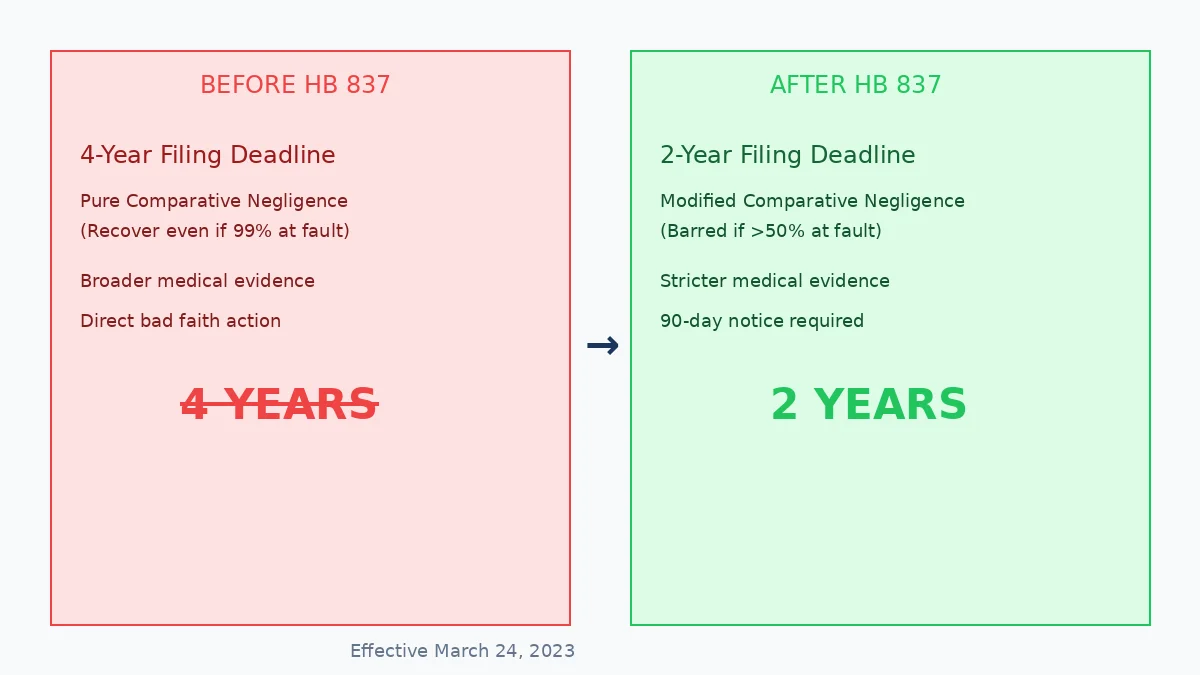
Before HB 837, the general statute of limitations for negligence-based personal injury claims in Florida was four years under the previous version of § 95.11. The new law reduced this to two years for all negligence claims arising on or after March 24, 2023.
| Aspect | Before HB 837 (Pre-March 24, 2023) | After HB 837 (March 24, 2023 and Later) |
|---|---|---|
| General negligence (car accidents, slip and falls, etc.) | 4 years from date of injury | 2 years from date of injury |
| Comparative negligence standard | Pure comparative negligence (recover damages even if 99% at fault, reduced by fault percentage) | Modified comparative negligence (barred from recovery if more than 50% at fault) |
| Insurance bad faith claims | Direct action available | Requires 90-day notice and cure period before litigation |
| Medical damages evidence | Broad range of billing evidence | Stricter limits on what medical costs can be presented |
Florida Shifted to Modified Comparative Negligence
In addition to shortening the filing deadline, HB 837 changed Florida from a “pure” comparative negligence state to a “modified” comparative negligence state. Under the old system, you could recover damages even if you were mostly at fault for your own injuries; your compensation would simply be reduced by your percentage of fault.
Under the new modified system established by Florida Statute § 768.81, if you are found to be more than 50% at fault for your injuries, you are completely barred from recovering any compensation. This applies to all negligence-based claims except medical malpractice, which still operates under the prior pure comparative negligence standard.
This change makes the two-year statute of limitations even more critical. Insurance companies know that the shorter deadline and the modified comparative negligence rule work together to pressure victims into accepting lower settlements. The less time you have to prepare your case, the harder it becomes to establish that the other party bears the majority of the fault.
Is HB 837 Retroactive?
No. House Bill 837 is not retroactive. The two-year statute of limitations applies only to causes of action that accrued (meaning the injury occurred) on or after March 24, 2023. If your accident happened before that date, the previous four-year deadline still applies.
For example:
- Accident on January 15, 2023: The four-year statute applies. Your deadline to file is January 15, 2027.
- Accident on June 1, 2024: The two-year statute applies. Your deadline to file is June 1, 2026.
- Accident on March 24, 2023 (the exact date the law was signed): The two-year statute applies. Your deadline is March 24, 2025.
If you are unsure which deadline applies to your situation, contact Injury LawStars at (407) 887-4690 for a free consultation. We can review the facts of your case and tell you exactly how much time you have remaining.
Statutes of Limitations for Different Types of Claims in Florida
Not all personal injury claims are treated the same under Florida law. Different types of cases carry different filing deadlines, and understanding which statute applies to your situation is essential. Here is a comprehensive breakdown:
General Negligence Claims (2 Years)
This category covers the majority of personal injury cases. If your injury resulted from someone else’s failure to exercise reasonable care, you have two years from the date of injury to file a lawsuit. This includes:
- Motor vehicle accidents (cars, trucks, motorcycles, bicycles, pedestrians, golf carts, boating accidents)
- Slip and fall accidents
- Premises liability (injuries on someone else’s property)
- Construction accidents
- Dog bites
Authority: Florida Statute § 95.11(5)(a)
Wrongful Death Claims (2 Years)
If a loved one died as a result of someone else’s negligence, the personal representative of the deceased person’s estate has two years from the date of death to file a wrongful death lawsuit. Note that the clock starts from the date of death, not the date of the incident that caused the death.
Authority: Florida Statute § 95.11(4)(d)
Medical Malpractice (2 Years with 4-Year Repose)
Medical malpractice cases have a more complex statute of limitations. You generally have two years from the date you discovered (or should have discovered through reasonable diligence) the injury caused by medical negligence. However, there is an outer limit known as a “statute of repose” that caps the filing window at four years from the date of the malpractice, regardless of when the injury was discovered.
There are exceptions to this repose period: if the medical provider committed fraud, concealed the malpractice, or committed intentional misrepresentation, the repose period may be extended. Additionally, claims involving minors under the age of eight have a special extended deadline.
Medical malpractice claims also require a pre-suit investigation period. Before filing a lawsuit, you must notify the medical provider and allow a 90-day investigation period (extendable to 120 days for certain claims). This requirement makes it even more important to contact an attorney well before the two-year deadline.
Authority: Florida Statute § 95.11(5)(c) and Chapter 766
Product Liability (4 Years)
If your injury was caused by a defective product, Florida maintains a four-year statute of limitations from the date of injury. This longer deadline reflects the reality that defective product injuries are often more complex to investigate and may involve multiple manufacturers and distributors.
Authority: Florida Statute § 95.11(3)(d)
Intentional Torts (4 Years)
Claims based on intentional conduct (as opposed to negligence) carry a four-year filing deadline. Intentional torts include assault, battery, false imprisonment, and intentional infliction of emotional distress. Because these claims are not based on negligence, the HB 837 changes to the negligence statute of limitations do not apply.
Authority: Florida Statute § 95.11(3)(n)
Workers’ Compensation (2 Years)
Workers’ compensation claims in Florida have a two-year statute of limitations from the date of the accident or from the date of the last payment of workers’ compensation benefits, whichever is later. Workers’ comp operates under a separate statutory framework from general personal injury claims.
Authority: Florida Statute § 440.19
Summary Table: Florida Statutes of Limitations by Claim Type
| Claim Type | Time Limit | Clock Starts |
|---|---|---|
| General negligence (car accidents, slip and falls, etc.) | 2 years | Date of injury |
| Wrongful death | 2 years | Date of death |
| Medical malpractice | 2 years (4-year repose) | Date of discovery |
| Product liability | 4 years | Date of injury |
| Intentional torts (assault, battery, etc.) | 4 years | Date of incident |
| Workers’ compensation | 2 years | Date of accident or last benefit payment |
Exceptions That May Extend the Filing Deadline
While the statute of limitations is strictly enforced in most cases, Florida law does recognize a limited number of circumstances that can pause (“toll”) or extend the filing deadline under Florida Statute § 95.051. These exceptions are narrow and apply only in specific situations.
Minors (Under 18)
If the injured person is a minor (under 18 years old) at the time of the accident, the statute of limitations is tolled until they turn 18. The two-year (or applicable) filing deadline begins running on their 18th birthday. For example, if a 15-year-old is injured in a car accident, they would have until their 20th birthday to file a lawsuit.
However, parents or legal guardians can file a claim on behalf of a minor at any time before the child turns 18. In many cases, filing sooner is advantageous because evidence is fresher and witnesses are more easily located.
Mental Incapacity
If the injured person is mentally incapacitated at the time the cause of action accrues (meaning they lack the legal capacity to manage their affairs), the statute of limitations may be tolled for the duration of the incapacity. For this exception to apply, the incapacity must typically be documented by medical professionals.
This exception is particularly relevant in cases involving serious brain injuries where the victim may be unable to understand or assert their legal rights in the immediate aftermath of the accident.
Defendant Absent from the State
If the person who caused your injury leaves Florida and cannot be served with legal process, the statute of limitations may be tolled for the period of their absence. This prevents a defendant from avoiding a lawsuit simply by leaving the state.
Fraud, Concealment, or Misrepresentation
In some cases, the statute of limitations may be extended when the defendant engaged in fraud, concealment of their identity, or intentional misrepresentation that prevented the injured person from discovering the injury or the responsible party. This exception is most commonly applied in medical malpractice cases where a healthcare provider concealed an error.
The Discovery Rule
While the general rule is that the statute of limitations begins running on the date of the injury, Florida recognizes a “discovery rule” in certain limited circumstances. Under this rule, the clock starts when the injured person knew or should have known about the injury through the exercise of reasonable diligence.
The discovery rule is most commonly applied in:
- Medical malpractice cases where the patient could not reasonably have known about the injury at the time it occurred
- Toxic exposure cases where symptoms may not appear until years after exposure
- Cases involving latent injuries that manifest long after the initial incident
In standard negligence cases like car accidents and slip and falls, the discovery rule rarely applies because the injury is immediately apparent.
Important Limitations on These Exceptions
These exceptions are narrowly construed by Florida courts. Simply being unaware of the filing deadline, being too busy to consult an attorney, still receiving medical treatment, or being in the middle of settlement negotiations with an insurance company are not valid reasons to extend the statute of limitations.
If you believe an exception might apply to your situation, it is essential to consult with a personal injury attorney immediately. At Injury LawStars, we can evaluate whether any tolling provisions apply to your case and advise you on the best course of action.
What Happens If You Miss the Statute of Limitations?
Missing the statute of limitations for a personal injury claim in Florida has devastating consequences:
- The defendant will file a motion to dismiss, and the court will almost certainly grant it.
- Your case will be dismissed with prejudice, meaning you cannot refile. Your right to seek compensation is permanently extinguished.
- You lose all leverage in settlement negotiations. Insurance companies know that without the ability to file a lawsuit, you have no way to compel them to pay a fair settlement.
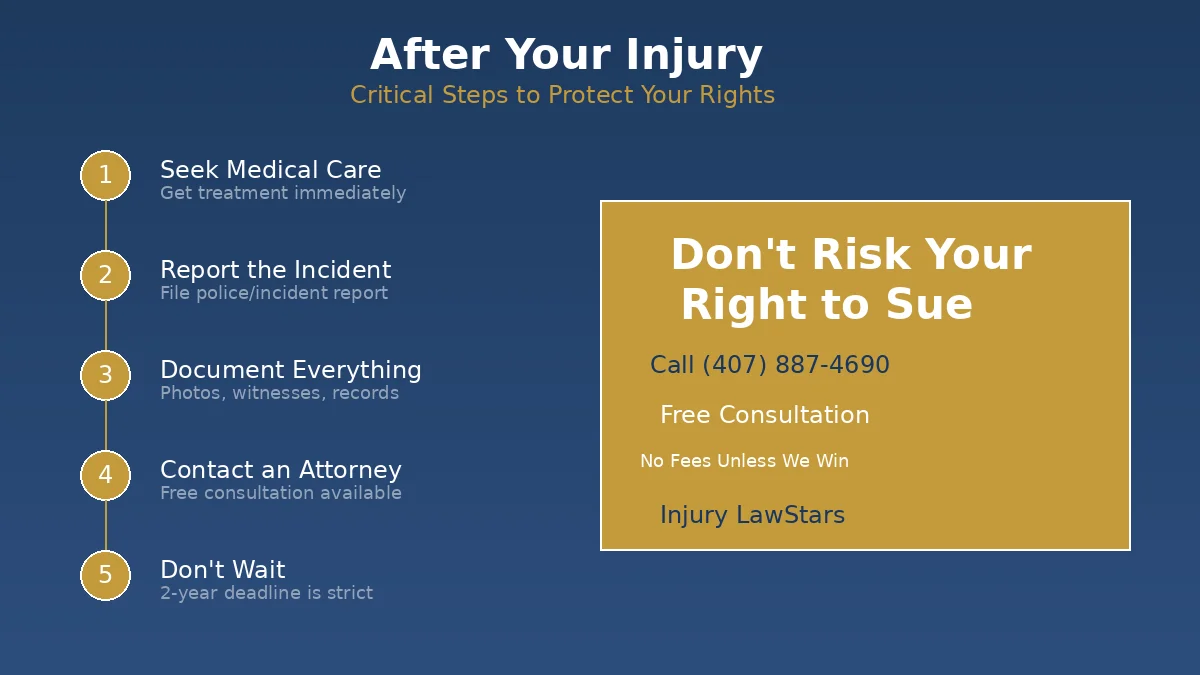
- Seek immediate medical attention. Your health is the top priority. Prompt medical care also creates documentation that links your injuries to the accident.
- Report the incident. File a police report (for car accidents) or incident report (for slip and falls, workplace injuries, etc.). Official reports provide important evidence for your claim.
- Document everything. Take photographs of the accident scene, your injuries, and any property damage. Collect contact information from witnesses. Keep copies of all medical records, bills, and correspondence with insurance companies.
- Do not give a recorded statement to the other party’s insurance company without consulting an attorney first. Insurance adjusters are trained to get you to say things that can be used to minimize or deny your claim.
- Contact a personal injury attorney as soon as possible. The sooner you get legal counsel, the better your attorney can protect your rights and begin building your case. At Injury LawStars, consultations are free, and you pay no fees unless we win your case.
- Do not wait until the deadline is approaching. The two-year window goes by faster than you think, especially when you are focused on recovering from your injuries. Early action gives your legal team the time they need to prepare the strongest possible case.
Many people do not realize that the statute of limitations affects far more than just your ability to file a lawsuit. An insurance adjuster who knows you cannot file a lawsuit has no incentive to offer a fair settlement. They can delay, lowball, or deny your claim entirely. This is why you should contact an attorney within days or weeks of your accident, not months or years later.
Why Acting Quickly After an Accident Matters
Beyond the strict legal deadline, prompt action after an accident dramatically improves your chances of a successful outcome:
Evidence Deteriorates Over Time
Physical evidence at an accident scene can be cleaned up or altered within days. Surveillance footage from nearby cameras is often overwritten within 30 to 90 days. Skid marks fade, and damaged property gets repaired or scrapped. The sooner your attorney begins investigating, the more evidence they can preserve.
Witness Memories Fade
Eyewitness testimony is most reliable immediately after an event. As months pass, witnesses forget details and become harder to locate.
Prompt Medical Treatment Strengthens Your Case
Seeking medical treatment immediately creates a clear medical record linking your injuries to the accident. Delays in treatment give insurance companies ammunition to argue that your injuries are not as serious as claimed or were not caused by the accident.
Insurance Companies Use Delay Against You
Insurance companies are well aware of the two-year deadline. Their strategy often involves dragging out the claims process through repeated documentation requests and low initial offers. Starting early gives your attorney time to negotiate effectively while preserving the option to file a lawsuit if negotiations fail.
How HB 837 Affects Your Case Beyond the Statute of Limitations
The statute of limitations change is just one piece of HB 837. Several other provisions directly impact personal injury cases in Florida:
The 51% Bar Rule
Under modified comparative negligence, if you are found to be 51% or more at fault for your own injuries, you recover nothing. This change makes it more important than ever to have strong evidence establishing that the other party was primarily responsible.
Changes to Medical Damages Evidence
HB 837 limits the evidence of medical costs that can be shown to a jury, potentially reducing the perceived value of your medical damages and making it harder to demonstrate the full extent of your losses.
Insurance Bad Faith Reforms
The law requires a 90-day notice and cure period before you can bring a bad faith claim against your insurer. Together, these changes mean every personal injury case in Florida now requires more careful preparation, stronger evidence, and faster action than before HB 837.
Steps to Take After a Personal Injury in Florida
If you have been injured in an accident anywhere in Florida, whether in Clermont, Ocala, The Villages, Orlando, Tampa, or anywhere else in the state, here are the steps you should take to protect your legal rights:
To speak with Attorney Katie Miller about your personal injury case, call Injury LawStars at (407) 887-4690 or visit our website to schedule a free consultation.
Frequently Asked Questions
What is the statute of limitations for personal injury in Florida?
The statute of limitations for personal injury claims based on negligence in Florida is two years from the date of the injury, as established by Florida Statute § 95.11(5)(a) following the enactment of House Bill 837. This applies to car accidents, slip and falls, premises liability, and most other negligence-based injury claims occurring on or after March 24, 2023.
Did Florida change its statute of limitations for personal injury?
Yes. House Bill 837, signed into law on March 24, 2023, reduced the Florida statute of limitations for personal injury negligence claims from four years to two years. The change applies to all causes of action arising on or after that date.
Does the two-year deadline apply to my accident?
The applicable deadline depends on when your accident occurred. If your injury happened before March 24, 2023, the previous four-year statute of limitations applies. If your injury occurred on or after March 24, 2023, the two-year deadline applies.
What happens if I miss the statute of limitations in Florida?
If you file a lawsuit after the statute of limitations has expired, the defendant will file a motion to dismiss, and the court will almost certainly grant it. Your case will be dismissed with prejudice, meaning you permanently lose the right to pursue compensation through the courts.
Can I still file an insurance claim after the statute of limitations expires?
The statute of limitations applies specifically to filing a lawsuit, not to insurance claims. However, if the statute has expired, the insurance company knows you have no legal leverage, and they have little incentive to offer a fair settlement. In practice, an expired statute of limitations makes it extremely difficult to recover meaningful compensation.
Are there exceptions to the Florida statute of limitations for personal injury?
Yes, but they are limited. Exceptions include cases involving minors (tolled until age 18), individuals with mental incapacity, defendants who leave the state, and situations involving fraud or concealment. The discovery rule may also apply in cases where the injury was not immediately apparent, such as some medical malpractice and toxic exposure cases.
How long do I have to file a wrongful death claim in Florida?
The statute of limitations for wrongful death claims in Florida is two years from the date of the person’s death. This applies regardless of when the underlying incident occurred.
What is the statute of limitations for medical malpractice in Florida?
Medical malpractice claims have a two-year statute of limitations from the date you discovered (or should have discovered) the injury, with an outer limit of four years from the date of the malpractice (the “statute of repose”). Exceptions exist for cases involving fraud, concealment, or injuries to children under eight.
How does the statute of limitations affect my settlement negotiations?
The statute of limitations is one of the most powerful factors in settlement negotiations. As long as you have the ability to file a lawsuit, insurance companies are motivated to settle because they face the risk and expense of litigation. Once the deadline passes, that leverage disappears entirely. This is why it is critical to contact a personal injury attorney well before the deadline.
I was injured in Florida but I live in another state. Which deadline applies?
If your injury occurred in Florida, Florida’s statute of limitations generally applies to your claim, regardless of where you live. You should consult with a Florida personal injury attorney to understand the specific filing requirements that apply to your case.
Protect Your Rights: Contact Injury LawStars Today
Attorney Katie Miller and the team at Injury LawStars understand the urgency that Florida’s two-year statute of limitations creates for accident victims. Katie was once an injury victim herself, and she knows firsthand the fear, confusion, and financial pressure that follow an accident. That personal experience drives her commitment to fighting for every client with compassion and determination.
If you or a loved one has been injured in an accident anywhere in Florida, do not wait to explore your legal options. Every day that passes is one day closer to the deadline, and early action gives our team the best opportunity to build a strong case on your behalf.
We work on a contingency fee basis, which means you pay nothing unless we win your case. Your initial consultation is completely free, and there is no obligation to hire us.
Call Injury LawStars today at (407) 887-4690 or visit our website to schedule your free consultation. When you have been injured, justice starts today with Injury LawStars.