June 1, 2026
Florida pedestrian accident crosswalk claim guide

A painted crosswalk can become the center of an insurance fight within hours. Traffic signals, nearby cameras, and early statements may shape what an injured pedestrian can prove.
Schedule your free consultation with Injury LawStars if you were hit in a Florida crosswalk and need help protecting evidence before it disappears.
A Florida pedestrian accident crosswalk claim examines whether a driver failed to stop for a pedestrian crossing with a permitted signal. Under Florida Statute 316.130, a driver at a signalized intersection must stop before entering the crosswalk and allow that crossing. The claim also tests the pedestrian’s signal, path, and sudden movement, because fault may be disputed. Useful evidence includes scene photos, medical records, witness contacts, and quick requests for video from nearby businesses. This guide explains right-of-way, comparative negligence, serious injury issues, insurance routes, and local danger context after a Florida crosswalk crash. It focuses on preserving valuable proof before routine surveillance footage or clear recollections may disappear quickly.
The immediate question is not only who had the right of way, but which facts survive the first days after impact. Before addressing fault shares, insurance recovery, and evidence deadlines, start with Florida pedestrian accident crosswalk claim basics. The path begins with:
Florida pedestrian accident crosswalk claim basics
A Florida pedestrian accident crosswalk claim begins with the location and controls at the crossing. A marked crosswalk, walk signal, stop sign, turning lane, or nearby camera can shape the proof. These details help show what the driver and pedestrian each saw and should have done.
Contact Injury LawStars for a free pedestrian accident consultation and get help preserving the records that may matter. Learn how a Florida pedestrian accident lawyer can review fault, insurance, and next steps after a crosswalk injury.
What a crosswalk claim must show
A crosswalk claim is not just proof that a person was struck by a vehicle. The claim must connect unsafe conduct to the crash and the resulting harm. Evidence may include the police report, witness names, traffic camera footage, photos of the crossing, medical records, and proof of missed work.
Crosswalk evidence can answer key questions. Was the pedestrian crossing with a permitted signal? Was the driver turning, speeding, distracted, or failing to stop? Did the collision cause treatment costs, lost income, pain, or limits on daily life? A clear timeline keeps the focus on facts, not guesses.
Why right-of-way is not automatic fault
Florida law gives important protection to pedestrians in signal-controlled crossings. Under Florida Statutes section 316.130, a driver at a signalized intersection must stop for a pedestrian crossing with a permitted signal. That rule can support a claim when a driver enters the crosswalk or turns into a person who has the signal.
Still, being in a crosswalk does not decide every fault issue by itself. The same law addresses pedestrian conduct, such as obeying traffic control signals and avoiding a sudden step into a vehicle’s path. Insurers may examine the signal phase, visibility, entry point, and time available for the driver to stop.
Shared-fault review in Florida
In a general pedestrian crash, the dispute may begin with whether the pedestrian used a safe place to cross. In a crosswalk case, the dispute often shifts to signals, yielding, turns, sight lines, and driver attention. That makes fast collection of footage and witness details more useful.
Florida also uses comparative fault in negligence cases. This means the evidence can be used to assess each party’s conduct, rather than treating right-of-way as the only issue. Keep shoes, damaged items, medical records, and any crash photos. They can help show the event and its impact.
Who has the right of way in a Florida crosswalk crash?
In Florida, a driver generally must stop for a pedestrian crossing with a permitted signal at a signalized intersection, but final fault depends on signal timing, visibility, entry point, and driver conduct.
The crosswalk rule
In a Florida crosswalk crash, right of way depends on facts from the moment before impact. A crosswalk does not make one account true without proof. Key questions include where the pedestrian entered, which signal applied, and whether the driver had time to stop.
Under Florida Statutes section 316.130, a driver at a signalized intersection must stop before the crosswalk. The driver must remain stopped for a pedestrian crossing with a permitted signal. This often matters when a driver turns as a person crosses on a walk signal.
Duties for drivers and pedestrians
Pedestrians have duties under the same law. They must follow traffic control devices and must not step suddenly into the roadway when a close vehicle cannot safely yield. A driver may still be at fault when a pedestrian was already crossing and visible in the lane.
A marked crosswalk can help show the intended crossing path. At an intersection without painted lines, the investigation may focus more on the street layout and the pedestrian’s path. Either setting can raise a signal dispute or a claim that the pedestrian entered too late.
Those disputes often shape a Florida pedestrian accident rights and compensation claim. The insurer may argue that the person ignored a signal or stepped into traffic suddenly. The injured pedestrian may point to a permitted signal, a turning driver, clear sight lines, or a delayed stop.
- Signal evidence: The pedestrian symbol or traffic light shown when the crossing began.
- Crossing evidence: Painted lines, curb ramps, intersection features, and the point of impact.
- Driver evidence: Turning movement, braking, vehicle damage, and available video.
- Entry evidence: Accounts of whether the pedestrian appeared suddenly in the lane.
Evidence when fault is contested
A police report may identify the roadway, signals, markings, vehicle location, statements, and any citation noted by the officer. It gives an early record of the crash scene. Yet the officer may not have seen the impact, so other proof can matter.
Witness statements may describe the walk signal, the driver’s turn, braking, or how the pedestrian entered the street. Photos and nearby video can test those accounts. Prompt collection matters because cameras may record over footage, and witnesses can become harder to reach.
Right of way is therefore a fact question as well as a rule of law. A claim becomes clearer when the evidence shows the signal, crossing path, driver response, and time available to avoid the crash.
How comparative negligence changes your claim value
Comparative negligence can reduce a pedestrian accident recovery when evidence shows shared fault. Claim value depends on proof of both the driver’s conduct and the pedestrian’s actions.
Fault percentages and recovery
In Florida, claim value can change when both the driver and pedestrian share fault. Under Florida comparative fault law, fault allocation affects damages in a negligence action. A pedestrian who carries part of the blame may face a reduced recovery.
The percentage question is central in a Florida pedestrian accident crosswalk claim. If an insurer argues more than 50 percent fault, that position must be tested against the law and the proof. An early statement from the insurer does not settle that dispute.
Fault allocation can affect losses tied to the crash. Those losses may include medical expenses and lost income under Florida law. Bills, wage records, and treatment notes help show the losses that are part of the claim.
Why pedestrian fault is disputed
Insurers may argue that a pedestrian looked at a phone or crossed against a signal. They may also point to dark clothing or a sudden step into traffic. Those points do not answer the whole claim. The driver’s speed, attention, braking, and duty to yield also matter.
Florida pedestrian traffic law requires a driver at a signalized intersection to stop for a pedestrian crossing with a permitted signal. It also sets rules for pedestrian conduct. Photos, signal timing, video, witnesses, and vehicle damage can show which actions caused the crash.
| Crash detail. | Pedestrian fault argument. | Driver fault evidence. |
|---|---|---|
| Phone use near a crosswalk. | Pedestrian was distracted. | Driver saw, or should have seen, the crossing. |
| Crossing against a signal. | Pedestrian disobeyed the control. | Speeding reduced time to stop. |
| Permitted walk signal. | Visibility may be questioned. | Failure to yield supports driver fault. |
| Night or poor weather. | Pedestrian was hard to see. | Speed and headlights may show unsafe driving. |
Evidence that protects claim value
Consider a pedestrian crossing with a walk signal while a turning driver fails to yield. If the pedestrian also checked a text, an insurer may seek a fault share. Video showing the signal and turn path can keep the focus on what caused the impact.
Now consider someone crossing outside the marked lines at dusk. The pedestrian’s location and visibility may affect the fault analysis. Still, proof that the driver was speeding or failed to brake can show shared fault, not fault on one side alone.
Preserve scene photos, damaged clothing, medical records, witness details, and any available camera footage. A review of Florida pedestrian accident crosswalk claim issues can tie each fact to fault and losses. The value question should follow the proof, not an early blame argument.
Which insurance pays after a Florida crosswalk injury?
A Florida crosswalk injury may involve PIP, health insurance, the driver’s bodily injury coverage, and possible UM/UIM coverage, depending on the policies and injuries involved.
Starting with available medical coverage
A Florida pedestrian accident crosswalk claim may involve more than one insurance policy. The first question is often whether an injured person has personal injury protection (PIP) available through an auto policy. Coverage depends on the policy, the person’s status, and the facts of the crash.
PIP may help with covered medical bills or lost wages while fault is still being reviewed. It does not answer every loss from a serious pedestrian injury. Save bills, wage records, explanations of benefits, and each claim number in one place.
Health insurance may also pay covered care, subject to the plan’s terms and cost sharing. The health plan may later ask about any recovery from an auto claim. Before agreeing to repayment or signing a release, review which carrier paid each charge.
Claims against the driver and other policies
If the driver caused the crash, the driver’s bodily injury liability coverage may be a source of payment. Injured pedestrians can also compare this route with the firm’s Florida pedestrian accident lawyer guidance. It can be important when losses go beyond benefits available under the injured person’s own coverage. Yet a policy limit is not a promise that an insurer will accept fault or pay the full loss.
Florida law lists medical expenses and lost income among economic damages in a negligence action. Those categories matter when organizing a demand for payment under available coverage. The statute’s definition of economic damages helps show why receipts, pay records, and future-care notes should be kept.
Uninsured or underinsured motorist coverage (UM/UIM) may also need review. It can matter if the at-fault driver has no bodily injury coverage, or not enough for the documented harm. Look for UM/UIM terms on household auto policies, then give notice before resolving the driver’s claim.
Serious injuries and noneconomic loss
Medical payments and wage loss are not the same as pain, limits on daily life, or lasting impairment. In Florida, pain and suffering may depend on the injury evidence. The rules that apply to the claim also matter. A diagnosis alone does not settle that question.
Treatment records can help show how an injury changed work, walking, sleep, or home tasks. A claim file should also preserve crosswalk evidence, because insurers may dispute fault. A permitted-signal crossing matters. Florida law requires a driver at a signalized intersection to stop for a pedestrian crossing with a permitted signal.
Insurance paths may overlap, and order can affect reimbursement and releases. Injury LawStars’ guide to a Florida pedestrian accident crosswalk claim explains related rights and compensation issues. Before accepting payment, confirm the available policies, unpaid bills, claimed liens, and the losses a release would close. If the insurance path is unclear, send Injury LawStars a message before signing a release.
What evidence helps prove a Florida pedestrian accident crosswalk claim?
A Florida pedestrian accident crosswalk claim often turns on details that can fade soon after the crash. Preserve what shows where you crossed, what the driver could see, and how the impact harmed you.
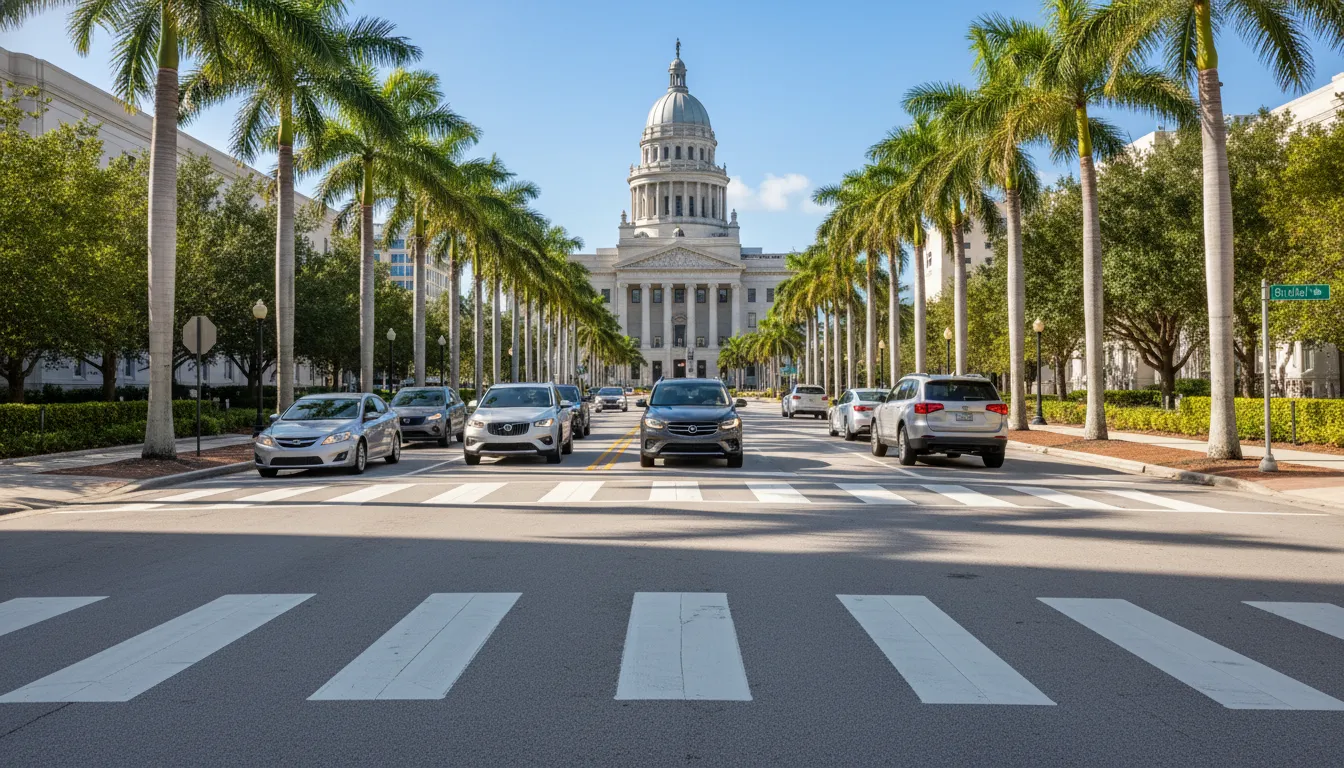
Proof at the crossing
Signal timing and crossing position matter. Florida law requires a driver at a signalized intersection to stop for a pedestrian crossing with a permitted signal. Photos and video can help show whether that rule fits the facts of the crash.
-
Photograph the full scene. Capture the crosswalk markings, curb ramps, traffic lights, pedestrian signal, stop line, lane layout, and the vehicle position. Include wide views and close views of debris, damage, skid marks, and any blocked sight line.
-
Record signal and visibility details. Note which crossing signal appeared, the time, weather, lighting, and street lighting. Keep the shoes and outer clothing worn during the crash. Their color and condition may become part of a visibility dispute.
-
Get official records. Request the crash report once it is available. Also request 911 audio and computer-aided dispatch records, often called CAD records. They may preserve early reports about location, injuries, or driver conduct.
-
Look for video at once. Identify businesses, homes, buses, traffic cameras, and parked or passing cars near the crossing. Ask that useful surveillance or dashcam footage be saved before a recording system replaces it.
-
Preserve vehicle evidence. Photograph the vehicle, license plate, windshield, mirrors, lights, and impact area when possible. A written request can seek onboard data, dashcam files, and phone-related records. These files may show speed, braking, or driver attention.
-
Collect witness information. Get each witness’s name, phone number, email address, and a short note about what they saw. A witness may recall the crossing signal, the pedestrian’s path, the driver’s turn, or a statement made after impact.
-
Document injury and loss. Seek needed medical care and keep discharge papers, bills, visit notes, prescriptions, and work-loss records. Write down pain limits and missed tasks while memories are fresh, without guessing about future recovery.
Records to keep together
Keep original photos, video files, medical records, clothing, witness contacts, and record requests in one safe folder. Do not edit original media; keep copies for sharing. That practice helps tie the crash scene to the treatment and losses that followed.
Why quick preservation matters
A claim may face questions about the signal, the driver’s view, or the pedestrian’s actions. The firm’s guide to a Florida pedestrian accident crosswalk claim explains rights and compensation issues that can connect with this evidence.
If you cannot collect evidence because of injuries, a trusted person can photograph the area and identify cameras. Save requests should be made early, since a nearby recording may not remain available.
Request a free Injury LawStars case review before you give a recorded statement or sign a pedestrian accident release.
Where crosswalk crash risk rises in Florida cities
Orlando visitor corridors and urban crossings
Crosswalk risk often grows where drivers must track many movements at once. On the Orlando injury claim page, local traffic patterns connect with crosswalk risk. In Orlando tourism corridors, a driver may watch lane changes, turn lanes, signs, hotel entrances, and people crossing. Visitors may also walk unfamiliar routes between hotels, restaurants, parking areas, and attractions.
The Tampa injury claim resource and Miami injury claim resource reflect similar urban concerns. Tampa and Miami present another setting: wide urban intersections with turning traffic, transit riders, cyclists, and short crossing windows. A marked crossing does not remove danger when a driver turns while looking for a traffic opening. Under Florida crosswalk law, a driver at a signalized intersection must stop for a pedestrian crossing with a permitted signal.
Clermont, Lake County, and everyday walking routes
In Clermont and Lake County injury cases, growing daily travel can bring people and vehicles together in common places. These include shopping centers, new residential routes, school approaches, and large parking lots. The danger may come from a quick turn, a backing vehicle, or a driver scanning for traffic instead of a walker.
That local setting matters after a Clermont collision. Photos can show lane layout, crossing paint, signs, nearby entrances, lighting, and the driver’s likely path. A witness may also recall whether a car turned through the crossing or backed from a space. Katie Miller’s personal injury experience shapes the firm’s attention to these details. Injury LawStars addresses this local context on its page about pedestrian accident crosswalk legal representation in Clermont.
Places where visibility and speed meet
Some Florida crossings deserve added care because walkers may be less easy to see or slower to clear a lane. School zones can involve children at arrival or dismissal, and related injury facts may overlap with Florida personal injury practice areas handled by the firm. Retirement communities may have walkers who need more crossing time. Bus stops can send people across a roadway before or after a ride.
High-speed arterials can add force and less time to react, especially near unsignalized crossings or driveway entrances. Parking lots create a different problem: vehicles turn, back out, and cross walking paths at close range. Each setting can shape the evidence in a Florida pedestrian accident crosswalk claim.
After a crash, the city name alone does not explain fault. The key details include the signal phase, vehicle turn, sight line, speed conditions, and where each person moved. Record the crosswalk, traffic control device, nearby stop or entrance, and any camera location before the scene changes. Nearby business video and transit stop cameras may help show the moments before impact.
When should you call a lawyer after a crosswalk crash?
Call a lawyer soon after a crosswalk crash if injuries are serious, fault is disputed, insurance coverage is unclear, or evidence such as business surveillance video may disappear.
Cases that need early help
You should consider legal help soon after a crosswalk crash that causes serious injury, lost work, or a hospital stay. A lawyer may also help when the driver left the scene, lacked insurance, or denies what happened. These cases can become harder to sort out while you are still getting medical care.
Legal help can matter when the signal timing is disputed. Under Florida’s pedestrian traffic law, a driver at a signalized intersection must remain stopped for a pedestrian crossing with a permitted signal. The same law also addresses pedestrian duties. Facts about the walk sign, vehicle turn, and point of impact can shape the claim.
Evidence and insurer pressure
Call a lawyer if a store, city camera, bus camera, or doorbell camera may have recorded the crash. Video can be lost as systems record over older footage. A lawyer can ask that available recordings be preserved while the events are still clear.
It is also wise to seek advice if an insurer asks for a recorded statement or offers quick payment. Be careful when an adjuster claims you caused the crash, walked against the signal, or were outside the marked lines. A Florida pedestrian accident crosswalk claim often turns on records, scene details, and witness accounts.
- Get advice if pain, dizziness, or mobility problems appear after the crash.
- Ask for help if fault shifts after witnesses, video, or the police report surface.
- Speak with counsel if medical bills grow while coverage remains unclear.
What an attorney can review
A lawyer can review the crash report, medical records, witness details, traffic-signal facts, and any available video. That review may also identify whether another policy may apply in a hit-and-run or uninsured-driver case. You can also learn more about attorney Katie Miller and the firm’s approach before deciding whether to speak with counsel.
If you are hurt or facing blame after a crosswalk crash, do not wait for missing proof to become harder to find. Call Injury LawStars at (407) 887-4690 to discuss what happened and what records may matter next.
Frequently Asked Questions
Can I claim damages if I was hit by a car while not in a crosswalk in Florida?
Yes. Being outside a marked crosswalk does not automatically end a Florida pedestrian injury claim. Fault may depend on visibility, traffic signals, vehicle speed, and each person’s conduct. Under Florida’s pedestrian statute, pedestrians must follow traffic controls and avoid stepping into a vehicle’s immediate path. Any assigned fault may affect recovery.
What damages are recoverable in a pedestrian crosswalk accident claim?
A Florida pedestrian crosswalk claim may seek payment for documented medical treatment, past and future lost income, and other financial losses caused by the crash. Florida law defines economic damages to include medical expenses and lost income, as detailed in section 768.81. Depending on the injuries and proof, non-economic damages may also be evaluated.
What must I prove to get compensation for a Florida pedestrian accident?
An injured pedestrian generally must show that another party owed a duty of care, breached that duty, caused the crash, and caused measurable harm. Useful proof may include the police report, medical records, witness details, scene photos, and nearby business video. The four-part negligence framework is explained in this Florida pedestrian claim resource.
What if the driver says I crossed against the signal?
Do not assume the driver’s statement ends the claim. Signal timing records, nearby video, witness accounts, vehicle movement, and the driver’s speed or distraction can all matter. A Florida pedestrian accident crosswalk claim should compare every account against physical evidence.
Can nearby businesses help prove what happened?
Yes. Storefront cameras, hotel cameras, parking lot systems, transit cameras, and dashcams can capture the crossing, the signal, or the vehicle’s turn. Ask quickly because many systems overwrite video within days or weeks.
Ready to protect your crosswalk claim?
Schedule your free Injury LawStars consultation online to discuss a Florida pedestrian accident crosswalk claim.
Injury LawStars helps injured pedestrians across Florida understand fault, insurance, evidence preservation, and next steps. The firm works on a contingency fee basis, so clients pay no upfront attorney fees and no attorney fees unless there is a recovery.
About the Author
Katie Miller, Esq.
Managing Partner · Injury LawStars
Attorney Katie Miller was once an injury victim herself. After a car accident in 2016 that required spinal surgery and a 13-month recovery, she turned her experience into a mission: fighting for people who are hurting. With 17+ years of legal experience and over \$45 million recovered for clients, Katie brings both professional expertise and personal understanding to every case.